
DEEP EDGE RESEARCH | POLICY WATCH
Policy as of 4 November 2026. Project and filing checks through 6 November. For informational purposes only. Not investment advice.
The US midterms gave proposals for data-centre moratoriums more weight. We wanted to understand what those proposals could mean for the companies building AI infrastructure. In Part 1, we looked at the five hyperscalers. In Part 2, we turn to the neoclouds and the companies building their data centres.
Neoclouds supply computing capacity to AI labs and hyperscalers. Some build their own data centres; others rent halls from developers. Bitcoin miners are also moving into this market, using their access to power to develop sites for AI. If those halls open late, the impact reaches beyond the developer: its tenant has less computing capacity to sell, and customers have to wait or find capacity elsewhere.
The financial risk is different for each company. A developer can borrow against future rent to build a hall. A cloud operator can borrow to buy the equipment that goes inside it. Both can owe interest before the hall earns anything. If a customer can move its workload to another site, that may protect the customer’s timetable. It doesn’t bring forward the rent on the original building.
And some projects still need to borrow. Hut 8 has raised $4.25bn for the first phase of Beacon Point and signed a tenant for Phase 2, but the second phase still needs its own financing. Management says the outstanding Phase 1 grid decision would help clear the way for that financing. It hasn’t moved either first-hall target. So the first thing we’d revisit at Beacon Point is the loan, not the opening date.
Compare that with Riot’s Corsicana site. Riot says its extra power cleared the earlier grid process. Both projects are in Texas, but the current review gives us a reason to watch Hut 8’s financing that it doesn’t give us at Corsicana. That’s why we went through the approvals and financing site by site. The state map shows where to look; it doesn’t tell us which projects are waiting on a decision or who pays if that decision takes longer.
Our judgement: We wouldn’t cut the sector’s delivery forecasts on the election alone. At Beacon Point, we’re keeping Hut 8’s delivery targets and watching whether it can close the Phase 2 loan. Where debt is already in place, we’d change the cash forecast if an approval pushes back handover and leaves the borrower paying interest for longer before rent starts. Those are two different risks, and we’d treat them differently.
TLDR
Texas exposure isn’t a delivery delay. Riot says Corsicana’s extra power already cleared the earlier process. At IREN’s Sweetwater, the wider hub’s classification is conditional, but we haven’t established that the first 300 MW depends on it.
At Hut 8, watch the next loan. Beacon Point Phase 1 has borrowed. Phase 2 has a tenant but still needs financing. Management is keeping its delivery targets.
At funded sites, rent can move while interest stays due. That’s the risk at Cipher’s Stingray and TeraWulf’s Lake Mariner if a covered approval pushes back handover.
Cash can be tied up before there’s rent to delay. MARA already posted $100m for utility capacity at Matagorda. It’s a deposit, not a loss. Cipher’s Colchis is still waiting on a grid decision and has no signed lease to delay.
A stricter rule isn’t always a pause. We found no applicable pause at Applied Digital’s Polaris and Delta Forge sites, Nebius’s Highridge or TeraWulf’s Justified.
1. What did the election change?
Before the vote, Governor Abbott ordered the state utility regulator and ERCOT, the grid operator, to verify which large projects could advance towards a connection. That’s the grid audit Hut 8 cited. Abbott separately ordered a halt to certain environmental permits.
ERCOT expects its community-impact report by 10 December, the same date Hut 8 gave for audit results. That report does not clear any project to connect. The election gives calls for a wider pause more weight, but doesn’t tell us which builds it would cover.
Figure 1 shows where each company’s quantified additions sit through 2028. Darker tiles mean a larger share of that company’s build, not a greater chance of delay. The comparison excludes capacity already running and projects without comparable dated capacity.
Figure 1. Selected neocloud and developer additions through 2028, by state policy
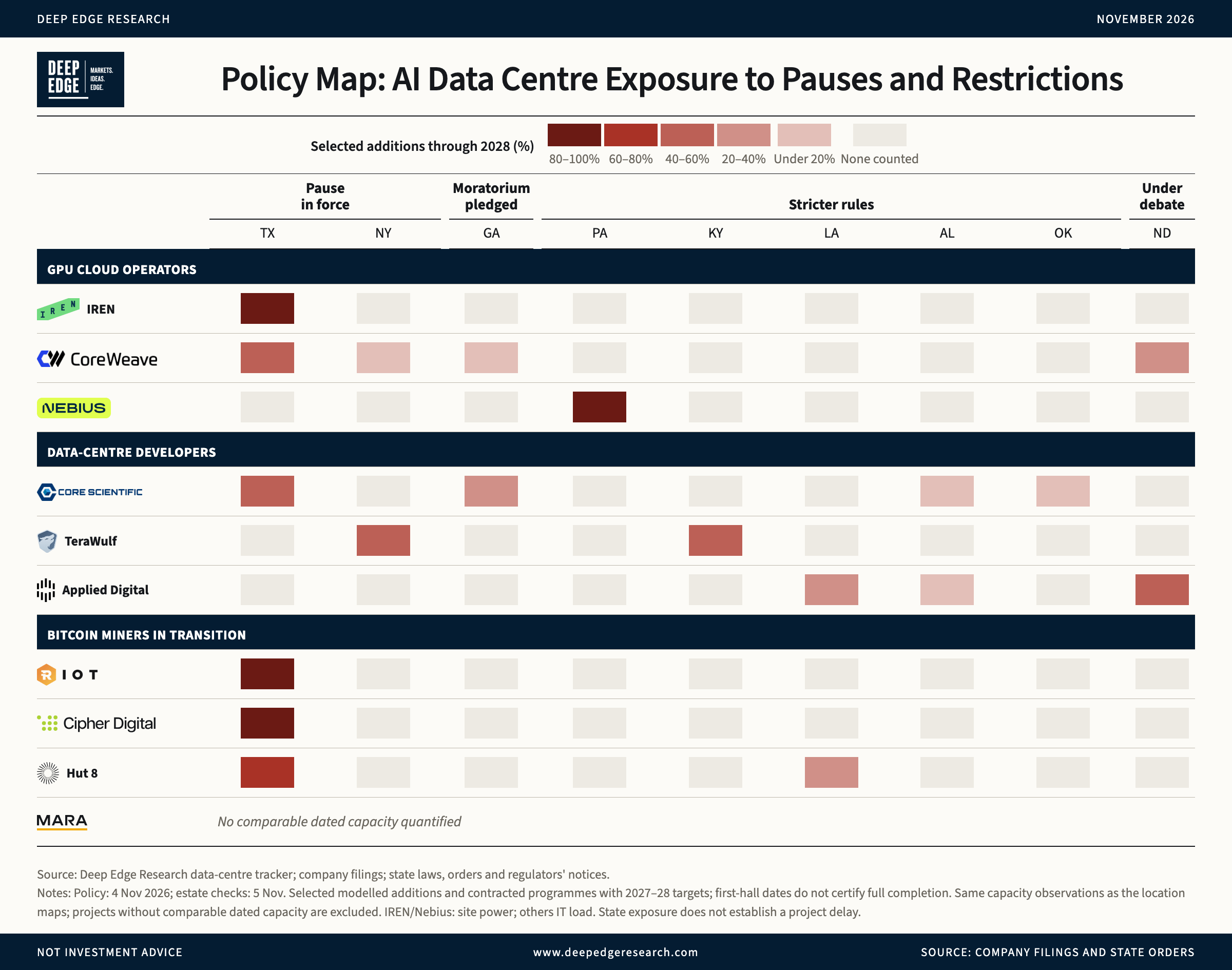
Source: Deep Edge Research data-centre tracker; company disclosures, state and regulator records. IREN and Nebius use total site power. Other quantified rows use IT megawatts, the power for the computers.
Read down Texas and you’ll see all the dated additions we track for Riot, Cipher and IREN, as well as most of Hut 8’s. Yet Riot says Corsicana’s extra power cleared the earlier grid process, so the current review gives us no reason to move its handover. The New York square for TeraWulf and the Georgia square for Core Scientific also mean different things: New York has a hold on certain permits; Georgia had a pledge. The map tells us where to check. It can’t tell us what’s still missing at a particular site.
2. Which approvals could hold up the next halls?
Figure 2 separates two questions: could an approval be held, and what cash is at stake while it’s pending? At Matagorda, MARA had already posted $100m to secure utility capacity. That’s cash tied up while the deposit stays in place, not a cost imposed by the pause. The payments to the seller have separate triggers. Colchis still needs a grid decision but has no signed rent to delay. Beacon Point sits below the plot: we know which grid decision is pending, but not what it does to delivery or Phase 2 funding.
Figure 2. Which projects could a state pause delay, and where is cash at stake?
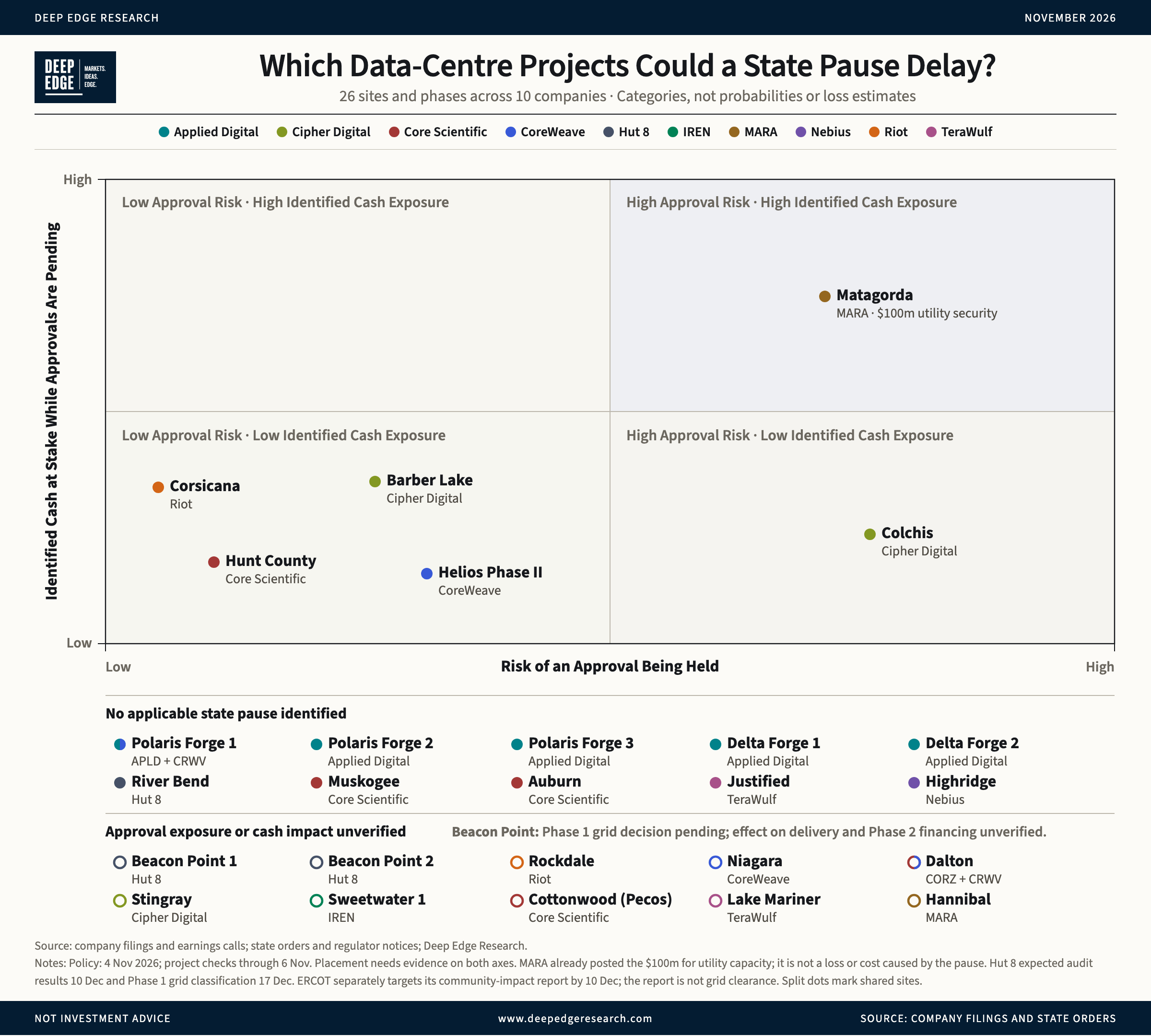
Source: state orders, regulator notices, company filings and earnings calls. Shared sites appear once. A project needs enough evidence on both approval risk and cash exposure for a quadrant placement.
Hut 8 (HUT)
Beacon Point accounts for about three-quarters of Hut 8’s contracted AI capacity, so the grid decision matters even if the opening date hasn’t moved. Hut 8 has key campus approvals. On its 4 November earnings call, management said Phase 1’s grid classification still depended on the Texas review. It expected audit results on 10 December and final classification on 17 December. The CFO said the outcome would help clear the way for Phase 2 financing. Hut 8 kept its delivery targets.
Beacon Point. The AEP Texas agreement covers 1,000 MW of utility power. The same tenant signed both phases, which account for 704 of Hut 8’s 949 contracted IT MW. The state registry lists two active stormwater authorisations (RN112474796). Neither settles the grid decision. Final classification would clear that hurdle for Phase 1. The tenant would still need a working hall, and Phase 2 would still need financing. Management also said batteries could replace diesel backup if generator permits became an issue.
River Bend. The other 245 contracted IT MW are in Louisiana. We found no applicable state pause, so we don’t put the project’s existing interest bill on the policy’s account.
Riot Platforms (RIOT)
Corsicana. The additional power is outside the current grid review. That review gives us no reason to defer Riot’s lease receipts or Anthropic’s access to the site.
Rockdale. The existing load is powered. The AMD and Anthropic additions may still need new or amended environmental permits. Riot hasn’t identified one that the pause holds up. Until it does, don’t attribute a later delivery or Riot’s equipment financing costs to the pause.
Cipher Digital (CIFR)
Stingray. Cipher says the 70 IT MW leased to Amazon don’t need another grid study. That doesn’t establish final permission to take power. If a covered approval pushes back handover, the landlord, Cipher Stingray LLC, would wait for rent. Stingray Compute LLC, the bond issuer, would still owe interest. We found no such hold.
Colchis and Barber Lake. Colchis still needs a final decision on 1 GW of site power and has no tenant signed. A delay there pushes back the next deal, not existing rent. Barber Lake’s substation is live and 300 MW of interconnection is approved without restrictions on how it draws power; no hold on the remaining halls was identified.
IREN (IREN)
Sweetwater 1. The substation is live, but IREN says the 2 GW hub’s grid classification is conditional. We couldn’t verify that the first 300 MW of site power depends on the outstanding decision. If it does, IREN could wait longer to put that capacity to work. We haven’t tied a customer payment or project loan to that tranche. IREN attributed its near-term revenue slip to a network change requested by Microsoft and to supplier timing, not the review.
Core Scientific (CORZ)
Cottonwood (Pecos). The extra power still needs a final allocation and timetable. The November deck separates that extra load from the first 185 IT MW leased to AMD. If the decision covers only the extra load, we wouldn’t move rent on those first halls.
Dalton. Georgia’s pause was a pledge, not a hold. If an enacted rule delays the remaining CoreWeave halls, Core Scientific would wait for those fees. The debt still being arranged is for the separate AMD and AMD-backed neocloud programme, which also includes capacity at Dalton.
Hunt County, Muskogee and Auburn. Hunt County has an approved power ramp. Utility or tax rules at the other two don’t establish a pause. We wouldn’t change their cash timing on those facts.
CoreWeave (CRWV)
Helios Phase II. This is c. 48% of CoreWeave’s tracked additions. Galaxy Digital’s subsidiary owns the property and owes the property interest. CoreWeave rents the halls and needs them to bill its customers. It can also owe interest on equipment, but its equipment debt isn’t publicly broken out by campus. This phase uses power approved earlier, not the separate 830 MW allocation at Helios.
Niagara and Dalton. At Niagara, landlord Blockfusion lists local permits and occupancy approval, outside New York’s state pause. We found no state permit on hold for CoreWeave’s 35 MW lease. At Dalton, if Georgia’s pledge becomes a rule that catches the unfinished halls, CoreWeave would wait for capacity to sell; Core Scientific, its landlord, would wait for receipts. That’s one set of halls with two different exposures.
TeraWulf (WULF)
Lake Mariner. New York’s order covers certain state environmental permits. We couldn’t verify one on hold that CB-4 or CB-5 needs. If a covered permit moves handover, TeraWulf would wait for rent while its project borrower still owes interest. Its earlier schedule changes came from tenant design and fit-out.
MARA Holdings (MARA)
Matagorda. The project isn’t in Figure 1 because it has no comparable dated capacity. It is in Figure 2 because the contract ties seller payments to decisions that are still pending, and MARA has already posted cash.
Hannibal. Ohio’s pledge is conditional. Federal clearance for the Long Ridge acquisition doesn’t approve an AI build. We found no contracted AI receipts to move.
Where we found no applicable pause
That includes Applied Digital (APLD) at Polaris Forge 1–3 and Delta Forge 1–2, Nebius (NBIS) at Highridge and TeraWulf at Justified. At Polaris Forge 1, Applied Digital’s project company owes the property debt and CoreWeave rents the halls. The same halls appear in both rows of Figure 1, but neither party’s costs are evidence of a policy delay.
The company that has to wait for capacity isn’t always the company that borrowed to build it. The same delay can leave a cloud operator short of capacity and a landlord short of rent, while the borrower still owes interest on the original schedule.
3. What would change the cash forecast?
Figure 2 shows where a decision could leave cash tied up. Figure 3 follows the payment to the company that owes it. A rent cheque, a bond coupon and a utility deposit can all be affected by the wait, but they don’t belong to the same company or move on the same timetable.
Figure 3. Who Pays While AI Projects Wait?
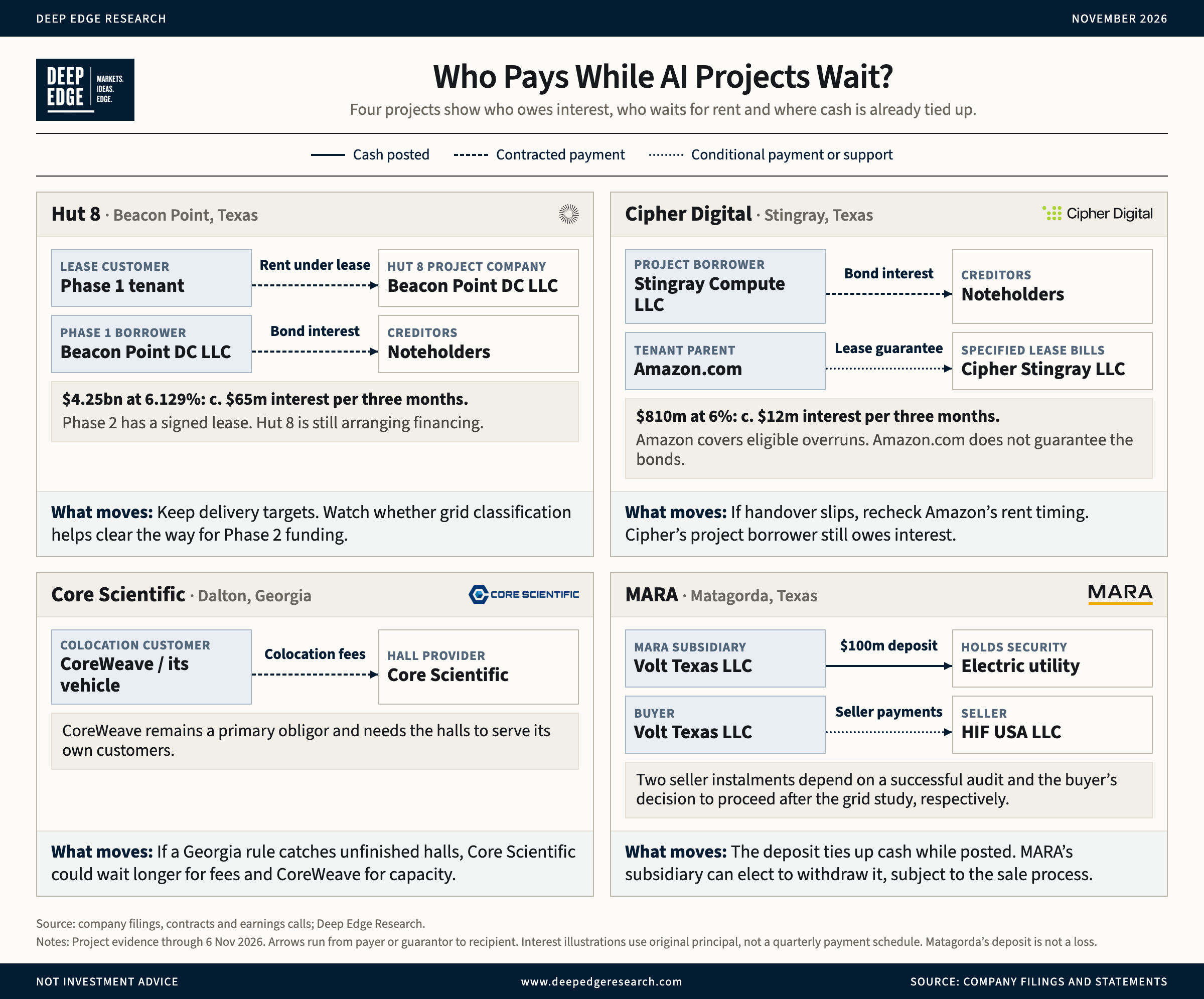
Source: Beacon Point note terms, Stingray note terms and lease support, Dalton agreements, and MARA’s amended agreement; Deep Edge Research.
What we can’t infer from the interest bill. Beacon Point and Stingray already owe interest on their notes. A delay could leave the borrowers paying for longer before rent comes in; it doesn’t create a new coupon. Beacon Point pays interest semiannually. Its note terms use c. $482m of estimated construction interest in the reserve formula, but that’s not the current balance or a measure of how much extra time it can fund. Hut 8’s $3.25bn River Bend financing is separate, and we found no applicable pause there.
What remains to finance. Hut 8 expects Phase 2 project debt without parent equity issuance or parent-backed borrowing. The amount, sponsor contribution and closing date are undisclosed. The c. $157m of September cash was group-wide, not a parent cash figure.
Core Scientific is the contrast. Management says it has invested the required equity for the first c. 530 MW of its c. $6bn programme and is still arranging project debt. The disclosures separate Pecos’s extra grid allocation from the first AMD halls; they don’t name that decision as a condition for the new debt. Watch for both, but don’t assume one is holding up the other. The $6bn budget isn’t an unfunded bill.
Matagorda is on its own timetable. MARA’s sale terms don’t give the seller the December dates Hut 8 cited for Beacon Point. MARA scheduled its September results for 9 November, after our cutoff, so we haven’t sized the deposit against September group cash.
Hut 8’s first-hall targets are Q3 2027 and Q2 2028. Those are delivery targets, not contracted rent-start dates or a timetable for closing Phase 2 debt.
Our bottom line: We’d keep the delivery dates unless there’s evidence an approval will move them. If a handover slips, check whether rent moves with it and who still owes interest. That’s different from a financing decision at Beacon Point Phase 2 or a deposit at Matagorda. The election gives us more decisions to watch. It doesn’t give us one revenue cut to apply across the sector.
References
State policy and grid reviews: Texas grid audit, Texas permit order, ERCOT report timetable, New York executive order, Georgia pause pledge.
Hut 8 and Riot: Beacon Point note terms, Hut 8 quarterly filing, Riot quarterly filing.
Cipher and IREN: Stingray project update, Stingray note terms, Amazon lease support, IREN quarterly results.
Core Scientific and CoreWeave: Core Scientific project update, Dalton agreements, Helios grid approval, Niagara prospectus.
TeraWulf, Applied Digital and Nebius: Lake Mariner project update, Polaris Forge and Delta Forge, Highridge project.
MARA: Matagorda sale agreement, Long Ridge acquisition clearance.