
DEEP EDGE RESEARCH | POLICY WATCH
Last week’s elections put data-centre moratoriums on the agenda in several states where the hyperscalers are building. Texas had already paused issuing certain permits before the vote. Elsewhere, incoming governors have backed pauses, but we don’t yet know which projects those rules would reach.
So which of the five has the most exposed capacity? And if an approval holds up a building, can the cloud company still serve its customers? It might be able to run their workloads elsewhere, but that can cost more. Meanwhile, the developer may still owe interest on a building that isn’t earning rent.
Oracle (ORCL) has the most new capacity in states with a pause or pledge in our comparison. But Alphabet (GOOGL) has the largest share of its own build in Texas, while Microsoft’s (MSFT) biggest concentration is in Wisconsin.
The biggest concentrations we can quantify for Amazon (AMZN) and Meta Platforms (META) raise different questions. At Amazon’s New Carlisle campus, what matters is when the minimum power bill starts. At Meta’s Hyperion, it’s whether a later phase needs a new tax exemption and can get one.
Our judgement: The election changes which approvals we’re watching. We wouldn’t push back a delivery date on a pledge alone. We’d change the revenue forecast when a delay leaves a company unable to serve customers on time. Where it can keep serving them, the first hit may be higher costs. And sometimes the bill belongs to the developer.
Not investment advice.
TLDR
Oracle: most capacity exposed, no change to Jupiter’s delivery forecast yet. All c. 5.25 GW we track sit in states with a permit pause or pledge. Watch the 19 November Jupiter conference and revised air recommendation against first-half 2027 delivery. At Lighthouse, the next test is transmission.
Alphabet: Goodnight’s permit could matter to Cloud margins. Texas accounts for c. 40% of the additions we track. If handover slips and Google pays more for replacement capacity, the cost shows up in margins even if customers get their service on time.
Microsoft: most of the tracked build is in Wisconsin. The state accounts for c. 63% of additions; check whether a pause reaches Fairwater’s expansion. At Childress in Texas, we’d move Azure’s timetable only if an approval delays capacity Microsoft can’t replace.
Amazon: watch the date the power bill starts. Indiana accounts for c. 58% of tracked AWS additions. At New Carlisle, minimum billing could start before AWS can use the added load. At Stingray, the project debt belongs to Cipher’s borrower, not Amazon.
Meta: watch build costs in Louisiana and approvals in Texas. At Hyperion, check whether later phases need a new tax exemption. El Paso targets first capacity in 2028, but Meta hasn’t said how much. Ohio’s pause pledge was conditional, and a late opening alone wouldn’t trigger Meta’s property-value guarantee at Hyperion.
1. Where the election puts new capacity under scrutiny
Texas had two measures before the 3 November vote. Governor Greg Abbott directed regulators and ERCOT, the grid operator, to check which large projects could advance towards a connection. Separately, the environmental regulator stopped issuing covered permits and screens applications for whether the directive applies. That’s a hold on approvals for construction or infrastructure directly supporting data centres, not an order to stop every build. ERCOT’s community-impact report is due by 10 December; individual projects still need their own clearance.
Gina Hinojosa won in Texas after calling for a wider pause. Deb Haaland in New Mexico, Jocelyn Benson in Michigan, David Crowley in Wisconsin and Amy Acton in Ohio also won after backing restrictions or pauses. The election gives those pledges more weight. We still need to see what gets enacted and whether it reaches later phases of projects already under way.
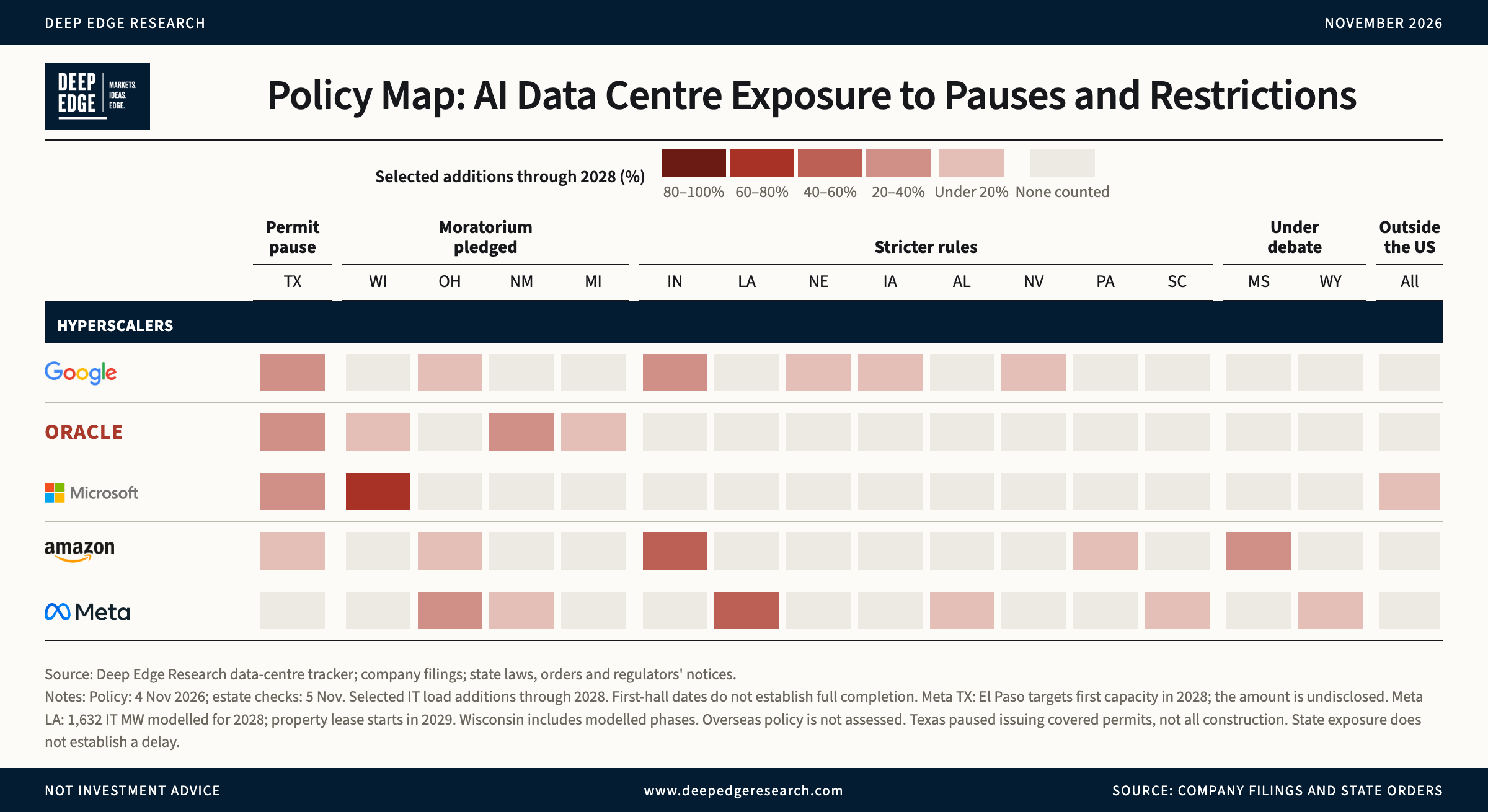
Figure 1 shows where each company is adding capacity. We use IT megawatts, the power for the computers, and include announced and modelled phases through 2028. We exclude running capacity and additions without comparable dates and sizes. Darker squares mean a bigger share of the company’s quantified build in that state. “None counted” means no comparable capacity was included for that state.
Figure 1. Where the five hyperscalers’ tracked additions sit
Source: Deep Edge Research data-centre tracker; company disclosures, state and regulator records.
Read across Oracle’s row and every square with capacity sits under either a permit pause or a pledge. Read down Texas and Alphabet has the biggest share of its quantified build there, at c. 40%, but Oracle has more megawatts in the state. Microsoft’s largest concentration is in Wisconsin. For Amazon and Meta, the largest squares are in Indiana and Louisiana, where the rules we’re watching concern power charges and tax exemptions. That doesn’t mean Meta has nothing at stake in Texas: El Paso is under construction, but we can’t put a 2028 number on it. The map gets us to the right states. We still need to know which buildings are waiting on a decision.
2. Which approvals could actually move an opening?
Oracle: Jupiter first, then Lighthouse
All c. 5.25 GW of Oracle’s tracked additions through 2028 sit in Texas, New Mexico, Michigan and Wisconsin. Jupiter in New Mexico accounts for about a third. That’s where we’d start.
Oracle closed a $20bn stock and debt raise on 4 November. Two days later, New Mexico took the December air-permit hearing for Jupiter’s power plant off the calendar. The raise gives Oracle more money to build. It doesn’t tell us when Jupiter can take power.
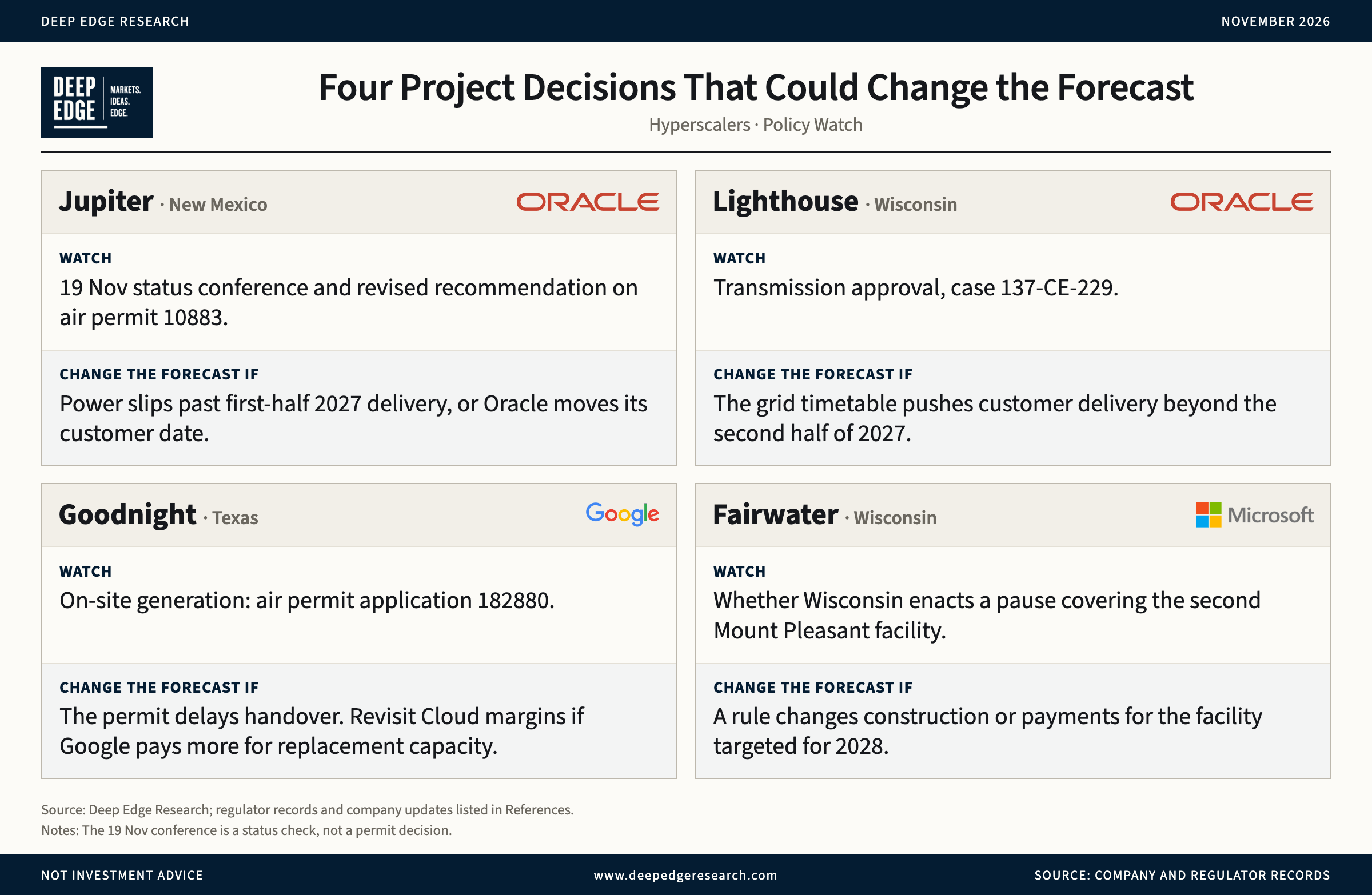
Jupiter, New Mexico. The 6 November order removed the 7 December hearing after the developer and the state air bureau asked for more time. The developer waived the decision deadline for air permit 10883, and the bureau has to file a revised recommendation before a hearing can be reset. The 19 November conference is a progress check, not a decision on the permit. The state land office’s July refusal to grant access for part of a gas pipeline is separate, as is Haaland’s pledge on new large projects. The hearing change doesn’t establish an election-related delay. We’re keeping first customer delivery in the first half of 2027 unless the power timetable or customer milestone moves.
Lighthouse, Wisconsin. The October settlement kept the generator permits valid after Sierra Club’s challenge. Vantage pays for the statewide review, due 31 January 2028. For Lighthouse, watch transmission case 137-CE-229 and the separate backup water project. We’d move delivery if grid power slips past Oracle’s second-half 2027 window.
Abilene and Frontier, Texas. Together they account for c. 1.61 GW, or 31% of Oracle’s tracked additions, but they’re at different stages. Oracle says it had delivered 75% of Abilene’s total capacity by September. The Longhorn air application names buildings 9 and 10, outside the original eight, so it doesn’t by itself change the schedule for those eight. At Frontier, Texas authorised the initial generators in 2025. VoltaGrid’s separate application, 182467, is still pending. We’d move Oracle’s first-half 2027 Frontier target only if the first halls depend on that permit and the wait changes delivery.
The Barn, Michigan. Oracle targets first customer delivery in the second half of 2027. The question is whether any rule following Benson’s pledge reaches the later phases.
Where approvals matter at Alphabet, Microsoft, Amazon and Meta
Alphabet (GOOGL). Goodnight accounts for c. 1.01 GW of the c. 1.08 GW we track for Google in Texas. Crusoe’s air application, 182880, covers on-site generation there; Red Oak is separate. The test is whether it moves Goodnight’s handover. Indiana, at c. 32% of Alphabet’s tracked additions, poses a different question: Fort Wayne already takes power, so we’re watching the terms and cost of that power.
Microsoft (MSFT). Wisconsin accounts for c. 63% of tracked additions, or c. 1.89 GW of modelled expansion. The first Mount Pleasant facility is running; Microsoft targets 2028 for the second. Crowley backed a pause during the environmental review. We’d check whether a rule reaches Fairwater’s expansion and moves construction or payments; Microsoft funds that build. Texas is c. 27% across IREN’s Childress and Crusoe’s separate Abilene expansion. IREN delivered Horizon 1 and says the other three phases are in late-stage construction. Watch its next Horizon update. The remaining c. 10% is planned overseas.
Amazon (AMZN). Indiana accounts for c. 58% of the Amazon Web Services (AWS) additions we track, including modelled growth at New Carlisle beyond the Project Rainier capacity already running. Watch when the minimum power bill starts on that added load. At Canton, Mississippi, where we track 399 MW (c. 26%), the state was debating restrictions, but we found no statewide pause or hold at the campus. At Stingray, Texas (c. 5%), Cipher says it is implementing a revised delivery schedule and the contracted phase needs no further grid study. That doesn’t establish final power clearance or show that the pause caused the revision.
Meta Platforms (META). Hyperion accounts for c. 54% of the 3,025 IT MW we can quantify for Meta through 2028. That’s 1,632 IT MW in our model for 2028, a measure of computing load, not utility generation. Meta expects compute to start coming online in 2028 and says its Louisiana venture lease starts in 2029. For the build cost, the question is whether a later phase needs a new tax exemption under Louisiana’s rules for prospective applicants.
In Texas, Meta expects first capacity at El Paso in 2028, the same year its Texas venture lease starts. But it hasn’t said how much of the announced 1 GW campus will come online that year, so El Paso isn’t in the 3,025 IT MW. We’d watch whether any approvals still needed for those first halls fall under the permit pause. Ohio’s Prometheus and Bowling Green account for c. 32% of the quantified additions. Acton’s pledge was conditional; we’d check which unfinished phases an enacted rule actually covers.
These are the project updates we’d use to decide whether to change a delivery or cost forecast.
Four Project Decisions That Could Change the Forecast
If a date moves, the next question is whose cash flow moves with it. Oracle can be waiting to earn revenue while the company that borrowed to build Jupiter still owes interest. At Stingray, that same distinction matters to Amazon and Cipher: a later handover can change when rent starts without moving the project’s bond payments.
3. Which bills keep coming if a hall opens late?
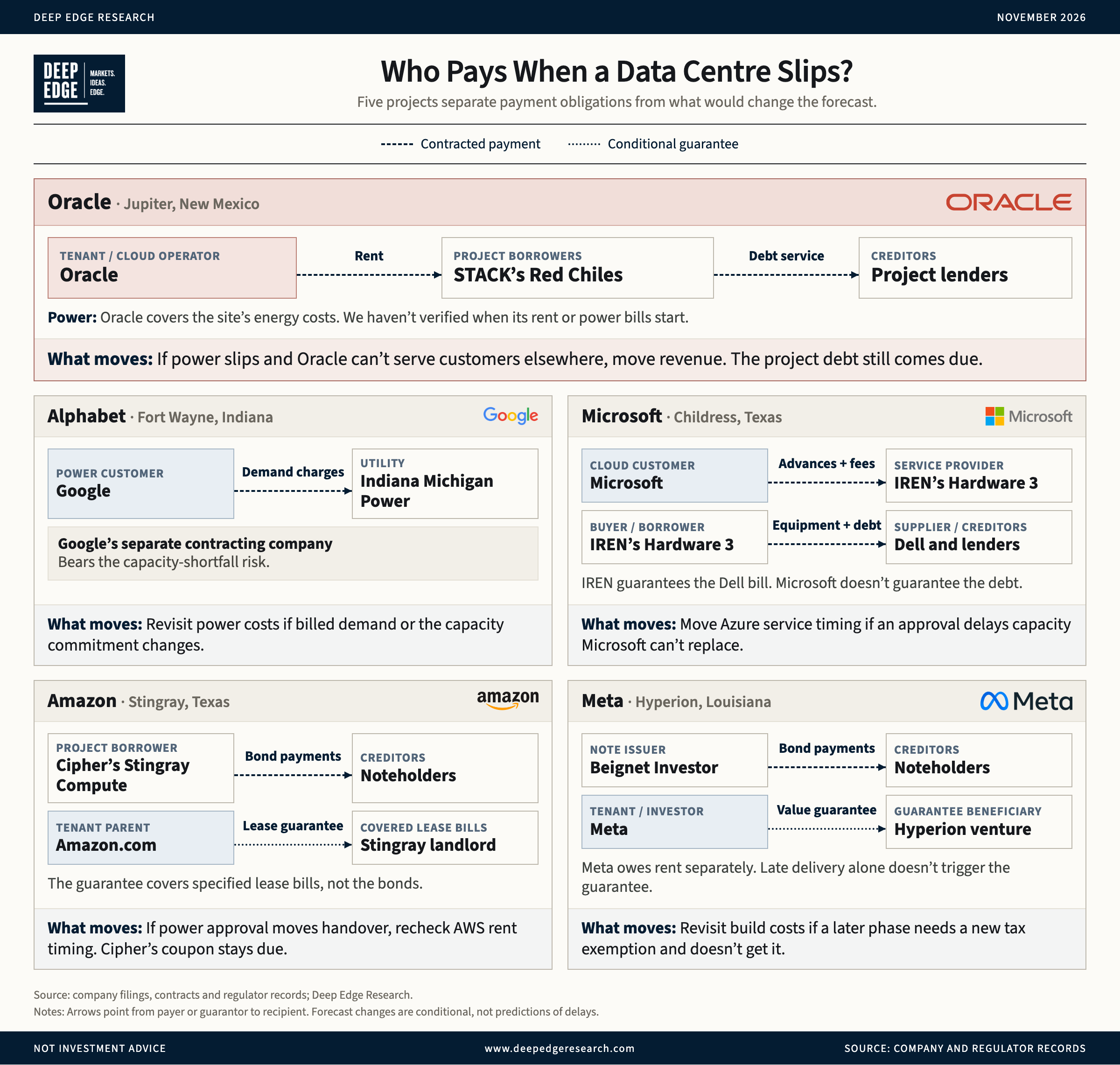
Figure 2 follows the money at one project per company. The arrows run from the company that owes or backs a payment to the one that receives it. At Jupiter, Oracle owes the rent; the project companies owe the lenders.
Figure 2. Who owes what at five hyperscaler projects
Source: company filings, contracts and regulator records; Deep Edge Research.
Oracle: the revenue can move; the interest still accrues
How much would a quarter’s delay at Jupiter matter? Say the affected phase would have earned $1bn a year at a steady rate. If the customer has to wait a full quarter and Oracle has no substitute, $250m of recognised revenue moves into later periods. That’s an illustration, not a Jupiter estimate. Oracle reported $664bn of group backlog, with c. 13% expected to turn into revenue within a year, but didn’t break out Jupiter. And an advance can put the cash in a different quarter from the service.
That matters because Oracle is already spending faster than it brings in cash. It reported a $5.4bn free-cash-flow deficit in the August quarter. Without the $11.4bn in customer prepayments with a financing component, the gap would have been c. $16.8bn, all else equal. Those prepayments were across the company, not cash we can trace to Jupiter, and Oracle still owes the service. The November raise helps fund the wait, but the new corporate notes accrue c. $194m in interest a quarter, based on $776.75m of annual coupons. That interest accrues whether or not Jupiter opens on time.
STACK’s Red Chiles companies owe the Jupiter construction debt. Oracle owes rent and covers energy costs, but the public terms we checked don’t establish when those bills start or who absorbs a delay. Vantage’s project borrowing at Lighthouse and Frontier is also separate from Oracle’s rent. At Abilene, Abilene DC 1 owes the loan on buildings 1 and 2; Oracle America owes rent and pays Lancium for power. The other six Oracle-leased buildings sit in separate ventures, so we wouldn’t read across from the terms on the first two.
From the 4 November close to the 6 November close, Oracle fell 6.2%, versus losses of 1.4% to 4.5% for the other four. The median yield on displayed trades of at least $1m in Oracle’s new 2031 note rose from 7.38% to 7.44%, while the five-year Treasury yield fell 5 basis points. That’s a widening of c. 11 basis points on that comparison. It tells us Oracle’s bonds weakened relative to Treasuries over those observations; it doesn’t tell us how much of that was Jupiter.
For Jupiter, we’d use the 19 November conference and revised air recommendation to test the power timetable. If it slips, we’d move revenue where customers have to wait and cut margins where Oracle pays more for replacement capacity. We’d revisit credit if the bills that keep coming widen the cash gap Oracle has to finance.
What changes for Alphabet, Microsoft, Amazon and Meta?
Alphabet: Cloud margins or power costs. Alphabet’s CFO said outside capacity arrived late and would weigh on Cloud margins as usage grew. At $30.7bn of quarterly Cloud sales, $307m of extra net cost takes one percentage point off operating margin. That’s the yardstick if Google buys replacement compute for a late Goodnight handover. If the customer waits instead, revisit revenue timing. We haven’t established who owes Goodnight’s debt, rent and power bills. At Fort Wayne, Google pays standard demand charges to Indiana Michigan Power. A separate Google contracting company agreed to supply capacity and cut usage when called on, and bears the risk of a shortfall. Revisit power costs if billed demand or that commitment changes in Indiana case 46276.
Microsoft: Azure delivery, if it can’t cover the gap. Azure grew 48% despite third-party delays, helped by better use of installed capacity. That’s why a delay at Childress doesn’t automatically move Azure revenue. Microsoft pays advances by delivery phase and monthly fees after acceptance. IREN guarantees its subsidiary’s Dell equipment bill and backs specified lender shortfalls if Microsoft rejects or terminates a phase and resale or redeployment falls short. Microsoft doesn’t guarantee that debt. We’d move Azure’s service timetable if an approval delays capacity it can’t replace.
Amazon: power at New Carlisle, rent at Stingray. In Indiana, case 46097 sets a minimum bill at 80% of the higher of scheduled demand and peak billed demand over the prior 11 months. It doesn’t set the date AWS starts paying for added load. Revisit power costs if that bill starts before AWS can use the power. At Canton, AWS pays Entergy; expansion terms aren’t public, and we’d move delivery only if a rule reaches an unfinished hall. At Stingray, a later handover would put AWS rent timing and Cipher’s cash before rent back in focus. Cipher’s project company still owes its first interest payment on 15 December 2026. The regular half-year coupon is c. $24.3m on $810m. Amazon.com backs specified lease bills and Amazon covers eligible construction overruns. Neither is a guarantee of the bonds.
Meta: the cost of the build. If a later Hyperion phase needs a new tax exemption and doesn’t get it, the venture’s build cost is where we’d make the first change. Meta owes rent separately and its property-value guarantee can be called under certain conditions after a lease ends. Late delivery alone doesn’t trigger it. If Meta buys replacement compute, that’s a separate increase in infrastructure costs.
Our bottom line: A late opening at Goodnight could mean Google pays more to serve the same customers. If minimum billing starts early at New Carlisle, Amazon could pay for power it can’t use yet. And if a later Hyperion phase needs a tax exemption and doesn’t get it, the cost of building goes up. None of those calls for a cut to sales on its own. For all five, we’d follow the decision that can move the project, then check what it does to customer delivery and which company owes the bill.
References
Oracle’s raise, capacity and cash: November financing filing, campus updates and delivery targets, August-quarter filing.
Texas measures and election: ERCOT connection review, environmental regulator’s response, ERCOT community-impact report timetable, Hinojosa’s proposal. AP race calls: Texas, New Mexico, Michigan, Wisconsin, Ohio.
Oracle projects: Jupiter order, 6 November, New Mexico land office decision, Haaland’s pledge, Jupiter borrowers, Oracle’s energy commitments, Lighthouse settlement, transmission case, backup water project, Abilene Longhorn application, Abilene lease ventures, Frontier initial generators, VoltaGrid application, Benson’s pledge.
Alphabet and Microsoft: Goodnight air application, Fort Wayne order, Alphabet earnings call, Microsoft’s Mount Pleasant update, Crowley’s position, IREN results, Microsoft results, IREN Dell guarantee, lender shortfall support.
Amazon and Meta: Project Rainier, Indiana tariff, Cipher delivery update, Stingray notes, Stingray lease and cost support, Louisiana tax-exemption requirements, Meta’s Hyperion agreement, Acton’s conditional pledge.
Market observations, 4–6 November: Oracle historical closes, displayed TRACE bond trades, US Treasury daily yields.
Meta capacity and lease timing: El Paso campus and first capacity, Hyperion compute timing, Meta’s September filing, Note 5.