
DEEP EDGE RESEARCH | POLICY WATCH
Company evidence to 5 November 2026; national policy evidence to 4 November. For informational purposes only. Not investment advice.
IREN Limited (IREN) reported earnings last night, and like other AI Infrastructure stocks, it was caught in the eye of the potential data centre moratorium storm and the ensuing sell-off.
At the time of our 5 November update, its shares had lost c. 26% in two sessions! The shares appear to be recovering some ground in pre-market trading.
IREN’s earnings call gives us fresh evidence to test the concern: how exposed is its 2GW Sweetwater buildout, and what would a longer approval process mean for shareholders?
That matters because investors are paying for a much larger AI business than the one earning revenue today. If the buildings take longer to open, shareholders wait longer for the income expected to justify that investment.
There is something important in those results. Management says its initial 300 IT megawatts of computing capacity are contracted and funded through completion. That programme targets more than $4bn of annualised revenue once operational. AI Cloud revenue has already risen from $71m to $200m between the June and September quarters.
Then there is Sweetwater itself. Management explicitly pushed back on the suggestion that Site 1 was still waiting for its grid connection: it is already connected, and management regards the full hub’s power as secured.
That puts IREN in a different position from a developer still waiting for permission to connect an empty field.
But it does not settle every approval needed to finish the buildings and bring successive phases into service. The written results still describe the hub’s grid classification as conditional, and management says it obtains permits throughout construction. Which of those remaining decisions a moratorium would catch is therefore important.
There is also more money to find. Its updated funding plan identifies $9bn of cash and committed sources against $15bn of remaining investment from 30 September 2026 to June 2027. The wider programme still needs another $6bn.
And we already have an example of how delivery timing affects the business. The greater-than-$4bn annualised revenue target has slipped from December to January, possibly February. Management attributes that to a Microsoft-requested network change and supplier timing. We should not blame politics for a delay the company has explained differently.
Our judgement: the election creates a genuine risk to the timing of IREN’s later expansion, but treating its entire Texas buildout as blocked would ignore the progress already made. The first programme has funding, service is starting and Sweetwater 1 has a grid connection. Our concern is the money committed before the remaining buildings can earn. If approvals take longer, management must either slow further spending or finance a longer wait for customer revenue. The next $6bn should be judged against that timetable.
TLDR
The near-term programme is funded. Management says cash, committed equipment financing and customer advances cover the remaining building and GPU expenditure for the initial 0.3GW IT programme. Funding conditions still apply; this does not cover every future site.
Delivery has moved into early 2027. The greater-than-$4bn operating annualised revenue target is now January, potentially February. Management cites a customer-requested change and supplier timing, not a policy hold.
The wider plan needs another $6bn. Remaining FY2027 investment is $15bn, against $9bn of cash and committed sources. Some of that money is restricted or not yet received.
Sweetwater has made more progress than a pending grid application. Management says Site 1 is connected and the full hub’s power is secured. Its written grid classification remains conditional. The policy question is which further permissions new restrictions would catch.
What the election can change at Sweetwater
As we’ve explained in our other articles, Texas governor-elect Gina Hinojosa called for an emergency executive moratorium on data centres “until the legislature meets”. Her election gives that position greater weight. Its final legal scope, duration and treatment of existing projects remain unresolved.
The state already has an approval review under way. Governor Greg Abbott ordered a grid audit in August, followed by a September direction to halt TCEQ data-centre permits pending the review. TCEQ is the Texas Commission on Environmental Quality. The letter also directs other state agencies not to advance related regulatory approvals until the information is acquired.
The Electric Reliability Council of Texas, or ERCOT, expects related reports by 10 December. That is a review date, not a promised date for IREN’s grid connection.
An analyst put that distinction directly to management last night, asking whether Sweetwater still expected final interconnection approval in December. Chief Commercial Officer Kent Draper replied that Sweetwater 1 was already grid-connected and described the 2GW across both sites as secured. He also said the company obtains relevant permits throughout construction.
That answer matters. We cannot reasonably write about Sweetwater as though nothing has been connected and the whole project is waiting for December. Equally, the results release retains the conditional wording for the hub’s inclusion in ERCOT’s Batch Zero process, which classifies large loads joining the grid. Management’s answer does not provide a complete list of permits still needed or establish exemption from every future measure.
Our concern is therefore specific: does a remaining permission fall within an existing hold or the incoming governor’s eventual restrictions, and would that delay a phase customers are expecting? We have not established an order stopping all Sweetwater construction. The election also does not undo Microsoft’s accepted Childress service.
The estate’s different stages determine where that question matters most.
Existing service and the next buildings are different risks
Childress already has accepted computing service. Sweetwater is building for a later opening, while Kiowa is an earlier development opportunity. Table 1 separates those positions rather than treating every megawatt as exposure to the same policy decision.
Table 1: Childress is earning; Sweetwater still has buildings to deliver
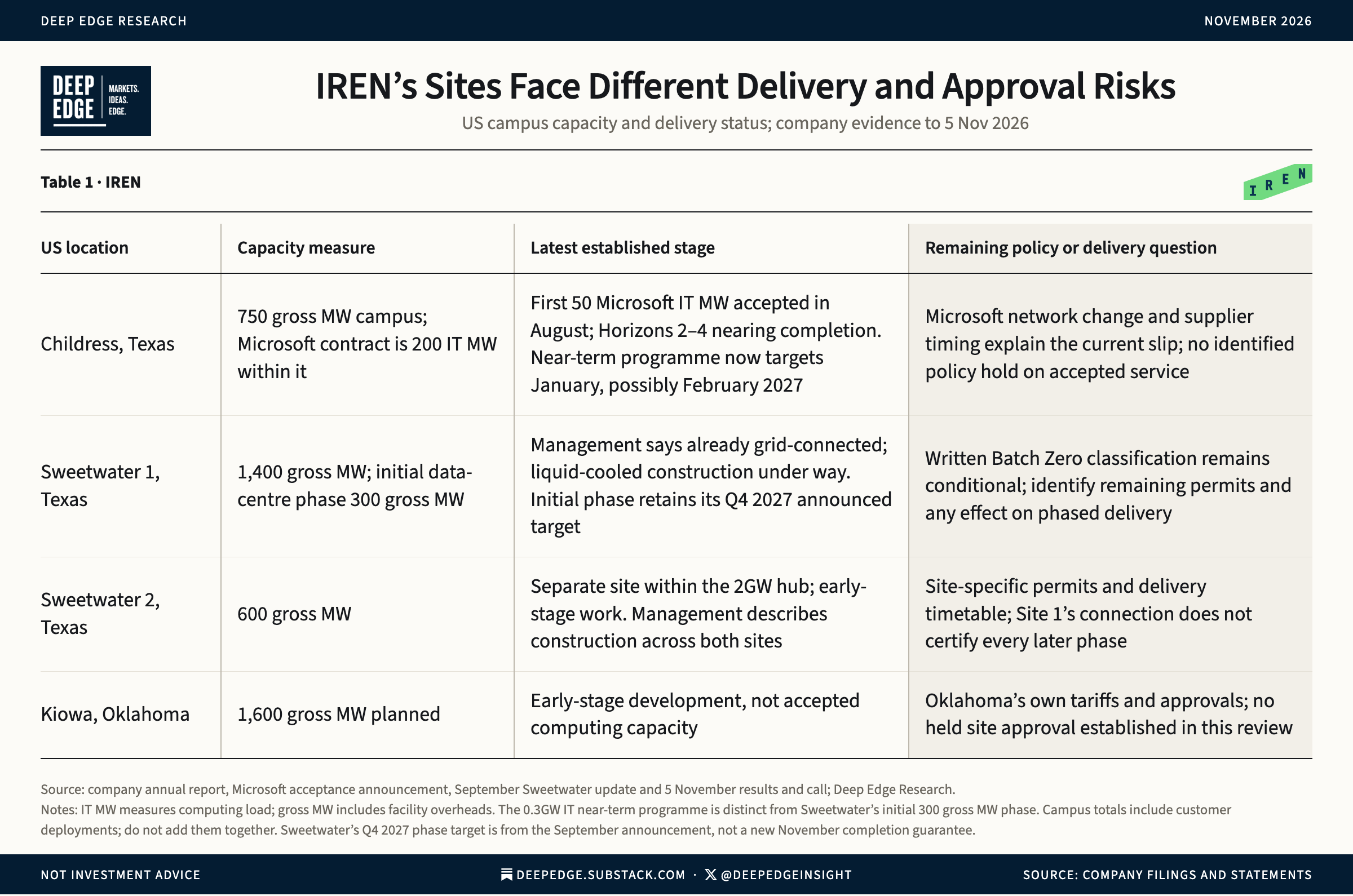
The revised Childress timing is evidence that even an advanced, funded project can take longer to earn. It is not evidence that Sweetwater’s policy position caused the delay. Microsoft’s remaining halls sit at Childress, a different campus.
Figure 1: IREN’s US footprint and remaining approval exposure
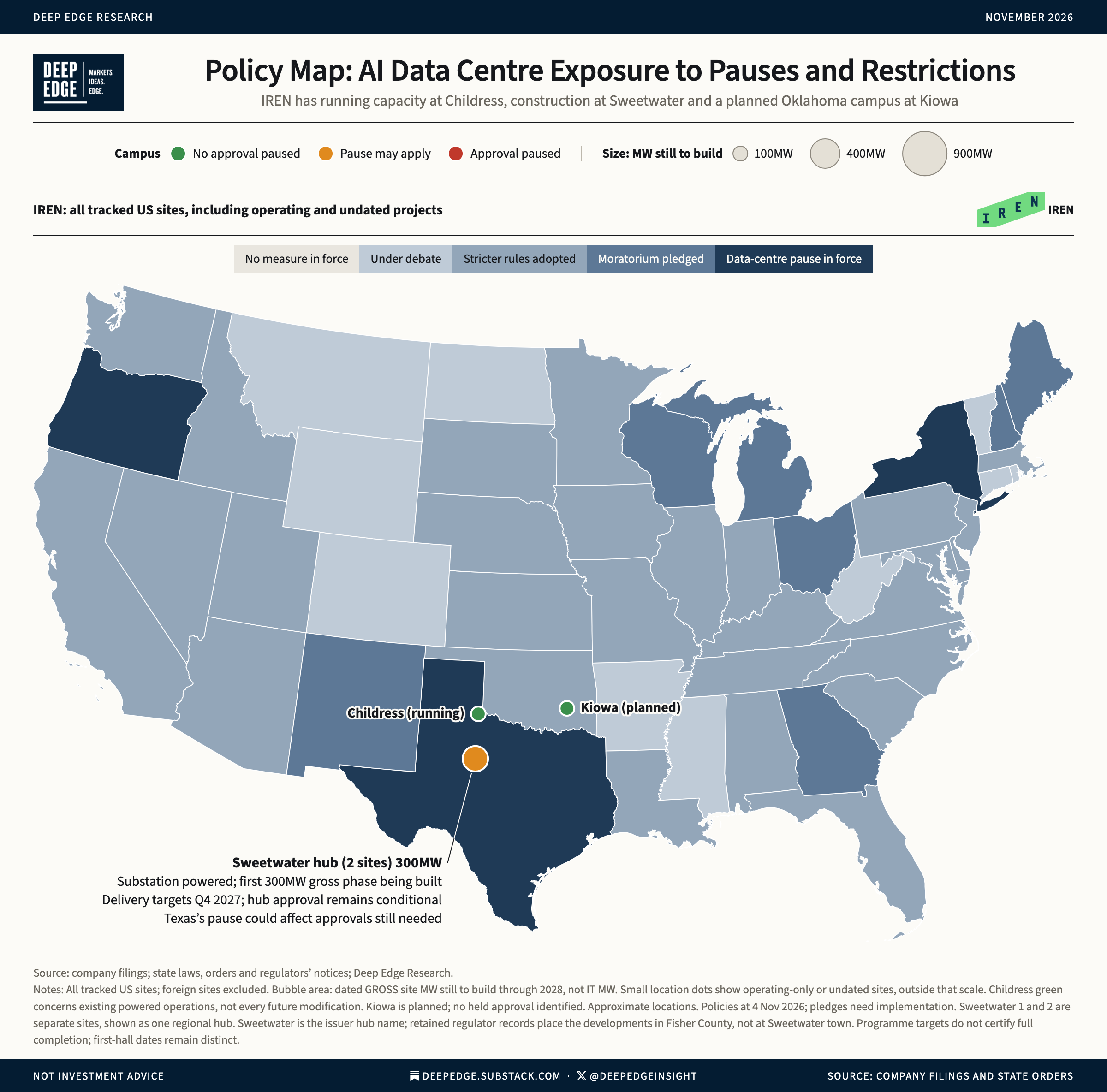
The map retains the pre-call estate wording and 4 November policy assessment. Management’s 5 November clarification is important: Site 1 is already grid-connected and management regards the hub’s power as secured. Amber flags possible effects on permissions still needed; it does not mean the existing connection awaits December approval or that a stop order has been established. The bubble measures the initial 300 gross MW phase, not the whole 2GW hub.
Kiowa faces Oklahoma’s own large-load tariff and credit-protection rules; no winning-executive construction moratorium is established there. Canada, Australia and Spain give IREN choices about where to develop next. They are not ready-made substitutes for a customer expecting service from a particular Texas hall.
Those choices do, however, help management decide where to spend the next dollar. That brings us to the part of the programme still needing finance.
The next expansion still needs $6bn
IREN develops the property, buys the graphics-processing units, or GPUs, used for AI computing, and sells the service itself. Owning more of that chain gives it more of the potential return. It also means paying for buildings and equipment before most customer revenue arrives.
Customer advances help bridge that wait. A five-year agreement signed after September includes prepayments covering 90% of the associated GPU cost. For specified Mackenzie deployments, management says equipment financing and prepayments together cover more than the GPU purchase bill. That can release corporate money for the property as well.
We should distinguish this funding advantage from money the parent can spend on anything it likes. The $9bn management identifies combines cash, restricted accounts, undrawn committed equipment facilities and customer advances contracted but not yet received. Draw conditions and restrictions still matter.
Table 2 replaces August’s funding framework with the remaining programme at September’s close.
Table 2: IREN has $9bn of identified sources against $15bn still to spend
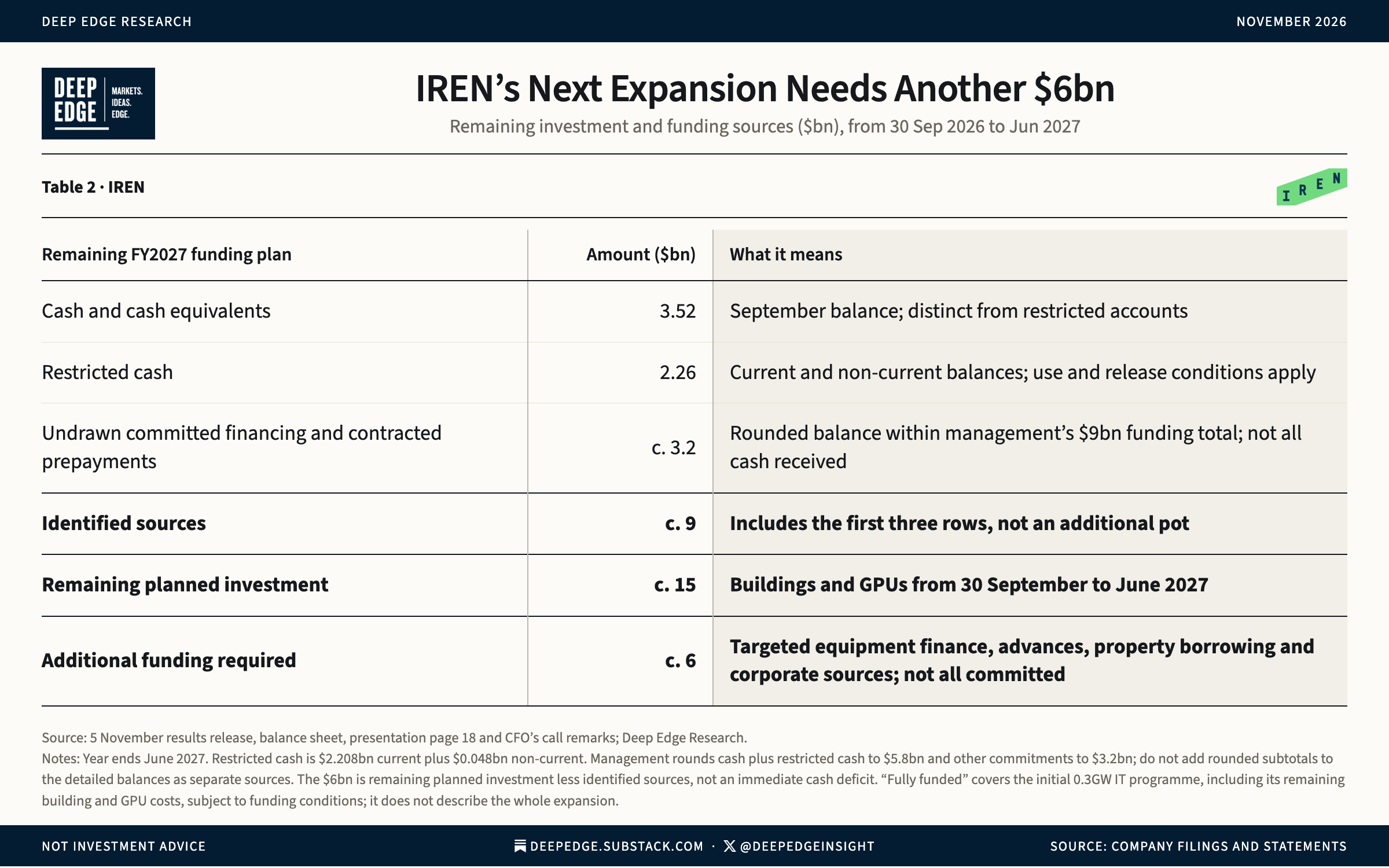
This is a more useful question than whether IREN has announced enough contracts: can it close the next $6bn on terms that leave shareholders a worthwhile return?
Management points to property and equipment it can borrow against, including data centres it has so far funded without property-level debt. Its estimate of $12–15bn of potential financing capacity is an argument for flexibility. It is not another $12–15bn of signed facilities to add to the table.
There is also a response available if funding becomes too expensive. Management says it has already reduced planned spending because of financial-market conditions, spreading Childress’s air-cooled deployments across 2027. It has not bought all the GPUs needed for next year. That gives it more scope to match later equipment purchases to buildings it can actually use.
So a slower build need not mean an emergency capital raise. IREN can preserve cash by pacing expansion. The price is later revenue, and the flexibility is greatest before equipment orders and customer delivery obligations become binding. A policy delay needs testing against those particular commitments.
Funding completion does not guarantee the date cash starts arriving
The Microsoft network change makes this more than a theoretical concern. Management says the incremental cost is immaterial against the cluster’s investment, yet the change and supplier timing have moved the revenue ramp. A small change in the construction bill can still move the date shareholders start earning on a large investment.
Dell’s equipment payment timetable and Microsoft’s customer-acceptance timetable are separate. IREN’s Hardware 3 equipment financing also has eligibility, collateral and release conditions. A delayed service start does not establish that supplier bills or lender payments move back by the same amount.
Customer advances carry a similar trade-off. The money arrives early, but IREN still owes the service and cannot collect the same advance twice. Later payments can be reduced as the advance is credited against service. If delivery slips, the relevant agreement determines credits, refunds, cure periods or termination rights. Management discussed community engagement on the call, but did not settle the analyst’s question about customer exit or deposit-refund rights if opposition causes a substantial delay.
GPUs add a further exposure if they arrive before a usable building. They can age competitively while waiting to earn. That does not mean every delay produces an equipment loss: management says older H100 GPUs have recently been recontracted at double their prior pricing. Demand can support returns for longer than a simple obsolescence argument assumes. We should test actual pricing and deployment dates rather than invent a resale loss or assume accounting depreciation starts before an asset is ready for use.
IREN has useful protections. It owns the buildings, can stagger later purchases and can seek property financing against completed assets. Management also emphasises rural locations, community consultation and limited water needs. Those measures can help projects progress; they do not themselves establish a legal exemption from a future restriction.
Our read is that the financial consequence depends on when a restriction bites. Before major commitments, management can slow the spend. After equipment purchases and delivery promises, a longer wait leaves more money tied up without the expected service receipts. That is why the remaining permits, invoices and customer dates need to be considered together.
What would change our view
The results answer an important part of the original question: the initial 0.3GW IT programme has identified funding through completion. The next tests concern delivery and the larger expansion.
January, with February as the stated risk: commission and obtain customer acceptance for the near-term programme. Annualised revenue is an operating target, not revenue already booked for a full year.
As the $6bn is financed: distinguish signed facilities from collateral-based estimates, and money received from conditional commitments. Show repayment terms alongside the new funding.
When Texas specifies its restrictions: identify which remaining Sweetwater permits or later phases are covered, including the treatment of existing construction. December’s audit is not a substitute for a project-specific answer.
Before Sweetwater’s initial phase opens: align remaining permissions, equipment orders, customer commitments and financing. Show what expenditure can still be deferred if the timetable moves.
Our conclusion: the election adds uncertainty to IREN’s later expansion, but the results give us stronger grounds to separate that risk from the funded programme nearing completion. There is operating service, a secured-power argument management is willing to defend and room to pace future spending. There is also $6bn still to raise for the wider plan. We would judge the next stage by whether management closes that funding and brings capacity into service without committing money faster than it can earn it back.
References
Our 5 November Core Scientific policy update: the dated intraday snapshot in which IREN was down c. 26% from the 3 November close, not a 5 November closing return or a new 6 November quote. The Hut 8, Cipher and Core Scientific policy articles were all published on 5 November.
5 November FY2027 first-quarter results, including balance sheet and definitions; results presentation, particularly pages 12–14 and 18–19; complete earnings-call transcript, including Q&A. Prepared remarks establish funding and timing; Microsoft delivery discussion begins around minute 24, spending flexibility around minute 38, community/refund question around minute 51 and Sweetwater grid clarification around minute 57.
FY2026 annual report, filed 27 August: property perimeters, financing vehicles, restrictions and commitments. November’s remaining-capex framework supersedes the earlier annual funding illustration in this article.
Microsoft’s Horizon 1 acceptance, 13 August; Microsoft statement of work and Dell purchase terms: distinct customer, supplier and delivery obligations, not a Sweetwater contract.
Hardware 3 common terms and limited parent support: draw/release conditions and specified support; no blanket transfer to another equipment pool.
8 September Sweetwater announcement and issuer’s Sweetwater campus page: two-site hub and initial 300 gross MW Q4 2027 phase target. November’s written results retain conditional Batch Zero wording; the call adds management’s grid-connection clarification.
Oklahoma HB2992 enrolled law and enactment history: large-load tariffs and credit protections, not a statewide construction pause. Individual Kiowa applicability remains to be established.
Abbott’s August audit announcement, September directive, ERCOT September notice, Hinojosa’s proposal and AP’s 4 November Texas race call: retained policy evidence to 4 November. The map is the reviewed unified-estate edition; company commentary is refreshed separately to 5 November.