
DEEP EDGE RESEARCH | POLICY WATCH
Evidence to 5 November 2026. For informational purposes only. Not investment advice.
Core Scientific had their earnings today.
But you would hardly know that because the election-driven sell-off we wrote about yesterday continued even further today.
In the snapshot we shared yesterday this was the damage:
Hut 8 (HUT) -22%,
Cipher Digital (CIFR) -21%,
IREN -12%
Core Scientific (CORZ) -11%,
Today, those same companies have continued free-falling.
At the time of writing, Cipher had lost c. 32% of its value over the last 2 days. Hut 8 was down c. 29%, IREN c. 26% and Core Scientific c. 21%. These are cumulative losses to an intraday snapshot, not closing returns.
It is clear that policy risk is being repriced across the AI buildout.
And the concern reaches well beyond one company’s earnings: if new data centres take longer to get approval, the buildings start earning later, customers wait longer for computing capacity and suppliers wait longer for equipment orders.
Meanwhile, money already committed to the build still has to be financed. That is why the election matters to shareholders across the chain.
So where does that leave Core Scientific?
Texas and Georgia account for 415 of the 529 IT megawatts in its new leased programme, which management expects to cost c. $6bn. Both incoming governors campaigned for data-centre pauses. IT megawatts measure power for the computers.
But today’s results give us reasons to distinguish its projects from the sector-wide fear. Hunt County has an approved grid ramp. Management says it has already invested its own required contribution to the initial Advanced Micro Devices (AMD) building programme. And 485MW was billing at September’s end, with quarterly colocation revenue up nearly 60% to $215m. Colocation means supplying the buildings, power and cooling in which customers run their computers.
Those are real advances. They do not settle Pecos’s remaining permissions, the treatment of unfinished Dalton construction under any future Georgia pause, or the loans still needed to finish the new programme.
Our judgement: the policy concern is justified. A longer wait for approval can delay rent and increase the amount of time shareholders must finance before their investment earns. But today’s broad sell-off does not tell us which Core Scientific buildings will actually be delayed. Hunt’s approved ramp and the owner contribution already invested improve its position. The next tests are the permissions still outstanding and the project loans still to close.
TLDR
The policy sell-off is continuing into a second day. Cipher has lost c. 32%, Hut 8 c. 29%, IREN c. 26% and CORZ c. 21% since the 3 November close, at the time of writing on 5 November. The shareholder problem is how long committed capital must wait to earn.
The election reaches different projects at different stages. Texas and Georgia hold 415 of the 529 new IT MW. Hunt now has an approved grid ramp; Pecos’s final power-on clearance is unconfirmed here, and Georgia’s proposed pause remains a pledge.
The existing business is delivering. CoreWeave capacity billing rose from 395MW at June to 485MW at September; final Dalton work remains under construction.
CORZ says its initial AMD contribution is already paid. The company does not expect a new equity or equity-linked issue for that phase. The remaining project financing still has to close.
Cash and headline liquidity are different. September held $804m of ordinary cash and $838m restricted. Management expects c. $650m from existing warrant exercises around January, with more shares issued in exchange. Those proceeds and a possible collateral release are future sources.
Delay still has a financial consequence. Existing debt payments continue, and holders of $625m of convertible notes retain a separate right to request cash in December 2027. Later rent would leave less flexibility around those claims.
The election changes the next buildings more than the last ones
Texas governor-elect Gina Hinojosa called for a data-centre moratorium until a legislative session. Georgia governor-elect Keisha Lance Bottoms called for a pause on new construction while the state reassesses utility, environmental and community impacts.
Neither pledge establishes a new ban already in force or settles how existing construction and later expansions would be treated. The policy evidence here is dated 4 November; company disclosures are updated through the 5 November results and full call.
Texas already has measures in place. Governor Greg Abbott’s August directive required a grid audit; his September directive halted Texas Commission on Environmental Quality (TCEQ) data-centre permits and told other state agencies not to advance related approvals until the audit information is acquired.
ERCOT, the Electric Reliability Council of Texas, expects its related report by 10 December. That reporting date does not automatically clear individual projects to switch on.
The latest filing confirms Hunt’s approved ERCOT interconnection ramp schedule. The company says existing grid and electricity-service agreements limit exposure to restrictions on new approvals for the capacity they cover.
Management still describes a November grid stability study as an energisation milestone. Backup-generator air permits at Hunt and Pecos are being progressed, with a permit-by-rule route expected if the qualifications are met. These are separate from Hunt’s approved ramp.
Pecos’s existing power and additional studied load were conditionally classified in September. Management remains confident in early-2027 delivery, pointing to the existing building and construction progress. We have not established final power-on clearance or a current order stopping the initial 185 IT MW lease.
Denton has a different position again. September’s update excluded its existing 297MW of electrical power and a separate 74MW of studied, not-yet-energised load from Batch Zero, ERCOT’s classification process for large new loads. These gross electrical figures include wider campus needs and must not be added to customer IT leases.
Secured approvals improve the starting position. Later expansions and remaining permits still need their own decisions.
Where the new rent is meant to come from
AMD leases 377 IT MW across three locations; an unnamed specialist cloud provider takes another 152 at Auburn and Dalton, under a separate AMD support arrangement.
Table 1 shows the new leased computing capacity behind the 78% figure. IT megawatts measure power for the computers. The denominator is neither the whole operating estate nor the construction budget.
Table 1: Texas and Georgia hold most of the new leased capacity
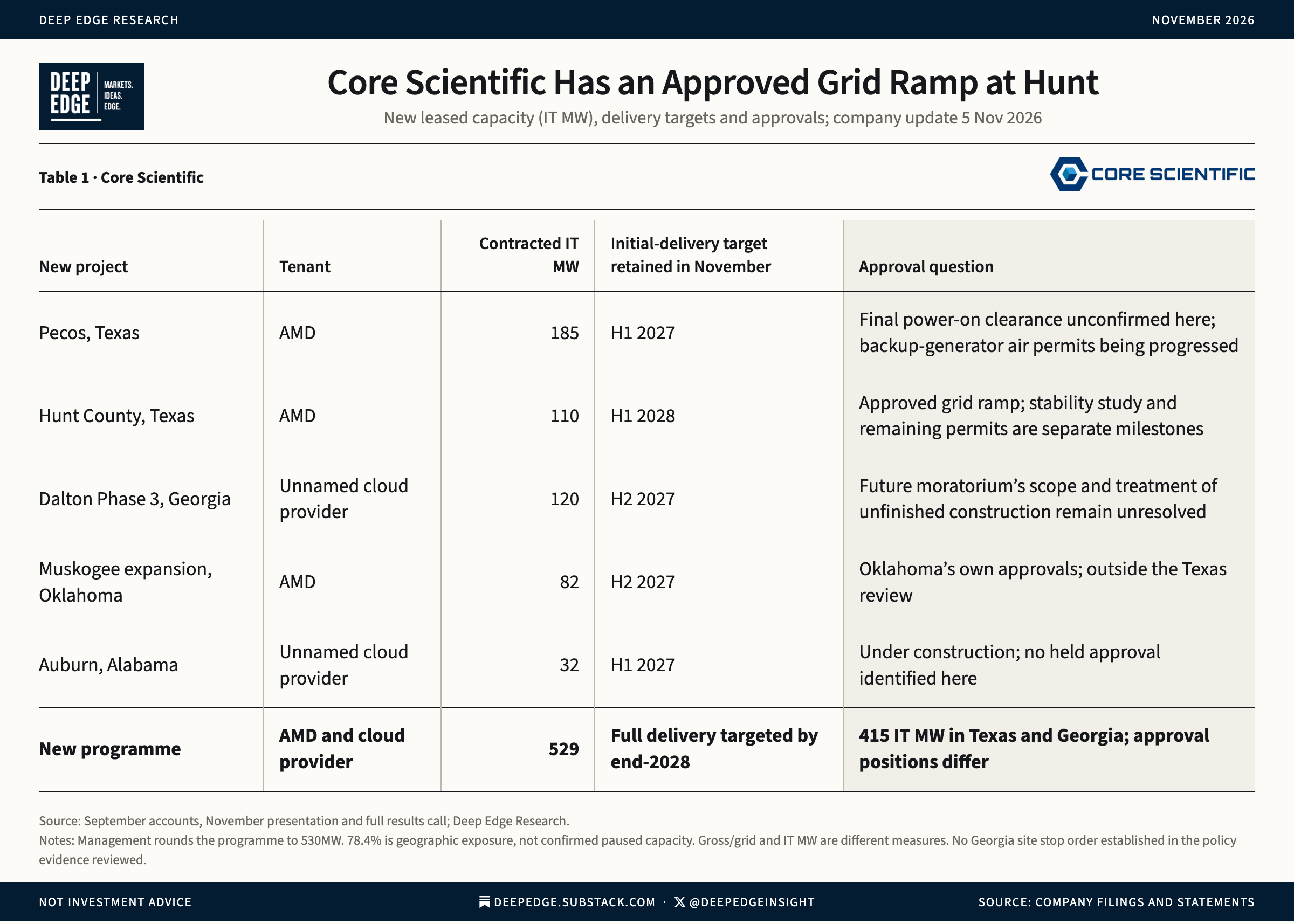
The delivery dates remain intact. Management expects roughly half the new programme to come online during 2027, with the balance during 2028. Its cost assumption remains $11m–$12m per MW, or c. $6bn overall.
Dalton has c. 175 IT MW contracted to CoreWeave and c. 75MW billing, leaving c. 100MW for early 2027. Adding the separate 120MW new lease gives the map’s c. 220MW remaining, rather than Table 1’s new lease alone. The site figures are rounded; the portfolio’s exact remaining balance cannot be assigned mechanically to Dalton.
Dalton Utilities supplies the original campuses. Georgia Power’s rule for new customers above 100MW cannot automatically be applied to that municipal utility. Phase 3’s supply terms need checking, alongside any future statewide measure’s treatment of existing construction. Operating halls cannot exempt every later building beside them.
The map separates those stages across eleven US facilities in seven states. Dalton’s two facilities share one locality marker.
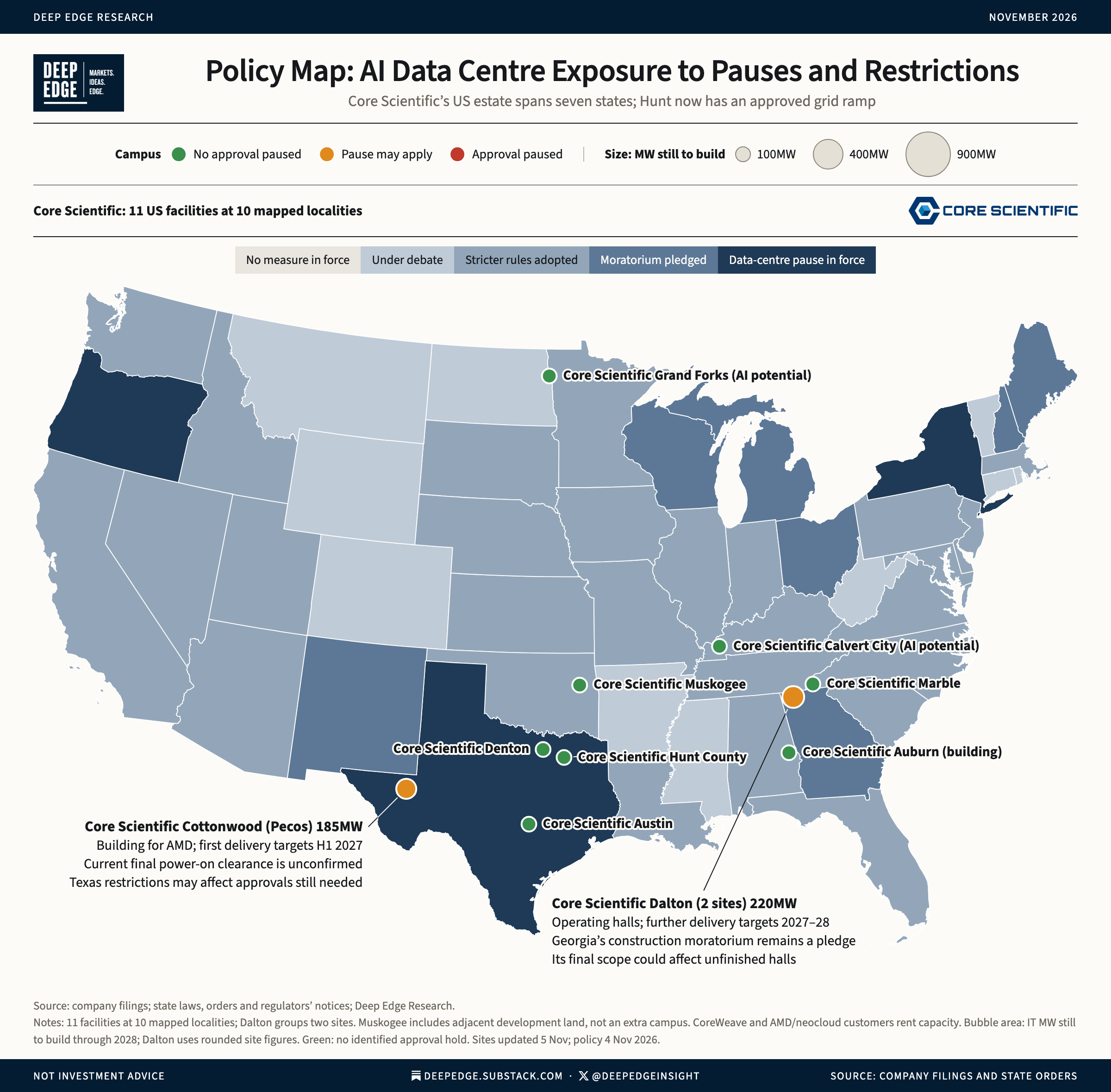
Hunt’s green marker reflects its improved approval position; Pecos and Dalton warrant the next permission checks. Calvert City and Grand Forks are existing campuses with uncommitted AI opportunities. The election question is which decision can still delay rent, rather than how much capacity sits inside each state.
CORZ has invested its share. The project loans are next
Management’s most important financing update is that all required Core Scientific equity for the initial c. 530MW AMD programme has already been invested from cash on hand. It does not expect to issue new equity or equity-linked securities to fund that phase.
Management is arranging the remaining debt, discussing how to package five leases. Project bonds remain the expected route, with other debt options under consideration. The next proof is signed terms and proceeds received.
The distinction changes our earlier funding illustration. On a $6bn programme, 80% debt would leave $1.2bn for other sources across the whole build. Management now says its required contribution is already invested. That illustration must not be read as another $1.2bn still owed. A lower lender contribution or a cost overrun could require more owner money; the terms actually agreed will determine that exposure.
September’s filing reports c. $4.4bn of purchase and construction commitments, including $202m recoverable from CoreWeave: c. $4.2bn net, substantially over 24 months. These cover existing and new developments and overlap the $6bn programme; they are not a second bill to add to it.
Spending has flexibility. Orders can generally be cancelled before delivery and construction contracts terminated, subject to their terms. Work done or in progress and applicable fees remain payable. A slower build can conserve cash without recovering every dollar committed.
The original CoreWeave programme illustrates another constraint. CoreWeave funds specified construction, with amounts recovered through credits against future hosting fees, capped at $1.5m per MW and no more than 50% of monthly base fees under the relevant arrangements. Denton has a separate own-funded portion, and Austin’s terms differ.
That help funds construction, but the tenant recovers its credits from later fees. The CFO also reminded investors that reported CoreWeave revenue spreads future rent increases across the lease term. Property costs, lenders and reserves take cash before the parent can reinvest it. Rising reported revenue therefore strengthens the operating case without proving that the next build can fund itself.
The new programme does not automatically inherit CoreWeave’s construction funding. Management describes AMD’s support for the cloud-provider leases as credit support for the fifteen-year term. The filed summary includes equipment protections, an optional right to cure specified defaults, and rights and obligations upon certain material defaults. It also describes termination conditions. That summary alone does not establish a guarantee of every rent payment or project debt; the executed scope matters.
AMD’s November filing separately reports broader partner lease and debt guarantees without naming CORZ. Those aggregates cannot be assigned to these projects without contract-level evidence.
Who carries the wait?
Core Scientific’s own completion promise remains important.
Core Scientific Finance I LLC is the subsidiary that issued the $3.3bn project notes. For specified original projects, the parent gave an uncapped completion guarantee benefiting those noteholders. It must supply completion funds if note proceeds and other available money are insufficient. The April supplement excludes completed Austin and distinguishes this undertaking from a general guarantee to repay the notes.
CoreWeave’s construction funding is a different promise from a different company. It is not a CoreWeave guarantee of CORZ’s notes. The old parent completion guarantee should not automatically be extended to the new AMD buildings without their financing terms.
If a delay adds costs at an unfinished covered project, the parent may have to pay. The contracts, available project money and relief provisions determine whether a claim arises.
September ordinary cash was $804m, down from $1.77bn at June. A further $838m was restricted, including $348m reserved for debt service. The headline $1.74bn liquidity figure also includes $100m of unused revolving credit and a small Bitcoin balance. It does not represent $1.74bn freely available for the next campus.
Management expects two further sources: c. $650m from existing warrant exercises around January, and c. $300m of restricted cash potentially released when accepted bank letters of credit replace utility cash collateral. Neither was an available September cash receipt. Full exercise of the c. 95m warrants would add nearly 30% to September’s ordinary share count. The rights already exist; this is the cash and ownership consequence of exercising them, not a newly announced share offer.
The sell-off matters here too. The existing warrants have a fixed $6.81 exercise price: falling shares do not change the cash per warrant or the shares issued, but a price below that level would weaken the incentive to exercise. Raising fresh equity at a lower price would require more shares for the same money. Policy uncertainty can therefore affect financing before a particular building is formally delayed.
Table 2 separates the cash already held, the conditional sources and the claims that continue while new buildings wait to earn.
Table 2: The cash claims do not all wait for the new buildings
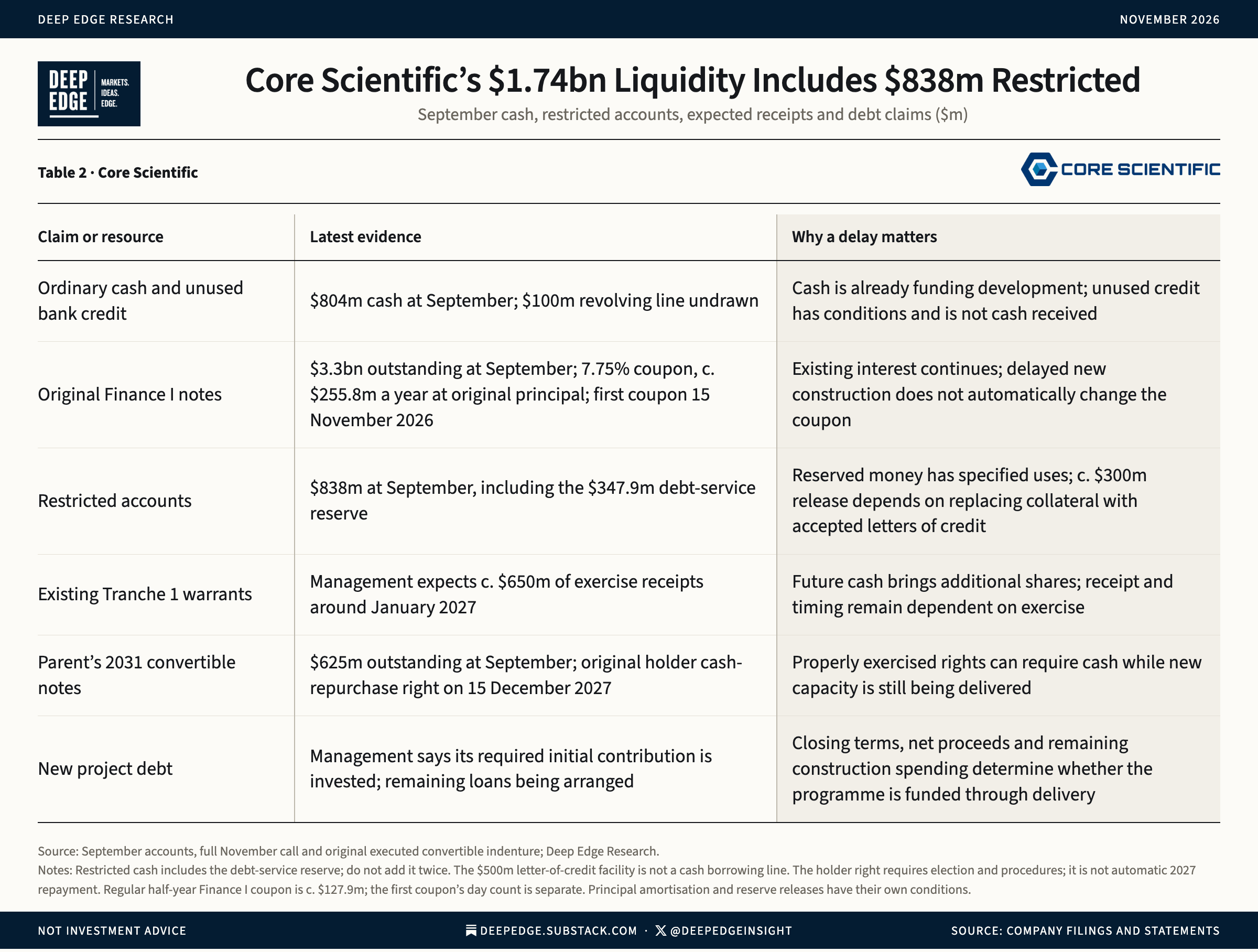
The election does not accelerate the convertible notes. A delay can, however, leave less cash available when holders can request repayment, increasing reliance on refinancing or new capital. The expected warrant proceeds are intended primarily for further development as reservations become contracts; management has not set them aside for that repayment option.
There is a positive case too. Core Scientific has already delivered substantial capacity and has experienced counterparties. If competing projects struggle with approvals, its operating properties could become more useful to customers. But better market rent does not automatically rewrite an existing fixed-fee agreement. Scarcity helps most when it improves a new lease, an expansion or a renewal that the company can actually deliver.
What would change our view?
The results have answered two important questions: delivery has advanced, and management says its initial AMD contribution is invested. The next tests are more specific than waiting for another broad reassurance about Texas.
As project financing is arranged: show signed terms, net proceeds, owner obligations and the remaining spending calendar. The company expects project-level bond financing within the next twelve months; the construction timetable determines when it actually needs the money.
On 15 November: confirm the first Finance I coupon and updated debt-service reserve, separate from construction cash.
Through the Texas review: establish Pecos’s final power-on position and the remaining air permits and energisation steps at both Pecos and Hunt. Hunt’s approved ramp should remain in the starting facts.
When Georgia specifies its policy: distinguish original Dalton work from the new Phase 3 lease, and establish how existing construction and municipal-utility service are treated.
Around January’s warrant expiry: establish cash received and shares issued, rather than counting the expected c. $650m in advance. Separately confirm any utility-collateral release.
Through the 2027 delivery programme: show collected rent and cash that can leave completed properties after credits, costs and lender claims.
Ahead of 15 December 2027: update the put-eligible notes outstanding and the cash or refinancing plan if holders elect repayment. An equity conversion assumption cannot replace that plan.
Our conclusion: today’s sector-wide sell-off makes the policy question immediate, but it does not make every project equally exposed. Core Scientific has improved Hunt’s approval position and paid its required initial contribution, according to management. We would judge the remaining risk by Pecos’s permissions, Dalton’s treatment under any new rules, and the financing actually closed. If those steps take longer, later rent and weaker access to capital can leave shareholders carrying more of the wait.
References
September financial statements, filed 5 November: Hunt’s approved interconnection ramp, site-specific regulatory exposure, current cash restrictions, outstanding debt, warrants, construction commitments and financing plans.
5 November results release, November presentation and complete earnings-call transcript, including Q&A: billing capacity, site delivery, cost assumptions, owner contribution already invested, financing still being arranged, outstanding permits, anticipated warrant cash and its intended use. Call statements are management’s assessment, not independent permit or financing certificates.
10 September power update: Denton exclusions and earlier conditional positions. November’s Hunt ramp disclosure supersedes its older classification warning.
April project and licence supplement: Dalton Utilities, project entities, construction support, fee-credit exceptions and parent completion guarantee. November billing figures supersede older remaining-capacity estimates.
June financial statements, July presentation and issuer prepared remarks: original new-lease allocations and c. $6bn programme. Current financial and delivery claims use the November update.
AMD’s September-quarter accounts, filed 4 November, Note 8: aggregate lease/debt guarantees, without named CORZ allocation. This does not identify the funding of a particular new CORZ building.
Original 2031 convertible indenture, Section 4.03: separate holder cash-repurchase right, not an automatic 2027 repayment. September accounts establish the outstanding principal.
Abbott’s August audit announcement, September TCEQ directive, ERCOT September notice, Hinojosa’s proposal and AP’s Texas race call: existing measures, report expectation and future policy, checked to 4 November.
Bottoms’s published pause position, AP’s Georgia race call, CBS’s election projection and Georgia PSC’s existing utility-specific rule: pledge, election and existing Georgia Power tariff are different facts. Policy evidence to 4 November; refresh before publication if new orders appear.
Reuters’s 5 November sector report and Schwab’s election commentary: election-related AI infrastructure concerns. Yesterday’s rounded moves reproduce our 4 November post’s snapshot. The two-session losses use Financial Modeling Prep quotes at 18:20 London on 5 November divided by each company’s 3 November closing price, rather than adding daily percentages or mixing the post’s snapshot with a later close. These are intraday cumulative returns; the policy interpretation is ours.