
Evidence to 30 October 2026. For informational purposes only. Not investment advice.
On paper, Oracle Corporation’s (ORCL) free-cash-flow deficit is $5.4bn for the August quarter, modest beside the shortfalls at Google and Amazon.
However, strip out the cash contribution from customer financing advances and that gap grows to c. $17bn.
Customers have paid $11.4bn ahead of service, making Oracle’s current cash position look stronger than it would be without those early payments.
The scale of the build explains why that dependence matters. Across five US campuses we track, projected additions would take capacity to about 9.5 times the estimated operating footprint. Most of that expansion still needs completed buildings, computing equipment and power before it can earn service revenue.
Building that capacity is a different financial task from selling more software through infrastructure already in place.
Oracle Cloud Infrastructure rents computing capacity to customers. To supply more of it, Oracle and its partners have to put money into physical assets first, then recover that investment from the service those assets deliver.
The spending is already accelerating. Oracle invested $28.5bn in buildings and equipment in its August quarter, compared with $8.5bn a year earlier. Its existing database, application, support and cloud businesses supply cash, but investment has grown faster.
Oracle is getting customers to help fund the wait. Financing advances supplied about half the quarter’s operating cash. Some customers also supply their own graphics processing units (GPUs), the accelerators used for AI computing. Property investors finance buildings that Oracle rents, while equipment suppliers can let it pay later.
Management’s plan calls for the additional $20bn of capital through fiscal 2030, excluding ordinary debt refinancing. It can contemplate a raise of that size because customers and partners are carrying substantial parts of the upfront bill, alongside Oracle’s own cash and capital already raised.
Our judgement: Oracle is further from self-funding than its reported deficit suggests. The $20bn capital raise launched on 2 November relies on customers and partners continuing to supply money until the new capacity pays its way. If fresh advances slow before service cash improves or spending falls, we expect Oracle to return to the market for more capital. It cannot collect the same prepayments twice, yet it still owes the service. Construction delays can make that pressure worse where bills keep running but new customer receipts arrive later.
TLDR
The $5.4bn cash shortfall already benefits from customer financing. Without the cash-flow contribution from $11.4bn of financing advances, the same quarter’s deficit would have been c. $16.8bn. Oracle still owes the prepaid service.
Much of Oracle’s selected capacity is still to be built. The operating estimate is 618MW at Abilene. Expansions and four new US campuses add a projected 5,246MW through 2028, with most arriving in 2028.
Customer money covers 54% of capex in the funding comparison. That combines financing advances with other deferred-revenue cash. The financing advances alone supply about half Oracle’s operating cash; they are not the whole customer-money segment.
The $20bn funding target depends on continuing support. Customer-owned equipment, supplier credit and landlord-funded buildings reduce or defer Oracle’s upfront bill. If fresh advances slow before service cash improves or spending falls, more investor capital may be needed.
Funding the build is the first test. Part 2 examines whether it earns enough and how much room remains for error. Part 3 follows the interest, balance-sheet and off-balance-sheet exposures shareholders retain.
How to read this series
This is a three-part investigation into Oracle’s AI expansion. Each part answers a question the preceding analysis leaves open.
Part 1 (This Part): What is Oracle building, and how is it funded? We establish what already operates, what is being expanded and what still needs construction. We then examine Oracle’s customer-funded model and compare it with its competitors.
Part 2: Do the economics work? We test what the investment earns, what management must deliver and how much disappointment the return can withstand.
Part 3: What risks do shareholders carry? We examine interest and repayment demands, balance-sheet exposure and commitments outside the headline debt figures, following the parties that fund the campuses and expect payment from Oracle.
Here, we begin with the assets the money is meant to support. Oracle’s financial statements cover the quarter to 31 August 2026. Campus estimates retain the 30 October cutoff; the capital-raising update is separately dated 2 November.
1. What Oracle is building, and what still needs funding
An operating data centre and a new construction site make different demands on cash. The operating centre can already serve customers, although rent, running costs and equipment replacement continue. An expansion needs more money before the extra capacity earns. A new campus has a longer sequence to complete: buildings, power, equipment and customer acceptance.
Table 1 separates those stages. Capacity is measured in IT megawatts (MW): power available to the computing equipment, excluding cooling and other facility overhead. This gives us a measure of physical scale, rather than a value for the equipment or the cash it generates.
Table 1: Oracle’s operating capacity and the build still ahead
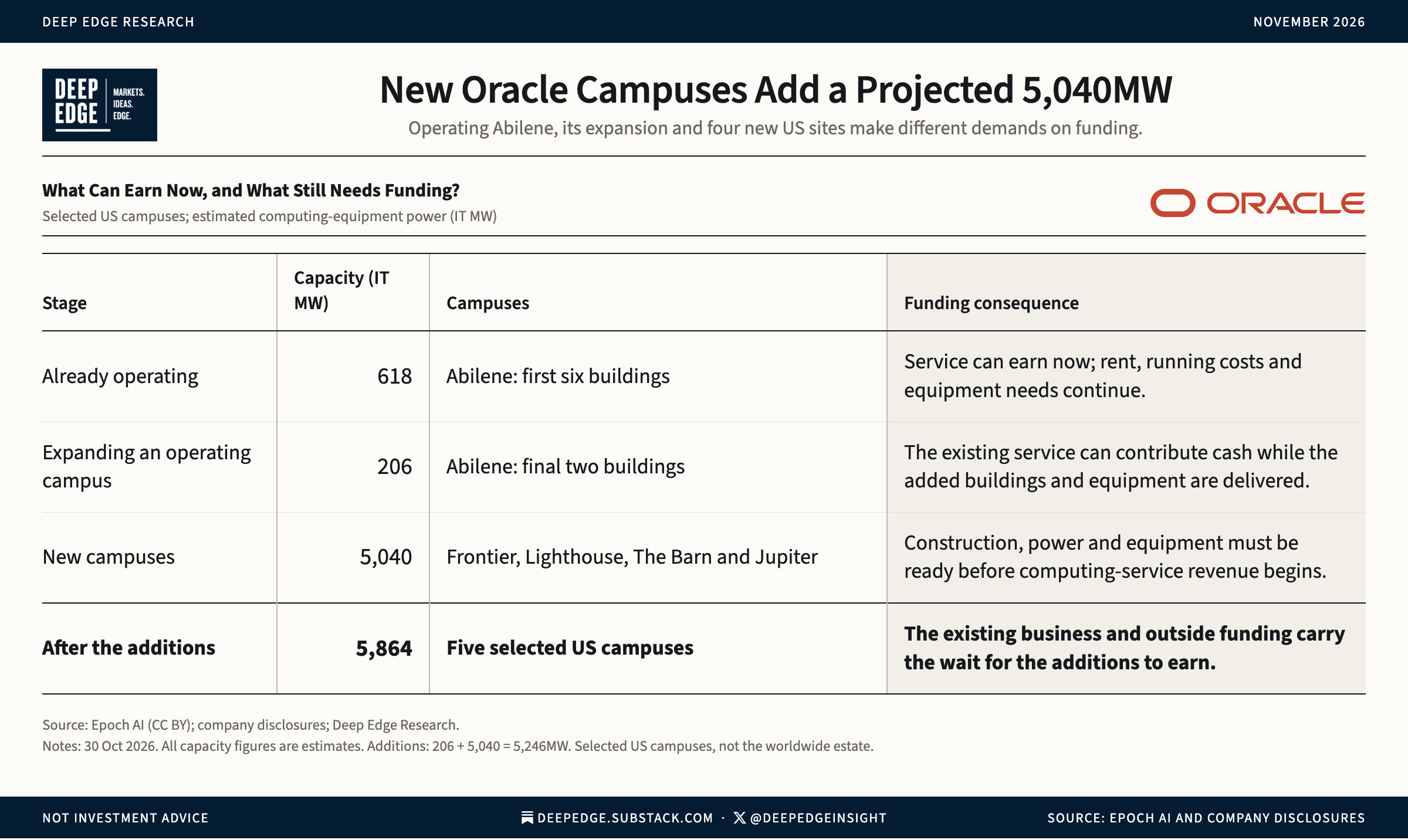
Oracle reports 618MW delivered without specifying its power basis; the IT-power estimate comes from the campus model.
Abilene shows why an operating campus can still need funding. Its first six buildings can serve customers while the final two require more equipment and delivery work. The four new US campuses have further to go before they can earn, and account for nearly all the additional capacity.
The existing business can help pay for expansion, but it also has its own rent, running costs and equipment needs. The funding test is how much cash remains for a much larger next phase.
The scale is large. The biggest phase comes later.
Figure 1 shows when those additions are projected to arrive. Abilene’s expansion and Frontier’s first phase add 626MW through end-2027. A further 4,620MW is projected during 2028. Together with the operating baseline, that produces 5,864MW, or about 5.9 gigawatts. One gigawatt equals 1,000MW.
Figure 1: Oracle’s selected capacity ramp through 2028
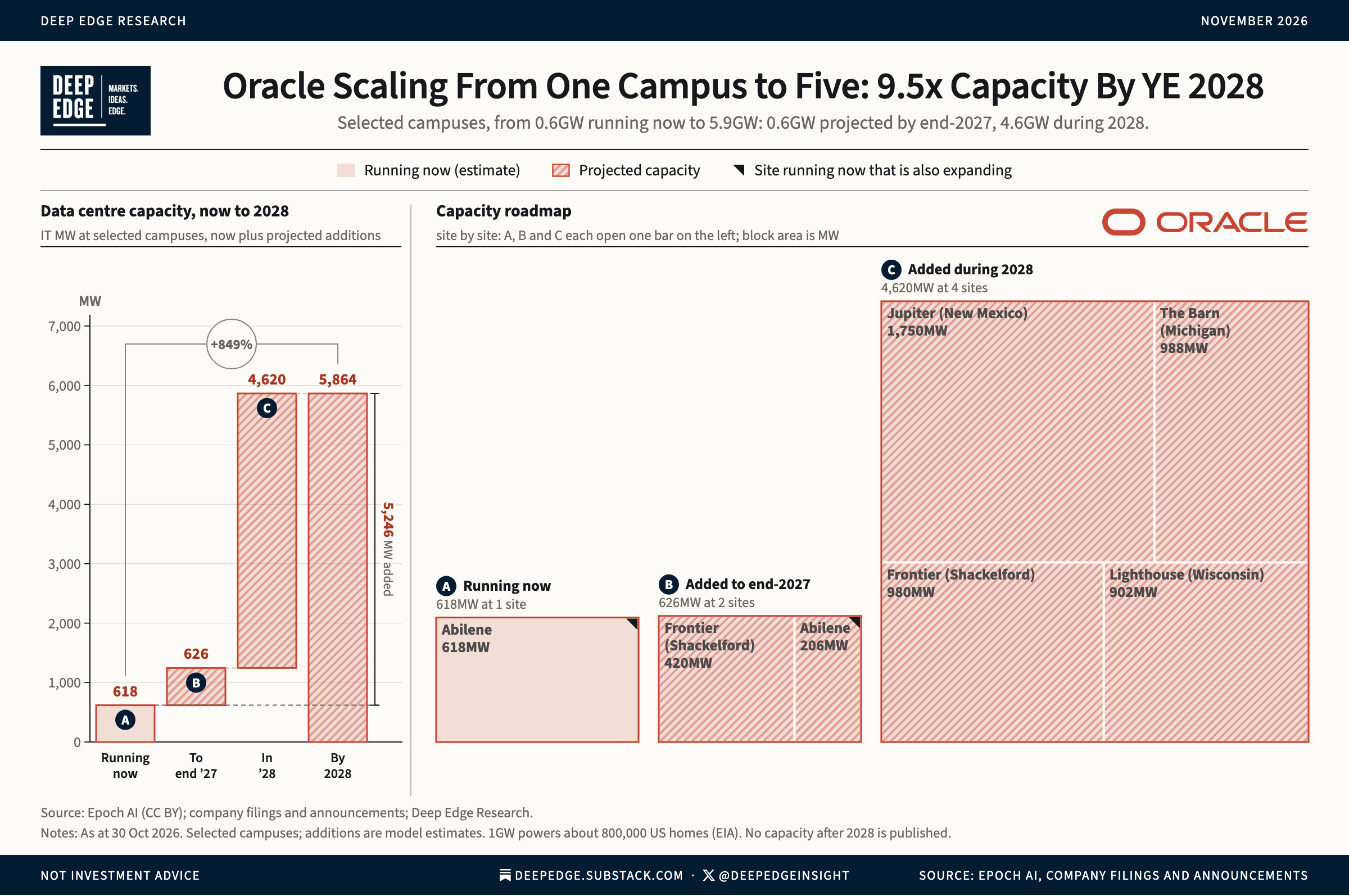
About 88% of the selected additions arrive during 2028. Oracle and its partners need to pay for work before that capacity can contribute service revenue. Customers can help bridge the interval by paying early; operating buildings can also collect while later phases are completed.
OpenAI has agreed to buy up to 4.5GW of additional Oracle capacity. That gives Oracle a substantial reason to build. It does not make every megawatt in the chart OpenAI’s capacity, or make a signed purchase the same as collected cash. The individual sites have different owners, delivery schedules and funding arrangements.
What still has to happen at the campuses?
At Abilene, the funding model has already reached the operating stage. Outside investors financed the buildings, Oracle is serving its customer and rent has begun. The service can contribute cash while the remaining buildings are completed and equipped.
The new campuses have further to go. Table 2 puts the construction evidence beside the next capacity milestone and the party carrying the upfront build. A closed property financing supports construction, but Oracle still needs a finished, powered campus with computing equipment ready for its customer.
Table 2: The campuses still needing construction and commissioning
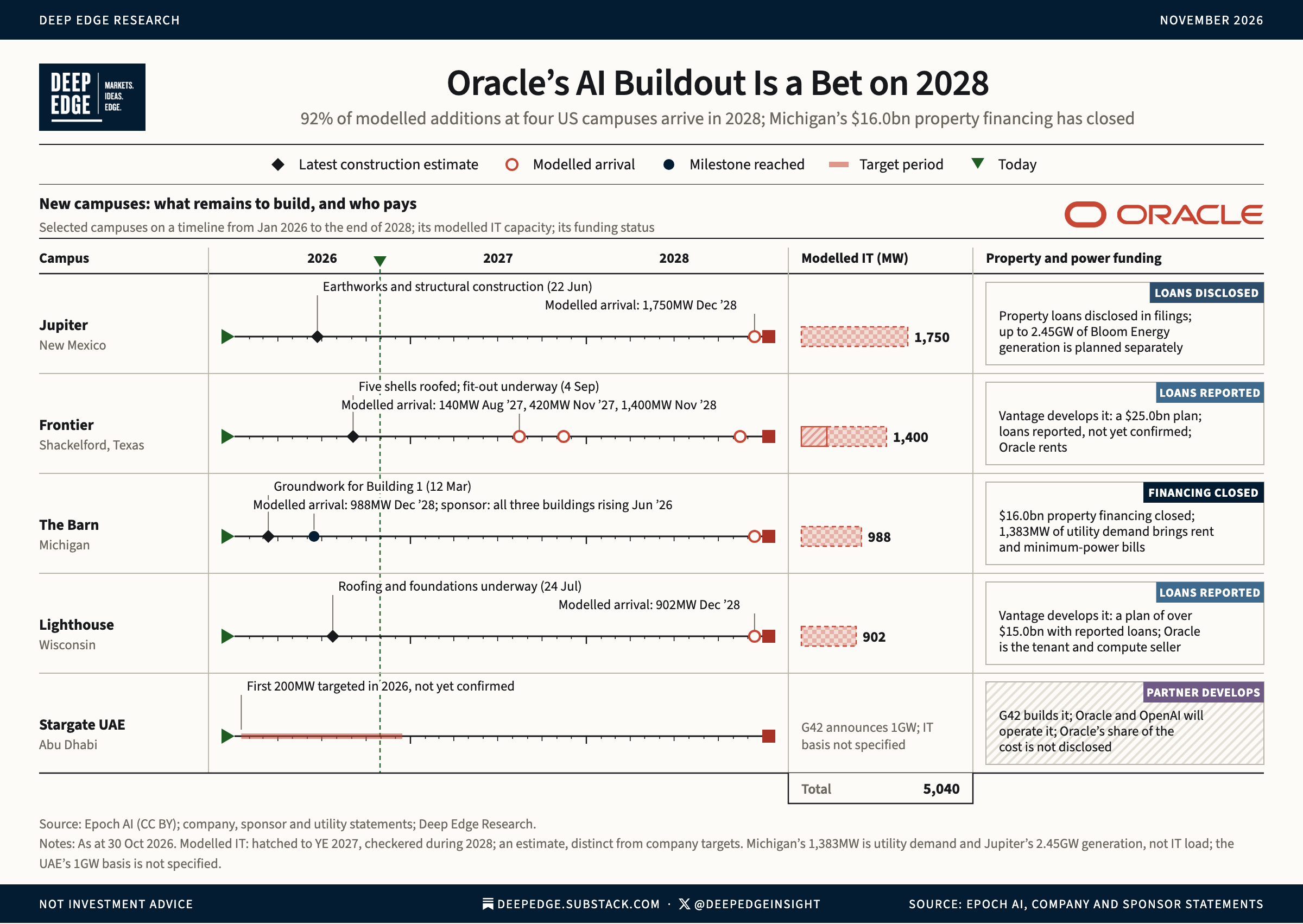
UAE is outside the five-campus US total. Reported Vantage loans are distinct from verified executed financing or cash drawn.
Michigan has secured its property financing. Its next task is delivery, including equipment and power. Jupiter’s property development and separate power system need to come together. Frontier and Lighthouse have reported financing arrangements alongside construction still to complete.
Looking at the four new US campuses alone, 92% of their projected capacity arrives in 2028. The 88% in the capacity ramp includes Abilene’s expansion as well. Both show the same issue for funding: most of the additional capacity comes late in the period, while construction needs paying for earlier.
Oracle’s own equipment spending sits alongside this property work. Some buildings are funded by landlords, some equipment can belong to customers and some purchases can be paid for later. The capacity totals therefore cannot be turned into Oracle’s borrowing requirement by assigning a single cost to each megawatt. We need to follow who buys what and when each payment falls due.
2. How Oracle funds the build, and how it compares to other hyperscalers
The size and timing of that programme explain the need for funding before it earns. Oracle’s August accounts show $28.5bn of capital expenditure, or capex, against $23.1bn of operating cash. Capex buys longer-lived assets such as buildings and computing equipment. Operating cash is what the business generates after day-to-day costs and changes in customer payments and other unpaid bills.
Subtract the investment bill and Oracle had a $5.4bn free-cash-flow shortfall. A year earlier, operating cash almost covered investment. Both have grown since then, but investment grew faster. The shortfall needs reserves or another source of money.
Oracle’s row in Table 3 shows how important customer payments have become. The panel separates those payments where the accounts disclose them, then shows new debt and share proceeds alongside the cash gap. It covers whole companies, including spending outside AI; it does not trace each capital raise to a particular campus.
Table 3: How the hyperscalers cover capex and raise capital
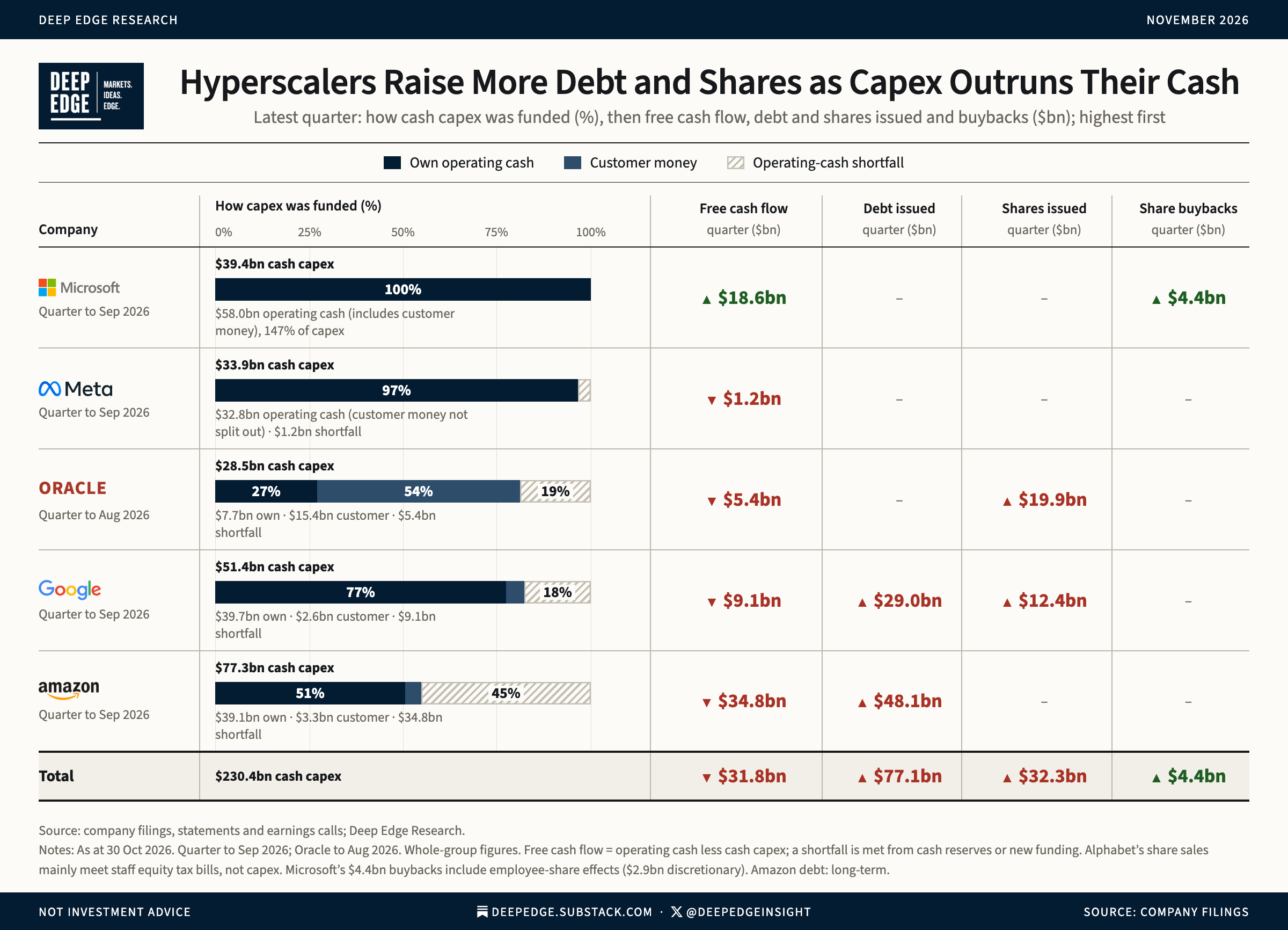
Gross cash capex is before separate lease repayments; percentages allocate cash, rather than trace its use.
Oracle: what the 54% customer-money segment means
The customer-money segment represents $15.4bn against Oracle’s $28.5bn investment bill. It combines two different contributions to operating cash:
$11.4bn of financing advances: customers paid before receiving the service. This is the clearest evidence of customers financing Oracle’s wait for delivery, and it supplied about half the quarter’s operating cash.
A separate $4.0bn contribution from other deferred revenue: payments received before the related sales were recognised. This includes ordinary business payments, so it cannot all be treated as funding for AI construction.
Together, they cover about 54% of capex in the comparison. The remaining operating cash covers about 27%; the uncovered 19% is the $5.4bn shortfall. These percentages show the importance of each cash source without claiming that particular receipts paid particular equipment invoices.
The effect of the financing advances is substantial. Remove their cash-flow contribution and the remaining $11.7bn of operating cash covers 41% of capex, rather than 81%. Against $28.5bn of investment, that leaves a c. $16.8bn deficit instead of $5.4bn. Remove the other deferred-revenue contribution too and coverage falls to 27%. The wider business is generating more cash than a year ago, but customers paying early are carrying much of the larger investment bill.
That support has a cost. Oracle still owes the prepaid service. Its accounts identify a financing component, so it records interest on the advances, although that interest was immaterial in this quarter. A delivery failure can also create refund exposure where the customer’s contract provides for it. Oracle’s public cloud services agreement permits a refund of unused prepaid fees after a service-warranty failure it cannot correct. The specific AI agreements determine the rights attached to these advances.
Prepayments bring forward cash for future service. Oracle cannot collect those same payments again when it delivers that service, although delivery still costs money. Its accounts already record the service still owed as a liability, called deferred revenue. If construction slips, the service remains owed and new collections can arrive later than rent or other bills that cannot be deferred. Further advances can help fund the wait, but they also add more service to deliver.
Customers can reduce the equipment Oracle has to buy
There is another route beyond paying early. In June’s results, Oracle disclosed $75bn of AI contract value backed by prepayments or customer-supplied hardware.
Customer-owned GPUs reduce the equipment Oracle itself must purchase. Oracle provides the surrounding infrastructure and service, with a smaller investment of its own. It also earns less revenue in management’s customer-owned-equipment example. Prepayments put cash in its hands; customer-supplied hardware reduces its cheque. The $75bn is contract value across both routes, not $75bn of cash collected, and it cannot simply be added to the August advances.
Supplier credit works differently again. It lets Oracle pay for equipment later, but Oracle still has to repay the supplier or financing provider. Landlords finance buildings in exchange for rent. These arrangements spread the upfront investment across several balance sheets while leaving Oracle with future service and payment obligations.
The landlord contribution also leaves a substantial future bill. Oracle’s accounts disclose $288bn of rent on leases that have yet to start, generally running for 15–19 years once they begin. Those are future payments across the group, rather than cash due today. The buildings can be financed elsewhere while Oracle commits to paying for their use. Part 3 examines the risk that remains with shareholders under those arrangements.
That is why a large physical expansion can require a smaller capital-market raise than the headline equipment bill might suggest. The rest of the bill has other funders, and their terms matter.
Where the new $20bn fits
Oracle already raised $19.9bn net through its completed share-sale programme in the August quarter. That cash is in Table 3. The proposed $10bn share offering and concurrent $10bn senior-note offering, launched on 2 November, are separate and come after the reported quarter.
Those two offerings match the additional capital in management’s Investor Day plan through fiscal 2030. If both complete at those sizes, Oracle will have raised that planned bridge upfront. They are not another $20bn on top of the same plan; ordinary debt refinancing remains outside it.
Management expects customer contributions, supplier financing and landlord-funded property to carry much of the remaining investment, alongside cash from Oracle’s businesses. Its $20bn target therefore assumes those routes keep supplying support until service cash improves and investment spending falls. If advance inflows weaken first, Oracle must draw more heavily on reserves, slow spending or seek additional capital. Completing the proposed raise would meet management’s capital-raising target while leaving its dependence on those other funding sources in place.
New shareholders also share future earnings, and the new notes add interest and repayment claims. The money improves Oracle’s ability to build. Shareholders still need the resulting service to earn enough to justify the cost of obtaining it.
Funding update: 2 November 2026. The inspected offering documents are preliminary. Proposed proceeds are separate from cash received; final pricing and settlement are not established by those documents.
How that compares with the other hyperscalers
Oracle’s dependence on customer cash is the main distinction in this panel. Its reported operating cash covers 81% of capex, close to Alphabet’s 82%. But Oracle’s disclosed customer-payment contributions cover 54% of investment, compared with 5% at Alphabet. Similar overall coverage can therefore conceal very different sources of support.
Microsoft Corporation (MSFT) has a stronger current cash position: operations covered its whole investment bill and left an $18.6bn surplus. It also priced $25bn of notes after the quarter shown. That surplus gives it more choice over when to raise money for future needs.
Amazon.com (AMZN) has the largest shortfall in the panel and issued the most debt. Alphabet (GOOGL) combines borrowing with share-sale cash, though its quarterly market-sale programme mainly meets employee-equity tax obligations. Meta Platforms (META) has a small shortfall without new debt or share proceeds in that quarter; previously raised cash can still support spending.
Those comparisons show why the mechanism matters as much as the size of the gap. Oracle gets substantial support before service arrives, then owes delivery. Other companies rely more heavily on their existing cash engines, borrowing or reserves. All need the completed investment to produce enough cash and profit for the claims it leaves behind.
What the funding tells us, and what it does not settle
We can now connect the build with the capital raise. Oracle has an operating base at Abilene, an expansion alongside it and four new US campuses making up most of the selected capacity still to come. The largest phase is projected for 2028. Customers, equipment providers, landlords and Oracle’s own businesses help pay for that interval, with new investor capital supplying another part of the bridge.
Customer and partner funding makes the expansion more plausible, but Oracle’s $5.4bn shortfall comes after customers have already helped finance it. Without the advance contribution, the quarterly gap would have been c. $16.8bn. We therefore see the $20bn target as dependent on continuing support, with a material risk of further fundraising if fresh advances slow before the business can fund the build itself.
At the next results, covering the quarter to 30 November, we will compare investment coverage with and without financing advances against the current 81% and 41%. We want the c. $16.8bn gap excluding advances to narrow as completed capacity earns and collects. A better headline cash-flow figure driven only by larger advances would leave Oracle more dependent on customers financing the wait. Better coverage caused only by slower construction would tell us less about whether the programme is working.
Part 2 tests what that finished capacity must earn. We examine whether Oracle’s equipment economics work, what sales and margins management must deliver, and how much room remains for a delay or a miss. Raising the money gets Oracle closer to delivering the service. The return test establishes whether doing so rewards its shareholders.