
In Part 1, we explained how debt is funding much of the construction, with future rent expected to repay it. In Part 2, we showed why an attractive property yield does not automatically become an attractive shareholder return.
Now we follow where that rent goes, and what happens if delivery or customer payments disappoint and crucially, how much protection does it actually give Cipher’s shareholders?
Cipher Digital (CIFR) has secured the money to finish its three contracted AI properties. It has Amazon as a tenant and Google supporting specified obligations of another tenant.
But this is where project financing gets tricky: Google’s backing is not free. Cipher gave Google rights to buy shares for one cent each, with a promise that those rights would have a minimum total value of $435m.
If their value falls short at the contractual test, Cipher must make up the difference with cash, more shares or a combination.
At the Ciphers current $7.29 price used in our analysis, that means about $244m of extra value. Paid entirely in cash, it would consume roughly a third of management’s $724m cash figure. Paid in shares, it would leave more owners dividing the eventual return. The actual test price and settlement remain unconfirmed.
And that sits alongside the lenders’ claims on project rent, money reserved inside the properties and Cipher’s own promises to finish construction.
Our judgement: Google and Amazon help make Cipher’s rental contracts financeable. But they have not taken every risk off shareholders’ hands. Rent must meet project bills and lender payments before it can reach the parent, while completion obligations and the price of Google’s backing remain with Cipher. Getting the buildings funded is real progress. What shareholders ultimately keep is the key question.
TLDR
Google’s protection has a price. The $435m minimum includes the value of its existing warrants. A shortfall can require extra cash or shares; it is not an established $435m cash bill.
The c. $244m illustration is a scenario, not today’s invoice. It uses a hypothetical contractual average of $7.29. The actual test date, averaged price and settlement need confirmation.
The guarantees protect different things. Google supports specified first-term Fluidstack obligations. Amazon covers specified tenant payments and eligible construction costs. Neither guarantees Cipher’s entire debt or shareholder return.
Rent has prior claims. Three project borrowers raised about $4.5bn between them. Project costs, debt payments and reserves come before freely distributable owner cash.
Cash preserved through shares still has a cost. October’s debt exchange helped avoid a cash repayment, but increased the share count. Ordinary shareholders receive what remains, divided among the owners then outstanding.
How to read this series
Part 1 established what Cipher is building and who pays. Part 2 tested the economics, delivery requirements and room for error. Here we follow the relationships behind those answers: who gets paid, what support applies, and who carries a setback.
The map comes first. We follow Barber Lake on the left, Amazon’s two properties on the right, then the obligations at Cipher’s parent below. That shows who gets the rent, what the tenant protection covers and what remains for shareholders. We use September accounts, October transactions and the 2 November presentation and complete call; the share-price illustration remains dated 30 October.
1. Follow the rent before following the shareholders
Cipher owns and develops the properties. Tenants pay rent; they or other equipment owners supply computing systems. Three separate project borrowers raised money against that future rent, while the parent supplied capital alongside them.
Figure 1 connects those parties. On the left, Google supports specified obligations of Barber’s initial Fluidstack tenant; a separate arrow runs back to Google for Cipher’s warrant-value promise. On the right, Amazon’s payments support Black Pearl and Stingray, each with its own borrowing. Below those properties, Cipher has its own financing, completion promises and supplier bills. Solid arrows show money already paid or lent, dashed arrows future commitments, and dotted arrows conditional payments or releases.
Figure 1: Who funds Cipher, and what its money must carry
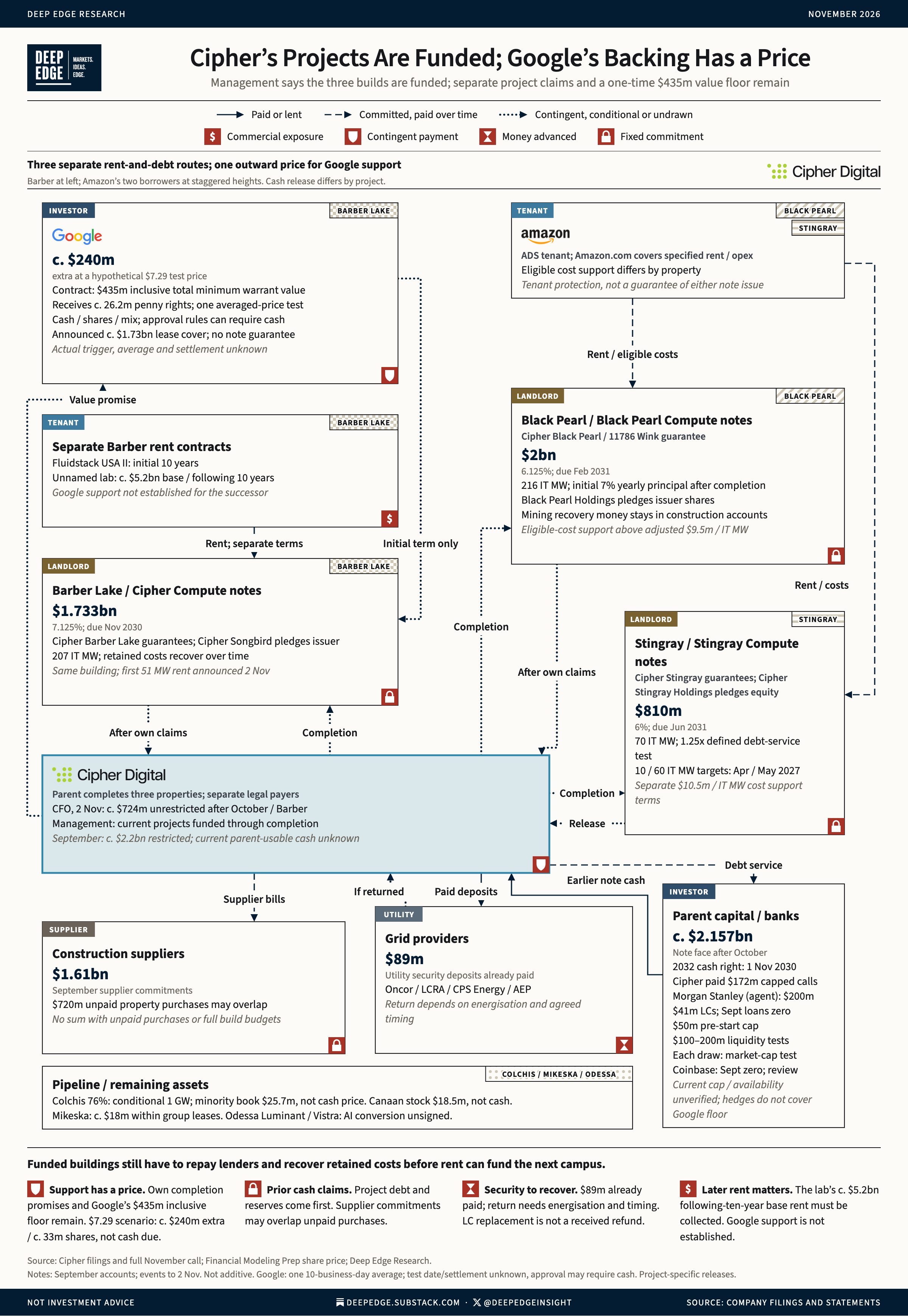
Start with Barber on the left. Its $1.733bn notes pay 7.125% interest and mature in November 2030. Across on the right, Black Pearl’s $2bn pays 6.125% and matures in February 2031; Stingray’s $810m pays 6% and matures in June 2031. Each has its own security, repayment schedule and cash restrictions.
Those restrictions matter even when tenants pay. Black Pearl initially repays about $140m of principal annually after full completion, alongside interest. Its reserve requirements also hold money back. Stingray uses a different repayment formula. Cash can be working exactly as lenders intended while remaining unavailable for another Cipher campus.
The blue Cipher box is where the retained obligations come together. Its parent has separately promised completion funding under the project terms. If defined project resources cannot cover completion, that undertaking can require more parent money. It is distinct from a general guarantee to repay every project note.
So rent supports the properties and their lenders first. The tenant guarantees help protect that income, but their scope determines how much protection reaches the owner.
2. What Google and Amazon actually protect
Google: specified Fluidstack obligations at Barber
Google’s agreement supports specified obligations of Fluidstack USA II, Barber’s initial tenant. The announced support of up to c. $1.73bn is a contingent commitment, not construction cash received by Cipher.
If a qualifying default occurs, the contract provides a replacement-tenant process before Google’s election. That can lead to taking over the lease, paid deferral or a permitted termination payment. Replacement and settlement can take time; every remaining dollar of rent is not automatically paid immediately. Redacted schedules limit what we can establish about exact recovery.
Barber’s later AI-lab commitment is separate. It adds another ten-year period at the same 207 IT megawatts, rather than another building. Google’s support for that successor period has not been established. A twenty-year income story therefore cannot simply inherit ten-year tenant protection throughout.
Amazon: covered rent and property-specific cost support
At Black Pearl and Stingray, Amazon Data Services is the tenant. Amazon.com guarantees covered tenant obligations, including specified rent and operating payments. Eligible construction costs also have support under each property’s terms.
Black Pearl’s protection applies above an adjusted $9.5m-per-IT-megawatt allowance, with exclusions including landlord negligence or wrongful acts. Stingray’s stated threshold is $10.5m, under separate terms. Neither is an unlimited commitment to pay whatever Cipher spends.
These arrangements transfer real risks to the hyperscalers. Calling everything off their books would miss those promises. But Amazon does not guarantee either project note issue, and Google’s agreement does not insure the whole Cipher group.
That leaves the next question: what did Cipher give up to obtain the backing?
3. Google’s backing can take cash or more shares
Google received warrants, rights to buy Cipher shares for one cent each. After October’s actual debt-for-share exchange, the underlying warrant count increased by about two million, giving approximately 26.2m base shares for our sensitivity.
The contract protects $435m of total warrant value at a one-time test. If the base warrants are worth less, Cipher supplies the difference. That floor includes their value; it is not $435m on top of the warrants.
Table 1 shows how the contractual average price changes the extra value required. The bold row uses the 30 October close only as a hypothetical average. Cash and shares are alternative ways of meeting the same shortfall.
Table 1: Google’s value promise can use cash or increase the share count
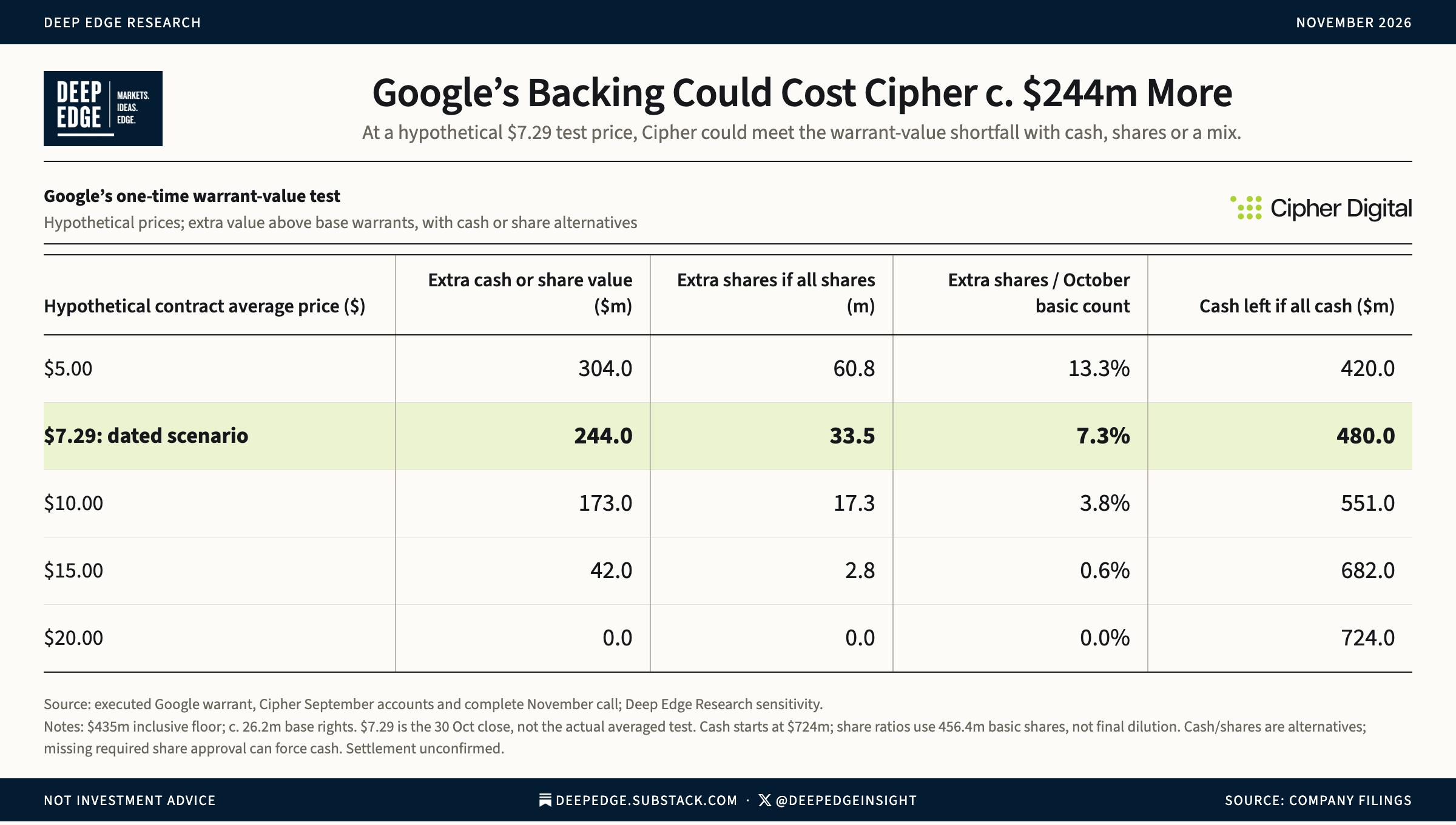
Source: executed amended warrant, September accounts and Deep Edge Research. Shortfall = maximum of zero or $435m less 26.2m × hypothetical price. Cash starts from management’s later $724m, assuming the illustrated shortfall remains outstanding and unprovided for. Share percentages compare extra shares with October’s 456.4m basic shares; they are not final ownership-dilution percentages.
At $7.29, the extra value required is about $244m, rounded to c. $240m on the map. Meeting the promise entirely in cash leaves about $480m, before other new uses. Paying entirely in shares adds about 33.5m shares, on top of the base warrants. At $15, the extra value falls to $42m; above roughly $16.60, it disappears on this approximate base.
Cipher chooses cash, shares or a mix, subject to the terms. Where share issuance needs shareholder approval that has not been obtained, the contract requires cash instead. Cash payment is due within three business days under the clause.
The actual test uses a ten-business-day volume-weighted average ending two business days before valuation. It occurs immediately before the exercise period begins, linked to defined Phase I commencement or its outside completion date. First rent from 51MW does not by itself establish that contractual trigger. We have not confirmed the measurement or settlement.
So a lower test price leaves Cipher with a harder choice: use cash needed for growth, or issue shares that reduce existing owners’ share of future returns. The support helps finance the building, while its price remains with Cipher and its shareholders.
4. Where a setback lands
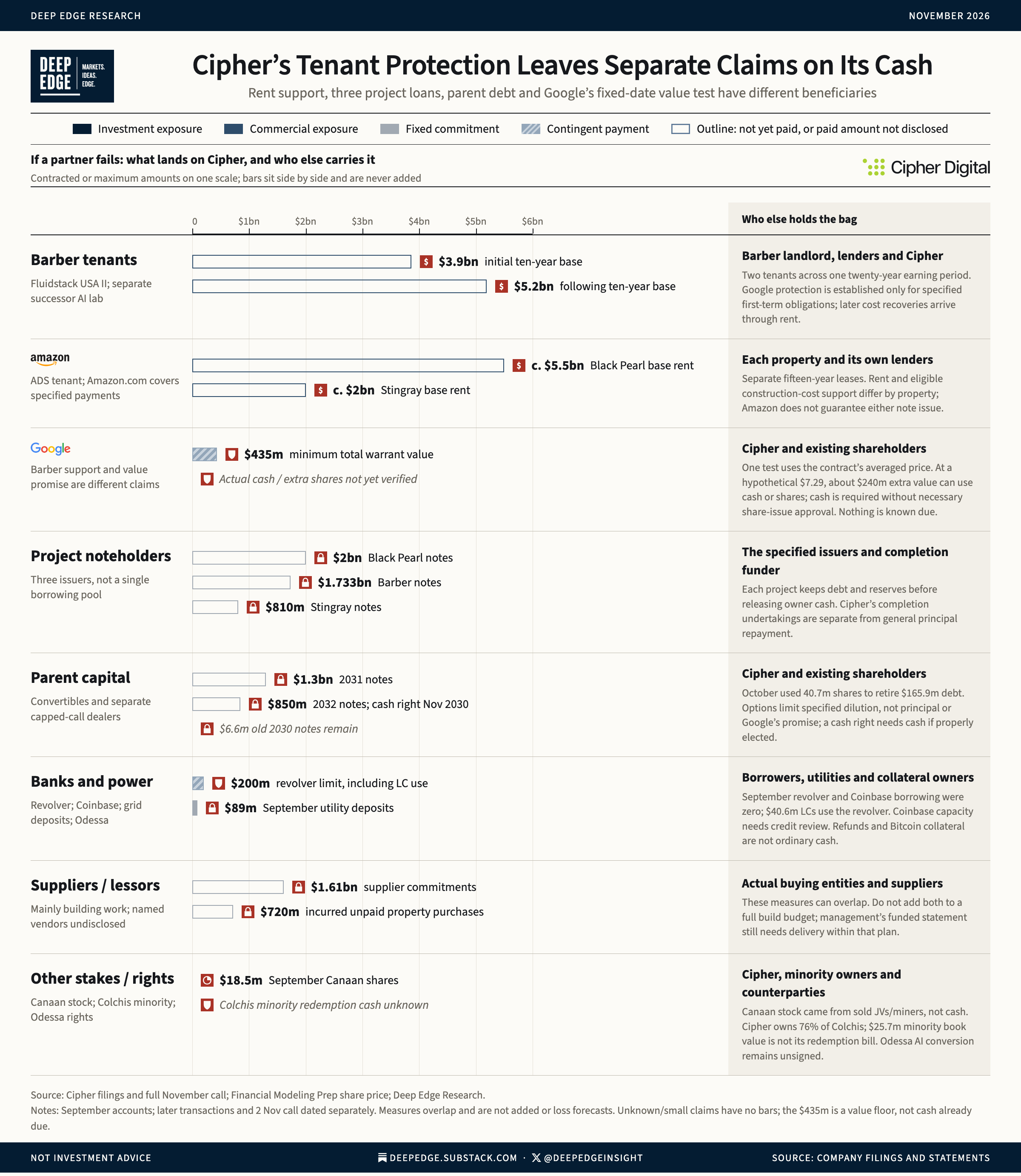
That price sits alongside several other claims. Figure 2 separates them by beneficiary and consequence. Its bars compare contractual scales; adding rent, borrowing and guarantees would count financing of the same buildings as separate demand.
Figure 2: Tenant protection leaves separate claims on Cipher’s cash
A late or more expensive building
Cipher retains completion duties and costs outside tenant protection. Delays can postpone rent while construction and interest bills continue, subject to the contracts’ remedies. Recovering some overruns through twenty years of rent also leaves an upfront financing need.
September’s $1.61bn supplier commitments and $720m of incurred unpaid property purchases show the construction obligations involved. They can overlap and form part of completion budgets, so we do not add both as fresh bills on top of management’s funded plan.
Cash reserved for properties, and debt coming due
Project cash remains subject to permitted uses and release conditions. Even Black Pearl’s mining-asset recoveries must go into its construction account. They cannot simultaneously fund another site.
The corporate revolver had a $200m limit and no borrowing at September, but letters of credit used $40.6m of that limit and draws face conditions. Utility deposits require qualifying releases. Neither a borrowing ceiling nor a possible refund is cash already available to the parent.
Company-level loans that can become shares add another repayment clock. After October, roughly $2.16bn of this convertible principal remained. Holders of the new $850m series can require cash repurchase in November 2030, ahead of its 2032 maturity. Existing project coupons are fixed; higher future borrowing costs affect new loans and refinancing. Each extra percentage point on $1bn costs $10m annually before fees.
The map’s other interests also need care. Canaan shares are stock, not cash already collected. Colchis’s redeemable minority interest can create a claim under its terms, but its $25.7m book value is not an established cash bill. Odessa’s prospective AI conversion still needs commercial and power agreements.
More owners dividing the eventual return
Cipher issued about 40.7m shares in October to retire $165.9m of older note principal. That preserved cash, but shares outstanding reached 456.4m, about 10% above September’s 415.1m.
Converting all remaining notes at their initial rates would represent roughly 138.1m shares. Actual settlement choices mean those are potential shares, not inevitable issuance. Cipher also paid about $172m for capped-call options intended to limit specified conversion dilution within price limits. Those options do not cancel principal or protect against Google’s separate value promise.
The building’s residual value remains another owner risk. Accounting lives of ten to forty years do not guarantee useful operation or resale value for that long. Cipher is the landlord, so it should not inherit an assumed tenant-GPU replacement bill; its own property still needs maintenance and future customers.
These risks explain why funded construction and a profitable building are necessary steps, rather than the final shareholder answer.
What would change our view?
The next tests are specific: completion and collections at the remaining Barber and Black Pearl halls; delivery against Stingray’s earlier April and May 2027 rent-start targets; disclosure of Google’s actual measurement and settlement; and cash released after project obligations.
If those milestones arrive within budget and cash replenishes the parent, the funding structure will be doing what management intends. Further contributions to the same buildings, delayed collections or substantial extra cash or shares for existing promises would reduce what remains for growth and shareholders.
Our conclusion: Google backs specified tenant obligations, and Cipher pays for that protection. Amazon carries other defined risks. Those arrangements make the properties easier to finance, but Cipher’s owners still carry completion, company-level repayment and dilution risks. The investment succeeds when collected rent meets those claims and leaves a worthwhile return for each share.
Across the three parts, that is the distinction we have followed: money to build, economics that justify the building, and cash shareholders can ultimately keep. Cipher has made real progress on the first. Delivery, collections and the financing terms decide how much of the other two reaches its owners.
References
Cipher’s September financial statements, particularly Notes 2, 10 and 12–16 and subsequent events: restricted cash, project and parent debt, completion undertakings, supplier commitments, warrants, share counts and depreciation. 2 November complete call: funded-through-completion statement, c. $724m pro forma unrestricted cash, construction status and rent starts.
Executed amended Google warrant, sections 1.01, 2.01 and 3.08: averaging period, adjustment, $435m inclusive floor and cash/share/approval provisions. Recognition agreement: specified Fluidstack support, default and election process. No daily mark-to-market cash obligation or blanket successor-term protection is inferred.
Black Pearl lease and contribution presentation, actual February closing and executed financing, and Stingray executed June financing: property-specific borrowers, guarantees, security, completion, debt service and cash restrictions. Cost contributions remain distinct from note-repayment guarantees.
October convertible pricing and closing and exchange: parent funding, capped calls, cash rights and debt-for-share settlement. Gross conversion potential and Google adjustments are separate; repayment and full conversion are not simultaneously charged.
Deep Edge Research sensitivity: the retained 30 October unadjusted close of $7.29 is a hypothetical contractual average, not the actual averaged test price or a current quote. Table 1 uses an approximate 26.2m base, $435m floor, 456.365m basic shares and management’s later $724m cash illustration. It is a one-time settlement sensitivity, not a certified current payable, liquidity forecast or valuation of CIFR shares.