
OK, so a quick health warning first.
In Part 1 we explained why there is something to like in Cipher Digital’s (CIFR) results yesterday: management says it can fund its three contracted projects, and rent is starting.
That was the exciting part.
This part, however, is the one that matters most but is rarely discussed. It digs into the mechanics of project finance.
It can be dry, BUT these are the nuts and bolts of whether the buildings earn enough to pay Cipher’s bills and reward shareholders.
Take Barber Lake for example. The site now has a cost over-run of $409m because customers requested changes to the building. Normally, the customer would foot that bill; but in this situation, Cipher is the one eating $359m of the costs. Not ideal as a shareholder.
To management’s credit, to try and compensate for that additional investment and salvage sufficient ROI, they have extended leases from 10-years to 20-years and therefore are now earning an additional ten years of rental income.
But there-in lies the problem - they are paying out-of pocket today for the promise of money tomorrow (in ten years). Those are not attractive economics.
Another example we scrutinise is Google’s backing of Fluidstack. That support helped Cipher borrow...but it comes at a price.
Google received rights to buy Cipher shares, with a provision protecting their value at $435m on a contractual test date. If those rights fall short of that value, Cipher must cover the difference with additional shares, cash or both. So shareholders pay for the protection through dilution or money leaving the company.
As we hope you can see, these are not the flashy headlines you read in the PRs, but they are absolutely vital to understand as an investor (or anyone interested in project finance).
Our judgement: Cipher has secured construction funding, but shareholders are committing more money today for returns further into the future. The buildings must earn enough to repay lenders, meet the other financing obligations and still leave a worthwhile return for owners.
Our sensitivity analysis suggests three things:
A. Economics: the buildings can generate attractive property income, but that does not establish an attractive shareholder return. Barber’s restored 15% yield is before financing and company costs.
B. Delivery: management must complete the buildings within budget and collect enough rent to cover their bills. What matters to shareholders is the cash left after those obligations, available to fund growth or reward owners.
C. Room for error: further cost increases and weaker income can quickly reduce the return. At Barber, 10% less income and 10% more retained cost cut the yield to 12.3%. At Black Pearl, loan repayments further narrow the cash cushion,
TLDR
Barber’s longer lease repairs the projected property yield. Cost to Cipher rose from about $10.4m to $13m per IT megawatt. More rent over twenty years restores the average yield to about 15%; it does not undo the upfront investment.
The borrower has to repay principal as well as interest. At Black Pearl, average gross rent of c. $367m compares with c. $263m of initial annual interest and principal, leaving c. $104m before other claims.
That remainder is sensitive to costs. In our Black Pearl screen, $50m of retained annual costs leaves about $54m; lower average rent of $300m with those costs leaves a $12.5m shortfall against initial debt payments.
Delivery and collections decide the cash outcome. A rent start, reported revenue and cash available to the parent are separate milestones.
The positive funding story survives. The shareholder return still needs proving. Part 3 follows the guarantees, lender claims and share-based obligations behind that distinction.
How to read this series
Part 1 established what Cipher is building and how it pays. Here we ask A, do the economics work; B, what must management deliver; and C, how much room remains for error? Part 3 then follows who gets paid first and who carries a setback.
The analysis uses September accounts, project terms and the 2 November presentation and complete call. Tables distinguish management’s estimates from our sensitivities, and property income from cash available after financing.
A. Do the economics work?
Barber: more investment in exchange for more rent
Cipher chose to fund more work at Barber in exchange for the longer commitment.
Management described about $409m of tenant change orders, of which roughly $50m will be reimbursed. Cipher agreed to invest the other $359m alongside the longer lease. Separately, about $350–400m of cost increases is shared with the tenant, with the tenant’s half recovered through additional rent over twenty years, including a contractual return.
The extension adds about $5.2bn of base rent. Cost recovery supplies another potential rental stream. Those are payments spread over time for an operating building; they are not cash received today for the $359m alone.
Table 1 shows the choices management presented. The middle row is its alternative without the amendment, rather than a second executed deal.
Table 1: The longer lease restores Barber’s projected property yield
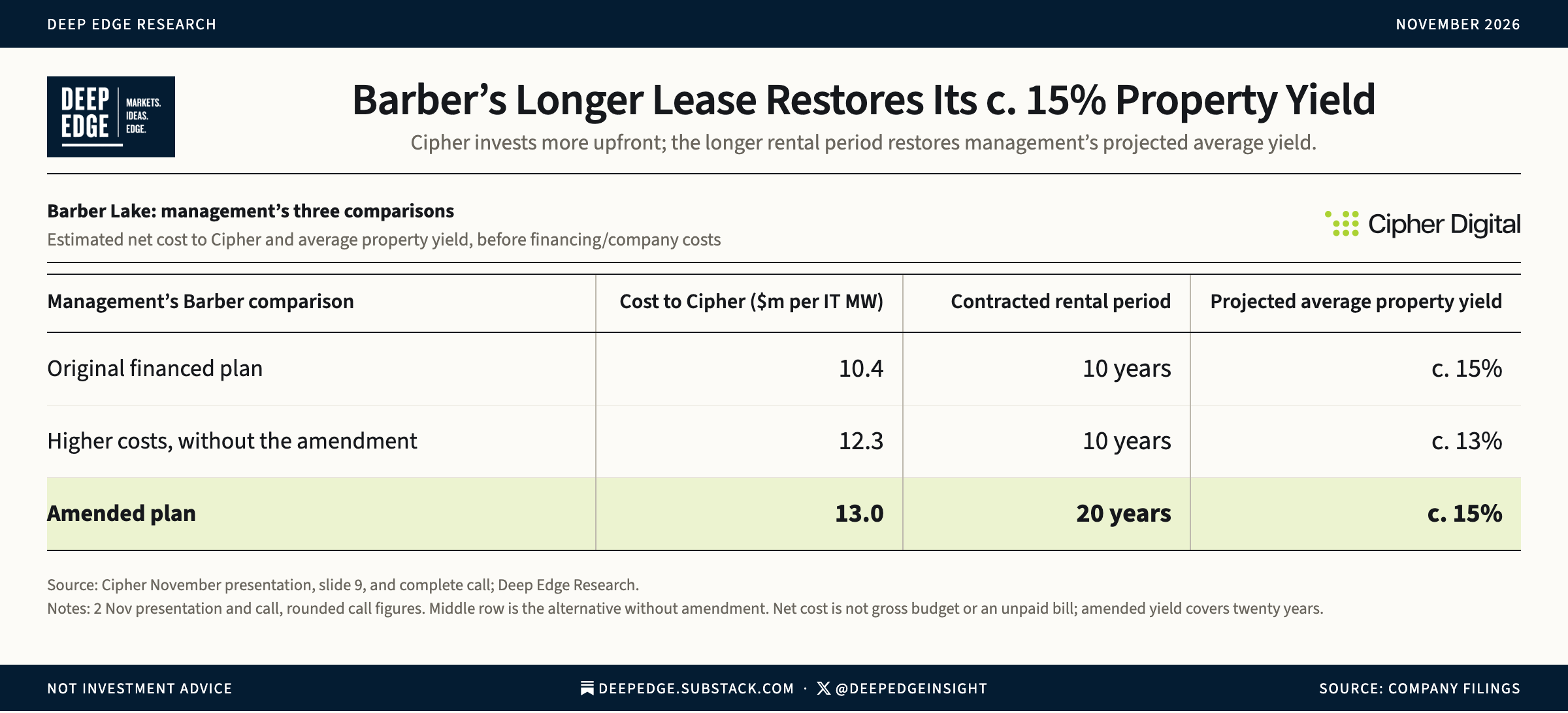
Source: 2 November presentation, slide 9, and call. Rounded call figures; all costs are management estimates of net cost to Cipher, not gross construction budgets or an unpaid bill. Yield is average property income relative to cost, before financing and corporate costs. The amended average covers a longer rental period.
Across 207 IT MW, the change represents about $540m more net cost to Cipher. The longer commitment helps compensate it, and management says lifetime returns improve. That benefit deserves weight, but the property yield is not the return on an ordinary share.
Property income is rent less the property’s operating costs. Interest, loan repayments, reserves, company overheads, tax and further investment can still stand between that income and money shareholders keep. A lifetime return also depends on when money goes in, when it comes back and what the building is worth afterwards.
Black Pearl: follow the rent through the loan payments
Black Pearl provides a useful cash test. Its fifteen-year base rent totals about $5.5bn, averaging c. $367m a year. Its $2bn project notes pay 6.125% annual interest. Once all construction phases are complete, the initial principal repayment rate is 7% of the original loan each year, subject to the loan terms.
Table 2 shows why interest alone overstates cash left for growth.
Table 2: Loan repayments change what the rent can leave
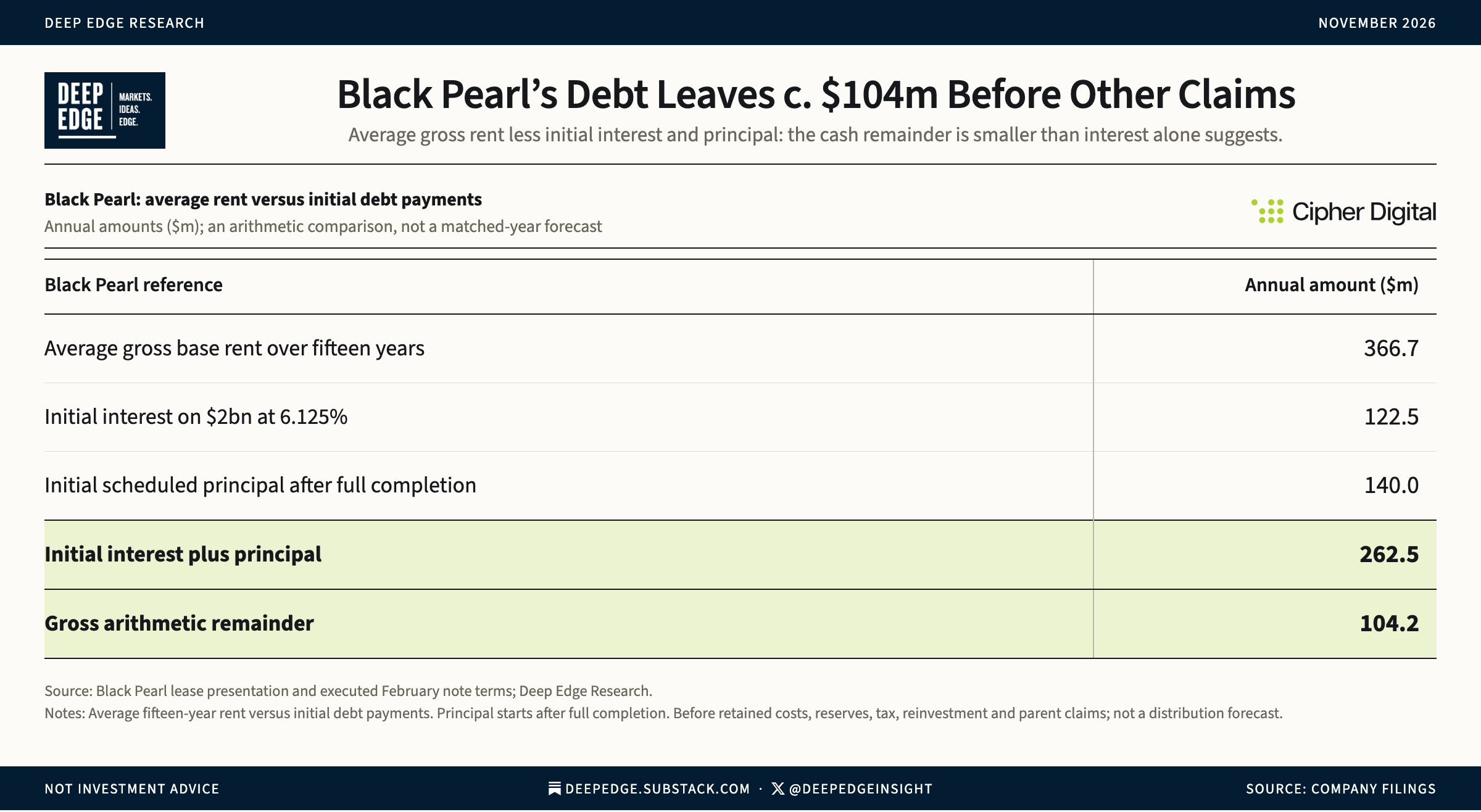
Source: Black Pearl lease presentation and executed note terms; Deep Edge Research. Average nominal rent is compared with initial debt payments, not a matched year’s receipts and spending. Rent escalates, starts in phases and debt falls as it is repaid. The remainder excludes retained costs, reserves, tax, reinvestment and parent obligations; it is not a distribution forecast.
Repaying principal reduces the debt against Cipher’s property. That benefits the owner, but it also uses cash that cannot simultaneously fund another campus or pay shareholders. Rent is roughly three times the initial interest reference, but only about 1.4 times interest plus principal.
There is a positive longer-term effect as debt is repaid. Stingray’s separate company model illustrates the early constraint: it projects $74m of rent and $16m after debt service in 2027, then $112m and $22m respectively in 2028. The amounts left can grow as debt falls. These are project estimates, not observed distributions or a template to copy onto Black Pearl.
That potential becomes useful cash when the halls are delivered, tenants pay and project bills are met.
B. What must management deliver?
First, complete the halls on schedule. Barber’s first 51 IT MW were announced ready for service, with rent started; the final hall targets Q1 2027. Black Pearl had delivered 18 IT MW by the November call, with further phases to complete. Stingray targets initial rent in April and May 2027.
Second, control the remaining cost. A funded budget becomes less reassuring if the owner must keep contributing more. At Barber, some increased cost comes back through rent over twenty years. That recovery helps the economics, but Cipher must carry the wait before collecting it.
Third, collect the rent and show what can leave the project accounts. Fixed rent is spread across the lease for accounting purposes, so reported revenue can differ from cash billed and collected. Even collected cash must meet the property’s payment and reserve requirements before it can move to the parent company.
Management plans to improve the next builds by completing more design work with tenants before signing leases and securing equipment earlier. That is a sensible response to the changes and cost pressure at the first sites. It also uses development money before the next project’s borrowing arrives. Existing properties need to replenish that cash if growth is to become less dependent on new financing.
Completed capacity, collections, remaining construction costs and permitted cash releases will show how much room remains for disappointment.
C. How much room for error remains?
Higher retained costs and lower income compound each other
Table 3 tests Barber’s rounded 15% property-yield reference. Choose property income down the left and the cost retained by Cipher across the top. Management’s reference is highlighted. More cost means the same income must earn a return on more money; less income reduces what the building produces.
Table 3: Barber’s restored yield is sensitive to income and cost
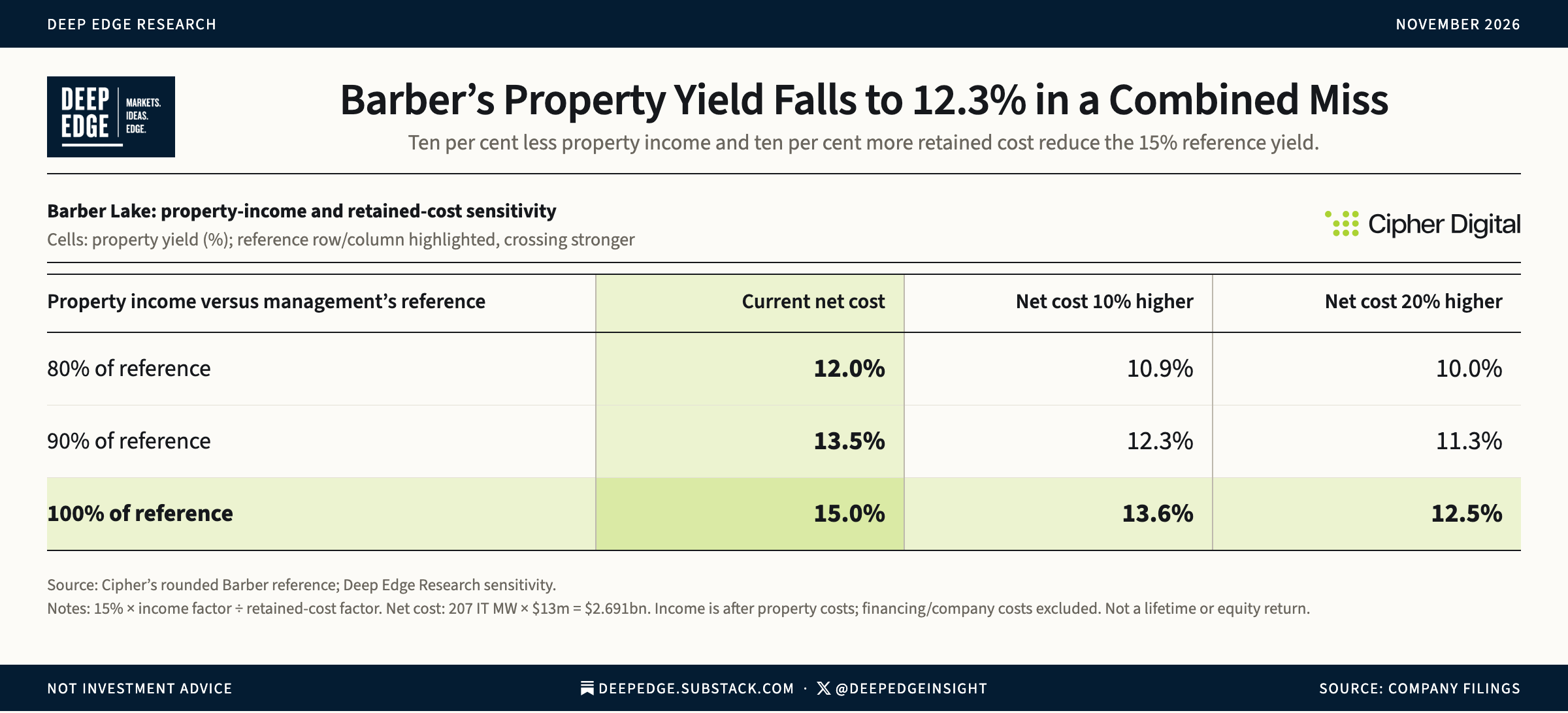
Source: management’s rounded Barber reference and Deep Edge Research. Cell = 15% × income factor ÷ retained-net-cost factor. The cost reference is 207 IT MW × $13m, or $2.691bn. Costs are further amounts retained after recovery; income is after property operating costs. Financing and company costs remain outside this yield. This is not a lifetime or shareholder-return calculation.
Ten per cent less income and 10% more retained cost bring the yield to 12.3%, before financing and company costs. That still leaves property income, but less return on each dollar Cipher invests.
Black Pearl: costs consume the cash left after lenders
Table 4 tests the rent and retained costs against Black Pearl’s initial $262.5m annual debt-payment reference. Read each cell as the amount left for further claims, or missing under that combination. The bold row uses the disclosed average rent; the cost columns are sensitivities, not disclosed budgets.
Table 4: What Black Pearl’s rent could leave after initial debt payments
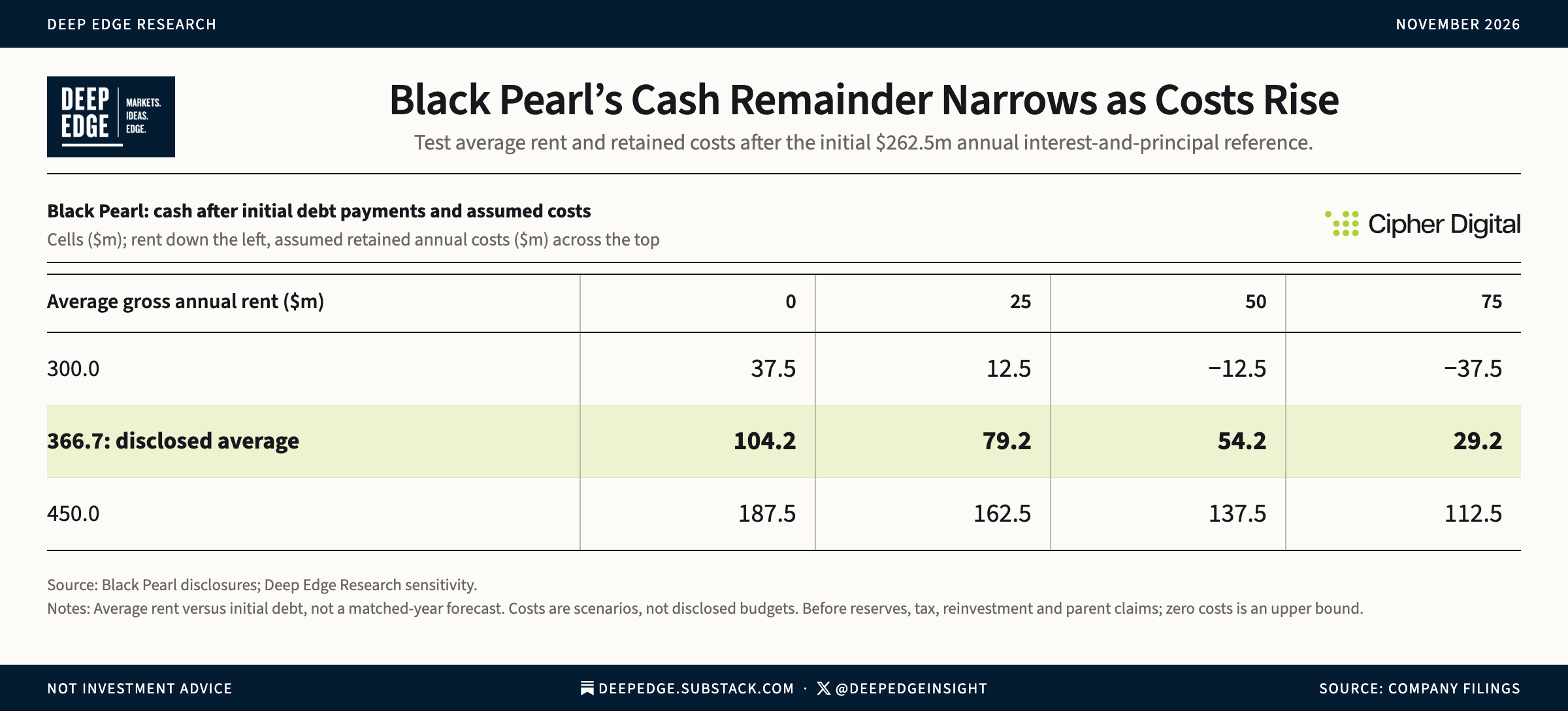
Source: Black Pearl disclosures and Deep Edge Research. Cells are $m: rent less $262.5m initial annual interest/principal and assumed retained costs, before reserves, tax, reinvestment and parent claims. The average-rent/initial-debt timing boundary in Table 2 applies. Zero costs is an upper-bound reference; no actual cost column is established.
At average rent and $50m of retained costs, about $54m remains before the other claims. At $300m rent and the same costs, there is a $12.5m shortfall against that initial debt-payment reference. A positive rent headline alone cannot tell shareholders how much is left for them.
Timing matters too. A later hall can postpone rent while some interest and construction costs continue. Tenant remedies and cost-sharing terms determine the allocation; we do not assume every bill stays fixed when a phase slips. Existing project coupons are fixed, but each additional percentage point on $1bn of new or refinanced borrowing costs $10m a year before fees.
Our sensitivity conclusions:
A. Economics: the longer Barber commitment supports a credible property case, and rent can leave cash after lenders. The full common-shareholder return is not established by the property yield.
B. Delivery: complete within the revised budget, collect rent and release cash after the project bills. Those steps determine what can fund growth or reward owners.
C. Room for error: income misses and retained costs reduce Barber’s yield together; Black Pearl’s initial loan repayments materially narrow the cash cushion. Delay or costlier future borrowing can reduce it further.
What would change our view?
Our confidence would grow with collections, costs within budget and cash leaving the properties. Updated schedules would let us match receipts to payments and assess the return on Cipher’s contributions more precisely.
Further capital for the same buildings, slower collections or less cash leaving the properties would weaken the case. A longer lease is valuable only if the income compensates for the money invested and the wait to recover it.
Our conclusion: Cipher has a credible route from funded construction to earning properties. The longer Barber lease helps repair higher costs. But the figure shareholders should care about is what remains after the building, its lenders and the wider company are paid. That return has to be earned through delivery and collections, not inferred from a 15% property yield.
That takes us to Part 3. The rent has several claims against it, and some financing arrangements can also require cash or more shares from Cipher. We follow those relationships to establish what Amazon and Google protect, what Cipher still owes and where the risk lands if delivery or customer payments disappoint.
References
Cipher’s 2 November presentation, especially slides 8–9, and complete results call: Barber cost, lease amendment, yield comparisons, recovery terms, delivery and design changes. Figures rounded consistently with management’s call and our underlying analysis; the slide shows 15.2% / 12.9% / 15.2%.
Black Pearl lease presentation and executed February financing: fifteen-year $5.5bn base rent, actual 6.125% coupon, initial 7% annual principal after completion and cash restrictions. The earlier presentation’s illustrative 7% coupon is superseded by actual issue terms.
Stingray June financing presentation, annual model on page 10 of the filed document, and September accounts: separate project projections, collections and accounting treatment.
Deep Edge Research sensitivities: Barber’s rounded property yield is crossed with income and retained-cost changes. Black Pearl uses $5.5bn ÷ 15 average rent and $2bn × (6.125% + 7%) initial debt service. These are directional property/cash tests, not project internal rates of return or a valuation of CIFR shares. A full equity return requires dated contributions, receipts, operating and maintenance costs, debt payments, reserve releases, tax and residual property value. No return is inferred by dividing the whole extension rent by one component of Cipher’s additional contribution.