
DEEP EDGE RESEARCH | DEEP DIVE
Evidence to 30 October 2026. For informational purposes only. Not investment advice.
Cipher Digital (CIFR) is up more than 10% today, despite reporting a quarterly free-cash-flow deficit of about $1.7bn yesterday.
So the key question is why?
Our read is that the deficit makes more sense once you understand what Cipher is building and who is paying for it.
Cipher is spending heavily to expand its capacity to more than four times its current level by the end of next year!
It has raised about $4.5bn through project bonds secured against the properties and their future rental income.
Crucially, it has some key tenants: Amazon’s leases and Google’s support for specified Fluidstack obligations help lenders finance that construction.
So whilst debt is funding much of the build, it is backed by future rent commitments. Management now says all three contracted projects are funded through completion, and some halls have started earning rent.
That gives investors a reason for optimism. The next question is whether those buildings will earn enough to repay the lenders and leave a worthwhile return for shareholders.
Our judgement: the optimism about getting these buildings finished is justified. Cipher has tenants and good revenue backlog, a funded construction plan and rent starting to arrive. But shareholders still need the buildings to earn enough to repay the money put into them and leave a worthwhile return.
TLDR
There is a reason for optimism beyond another AI contract. Rent has begun and management says it can fund all three projects through completion. October’s $850m issue helped pay for more investment at Barber; the later c. $724m cash figure already reflects that financing and investment.
The current programme is 493 IT megawatts across three properties. Black Pearl has delivered initial capacity, Barber has announced its first rent start, and Stingray’s earlier financing targets put initial rent in April and May 2027.
The $1.7bn quarterly cash deficit mainly reflects construction. Previously raised money is paying builders before full rent arrives. The question is whether the cash left covers the work left, rather than assuming the same spending continues indefinitely.
Most September cash was reserved for particular uses. About $2.2bn was restricted, beside $656m of ordinary cash. A construction account cannot automatically pay for another campus.
Funding relief is not yet proof of shareholder returns. Part 2 tests the property economics; Part 3 follows the claims attached to the financing.
How to read this series
This is Part 1 of three.
What is Cipher building, and who pays? Here we establish the contracted programme, the construction bill and the difference between project funding and cash available for expansion.
Do the economics work? We test what the properties earn, what management must deliver and how much room remains for error.
What risks do shareholders retain? We follow the lenders, tenant guarantees, completion promises and share-based financing terms that determine who absorbs a setback.
Financial statements are to 30 September 2026, with the 2 November update and a 3 November intraday price observation. The peer graphic uses Cipher’s September quarter and June quarters for the other miners, as labelled.
1. What the new money is building
First, what is Cipher actually building? It secures powered land, builds data centres and rents them to customers. Tenants fit the halls with computing systems, including graphics processing units (GPUs). Cipher pays for the property and supporting infrastructure; it is not buying a fleet of chips to sell computing time.
The three contracted properties total 493 critical IT megawatts, split between Black Pearl, Barber Lake and Stingray. An IT megawatt measures power for the computing equipment. Add cooling and other overheads and the same properties require 700MW of gross power. Those figures describe the same buildings and must not be added together.
Figure 1 shows how much of that programme is ready and how much still has to arrive. The dated portion rises from a reported 69 IT MW to 295 IT MW, more than four times the starting point. Another 198 IT MW at Black Pearl remains undated.
Figure 1: Cipher’s capacity ramp, campus by campus
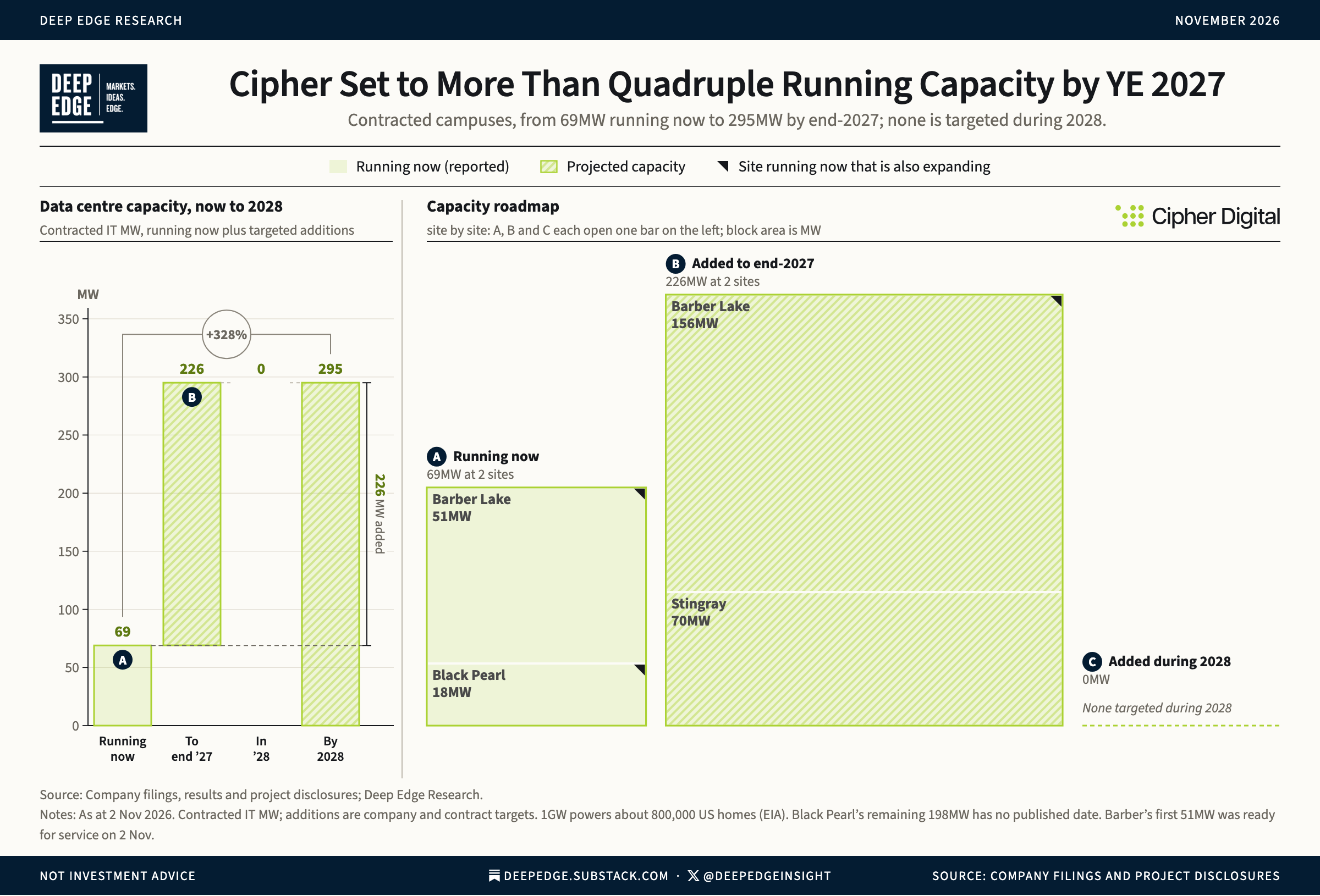
Source: company disclosures; Deep Edge Research. The graphic’s 295MW is the dated subset, not the full 493MW programme. Ready-for-service notice, delivered capacity, acceptance and collected rent are different milestones; the 198MW without a published date is not assigned to 2028.
At Barber Lake, the first 51 IT MW received a ready-for-service notice on 2 November, and management said rent had started. The remaining 156 IT MW takes the property to 207, with the final hall targeted for early 2027. Fluidstack USA II is the initial tenant; a separate AI-lab commitment covers the following decade.
At Black Pearl, 18 IT MW had been delivered by the November call. Initial rent began in August. The other 198 IT MW takes it to 216, but the updated phased schedule does not give every delivery date.
Stingray adds 70 IT MW, completing the reconciliation: 69 reported + 226 targeted additions + 198 undated = 493 contracted. Its June financing targets put the first 10 IT MW in April 2027 and 60 in May. November reported updated phasing without all revised dates. Amazon Data Services is the tenant at Black Pearl and Stingray.
So the properties are beginning to earn, but substantial contracted capacity still needs delivery. Barber’s longer commitment adds about $5.2bn of base rent in exchange for more investment from Cipher. More income is contracted, while more capital goes in upfront.
The pipeline is a separate funding decision
Cipher also describes 5.9GW of development pipeline, far larger than the contracted estate. This includes prospective sites, conditional power access and on-site generation opportunities. It is not 5.9GW of completed buildings or signed tenant demand.
At Colchis, for example, the 1GW grid classification remains conditional, with a December audit expected. Other locations need tenants, design work and financing. Odessa remains a mining site whose potential conversion requires a commercial agreement and power arrangements.
Those sites offer further growth. The three signed projects show what has to happen first: construction gets paid before the full rent arrives.
2. Why the cash deficit has widened
That transition explains the quarter’s cash use. Mining still supplied about $21m of revenue; the new property income had only started. Fixed rent is spread across the lease for accounting purposes, so recognised revenue can differ from cash collected.
Alongside the $1.55bn of investment, operations used $131m. Together they produce the $1.68bn free-cash-flow deficit, rounded to $1.7bn. The construction bill grew much faster than current income.
Figure 2 puts that acceleration in context. Its bars show the change against the same quarter a year earlier; the figures beneath them give the latest quarterly levels.
Figure 2: Construction spending is arriving before the full rental income
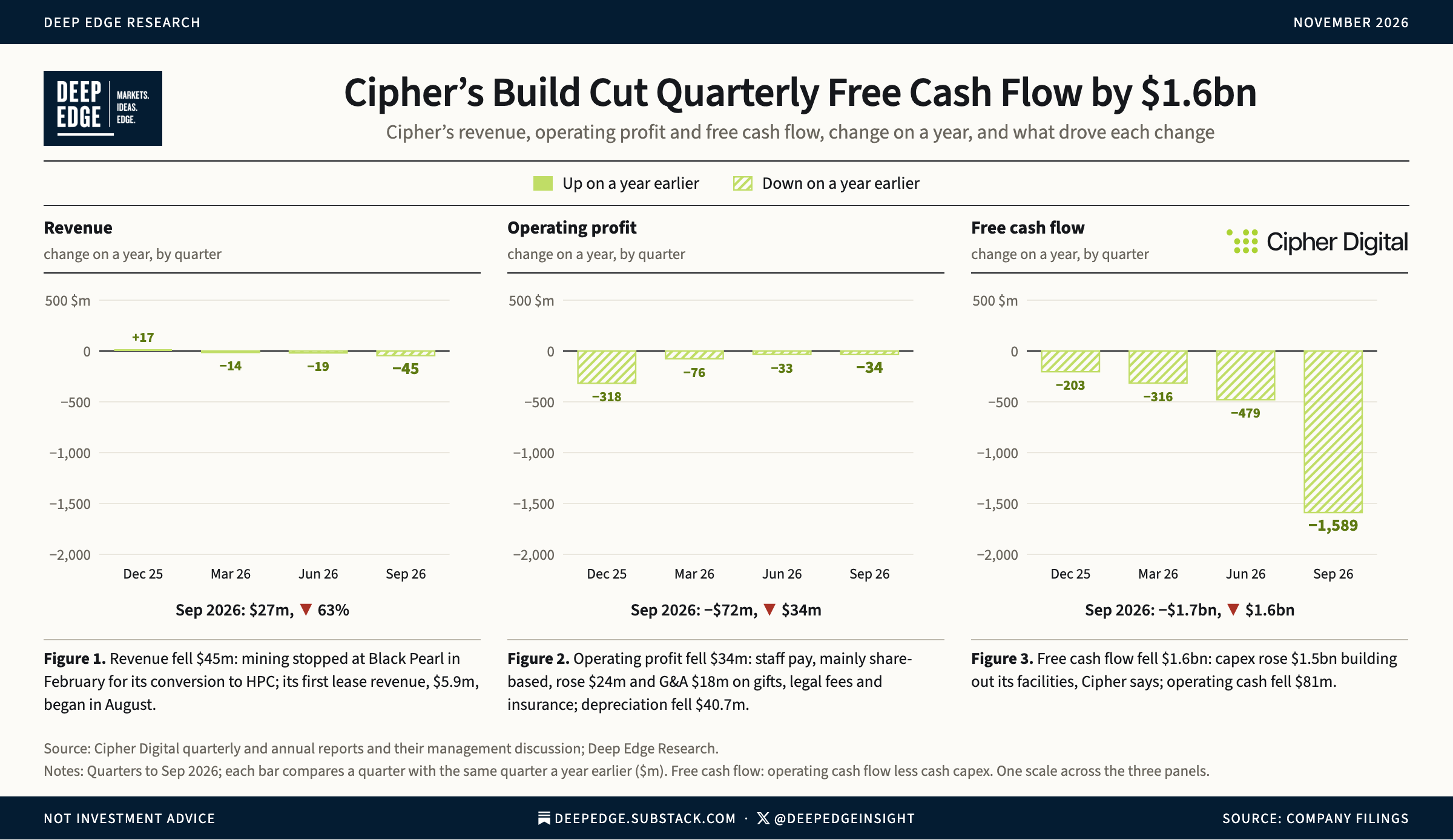
Source: Cipher financial statements and management discussion; Deep Edge Research. Bars show year-on-year changes, not cash balances. Free cash flow is operating cash less cash capital expenditure. September results incorporate the 2 November release.
Construction buys assets that can earn for many years, so the cash going out is much larger than the quarterly accounting loss. The reported $32m net profit needs care too: a noncash gain from revaluing Google’s warrants drove it. That accounting gain did not supply construction money.
Previously raised project money is now going into construction. Bitcoin sales added $46m during Q3, outside operating cash, but were small beside the building bill.
Management says it has enough funding to finish. To understand what is left for expansion, we need to separate money set aside for builders from cash the company can use elsewhere.
3. How Cipher pays, and what its peers show
Cipher has issued about $4.5bn of project notes, or bonds, across the three properties. Separate subsidiaries borrow the money, with rent intended to repay it. Cipher invests alongside those lenders and has promised completion funding in specified circumstances. Tenant support helps secure the loans, while Cipher still has its own building obligations.
The notes pay fixed annual interest: 7.125% at Barber, 6.125% at Black Pearl and 6% at Stingray. These are the existing loans’ rates, not today’s borrowing quotes. Rent must pay interest, scheduled loan repayments and other project bills before the remaining cash can move freely to the parent company.
September’s accounts show why money raised is not all money available for another site. Table 1 separates the accounts from management’s later cash statement.
Table 1: Cipher’s cash has different jobs
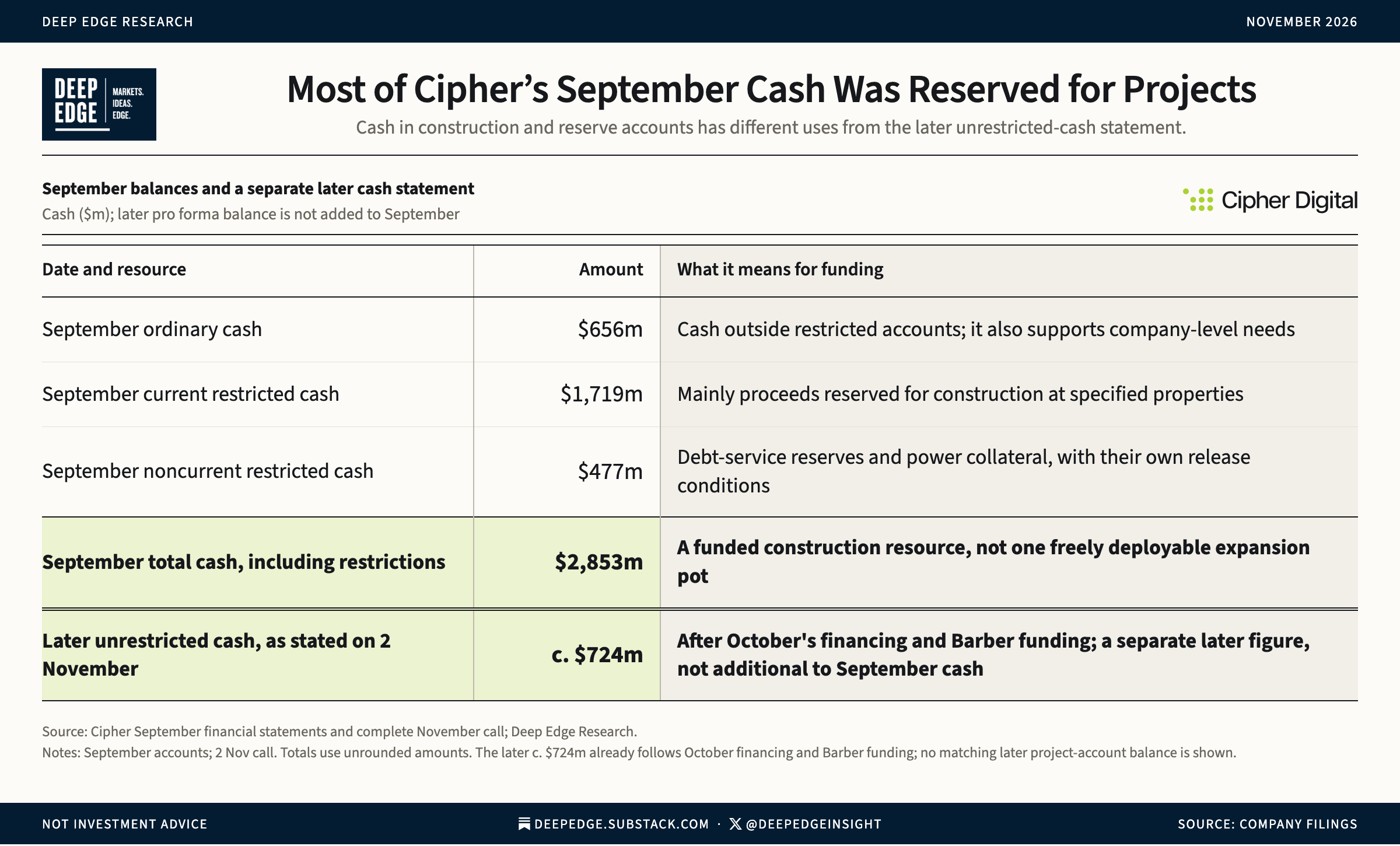
Source: September financial statements and 2 November call. Totals use unrounded amounts. No matching November project-account balances were disclosed here, so September restricted cash is not added to the later unrestricted figure to produce current liquidity.
That reserved money is doing its job when it pays builders. It cannot simultaneously be assumed spare for another campus.
How the transition compares
Figure 3 puts Cipher beside its mining peers, using the latest reported quarter for each: September for Cipher and June for Hut 8, Riot and MARA. These companies are at different stages; this is a funding comparison, not a profitability ranking.
Figure 3: How Cipher and its mining peers fund their spending
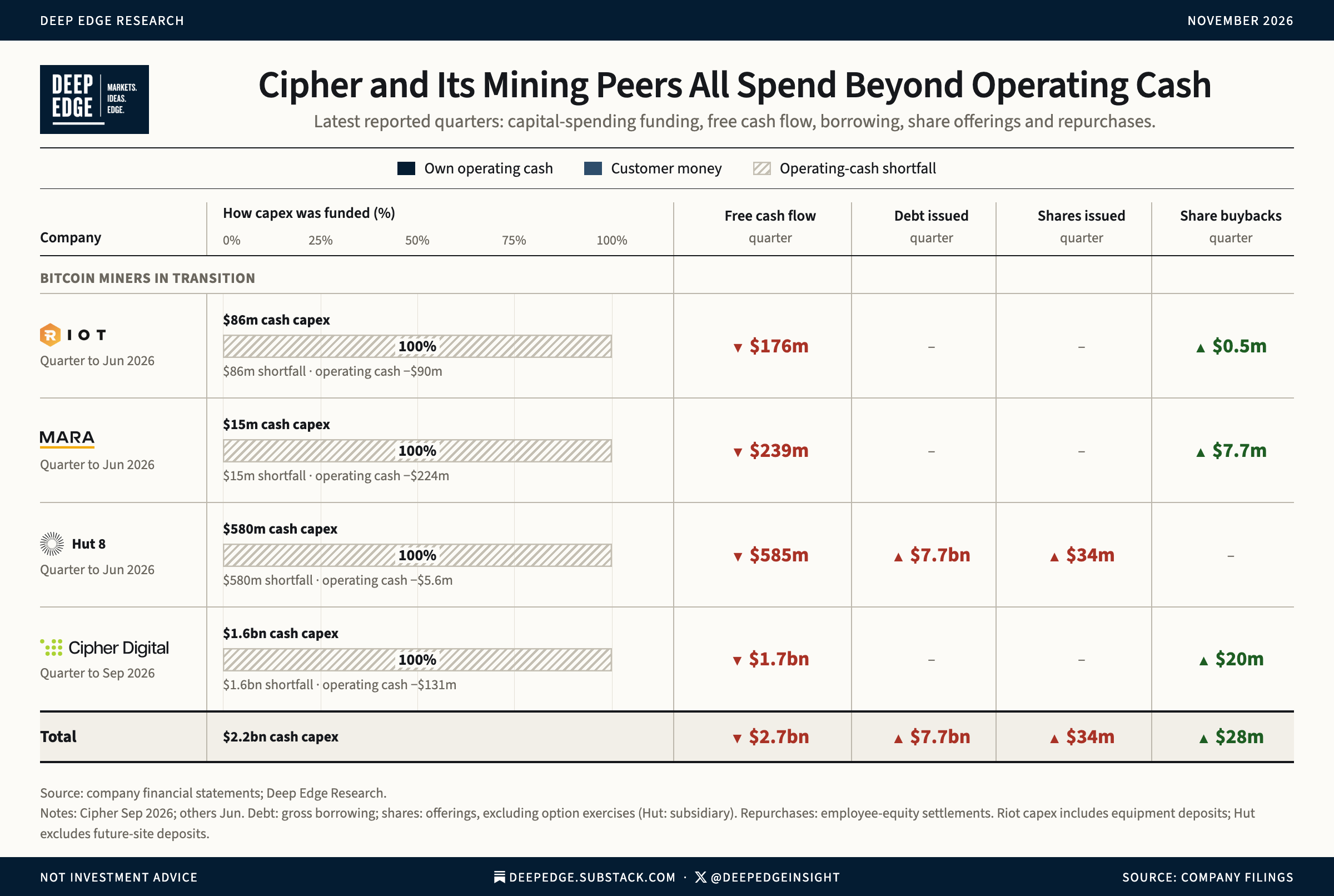
Source: company financial statements; Deep Edge Research. Cipher September 2026; others June. Borrowing is gross proceeds. Hut’s share-offering proceeds are its listed subsidiary’s; option exercises are excluded. Repurchases shown are employee-equity settlements. Riot investment includes equipment deposits; Hut excludes future-site deposits.
For Cipher, the hatched bar means operations supplied none of September’s $1.55bn capital spending. Operations also used $131m, taking the overall free-cash-flow deficit to c. $1.7bn. The money came from previously raised funding and reserves, alongside Bitcoin sales; the bar does not claim fresh borrowing paid every bill that quarter.
Hut raised $7.7bn of gross debt in June, mainly for its property programme. That is not spare cash at the parent. Cipher’s September borrowing and share-sale columns are blank because its next capital raise came afterwards.
What October’s $850m actually supplied
October’s convertible notes are company-level borrowing that can become shares. After purchaser discounts and about $90m spent on options intended to limit specified dilution, the indicative proceeds were about $745m before offering expenses.
That money helped pay for the larger Barber investment. The later $724m is what management says remains after the offering and funding; adding the proceeds again would count the same money twice.
The new notes pay no regular interest, which helps cash today. The money still has to be repaid or converted into shares. Holders can require cash repurchase in November 2030, before the stated 2032 maturity.
Cipher and Hut can borrow against long-duration rent before it begins. Bitcoin sales and Bitcoin-backed loans depend partly on a fluctuating asset price. Those routes carry different repayment and collateral risks.
Borrowing gets the buildings finished. Their rent then needs to cover the bills and leave money Cipher can use.
What the rally gets right, and what comes next
That helps explain the optimism. Cipher has moved beyond signing contracts: some halls are earning rent and management says it can pay to finish the rest. Its plan is then to recover some of its investment from operating properties and use that money to develop more sites.
The c. $724m gives it room for development and setbacks. But to know how much growth the existing properties can fund, we need to see rent collected and money left after their bills. Each new lease also needs rent and financing sufficient to justify its building cost.
Our conclusion: there is a sound funding reason to be more optimistic about Cipher. It has raised money to build, and the rent is starting. Shareholders now need to know whether that rent will repay the capital, cover the financing and leave enough for them. Having the money to finish is an important first step; earning a satisfactory return is a separate test.
At Barber, the cost per IT megawatt rose by 25%. The longer lease restored management’s projected property yield to about 15%, before financing and company-level costs. In Part 2, we test whether those economics work, what management must deliver and how much room it has for error. Part 3 follows who gets paid, and who carries the risk if things go wrong.
References
Market observation: Financial Modeling Prep quote at 15:12:39 GMT on 3 November 2026: $7.595 versus $6.86 previous close, up 10.7%. This is an intraday observation, not a closing return. The interpretation of the move is ours; the price change alone does not identify its cause or establish fair value.
Cipher’s third-quarter business update, 2 November 2026, accompanying presentation and complete results call: delivery, Barber amendment, October financing, funded-through-completion statement and c. $724m subsequent unrestricted cash.
September financial statements and June statements: cash restrictions, project debt, quarterly cash-flow derivation and first property revenue. Q3 equals the nine-month statement less the first half.
October convertible pricing and closing terms: proceeds, capped-call cost, repayment and conversion terms.
Stingray’s June financing presentation, printed slide 4: original April/May 2027 targets. November describes updated phased delivery without all revised dates; those earlier targets are not presented as reconfirmed.
Peer cash-flow sources: Hut 8, Riot and MARA, with March comparatives for standalone June quarters; Cipher uses September less June year-to-date accounts. The graphic uses the latest reported-quarter figures, with dates and funding definitions shown.
Rent-backed project bonds with Amazon on the lease is a clever way to borrow against someone else's balance sheet, the whole thing hinges on those halls still looking state of the art in year eight.
Your Colchis line became the one that matters a day later. Cipher fell 20.0% on Nov 4 after Texas elected Hinojosa, though from before the vote it was down 5.2%. Management expects Colchis's final classification in December, while Reveille's 70 MW has ERCOT interconnection approval and sits outside the batch process. (Edited: I first grouped Ulysses here; it's in Ohio on PJM, so it isn't an ERCOT site at all.) I sorted eight Texas developers by ERCOT status here: https://equibles.com/research/texas-data-center-moratorium-which-stocks-are-exposed-and-how-much?utm_source=substack