
For informational purposes only. Not investment advice.
On Monday, our W39 Weekly Brief described two routes into agents: professional work through OpenAI and Anthropic; consumer distribution through Meta and xAI. We wrote: “These are starting positions, not permanent camps. The companies can cross the boundary.”[1]
On Tuesday, OpenAI crossed it.
Dots combines GPT-6 Astra with its own cloud computer and browser. Codex Cloud lets development work continue after the laptop closes. Eligible Dots subscriptions include the first dot at no extra charge, making delegation easier to try.[2][3]
Our read is that supervision has been holding back how much work paying users can delegate. Dots makes it easier to run jobs in parallel and leave work going overnight. It also gives free users a reason to subscribe.
We expect that to increase occupied memory and processor-hours. We would not wait for a supplier to report Dots-labelled revenue before investing. Our valuation work starts now, so we can buy ahead of those disclosures when the price clears our test. Micron reports tonight, which is why we are holding off today.
TLDR
OpenAI’s researchers were already running c. 3.1 eight-hour agent-workdays per human workday by mid-August. Dots makes that working pattern easier to organise, though researchers are not representative customers.[4]
By month 12, existing paid users produce c. 36m daily jobs in our middle case. Every 100m consumers with agent access adds c. 12m more, on any platform.
High-bandwidth memory (HBM) serves active frontier reasoning and comes first in our 2027 ranking. Reusable context broadens the opportunity into server DRAM (working memory) and fast flash. Micron Technology (MU) is our first underwriting priority; SanDisk (SNDK) follows for context flash.
Today: hold the book, make no purchases before Micron; refresh MU and SNDK valuations first. Unowned processor, custom-chip and cloud names enter underwriting, not the portfolio.
Delegation Becomes a Superpower
For a professional already using AI, the constraint is how much work they can supervise. If they can hand over responsibility instead of steering every task, useful work per person can rise without a new audience.
OpenAI’s February disclosure counted more than 50m consumer subscribers and more than 9m paying business users. That historical c. 60m reference includes different plans; it is neither a Pro-only professional cohort nor launch-day Dots eligibility.[5][19]
By mid-August, OpenAI’s median researcher consumed more than $600 of daily inference, valued at the prices charged to developers for model access. Aggregate runtime reached 3.1 eight-hour agent-workdays per human workday.[4] Those prices are not personal bills or hardware costs. The researchers were supervising several streams of work.
We expect experienced paying users to be more likely to use this regularly than general consumers because they already have work to delegate. The paid pool includes others, so applying that higher uptake across it is our assumption. Table 1 models regular weekly use by month 12, activity on an average day and job frequency, at 30 minutes per job. The middle column is our working assumption, not a calibrated forecast; it assumes eligible access broadens.
Table 1: Existing Paid Users to Concurrent Work
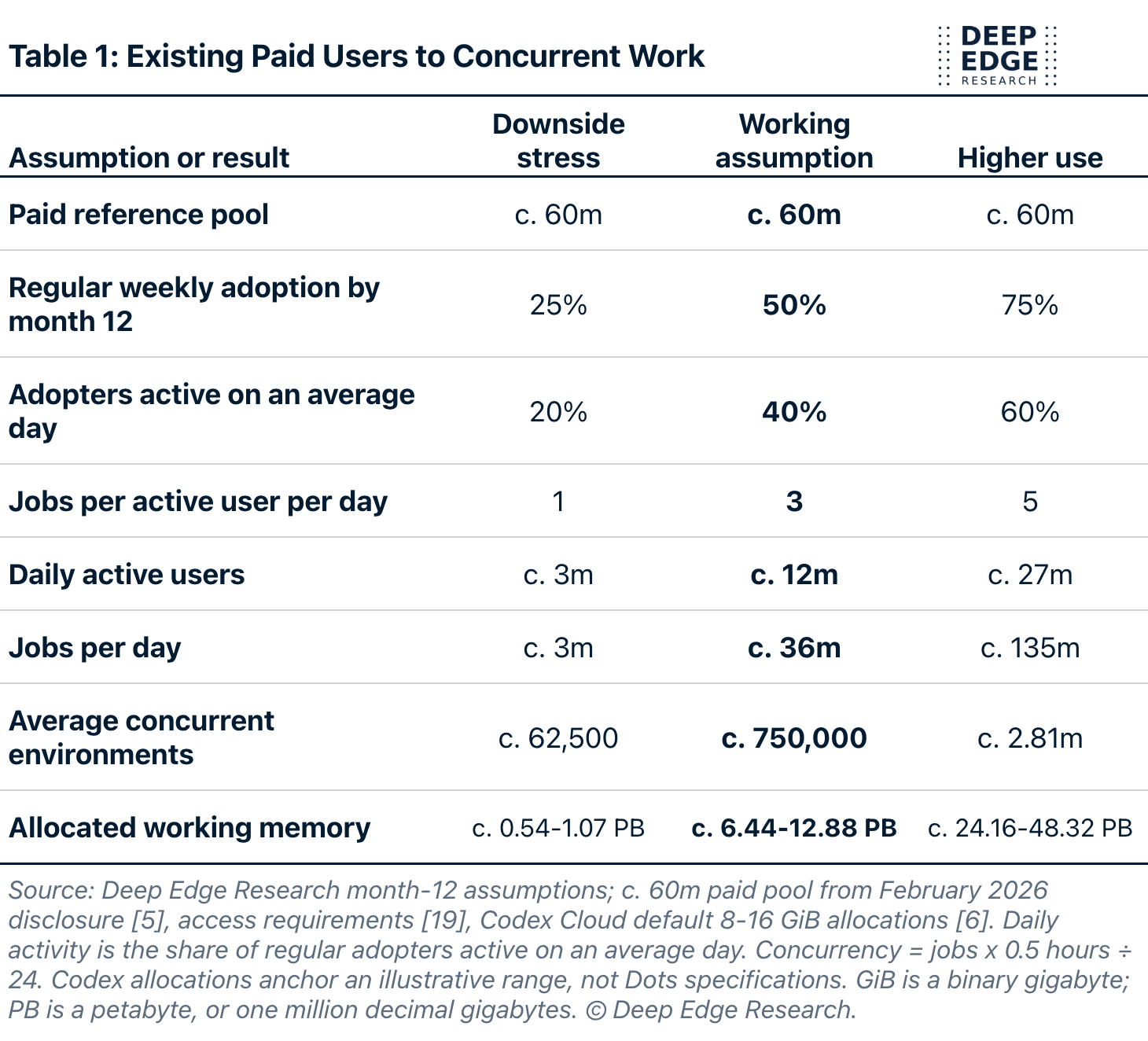
The middle case leaves c. 750,000 environments running at once. Doubling job duration doubles that concurrency without adding a user.
The middle case’s c. 6.4-12.9 PB equals c. 6,400-12,900 servers’ memory at an illustrative one terabyte each. Providers can share spare capacity and suspend idle environments, so that total alone does not establish an industry shortage. Our investment case also rests on repeated reasoning and reusable context meeting constrained supply.
What Happens When Everyone Can Delegate?
We put OpenAI’s consumers outside the existing paid pool in the same group as Muse and Grok Bot users. They have everyday work to delegate, such as planning trips or handling administration. We start with the same adoption assumptions and account for access and price separately.
We use 5% / 10% / 20% regular adoption by month 12 across all three: at least one completed agent job per week among consumers with access. A one-off trial does not qualify. These are our lower, working and higher-use scenarios, not observed conversion rates.
St Louis Fed research puts generative-AI use among US working-age adults at 62% in May; its separate daily-use measure was c. 15.4% in Q2.[17][18] Neither measures autonomous agents. They support rapid diffusion while showing why trying AI and using it repeatedly are different questions.
Payment is a separate decision. For OpenAI consumers who need an eligible subscription, the accessible pool grows through paid conversion or wider availability. Dots does not currently include every paying plan or region.[19] Where another platform also restricts access, we apply the same discipline. We do not turn 10% repeat adoption into a claim that 10% of all free users will pay.
The distribution is substantial: OpenAI’s collective c. 1.2bn weekly audience, Meta’s c. 3.6bn daily people and X/Grok’s c. 550m monthly users.[3][7][8] Those differently measured populations are reach references, not eligible agent users. Table 2 therefore shows the same workload per 100m consumers with access on any platform. The 100m is a scaling unit, not an estimate of who already has access.
Table 2: Consumer Work per 100m Users with Access
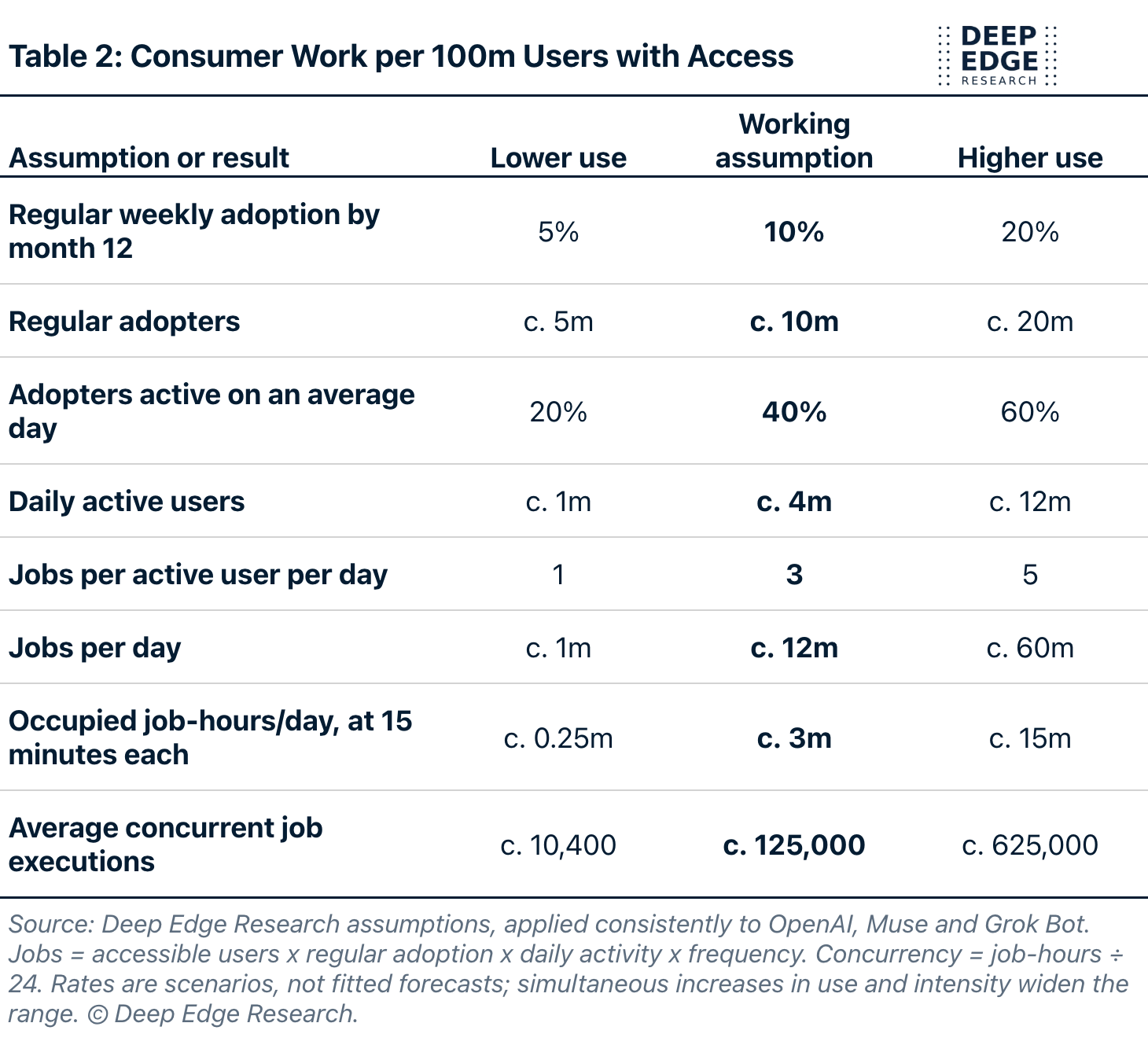
If 300m consumers across the three platforms gain agent access by month 12, the middle case produces c. 36m daily jobs, matching the existing paid-user case. At 15 minutes per consumer job, that means c. 375,000 running at once, half the paid case’s concurrency at 30 minutes per job. That is an illustration, not an estimate of access. The existing paid model reaches that workload without a new subscriber. We count newly paying OpenAI users in the consumer model, without adding them to the existing paid pool again. Our strongest near-term case is existing users delegating more work; broader consumer access adds to it.
Figure 1: How Much Work Could Delegation Create?
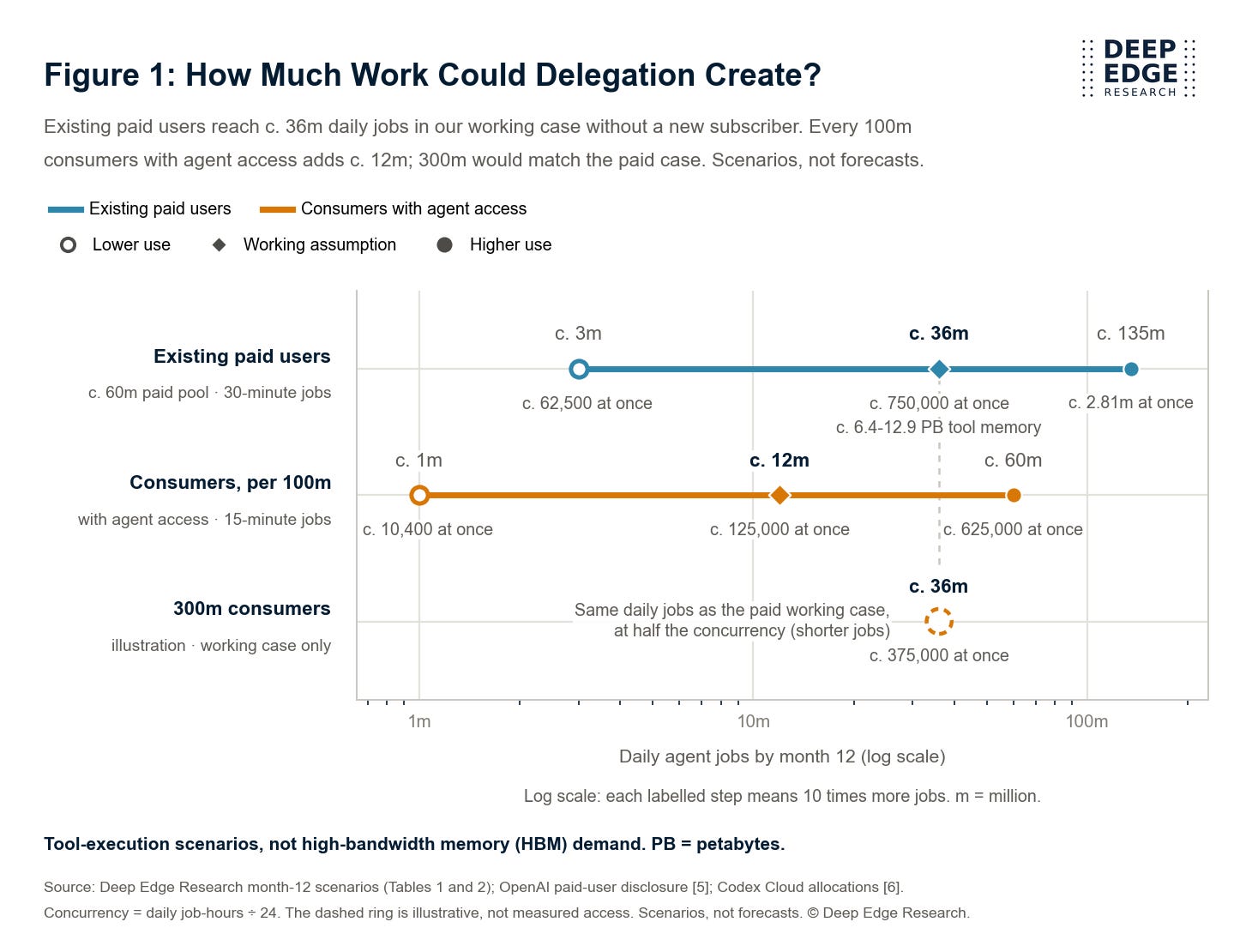
Source: Deep Edge Research month-12 scenarios in Tables 1 and 2. Tool-execution scenarios, not an estimate of HBM demand. PB means petabytes. The 300m accessible pool is illustrative, not observed.
Apptopia’s c. 642,000 US daily Muse estimate is an observation to track, not validation of global adoption.[9] Jobs switching platforms are not new aggregate work. We favour suppliers serving several architectures, while watching access, repeat use and genuinely additional work separately.
Agents Need Somewhere to Think
Each additional job uses accelerator compute and hot HBM for reasoning, while its tools use CPUs and server DRAM. Reusable context can occupy warm DRAM or fast flash and travel over networking. Power and cooling follow occupied hardware; permanent storage depends on the files retained, not job-hours alone.
Our 2027 ranking puts HBM first. We are backing the demand mechanism in the scenarios and the supply constraints Micron describes.[12] Our added bet on MU is that agents extend its earnings cycle through server DRAM and reusable context too. We want to buy MU for its HBM growth without paying upfront for a longer earnings cycle in its other memory businesses. Our valuation refresh after tonight’s result will test that opportunity. Thursday’s follow-up will compare our view with consensus and the share price.
Key-value (KV) cache keeps intermediate model calculations for reuse.[10] Before sharing or compression, the cache footprint scales with concurrent reasoning sessions × context tokens × KV bytes per token. At a fixed model and precision, doubling sessions or context doubles that footprint; doubling both makes it four times larger.
Actual demand depends on what context can be reused, what the system discards and where it keeps the cache. Our tables size tool execution. Without Astra’s serving details, we cannot turn those job counts into HBM shipments.
Dots and Codex Cloud let execution move from the laptop to the cloud.[2][6] Our read is that this shifts working memory from client to server DRAM before any job growth. Total bytes need not rise one-for-one, but the mix moves towards server products MU sells alongside its HBM exposure.
Figure 2 shows why our MU and SNDK cases rest on different parts of the same job. These workloads can overlap; they are not a fixed sequence, and retaining files is optional.
Figure 2: Where an Agent’s Work Pressures the System
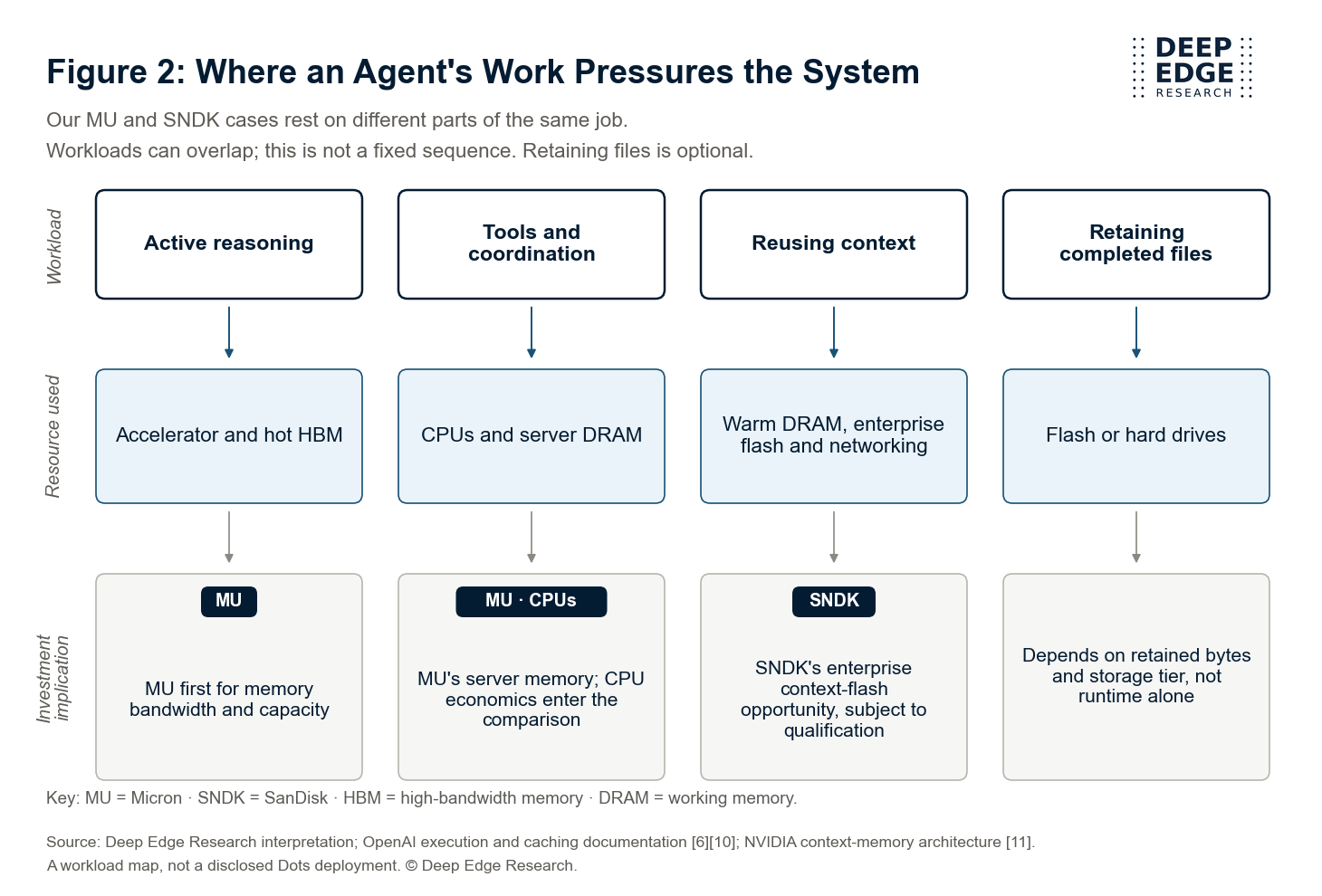
Source: Deep Edge Research interpretation; OpenAI execution and caching documentation [6][10], NVIDIA context-memory architecture [11]. A workload map, not a disclosed Dots deployment.
NVIDIA’s flash context tier gives flash a role beyond archived files.[11] Micron says HBM’s production needs squeeze other DRAM supply, while factory space also constrains NAND flash, the memory used in solid-state drives.[12] SNDK’s opportunity depends on its flash products winning approval for those enterprise workloads.
We also have to allow for efficiency. Caching saves compute while retaining memory; a discount on model access does not tell us the hardware saving. A 20% resource saving needs more than 25% job growth for consumption to rise. Applied to Table 1, it reduces middle-case tool memory to c. 5.2-10.3 PB. At equal duration, three jobs using 20% less memory each still occupy 2.4 times the memory. These are sensitivities, not measured growth.
Permanent files remain a separate opportunity. Pro’s 100 GB Library allowance implies a 100 PB ceiling per million users, or 10 PB at 10% occupancy.[13] We cannot treat that quota as usage. For now, we put warm context ahead of durable files.
Who Gets Paid?
A custom accelerator can displace a GPU while retaining substantial memory demand. Beyond MU and SNDK, our comparison includes:
Advanced Micro Devices (AMD) and Arm Holdings (ARM): CPU work and performance per watt.
Broadcom (AVGO) and Alphabet (GOOGL): custom silicon and the cost of useful inference.
Taiwan Semiconductor Manufacturing Company (TSM): manufacturing and packaging returns across competing designs.
Nebius Group (NBIS) and CoreWeave (CRWV): paid utilisation after equipment, power and financing costs.
We will compare what these businesses can earn at the prices we would pay. Their exposure to agents earns them a place in our underwriting; each still has to compete with MU and SNDK for our money.
Our January Outlook anticipated inference becoming continuous work.[14] Tuesday strengthens that view. Micron reports tonight, so we can start with a supplier already collecting the economics.
But Tonight, Micron First
Micron’s earnings call is at 21:30 BST on Wednesday 30 September. June guidance was $50bn revenue, plus or minus $1bn, and approximately 86% non-GAAP gross margin, its adjusted measure of revenue after production costs.[15][16]
The quarter predates Dots, so it cannot tell us how much demand Tuesday created. It can change the price and earnings base from which we invest. We will judge it against the W39 rules in Table 3.
Table 3: Micron’s Standing W39 Scorecard
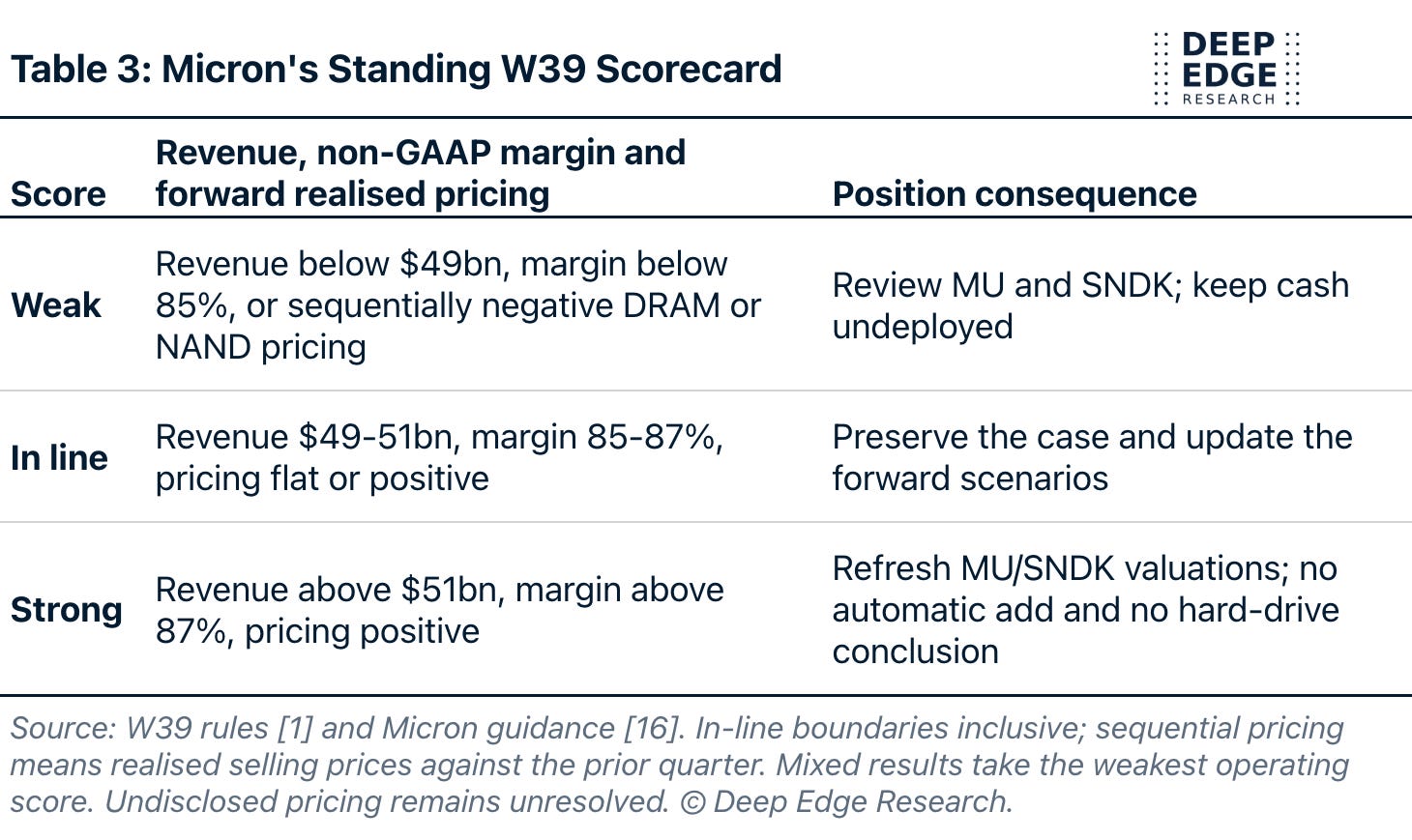
For fresh money, W39’s threshold remains below 12 times calendar-2027 earnings after a 40% cycle cut, with a 60% downside stress.[1] We can forecast a longer demand cycle without paying indefinitely for exceptional margins.
Thursday’s follow-up will use Micron to compare hot and warm memory with those alternatives, including how much suppliers keep under their customers’ pricing terms.
What We’re Watching
29 October, access and adoption: eligible Dots accounts and agent-led paid conversion; accessible Muse and Grok Bot users; then the share completing jobs weekly on each platform. Trial, repeat use and payment stay separate. Downloads and app rankings do not establish recurring delegation.
Through 29 October, repeat delegation: completed jobs per active user, occupied execution time and parallel work after the launch period. Persistent growth moves us towards higher use; fading repeat use reduces our demand estimate.
By 30 November, efficiency against volume: total resource demand after allowing for cheaper jobs. If adoption rises but efficiency keeps consumption flat or lower, we lower the capacity forecast rather than treating adoption as a hardware order.
Through 30 November, supplier capture: tonight’s pricing and margin scorecard, then SanDisk’s own disclosure. Sequentially negative DRAM or NAND pricing prompts a valuation review, not a verdict on whether agents are useful.
Our 30 November investment comparison will weigh those observations. Thursday’s follow-up will carry the fuller schedule.
Bottom Line
For now, we hold the book and make no purchases before Micron. MU comes first in our valuation work, followed by SNDK. The wider candidates must compete for our money. We intend to invest ahead of this change, but the price still has to pay us for the risk.
References
[1] Deep Edge Research, W39: Meta Rallied c. 13%. Our Storage Did Not Follow., 28 September 2026.
[2] OpenAI, Introducing dots, 29 September 2026.
[3] OpenAI, DevDay 2026 Recap, 29 September 2026.
[4] OpenAI, Research acceleration: The view inside OpenAI, 6 September 2026.
[5] OpenAI, Scaling AI for everyone, 27 February 2026.
[6] OpenAI, Cloud environments, accessed 30 September 2026.
[7] Meta Platforms, Second-quarter 2026 results, 29 July 2026.
[8] SEC, Space Exploration Technologies correspondence recording X/Grok audience disclosures, 29 May 2026; c. 550m monthly users at 31 March.
[9] TechCrunch, Meta’s Muse is outpacing ChatGPT’s early mobile launch, 21 September 2026.
[10] OpenAI, Prompt caching, accessed 30 September 2026.
[11] NVIDIA, Introducing NVIDIA BlueField-4-Powered CMX Context Memory Storage Platform, 16 March 2026.
[12] Micron Technology, Fiscal Q3 2026 earnings call prepared remarks, 24 June 2026.
[13] OpenAI, Using Library to manage files in ChatGPT, accessed 30 September 2026.
[14] Deep Edge Research, 2026 Outlook: AI Infrastructure Is Not a Bubble, Part 1 of 3, 25 January 2026.
[15] Micron Technology, Fiscal fourth-quarter reporting date, 26 August 2026.
[16] Micron Technology, Fiscal Q3 2026 results and Q4 guidance, 24 June 2026.
[17] St Louis Fed, What Work Does Generative AI Do?, 1 September 2026.
[18] FRED, Generative Artificial Intelligence, Daily Use Overall: Working-Age Adults, Q2 2026; updated 4 August 2026.
[19] OpenAI, Meet dots: access requirements, accessed 30 September 2026.
Deep Edge Research. Equity research. No bull. No fluff. Just actionable insights.