
Last week (W22, 25-29 May 2026) finally gave investors the first real signs of relief since the Hormuz crisis started showing up clearly in the data. Oil broke lower, with Brent down 19% on the month, its worst monthly move since March 2020. The 10-year Treasury slipped back below 4.50%. On the screen, the panic eased.
But that does not settle the story. Energy prices improved, while the household cushion got thinner. The personal saving rate fell to 2.6% in April, down from 4.3% in January and back near the low-savings zone last seen during the 2022 inflation squeeze and in the years before the financial crisis. Personal spending rose even as income was flat, and real disposable income fell 0.5%. That is not a clean relief cycle. It is a race between lower oil and a weakening consumer.
The question now is whether cheaper oil reaches inflation, yields, margins, and credit before the consumer runs out of room.
Fact of the week: the personal saving rate fell from 4.3% in January to 2.6% in April. That means the household buffer shrank by roughly 40% in four months. Consumers are still spending, but they are doing it with less room: spending rose 0.5% in April, income was flat, and real disposable income fell 0.5%. The relief trade is resting on a consumer that looks thinner, not stronger.
Figure 1: The Household Buffer Is Back in the Low-Savings Zone
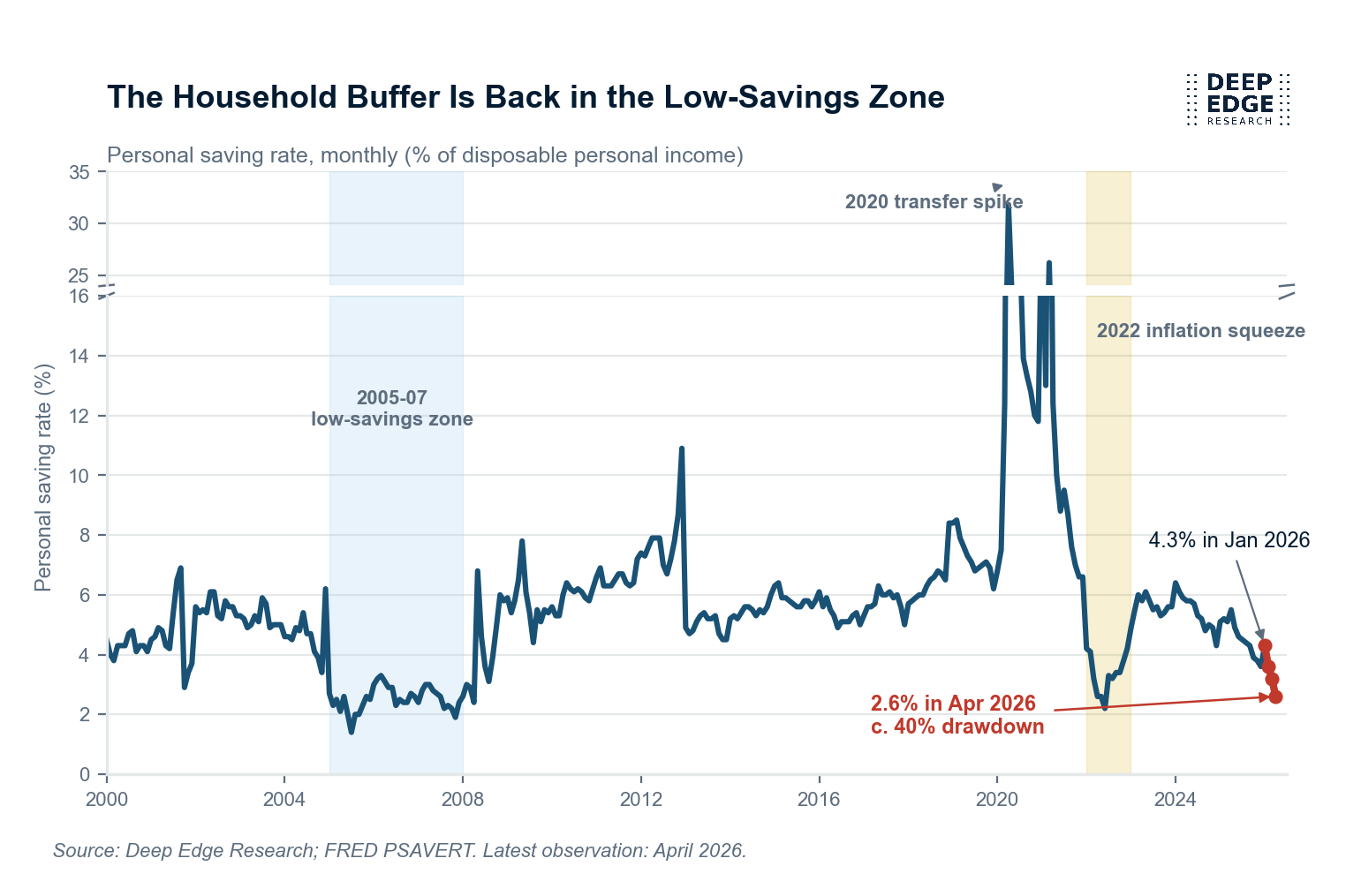
Source: Deep Edge Research; FRED PSAVERT [19].
TLDR
Last week (W22) only half-answered the question from the week before (W21). In W21, oil fell but borrowing costs did not. Then, last week, borrowing costs finally started to follow: the 10-year Treasury moved back below 4.50%, WTI broke lower, and markets stopped pricing the energy shock as if it were still getting worse [2][3].
The issue, though, is that the system did not fully clear. Instead, the pressure shifted from the supply shock to the consumer’s ability to absorb it. We can see that most clearly in the saving-rate data. The personal saving rate fell to 2.6% as spending kept rising, personal income was flat, real disposable income fell, and headline PCE was still running at 3.8% year over year. For corporate America, the near-term good news is that households are still spending, so revenues can hold up for now. The problem, however, is how that spending is being funded: more of it now appears to be coming from savings drawdowns and, at the margin, debt [1].
That said, this is still a bounded warning, not a recession call. Freight has refused to confirm stress for a month, oil and rates both eased, and the consumer still held up in important pockets, including Costco (COST) and Dollar Tree (DLTR). So the narrower point is this: the household balance sheet is now the first place where the macro pressure is clearly showing up.
Our internal six-sleeve framework captures that shift. In W21, tariff and trade sleeve showed that tariff pressure was the only area still getting worse. By contrast, last week, labour and macro was the only sleeve that strengthened. In plain English, oil and rates eased, but the household balance-sheet test got harder.
The AI sleeve also became more selective. On the one hand, Marvell Technology (MRVL) confirmed that the infrastructure cycle is still real, especially in interconnect. On the other hand, Salesforce (CRM), Asana (ASAN), Workday (WDAY), and monday.com (MNDY) made the software-disruption short case narrower. So the right AI trade is still mechanism-specific: we are choosing to own the bottlenecks where capex converts into revenue, and we are being more selective on SaaS shorts [4][5][6].
Meanwhile our private credit sleeve still looks like dispersion, not system-wide stress. Weaker BDCs remain live shorts. Blackstone Private Credit Fund (BCRED) is still a pending test, and FSK’s KKR tender matters on June 9. Even so, Ares Capital (ARCC), Trinity Capital (TRIN), and cleaner comparison names still argue against a lazy “short all private credit” trade [7].
Kill switch: if the consumer buffer keeps weakening while the 10-year moves back above 4.50%, CPI or core goods re-accelerates, AI financing stress broadens, and private-credit dispersion spills into public spreads, the relief trade has failed. That is when selective risk-taking has to give way to de-risking.
What changed from W21
W21 (2 weeks ago) tested whether lower oil was enough to ease the Fed’s problem. It was not. Oil fell, but the 10-year still closed above 4.50%, private credit did not repair, and the cost of money stayed in charge.
W22 (last week) moved that argument forward. Oil kept falling, the 10-year finally slipped below 4.50%, and the energy side of the shock started to ease. But at the same time, the consumer data exposed the next fault line. Households are still spending, yet the way that spending is being funded has worsened: income was flat, spending rose, and the personal saving rate fell to 2.6%.
That is why W22 is not a victory lap for the relief trade. Instead, it marks the handoff from the supply shock to the household balance sheet.
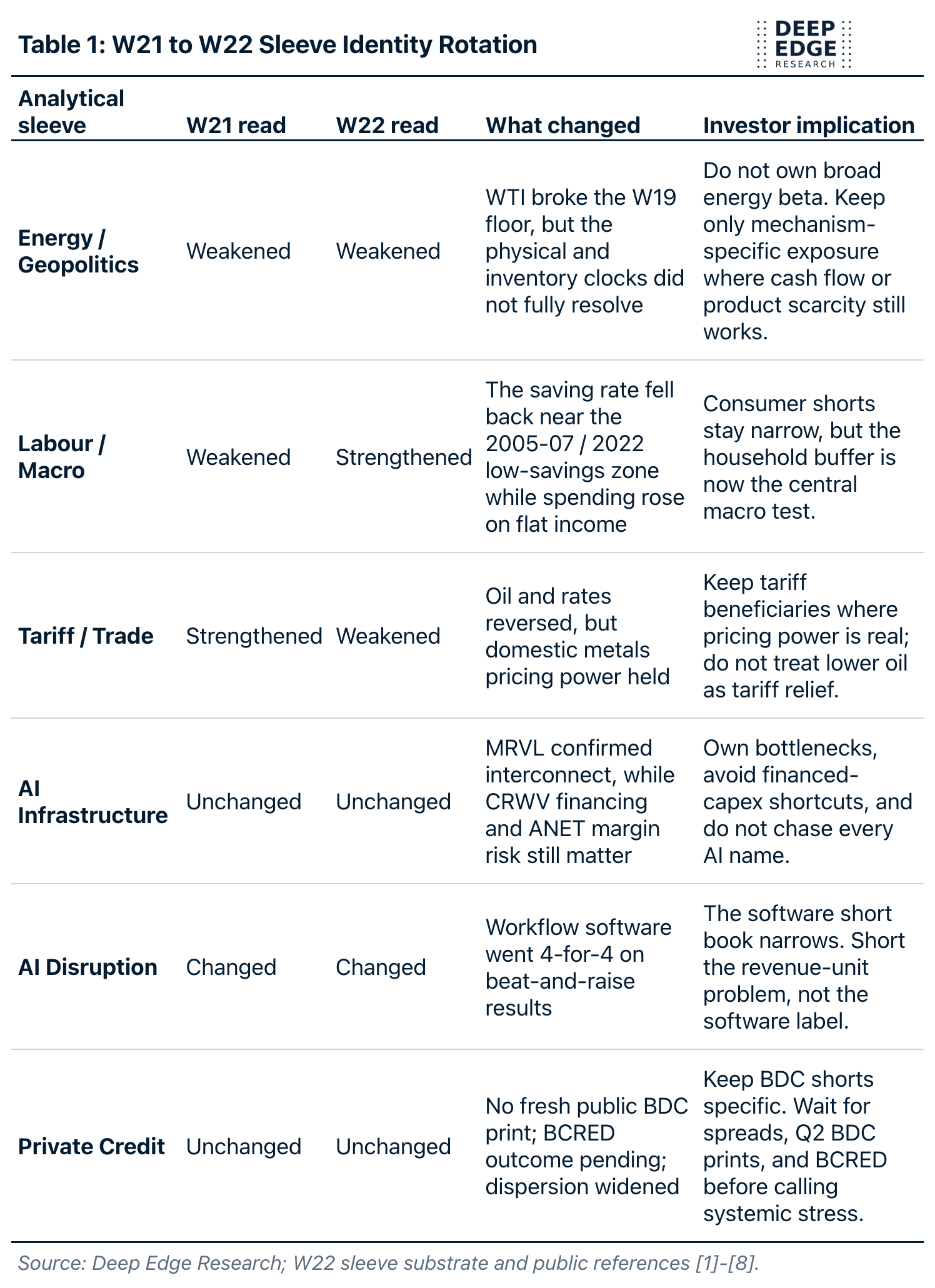
What consensus is missing: the easy line is that lower oil helps inflation. That is true, but it misses the more important shift. The real change happened inside our pressure map. The supply-shock sleeve cooled, tariff and trade stopped being the only area still getting worse, and Labour / Macro became the main pressure point because the consumer buffer weakened in the primary data. That does not mean the whole consumer has broken. It means the first confirmed stress is now in the funding mix: spending is still happening, but more of it is being financed out of savings rather than income. Relief showed up first in prices. The strain moved into household balance sheets.
The rotation is the point: last week did not make the pressure disappear. It changed where we should look for it: less in the crude screen, more in the household balance sheet.
W21 watchboard closure
Weekly briefs need memory. If we tell readers what to watch, we owe them a clear answer the following week.
The W21 watchboard was built around one question: would lower oil turn into broader relief, or would the pressure simply show up somewhere else? W22 gave us a mixed answer. Oil and rates improved. The household buffer weakened. AI infrastructure confirmed, but the AI-disruption short became less broad. Private credit did not heal; it simply remained unresolved.
That is why the closure table below matters. It is not there for bookkeeping. It shows which W21 risks actually changed the book, which ones were deferred, and which ones now need to carry into W23.
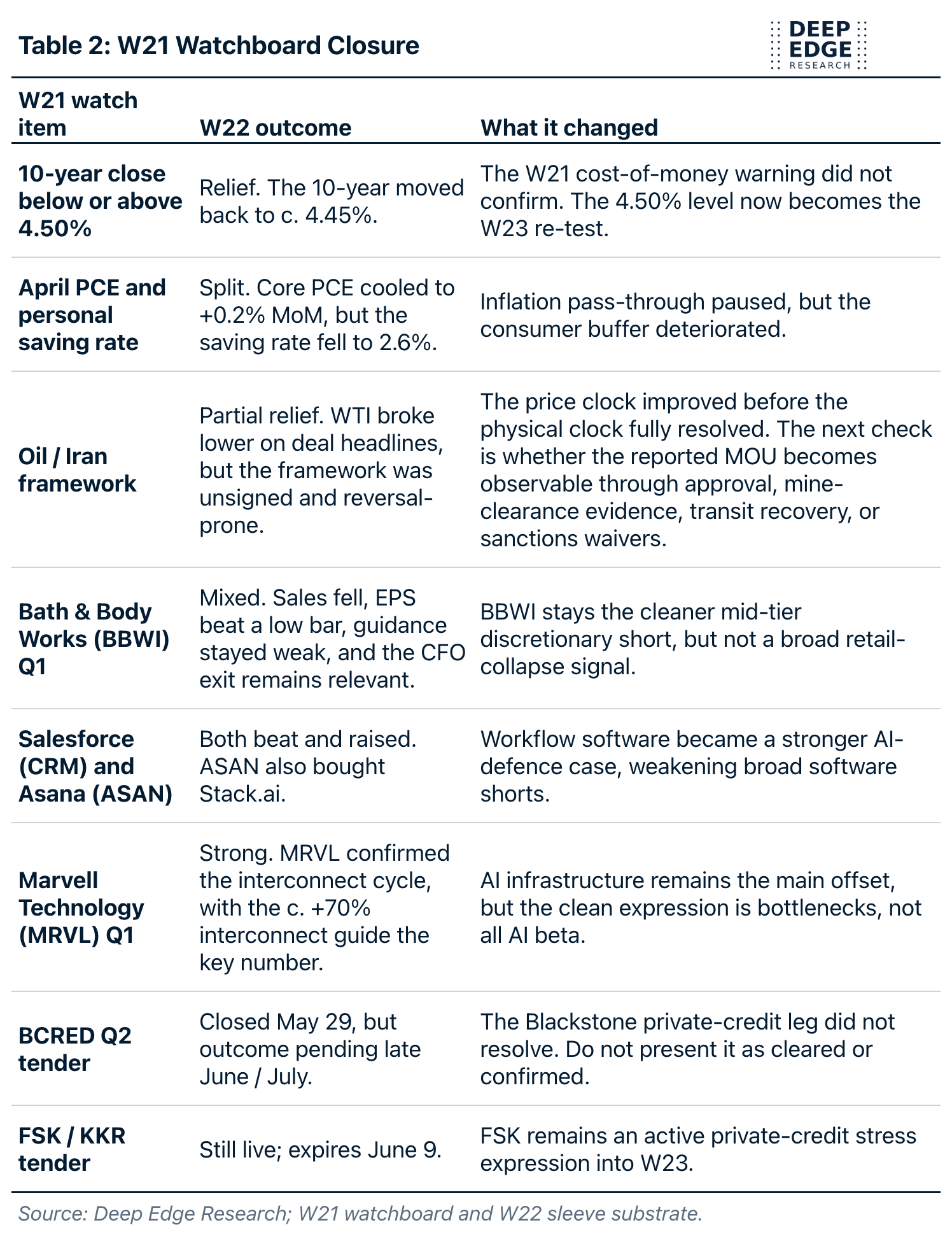
The clearest resolution was rates. The 10-year moved back below 4.50%, so the borrowing-cost pressure we were watching did not intensify in the way it might have. That matters because the 10-year still shapes mortgage pressure, long-duration assets, private-credit refinancing, and debt-funded AI infrastructure. If it had stayed above 4.50% while the saving rate was collapsing, this would be a much more defensive note.
The least settled area was the consumer. Core PCE cooled, but the personal saving rate still fell to 2.6%, which tells us the squeeze has shifted from prices into household balance sheets. AI and private credit also remained split. Marvell Technology (MRVL) strengthened the infrastructure case, while Salesforce (CRM) and Asana (ASAN) narrowed the broad software-short thesis. In private credit, Blackstone Private Credit Fund (BCRED) and FSK still did not give us a clean resolution.
Conclusion: W21 asked whether lower oil would lower pressure across the whole book. W22’s answer was: only partly. Oil and rates improved, but the household buffer became the new test, software shorts narrowed, and private credit remained unresolved.
Our pressure map moved from cost shock to absorption
Our pressure map is not a thesis to defend. It is how we locate where macro pressure is forming, where it is being absorbed, and where it may become earnings or credit stress. The sequence is now clear: W20 (May 11-15) brought the pressure into hard data, W21 showed that lower oil was to bring borrowing costs down. Last week (W22) moved the test to the household balance sheet.
Cost-side floor (Energy, geopolitics, tariffs, and trade)
Oil improved at the price layer, but the physical story did not fully resolve.
Tariffs did not disappear because oil fell; domestic metals pricing remained firm.
Absorption (Labour, consumers, margins, and housing)
This is now the main W22 layer: spending rose on flat income, the saving rate fell, and the consumer absorbed pressure by using the buffer.
This is not a recession call. Costco (COST), Dollar Tree (DLTR), freight, and selected quality names still push back against broad consumer collapse.
Supply-side offset (AI infrastructure)
AI still offsets the macro squeeze where capex converts into backlog, interconnect demand, memory demand, power contracts, or revenue.
MRVL strengthened that read; CoreWeave (CRWV) and Arista Networks (ANET) keep the financing and margin filter alive.
Displacement (AI disruption)
The software short thesis became more selective. Workflow software showed that AI can defend or expand the revenue unit.
Marketplace and labour-displacement risk remains live, but it needs fundamental confirmation.
Realization (Private credit)
Private credit is a dispersion trade, not a clean systemic stress trade.
Weak BDCs remain exposed; higher-quality comparison names are not confirming a broad credit event.
Conclusion: W22 did not clear the pressure map. It moved the pressure from the oil screen into the consumer buffer. The relief trade becomes durable only if lower oil becomes lower inflation, lower yields, cleaner margins, and calmer credit.
1. Energy: the price clock improved before the physical clock resolved
Our view: last week weakened the energy sleeve at the price layer. It did not prove that the physical energy shock is gone.
Why: WTI broke the W19 floor and settled at $87.36 on Friday, down c. 11% on the week and 16.5% on the month. Brent fell 19% on the month, its worst monthly move since March 2020. That is a real price break. The physical side is less clean: The Iran-US framework was reported by multiple sources but remained unsigned, fresh strikes and retaliation risk were still live, and the inventory draw slowed rather than fully normalising [3][11].
That contradiction matters. The United States struck Iran on May 27 even as the framework was being described as largely negotiated. So last week could weaken the energy sleeve at the screen-price level without giving us a clean all-clear on the underlying supply shock.
This is why the three-clock framework still matters. The crude screen, the physical system, and the macro data move at different speeds. Our internal regime model, built from public FRED inputs, still pointed to stagflation last week. Part of the reason is that its oil-shock input uses a three-month rolling move, so it is still carrying the earlier spike rather than just the Friday close [10].
But the more important question for investors is simpler: does last week’s oil break show up in CPI, inflation expectations, margins, and the 10-year before the household buffer weakens further? (Likely answer is probably no, since even if the blockade is removed, it will still take at least 3 months for trade-flows to normalise, but in that time, oil bought at a higher price will still be flowing through the system).
The cross-asset picture improved more broadly than crude alone. Four market signals softened at the same time: oil fell, the 10-year moved back below 4.50% instead of staying pinned above it, energy equities lagged, and gold rose about 1.3% to roughly $4,590 [2][11]. That is why last week was different from the week before. In the prior week, rates were the one big holdout after crude softened. Last week, that holdout softened too.
Scarcity check: ExxonMobil’s Neil Chapman warned at Bernstein that inventories were approaching “unprecedented” lows and that physical Brent could move toward $150-$160 if the operational floor is reached [15]. Chevron’s Mike Wirth made the same timing point from the other side: the buffers are being drawn down, and June into July is when physical prices should show whether the shortage is still live [16].
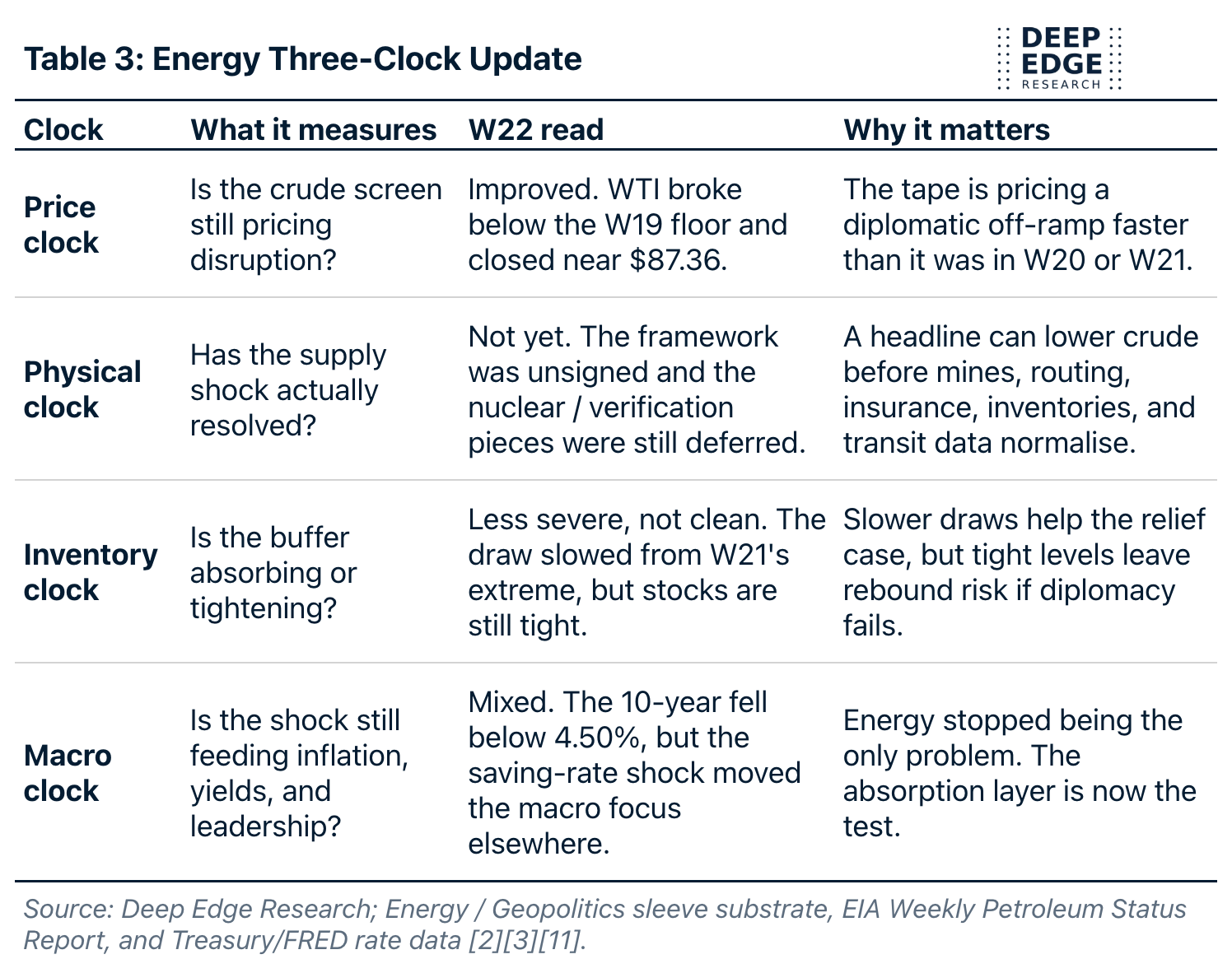
The way to express the energy sleeve changed because the clock changed. When the oil price breaks before the physical market has cleared, we should not carry the same broad energy beta we carried when crude was still rising.
Refiners
We still prefer Marathon Petroleum (MPC), Valero Energy (VLO), and Phillips 66 (PSX) if we want to express a lower-crude but still-tight product market. The mechanism here is crack spreads and product scarcity, not crude beta. If cracks soften and utilisation rolls over, that case weakens.
Tankers
Frontline (FRO), Scorpio Tankers (STNG), and International Seaways (INSW) still work if the bottleneck remains physical. But they are now much more exposed to the diplomatic headline. A signed deal with a dated reopening path would weaken that trade quickly.
Producers and structural energy
Diamondback Energy (FANG), Cheniere Energy (LNG), Exxon Mobil (XOM), and Chevron (CVX) now need confirmation from the tape. Good assets do not automatically become good entries after WTI breaks support. At the same time, the producer short is not clean either, because the scarcity evidence has not disappeared.
That is why we can stay long energy without pretending that lower crude is bullish for every energy name. The hedge now sits inside the sleeve itself: refiners can benefit from the same WTI break that pressures producers and tankers, while selected midstream and service names are less exposed to the diplomatic binary.
W23 is the decision window for energy. Three tests arrive together: the June 4 EIA report, the June 4-9 Iran/Hormuz binding window, and the June 7 OPEC+ meeting. If inventories keep drawing and the deal remains unsigned, the W22 crude break will start to look like calm before a retest. If draws slow again, OPEC+ leans toward more supply, and the Hormuz framework becomes binding, we should keep reducing disruption exposure.
So what: after W22, broad energy beta is the wrong expression. Producers do not get a free pass when crude breaks support. Tankers now carry more headline risk. We still prefer refiners and selected midstream and service names if the physical system remains tight but the crude screen has already repriced.
Conclusion: W22 lowered the oil price, not the broader energy problem. We want narrower energy exposure: refiners where cheaper crude helps, tankers only while the physical bottleneck persists, and producers only where the tape confirms.
2. Labour, macro, and tariffs: the consumer is still spending, but the funding mix worsened
This is the section where the relief story starts to get uncomfortable.
Our view: the consumer is not broken. But the household cushion is clearly weaker.
Why: personal spending rose 0.5% even though personal income was flat, real disposable income fell 0.5%, and the personal saving rate dropped to 2.6%. That saving-rate print is back near the lows seen in 2005-07 and down sharply from 4.3% at the start of the year. In other words, demand is still holding up in the near term, but more of it is being financed by lower savings rather than stronger income [1][19].
That distinction matters. A falling saving rate alongside rising spending is not, by itself, proof of recession. In the short run, it can keep revenues alive. But it also leaves households with less room to absorb another round of pressure if inflation, rates, or credit tighten again. The broader PCE picture is mixed: core PCE cooled on a month-to-month basis, headline PCE was still running at 3.8% year over year, real income fell, and households kept spending through a thinner buffer.
The handoff from savings pressure to credit stress has not broken yet. Credit-card delinquency was still 2.92% in the first quarter, which is not a clean sign of a consumer credit crack [17]. That is why the wording matters. The squeeze is getting closer, but it is not binding yet.
The table below is the map for this section. It shows where the pressure is already visible, where it still is not, and which names keep us from turning a household-buffer warning into a broad consumer-collapse call.
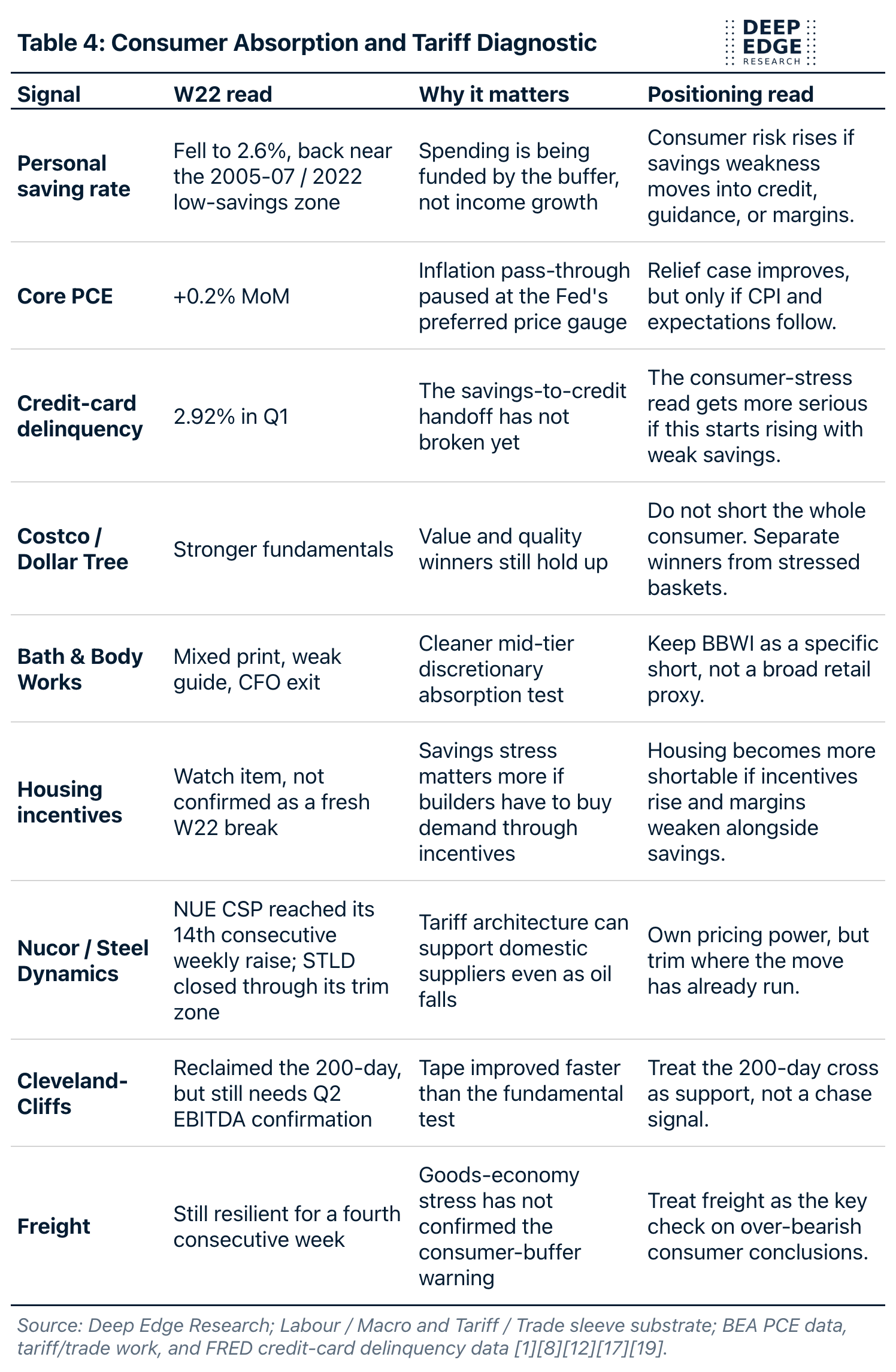
The company-level evidence keeps us honest. Costco (COST) reported strong comps, Dollar Tree (DLTR) beat expectations and raised guidance, and freight held up for a fourth straight week. That is not what a broad consumer unwind looks like. But the pressure test is still live further down the income ladder. Bath & Body Works (BBWI) remains our preferred discretionary short, while Dollar General (DG), Five Below (FIVE), and housing-sensitive names stay on the watchlist rather than moving straight into the short book.
Tariffs add a second layer of pressure. Cheaper oil does not make that problem go away. Core PCE strips out food and energy, so the oil reversal does not weaken the tariff story on its own. That story runs through core goods and domestic pricing power, not crude.
And this is not just a cyclical issue. The durable part of the setup is Section 232 metals protection. Section 122 matters too, because the July 24 expiry and the CAFC merits-decision window are still ahead. That is why metals pricing can stay firm even as oil and rates ease: the energy shock cooled, but the policy support under domestic metals did not.
The metals evidence was concrete. Nucor (NUE) raised its CSP for the 14th straight week to $1,095 a ton. Steel Dynamics (STLD) closed at $260.15, up 14% on the week and through the trim zone we had been watching. Cleveland-Cliffs (CLF) closed at $13.60, above its 200-day near $11.53, but that is still not a reason to chase it. The next step has to be Q2 EBITDA confirmation in late July [8].
So what: the Fed got better market prices, not a clean consumer picture. Cheaper oil and a 10-year below 4.50% help. But a 2.6% saving rate tells us the pressure has moved to the household buffer. The trade is not “short the consumer” across the board. It is to short the places where weaker consumers and tariff pressure are already showing up, keep the upper-tier and value winners separate, and watch closely for any move from savings stress into credit stress.
Conclusion: W22 moved the macro question from input costs to household absorption. Consumers can keep spending even as the cushion underneath them thins. That is why this is not a recession note. It is also why relief is still not proven.
3. AI: infrastructure confirmed, but the software short got narrower
Our view: AI is still the main source of strength offsetting the broader macro squeeze, but W22 made both sides of the AI trade more selective.
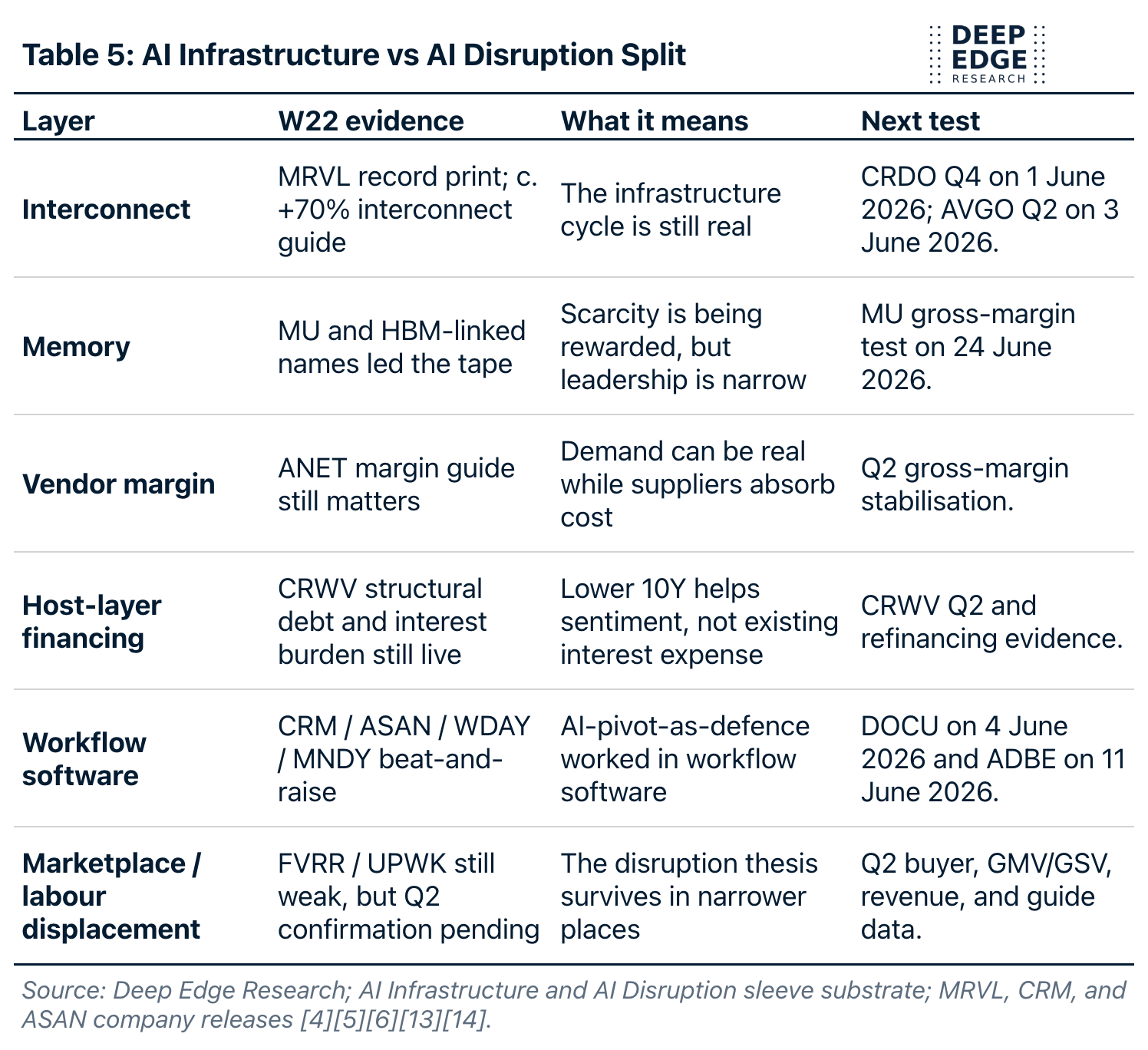
Why: Marvell Technology (MRVL) confirmed that infrastructure demand is still real. At the same time, workflow software showed that the broad “AI kills software” short is too blunt. The message from W22 is not “buy all AI” or “short all software.” It is to be precise about where the economics are still working [13][14].
Bottlenecks
MRVL’s Q1 was the clearest confirmation that the infrastructure buildout is still real. Revenue came in at $2.418 billion, data-centre revenue reached $1.833 billion, FY27 and FY28 guidance moved higher, and the most important number for our work was interconnect guidance of roughly 70% year-over-year growth. That continues to support Broadcom (AVGO), Credo Technology (CRDO), Arista Networks (ANET), and the broader interconnect-and-memory bottleneck thesis [4].
Memory is still the loudest part of the tape. Micron Technology (MU), SK Hynix, Sandisk (SNDK), Seagate (STX), Western Digital (WDC), and Samsung remain the strongest sub-group. That supports the AI infrastructure thesis, but it also tells us leadership is narrowing into memory and interconnect rather than broadening across every AI-linked name. MU’s June 24 gross-margin test matters because the memory trade now has to prove that pricing power is flowing through to reported margins.
Just as importantly, the gap between AI infrastructure winners and AI-disruption losers stopped narrowing in W22. In other words, the market did not suddenly broaden its AI leadership to everything with an AI label.
The move in oil does not invalidate the AI power story either. W22 also gave us a gas-up, oil-down split, with natural gas outperforming crude by a wide margin. That supports the idea that power demand and data-centre load can remain strong even as the crude shock fades.
Financing and margin filter
Lower rates help sentiment. They do not fix balance sheets that were built at a higher cost of capital. CoreWeave (CRWV) still has the structural financing problem we have been watching: interest expense, leverage, and cash-flow conversion still need to improve before we can fully retire the short. Arista Networks (ANET) still has a margin question: demand is real, but gross-margin guidance tells us suppliers may still be absorbing costs to protect growth.
The table below breaks the AI question into three parts: whether bottleneck demand is still converting into revenue, whether financing and margins can support the buildout, and whether software is defending the revenue unit rather than losing it.
Software pushed back
The strongest counter-evidence last week came from software. Salesforce (CRM) and Asana (ASAN) both beat expectations and raised guidance. Workday (WDAY) had already done the same, and monday.com (MNDY) is still trading off its earlier beat-and-raise. That leaves the workflow-software cohort four for four.
Why this matters: our software short was never meant to be a slogan. It was meant to identify the places where AI shrinks the revenue base by reducing seats, simplifying workflows, cutting pricing power, or lowering labour intensity. CRM and ASAN showed the opposite last week. In both cases, AI looked more like a defence than a disruption. CRM defended through revenue, operating margin, and buyback capacity. ASAN defended through its first positive net income and the Stack.ai acquisition.
Ford Motor (F) made the same point from a different angle. The stock stopped trading like a tariff-retaliation name and started trading more like a power-buildout beneficiary, helped by the Ford Energy / EDF Power Solutions battery-storage contract. It closed up 16.8% on the week, which tells us the old label no longer fits. That does not make Ford a core AI infrastructure long. It does show the discipline we want: when the mechanism changes, we reclassify the name rather than forcing it into last week’s framework.
So what: we are still choosing to own the bottlenecks where capex turns into revenue, backlog, memory pricing, interconnect demand, or power contracts. We are still being careful around balance sheets that need debt markets to stay open. And in software, we are not shorting the label. We are short only where AI is clearly shrinking the revenue base.
Conclusion: AI is still offsetting part of the macro pressure, but W22 raised the bar for both longs and shorts. The long book needs cash-flow conversion. The short book needs real evidence that AI is compressing revenue. Anything less is just AI vocabulary.
4. Private credit: dispersion is the point
Private credit is still the part of the article where we have to be most precise. The stress is real in weaker names, but the broader market is still not confirming a full credit event.
Our view: private credit did not heal in W22, but it also did not turn into a system-wide break.
Why: there were no new public BDC results last week to make the underlying picture worse. Blackstone Private Credit Fund (BCRED)’s Q2 tender closed on May 29, but the result will not be known until late June or July. FS KKR Capital (FSK)’s KKR tender expires on June 9. Main Street Capital (MAIN) bounced from its 200-day reference, but it still closed below its 50-day level: $51.21 versus roughly $53.54. Ares Capital (ARCC) and Trinity Capital (TRIN) still matter as comparison names because they argue against broad contagion [7].
The operating read is still dispersion. Weak lenders can keep cracking while higher-quality lenders hold up. That is why lazy “short all private credit” trades are dangerous.
Labour and private credit are now pointing in the same direction, but at different points in the chain. Households are drawing down savings at the front end. Weaker consumer-facing borrowers can show that same pressure later in BDC marks, dividends, and non-accruals. In other words, the consumer-stress channel is now clearly live in private credit, but it is still not systemic.
The damage from W20 still matters. FSK’s NAV fell 9.86% and required KKR support. Carlyle Secured Lending (CGBD) cut its base dividend. Crescent Capital BDC (CCAP) brought healthcare-linked non-accruals into focus. W22 did not reverse any of that. It only gave us a quieter week before the next real Q2 BDC test.
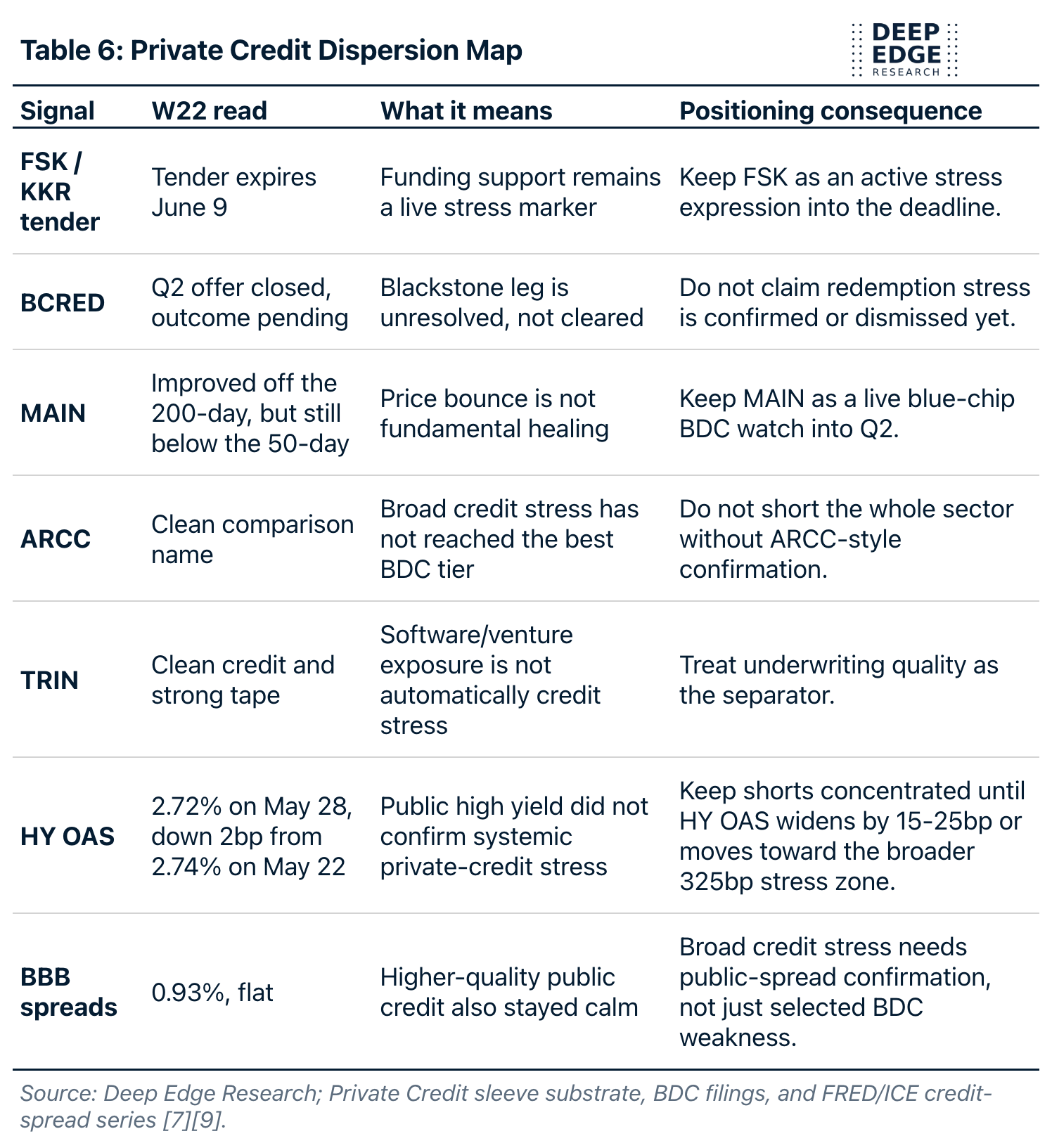
So what: we are still short selected weaker BDCs where the stress is already visible. But we are not turning that into a broad private-credit panic unless public spreads widen, Q2 BDC results deteriorate further, BCRED becomes a real issue, and the higher-quality comparison names start to crack as well. The useful trade here is selection, not sector-wide beta.
Conclusion: private credit is still a concentrated stress trade. W22 made the word systemic harder to defend, not because the old stress disappeared, but because the new evidence still points to dispersion rather than contagion.
Positioning after last week
W22 argues for selective risk with tighter tests. Relief has started in prices. It has not yet proved itself in consumer resilience, margins, or credit.
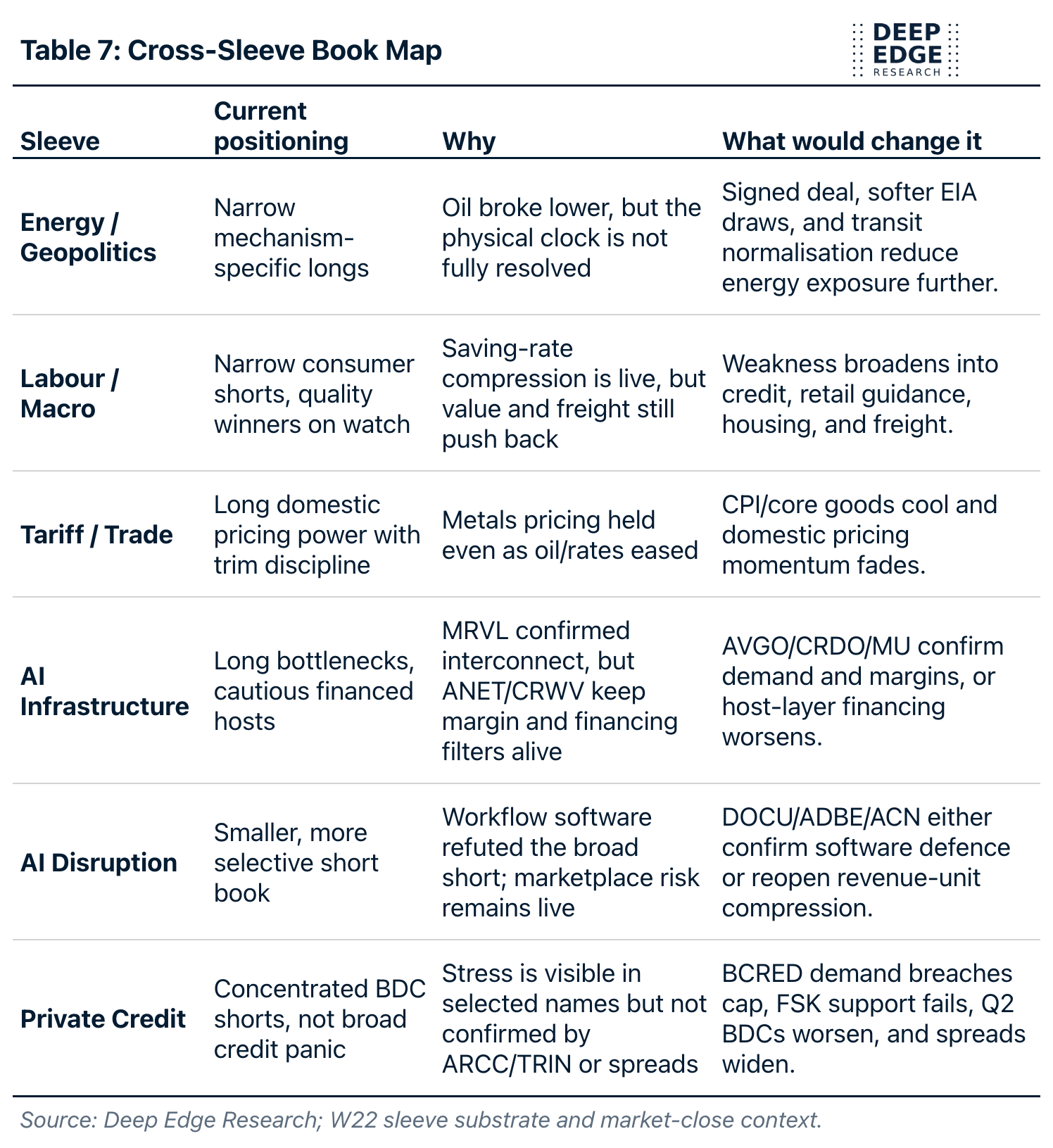
The translation is simple: we are keeping risk where earnings, backlog, pricing power, or cash-flow conversion are visible. Avoid broad beta where the mechanism has weakened. If savings weakness moves into credit, guidance, or margins, the book gets more defensive. If the 10-year reclaims 4.50%, the cost-of-money problem is back.
What we are watching this week
This week is the first test of whether last week’s relief becomes data relief. The calendar matters because the sequence is not random: input prices and AI bottlenecks come first, then inventories, labour, the 10-year close, credit support, CPI, software, and finally the Federal Open Market Committee meeting on 16-17 June 2026 [18].
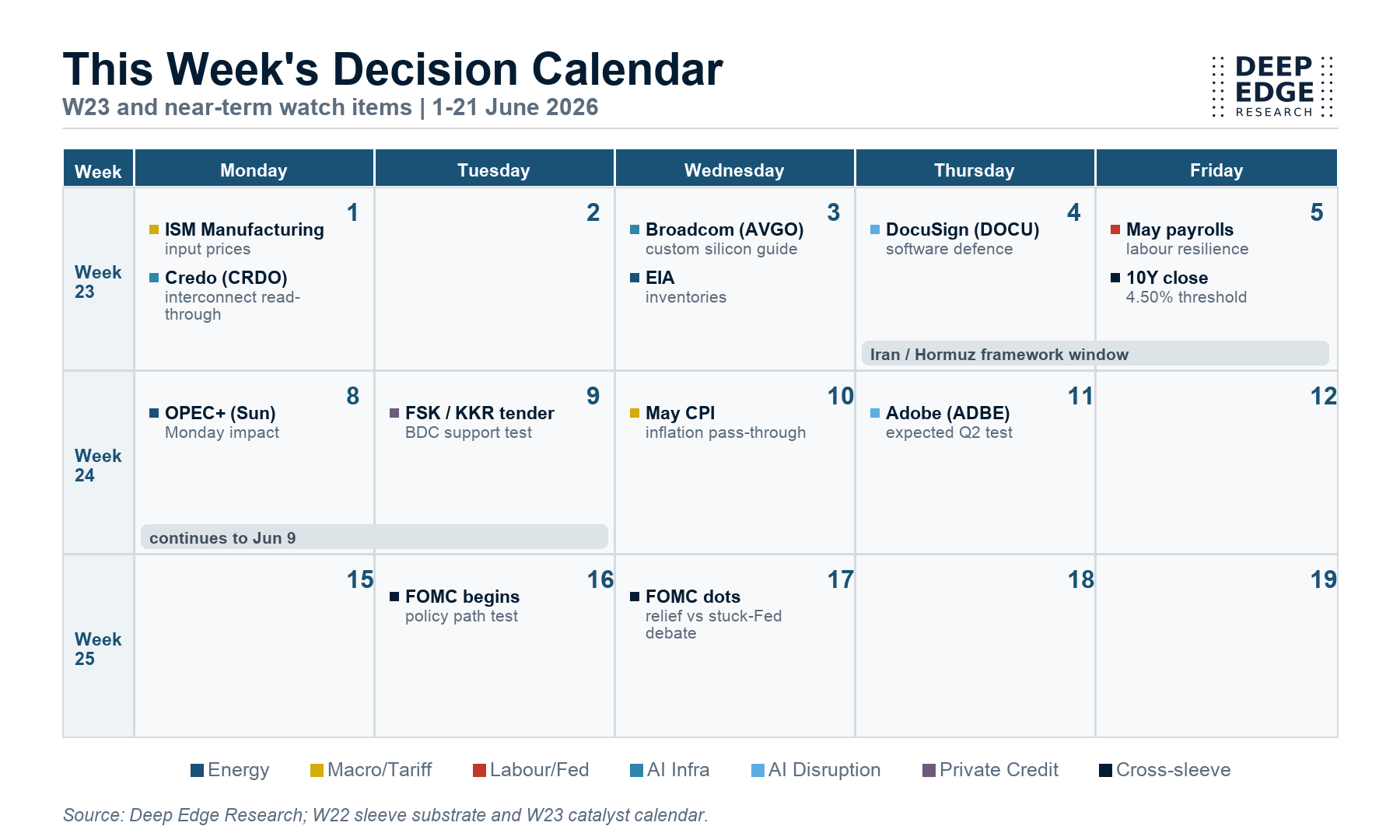
Figure 2: This Week’s Decision Calendar
Source: Deep Edge Research; W22 sleeve substrate and W23 catalyst calendar.
Read the calendar through the same two questions as the old watchboard: what does each item test, and what would it change in the book?
01-Jun: ISM Manufacturing. What it tests: whether input-price pressure is easing after oil fell. Positioning consequence: cooler prices support relief; hot prices keep tariff and goods pressure live.
01-Jun: Credo Technology (CRDO). What it tests: whether Marvell Technology’s (MRVL) interconnect confirmation extends to a smaller pure-play name. Positioning consequence: a strong guide broadens bottleneck confidence; a weak guide makes MRVL look more idiosyncratic.
03-Jun: Broadcom (AVGO). What it tests: custom silicon and interconnect demand. Positioning consequence: a strong AI guide supports bottleneck longs; weakness raises concern after MRVL.
04-Jun: DocuSign (DOCU). What it tests: whether workflow-software defence extends to another name. Positioning consequence: a beat-and-raise narrows software shorts further; weak identity-and-access-management or guide evidence reopens the short.
03-Jun: EIA petroleum inventories. What it tests: whether inventory draws keep decelerating. Positioning consequence: softer draws support energy normalisation; renewed draws revive scarcity risk.
04-09 Jun: Iran / Hormuz framework window. What it tests: whether the reported MOU becomes observable through Trump approval, mine-clearance evidence, Hormuz transit recovery, or sanctions waivers. Positioning consequence: binding evidence supports relief; drift, rejection, or retaliation keeps scarcity optionality live.
05-Jun: May payrolls and the 10-year Friday close. What they test: whether labour resilience is weakening or holding, and whether 4.50% re-fires as the cost-of-money threshold. Positioning consequence: weak labour with low savings raises late-cycle risk; a 10-year close above 4.50% tightens the book.
08-Jun: OPEC+ Monday impact. What it tests: whether the Sunday OPEC+ meeting changes supply expectations when markets reopen. Positioning consequence: more supply supports oil relief; supply caution keeps energy optionality live.
09-Jun: FSK / KKR tender. What it tests: whether sponsor support stabilises the loan book or confirms funding stress. Positioning consequence: weak tender dynamics keep FSK as a high-conviction BDC stress name.
10-Jun: May CPI. What it tests: whether lower oil is passing through into inflation. Positioning consequence: cool CPI supports relief; hot CPI keeps the stuck-Fed risk alive.
11-Jun: Adobe (ADBE), expected Q2 print. What it tests: software revenue-unit risk. Positioning consequence: weak ADBE product or guide evidence reopens the software short.
16-17 Jun: FOMC begins / FOMC dots. What they test: whether the Fed follows the relief trade or keeps the policy path tight. Positioning consequence: the dot plot is the policy version of the whole W22 question: did the pressure actually clear, or did it only move?
Falsification map: what changes the positioning
Relief confirms if:
WTI stays below the broken W19 floor, EIA draws decelerate, the Iran framework becomes binding, and the 10-year stays below 4.50%.
CPI and expectations cool while the saving rate stabilises before credit stress broadens.
AI prints confirm demand without new margin or financing damage.
Pressure returns if:
Oil rebounds on deal failure or renewed physical disruption.
CPI/core goods re-accelerate despite lower crude, or the 10-year reclaims 4.50%.
Savings weakness moves into retail guidance, credit-card stress, housing incentives, or freight weakness.
AI offset weakens if:
AVGO, CRDO, or MU fail to confirm bottleneck demand and margins.
ANET-style margin pressure broadens, or CRWV-style financing stress becomes the dominant AI story.
Software defence keeps broadening and leaves only a handful of true disruption shorts.
Credit stress broadens if:
BCRED demand exceeds the ordinary cap, FSK support fails to stabilise the name, or Q2 BDC prints deteriorate.
HY spreads or lower-quality credit spreads widen enough to confirm public-credit transmission.
Fed communication changes the book if:
A hawkish hold keeps selective risk alive but tight.
An insurance cut only helps if inflation and the long end cooperate.
A hike or higher-dot repricing forces de-risking across housing, debt-funded AI, and private credit.
Conclusion: the relief trade is early because W22 improved the market prices before it proved the macro pass-through. Lower oil and lower yields help. The next proof has to come from CPI, savings, credit, margins, and AI monetisation.
Final thought
The cheapest mistake after W22 is treating lower oil as the answer.
It is only the first leg of the answer. W20 brought the pressure into hard data. W21 showed that lower oil was not enough while the cost of money stayed high. W22 finally gave us lower oil and a lower 10-year, but it also gave us a weaker household buffer.
That is the article. Relief has started in prices. It still has to reach inflation, the consumer, margins, and credit. Until it does, W22 is not a clean relief trade. It is the week the pressure moved from the oil screen to the household balance sheet.
Deep Edge Research © 2026
References
[1] U.S. Bureau of Economic Analysis, Personal Income and Outlays release, April 2026: https://www.bea.gov/news/2026/personal-income-and-outlays-april-2026
[2] U.S. Treasury / FRED, 10-Year Treasury Constant Maturity Rate (DGS10): https://fred.stlouisfed.org/series/DGS10
[3] U.S. Energy Information Administration, Weekly Petroleum Status Report: https://www.eia.gov/petroleum/supply/weekly/
[4] Marvell Technology, Q1 FY2027 earnings release, May 2026: https://investor.marvell.com/news-events/press-releases/detail/1023/marvell-technology-inc-reports-first-quarter-of-fiscal-year-2027-financial-results
[5] Salesforce, Q1 FY2027 earnings release, May 2026: https://www.salesforce.com/news/press-releases/2026/05/27/fy27-q1-earnings/
[6] Asana, Q1 FY2027 earnings release, May 2026: https://asana.com/press/releases/pr/asana-announces-first-quarter-fiscal-2027-results/7fa2e1aa-cab3-4dff-99bd-43e34c888966
[7] Deep Edge Research, W22 Private Credit sleeve substrate and BDC filing review, 2026-W22.
[8] Deep Edge Research, W22 Tariff / Trade Architecture sleeve substrate, Steel Market Update tracking, and metals-pricing work, 2026-W22.
[9] ICE BofA credit-spread series via FRED/ALFRED, including HY OAS and related credit-spread monitoring: https://alfred.stlouisfed.org/series?seid=BAMLH0A0HYM2
[10] Deep Edge Research internal FRED-input regime model, W22 refresh. The model uses public FRED macro inputs across inflation pressure, oil shock, consumer strain, labour resilience, rates, and growth momentum. In W22, stagflation remained the dominant internal regime reading, but the oil-shock input was lagging the spot crude reversal because it uses a three-month rolling oil move. That component still captured the prior oil spike (+49.5% on the model’s rolling window) while live WTI had already broken lower to the W22 Friday close. Treat the model as a Deep Edge diagnostic, not a standalone public FRED series.
[11] Deep Edge Research, W22 Energy / Geopolitics sleeve substrate, 2026-W22.
[12] Deep Edge Research, W22 Labour / Macro Fragility sleeve substrate, 2026-W22.
[13] Deep Edge Research, W22 AI Infrastructure sleeve substrate, 2026-W22.
[14] Deep Edge Research, W22 AI Disruption sleeve substrate, 2026-W22.
[15] Exxon Mobil investor relations, Bernstein Conference Fireside Chat with Neil Chapman, 28 May 2026; MarketScreener report on Chapman inventory comments, 30 May 2026: https://investor.exxonmobil.com/news-events/ir-calendar/detail/20260528-bernstein-conference-fireside-chat and https://www.marketscreener.com/news/exxon-sounds-alarm-on-oil-inventories-sees-brent-hitting-160-ce7f5dd8db8bf024
[16] Chevron advisory for Mike Wirth’s Bernstein 42nd Annual Strategic Decisions Conference fireside Q&A, 28 May 2026; Argus report on Wirth inventory comments, 29 May 2026: https://www.businesswire.com/news/home/20260521136355/en/Advisory-Chevron-to-Participate-in-Fireside-QA-at-Bernstein-42nd-Annual-Strategic-Decisions-Conference and https://www.argusmedia.com/en/news-and-insights/latest-market-news/2833405-us-majors-warn-oil-prices-rise-as-stocks-fall
[17] Federal Reserve Bank of St. Louis / FRED, Delinquency Rate on Credit Card Loans, All Commercial Banks (DRCCLACBS): https://fred.stlouisfed.org/series/DRCCLACBS
[18] Federal Reserve Board, 2026 FOMC meeting calendar: https://www.federalreserve.gov/monetarypolicy/fomccalendars.htm
[19] Federal Reserve Bank of St. Louis / FRED, Personal Saving Rate (PSAVERT): https://fred.stlouisfed.org/series/PSAVERT