
Last week, W21 (18-22 May 2026), gave investors the relief headline they wanted: oil fell hard into the Friday close as ceasefire and framework-deal headlines improved.
That helps the inflation path only if it persists into delivered data; of which we don’t see that happening anytime soon. The 10-year Treasury closed above 4.50%. The 30-year mortgage rate held around 6.5%.
In terms of the 6 sleeves we track: the Energy inventory clock worsened (see later for definition); Tariffs strengthened as a policy and pricing-power sleeve; AI infrastructure still worked, but the financing and margin filters have tightened; and Private credit did not repair; it simply had a quieter week between the W20 damage and the next Q2 BDC test (end of this week).
For us, last week we were asking one question: was lower oil enough to relieve the Fed problem? Our answer is no, not yet.
Fact of the week: the U.S. drew roughly 17.8 million barrels from commercial crude and the SPR combined last week, including about 9.9 million barrels from the Strategic Petroleum Reserve. This (17.8m barrels) was the largest total crude oil inventory drawdown in the history of EIA’s weekly data going back to 1982.
TLDR
Last week was the first real test of the argument we made the week before. Oil fell on ceasefire and negotiation headlines, but the rest of the system did not give the same relief. The 10-year Treasury still closed above 4.50%, mortgage pressure stayed high, tariffs strengthened, and private credit remained under strain. Lower crude helps only if it stays down long enough to change the next inflation prints. It does not undo the higher costs that are already working their way through CPI, PPI, and yields [7][8][10].
Our pressure map still works because the shock did not clear all at once. Oil prices improved first, but the physical oil market and inventory buffer did not improve with them. Some consumer names held up better, but not enough to tell the Fed the inflation pass-through is over. AI infrastructure still provides a real offset, but financing got tighter. And because there were no fresh BDC prints in the week of May 18–22, 2026, the private-credit damage from the prior week still stands.
Our internal regime model, moved in the same direction and stagflation remained the leading regime at 44.8%, down 0.7 points from the prior week, with late-cycle second at 32.5% [11]. The exact decimals matter less than the message: lower oil reduced the pressure slightly, but not enough to change the overall read. Stagflation remains our base case.
What we corrected from W20: the contested zone. TThe biggest correction last week was our read on the 10-year. In the prior week’s note, we leaned too hard on Earl Davis as part of a hawkish threshold around 4.80% to 5.00%. But in a May 22 interview, Davis said he was buying bonds at 4.50%, 4.60%, and nearly 4.70% [12]. That changes the read.
The 4.50% to 4.70% range is not an automatic panic zone. It is the contested zone where real-money buyers start testing whether yields have already done enough tightening. Above 4.80%, the pressure on Fed communication and duration-sensitive assets becomes harder to ignore. At 5.00%, housing, long-duration equities, and debt-funded AI financing are dealing with a different problem.
Positioning after last week stays selective. Own bottlenecks, domestic pricing power, and specific energy mechanisms. Avoid or short weak consumer-absorption names, software companies where AI compresses the revenue unit, and BDCs where stress has moved from theory into accounting evidence. Do not use the Invesco QQQ Trust (QQQ) as an AI shortcut, and do not use broad energy beta as the oil hedge.
Kill switch: if the long end stays above 4.50% while PCE, CPI/PPI, retail margins, and BDC data confirm the pass-through we flagged the week before, the book has to move from selective risk-taking toward de-risking. Lower oil changes that only if it turns into lower inflation, lower yields, and easier funding.
What changed from W20
The week of May 11–15, 2026 (W19) was when the pressure started showing up clearly in the data. CPI, PPI, rates, energy, private credit, tariffs, AI infrastructure, and consumer pressure all began pointing in the same direction. The question then was whether the shock had moved out of headlines and into the real economy. It had.
Last week (W20) complicated that picture. Oil prices fell, but the rest of the system did not clear with them. That matters because the Fed does not get relief from a better oil chart. It gets relief from lower delivered inflation, lower long-end yields, easier funding conditions, steadier margins, and credit that stops getting worse.
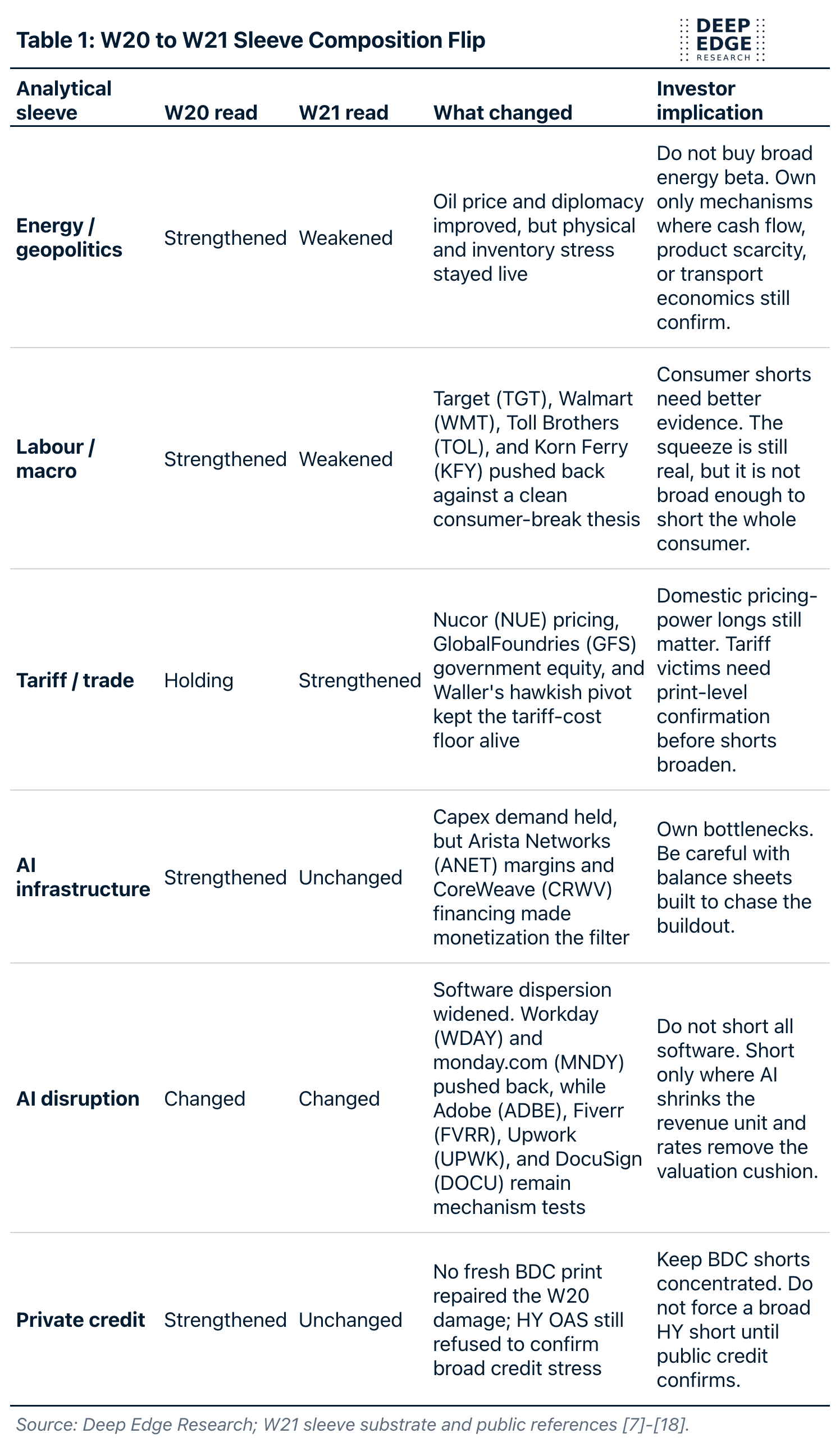
Our 6 sleeve framework tells the story:
Table 1: W20 to W21 Sleeve Composition Flip
Source: Deep Edge Research; W21 sleeve substrate and public references [7]-[18].
The composition flip was the key signal last week. Five of our sleeves cooled or paused, and only one strengthened. But the broader regime did not change, because borrowing costs did not ease.
That is the investor problem after last week. The most obvious inflation input improved, but the rate that matters for duration, housing, private credit, and AI financing stayed restrictive.
There was a second cross-sleeve signal underneath it: leadership changed.
Two weeks ago (W20) was led by the obvious stagflation and scarcity trade: the SPDR S&P Oil & Gas Exploration & Production ETF (XOP), the Invesco Solar ETF (TAN), the VanEck Oil Services ETF (OIH), the iShares S&P GSCI Commodity-Indexed Trust (GSG), and the Amplify Cybersecurity ETF (HACK).
Last week (W21) on the other hand narrowed toward HACK, the iShares U.S. Medical Devices ETF (IHI), the U.S. Global Jets ETF (JETS), the iShares Expanded Tech-Software Sector ETF (IGV), and the SPDR S&P Bank ETF (KBE).
Conclusion: Our read is that this is not a clean recession signal yet. It is the kind of rotation that often appears when investors stop paying for broad reflation and start paying for more defensive or more idiosyncratic quality.
That raises the burden of proof. If oil keeps falling and yields follow, the rotation can become relief. If oil falls but the long end stays high, the rotation is a warning that risk appetite is narrowing before the headline indices admit it.
The easy line is that lower oil does not automatically mean a Fed pivot. That is true, but it is not the useful part. The useful part is the composition flip: five sleeves cooled or paused, tariffs strengthened, leadership narrowed, and the 10-year refused to follow crude lower. That is not simple relief. It is a market that got a better oil headline without getting easier money.
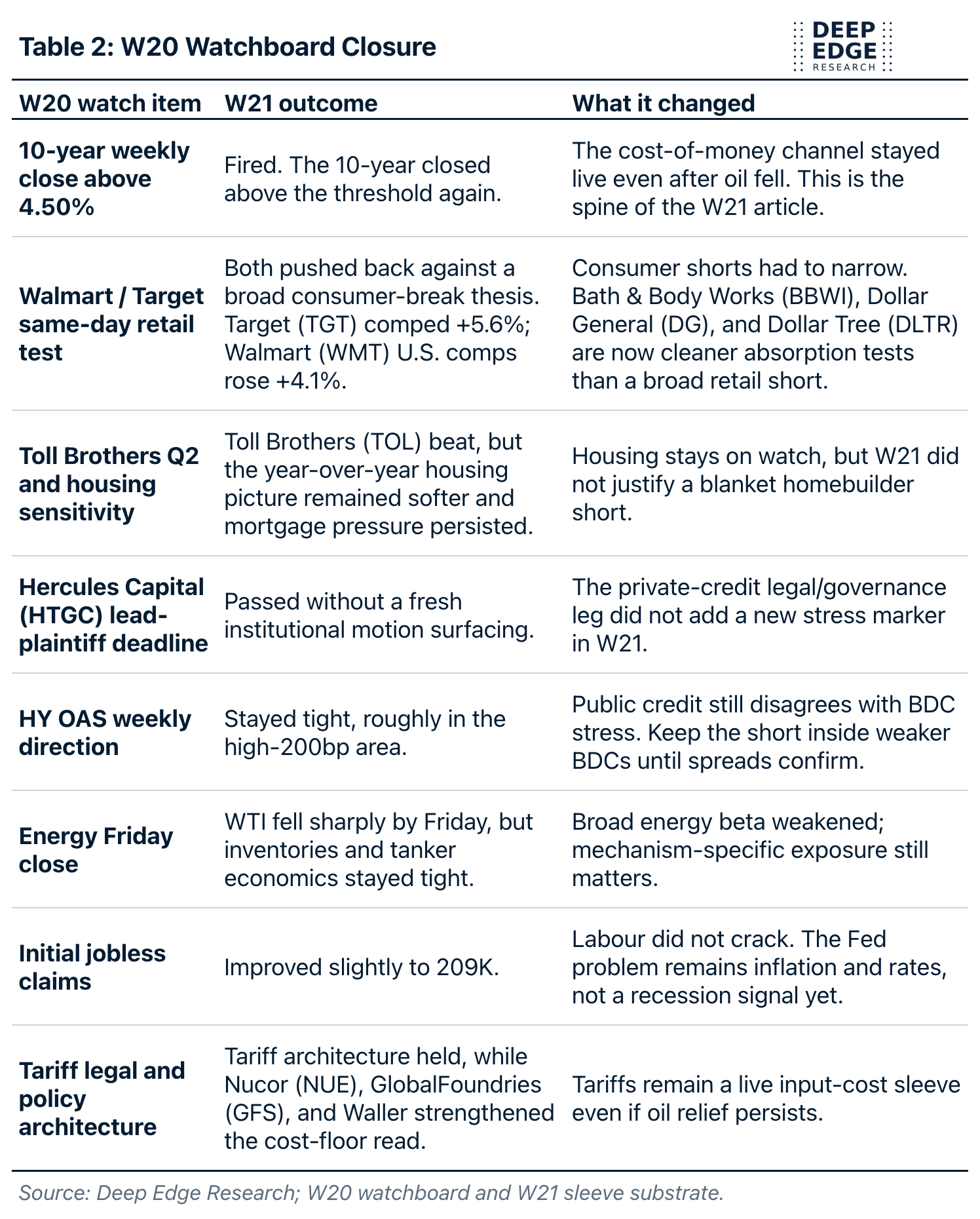
Table 2: W20 Watchboard Closure
Source: Deep Edge Research; W20 watchboard and W21 sleeve substrate.
The setup this week (W22): lower oil is helpful, but it is not the same as lower pressure
The central question for this week (W22) is simple: did last week’s oil reversal take the Fed out of the corner?
Our simple answer - no; it gave the Fed a better headline. It did not yet give the Fed a better data stack.
Oil does not move from the screen to inflation in a straight line. It moves through physical supply, inventories, product prices, transport costs, retail fuel, food and packaging, inflation expectations, margins, and then policy. That chain can take weeks.
It can also break if diplomacy holds, inventories stabilize, domestic supply improves, and gasoline falls before consumers and companies have to absorb another round of cost pressure.
Last week therefore becomes a timing test, not a relief verdict.
Conclusion: The physical oil shock is still visible. Hormuz transits remained severely impaired. The EIA data showed a combined commercial crude and SPR draw of roughly 17.8 million barrels, the largest combined draw in the available EIA series [9]; and also shows how much the economy is unlikely to be able to continue absorbing recuced oil supply.
The tanker market still priced scarcity, with VLCC TD3C rates near $397K/day. The macro screen, however, improved because the oil price fell sharply into Friday. For us as investors, lower crude only helps if it stops feeding the next prints. This week’s tests are PCE, personal saving, retail guidance, consumer confidence, the 10-year Friday close, and whether BDC or AI-financing stress keeps aging underneath.
1. Energy: oil prices improved, but the physical system did not
Our view: last week weakened the energy sleeve at the price and positioning level, but it did not resolve the supply shock underneath. That means energy exposure should be narrower, not abandoned.
Why: the week before showed that the oil shock had started feeding into hard data. Last week showed that oil prices can fall before the physical system is repaired. Those are not the same thing, and the distinction matters for investors.
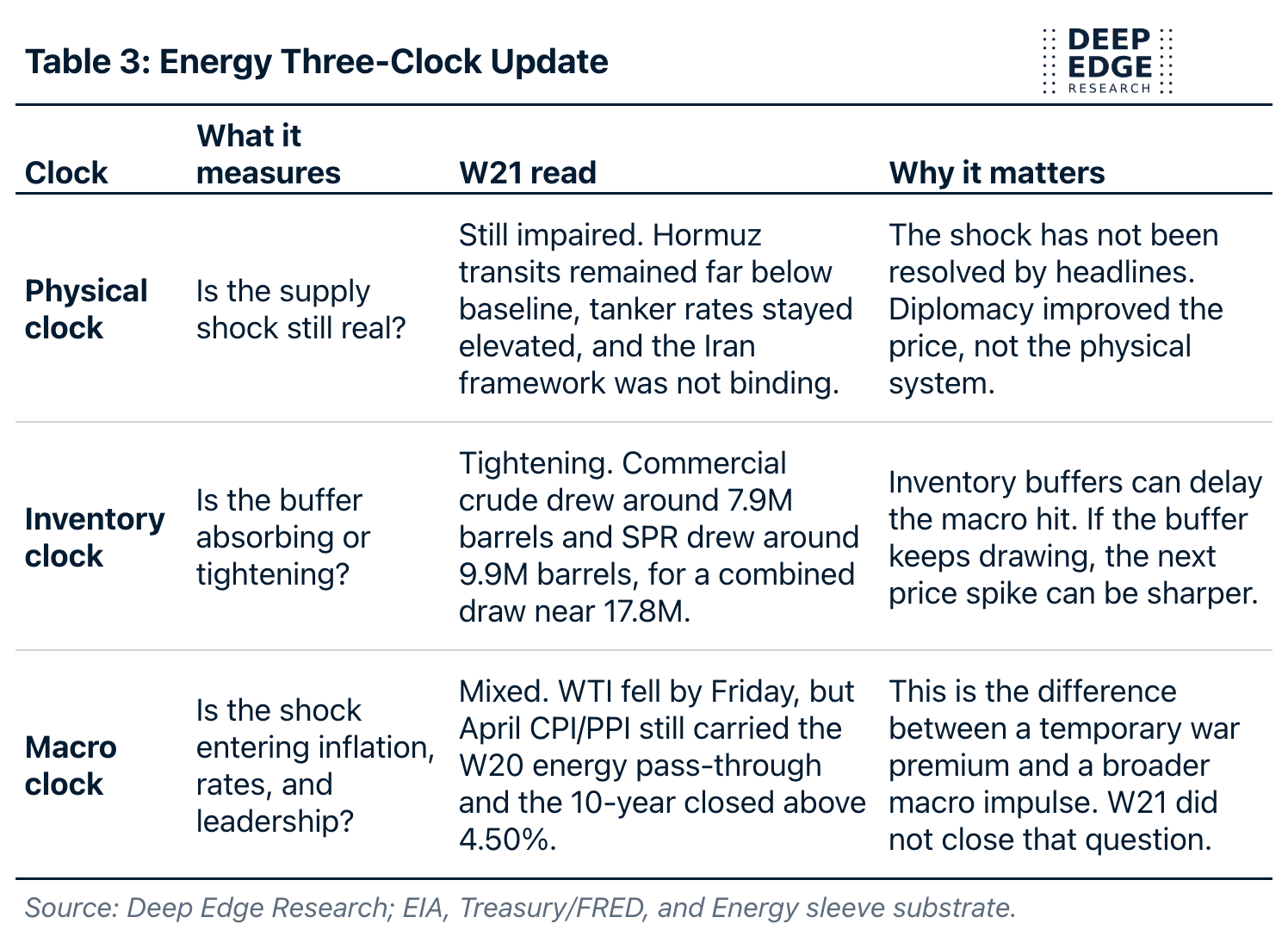
The best way to read the energy sleeve is still the three-clock framework we used the week before: the price clock is the crude screen, the physical clock is supply and transport, and the macro clock is inflation, rates, and equity leadership.
Table 3: Energy Three-Clock Update
Source: Deep Edge Research; EIA, Treasury/FRED, and Energy sleeve substrate.
The energy debate now sits in that gap. Oil prices improved first. The physical system did not. Inventories tightened further. And the macro clock is still waiting for the next inflation and margin prints.
The equity tape also argues against broad exposure.
Among producers, the message was mostly weaker. Devon Energy (DVN) broke its 50-day. Exxon Mobil (XOM) broke its 50-day. ConocoPhillips (COP) stayed below its 50-day. Diamondback Energy (FANG) lost its 20-day, even if it still held medium-term support. EOG Resources (EOG) was the only clean E&P name still above its key moving averages.
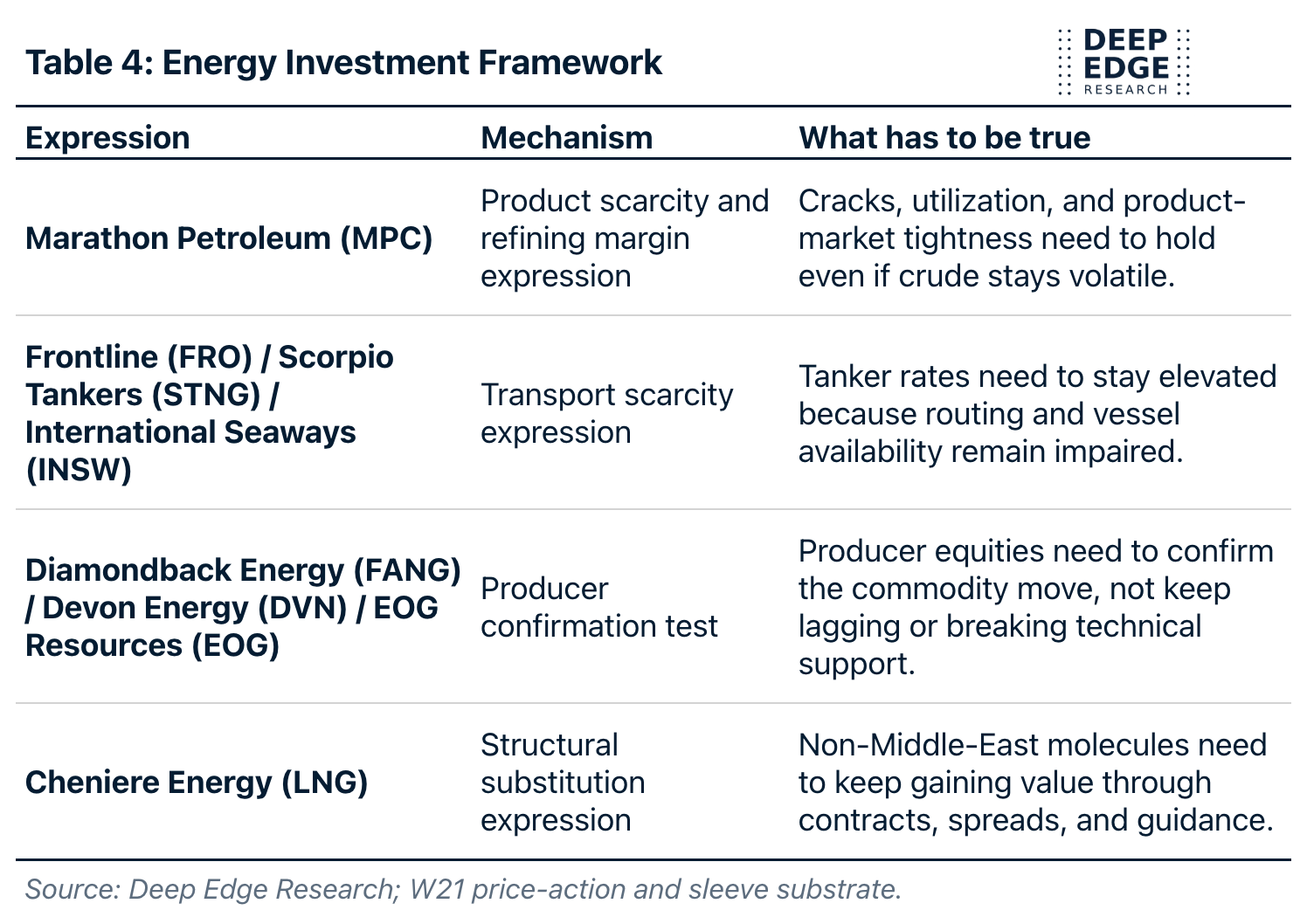
That is why the better expressions remain more specific. If the disruption stays physical rather than broad macro, refiners and tankers still look cleaner than broad E&P beta. Marathon Petroleum (MPC) formally discharged its prior conditional status. Frontline (FRO) still showed strong transport economics in Q1, despite some accounting noise against consensus.
So the energy book should not be “oil down, sell everything” or “oil shock live, buy everything.” It should be split by mechanism.
So what: last week did not make energy irrelevant. It made the expression narrower. If oil stays lower and the physical system repairs, energy exposure should shrink. If inventories keep drawing and transport stays tight, the exposure belongs in refiners, tankers, and only the producers that continue to confirm through the equity tape.
Table 4: Energy Investment Framework
Source: Deep Edge Research; W21 price-action and sleeve substrate.
Conclusion: last week lowered the oil price, not the broader energy problem. Positioning should stay mechanism-specific: refiners and tankers if the physical bottleneck persists, selective producers only where the equity tape confirms, and no broad-beta victory lap until inventories, diplomacy, and rates start moving the same way.
2. Rates, labour, and tariffs: the Fed needs delivered disinflation, not a lower crude screen
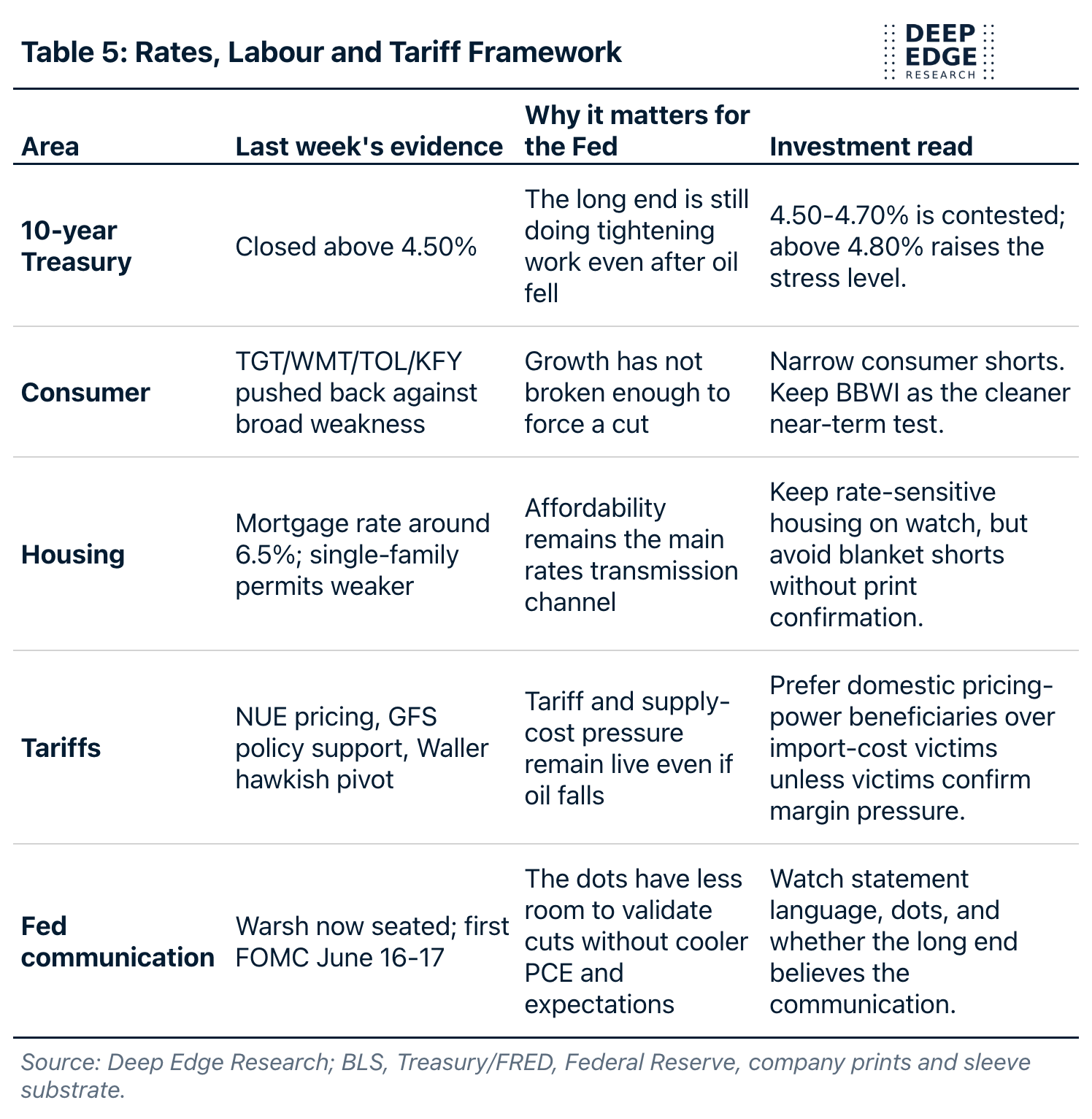
Our view: last week made the consumer-break thesis less clean, but it did not make the Fed’s job easier. Growth has not weakened enough to justify cuts, and costs have not cooled enough to make cuts safe.
Why: the same week gave us firmer consumer evidence and stubborn pressure in the cost of money. That narrows the short book, but it does not create an easing trade.
That is the uncomfortable macro point. Both sides of the Fed debate still have evidence.
The consumer is not broken. Target (TGT) beat, with comparable sales up 5.6% [13]. Walmart (WMT) beat, with U.S. comparable sales up 4.1%, and reaffirmed guidance [14]. Toll Brothers (TOL) beat consensus, even though the year-over-year housing picture was still weaker [15]. Korn Ferry (KFY) reclaimed its 200-day. Initial jobless claims improved slightly to 209,000.
That evidence narrows the short book. We are not going to allocate capital to the short book when the actual prints say the consumer is reallocating, not disappearing.
Table 5: Rates, Labour and Tariff Framework
Source: Deep Edge Research; BLS, Treasury/FRED, Federal Reserve, company prints and sleeve substrate.
So what: But the Fed still has a problem. Walmart (WMT) absorbed higher fuel costs and still grew operating income. Mortgage rates held around 6.5%. The 10-year stayed above 4.50%, which is our first signal that the long end is confirming inflation pressure. The personal saving rate and PCE are still ahead. And tariffs strengthened through policy and supply-chain architecture rather than fading.
Tariffs are why the cost floor no longer depends on oil alone. Nucor (NUE) delivered a 13th straight CSP increase, taking prices to $1,090 per ton. GlobalFoundries (GFS) moved higher on a quantum launch, a $375 million CHIPS letter of intent, and roughly 1% U.S. government equity participation. That equity stake is the important part. It goes beyond announce-the-plant industrial policy and makes the state a direct capital partner in strategic foundry capacity.
Christopher Waller’s May 22 speech made the rate-setting consequence explicit: remove the easing bias, keep hikes on the table if inflation does not cool, and watch PCE closely [16]. For the June 16–17 meeting, the practical implication is simple. The dots have less room to validate near-term cuts unless PCE and inflation expectations cool first. A hawkish hold is now easier to justify than an insurance cut.
That is the Fed trap. If it cuts into supply-driven inflation, it risks validating higher inflation expectations and pushing the long end higher. If it holds too long, it keeps pressure on housing, debt-funded capex, private credit, and lower-income consumers. Last week did not solve that problem. It only made one part of it, oil, look less ugly.
Conclusion: the labour and macro short book has to get narrower and more selective. Target (TGT) cannot stay in the same bucket after that print. Bath & Body Works (BBWI) is cleaner because the May 27 print tests tariff-pressed discretionary demand directly. Dollar General (DG) and Dollar Tree (DLTR) matter because they test lower-income exhaustion. Housing still matters because the 10-year and mortgage rates keep pressuring affordability. Tariff beneficiaries still deserve attention because they are one of the few places where policy friction can turn into pricing power instead of margin damage.
Last week lowered the odds of an immediate consumer break, but it did not create a clean easing setup. The Fed still needs proof that lower oil is turning into lower inflation and lower yields. Until then, the right trade is not broad consumer collapse. It is targeted margin pressure, targeted rate sensitivity, and targeted domestic pricing power.
3. AI: the buildout is still real, but financing matters more now
Our view: AI remains the main offset in our pressure map. The buildout is still real, but last week showed that demand alone is no longer enough. What matters now is where AI spending turns into revenue and cash flow, and where it starts to run into margin pressure, debt service, or customer concentration.
Why: last week confirmed demand in the bottlenecks, but it also showed where the cost of delivering that demand is starting to land: supplier margins, host-layer debt, and software revenue models.
Where bottlenecks are paying off
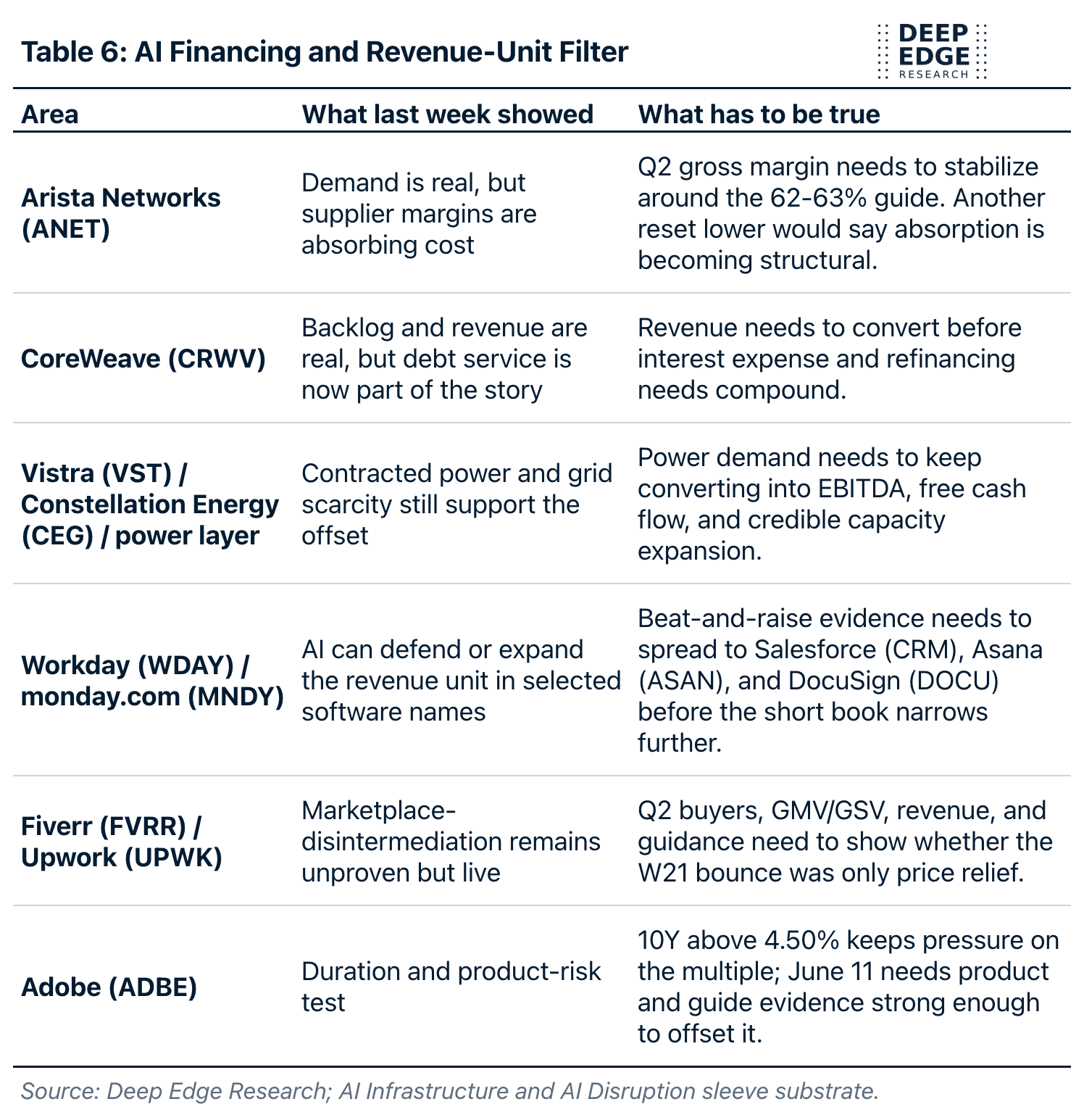
The bullish evidence is still real. Arista Networks (ANET), Vistra (VST), Constellation Energy (CEG), Nebius (NBIS), TeraWulf (WULF), Core Scientific (CORZ), and CoreWeave (CRWV) all support the idea that AI infrastructure demand has not disappeared. High-performance computing hosts, semiconductors, and interconnect led at the sleeve-family level. VST gave one of the clearest confirmations in the AI infrastructure work. WULF moved into the active long sleeve. CEG still has one of the cleaner power-and-cash-flow stories.
Table 6: AI Financing and Revenue-Unit Filter
Source: Deep Edge Research; AI Infrastructure and AI Disruption sleeve substrate.
Where the financing filter tightened
ANET showed where the pressure is landing for suppliers. Demand stayed strong, but the gross-margin guide and Q1 margin level showed that vendors are still absorbing cost to protect customer relationships and keep the growth cycle moving [18]. CRWV showed the same pressure at the host layer. Revenue and backlog were strong, but interest expense doubled year over year, total debt rose to roughly $24.9 billion, and Q1 new debt was about $8.5 billion [17].
That was the AI infrastructure lesson from last week: revenue can beat while the funding structure gets worse.
Software: sort by mechanism
The disruption side of AI tells the same story from the other direction. Workday (WDAY) beat and raised, with AI bookings above 25% of new business. monday.com (MNDY) held its post-earnings gains. That does not weaken the AI-disruption thesis. It sharpens it. The software book has to be sorted by mechanism. If AI expands the revenue unit, shorts come off. If AI compresses seats, workflows, marketplaces, or pricing power, the short book broadens again.
The next tests are Salesforce (CRM), Asana (ASAN), DocuSign (DOCU), and Adobe (ADBE). They will tell us whether the WDAY and MNDY evidence broadens, or whether the relief in Fiverr (FVRR) and Upwork (UPWK) was only a bounce without real repair.
Conclusion: the AI buildout has not broken, but the financing filter has tightened. Own the bottlenecks where AI capex turns into backlog, revenue, contracted power, or cash flow. Be careful with financed-capex shortcuts. In software, do not short the label. Short the revenue-unit problem.
4. Private credit: W20 damage still needs confirmation from public credit
Our view: last week (W21) did not bring a new BDC print that made private credit worse. But it also did not repair the damage from the week before. The right read is still concentrated stress, not a broad credit event.
Why: two weeks ago (W20) produced the real fundamental damage’ whereas, last week (W21) gave us a quieter tape, but no evidence that the damage had reversed. Public credit still has not confirmed the stress, which is why high-yield spreads remain the key arbiter.
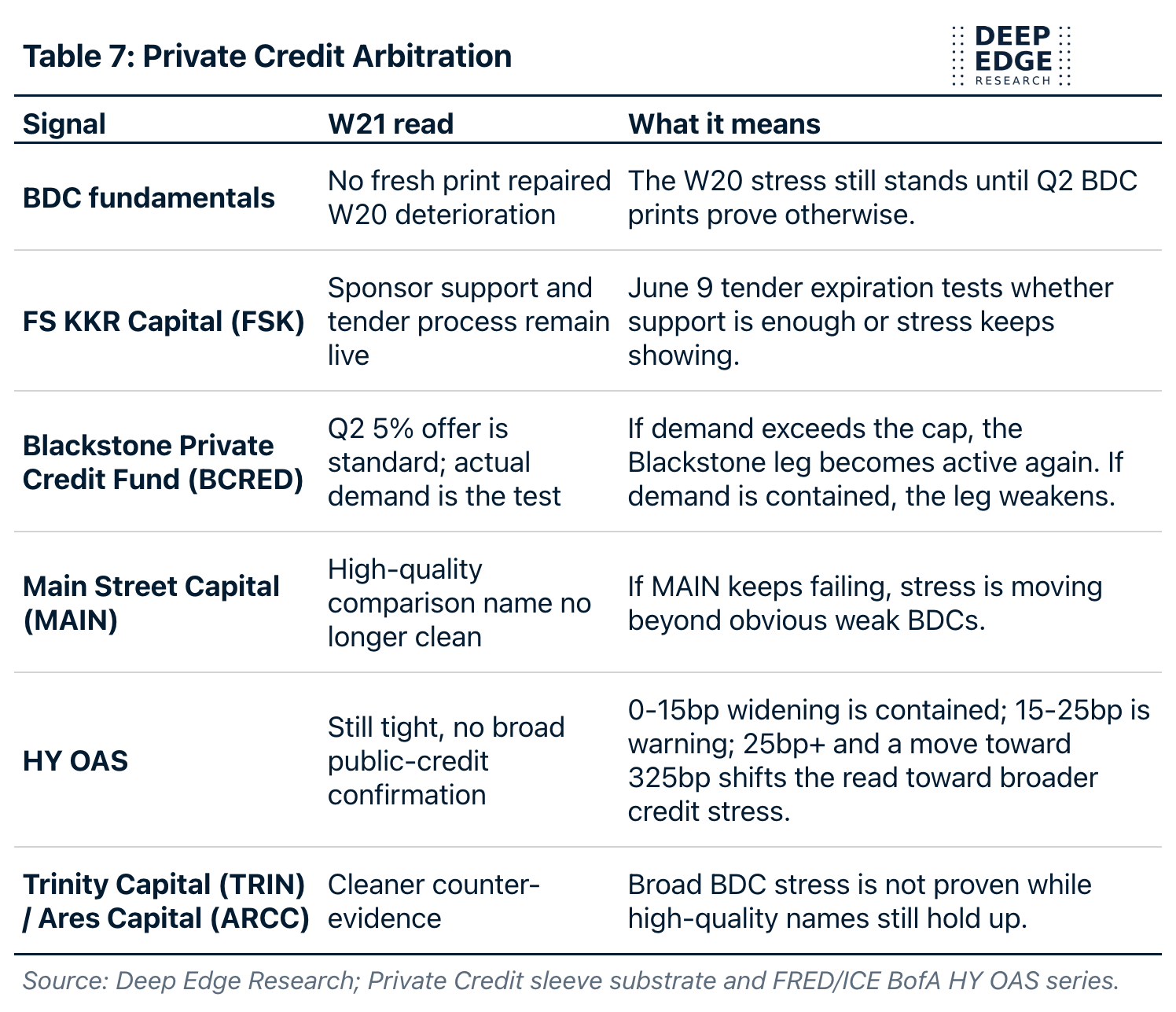
The week of May 11–15 (W20) was the active damage week. FS KKR Capital (FSK), Carlyle Secured Lending (CGBD), and Crescent Capital BDC (CCAP) deteriorated across non-accruals, NAV, dividend coverage, and sponsor support. KKR & Co.’s (KKR) tender for FSK at $11.00, a 41.6% discount to NAV, remains the clearest image from that sleeve. That is not normal-course noise. It is a sign that the loan book needs support.
Last week (W21) was different. Hercules Capital’s (HTGC) May 19 lead-plaintiff deadline passed without a fresh institutional move surfacing. FSK’s tender now runs into June 9. Blackstone Private Credit Fund’s (BCRED) Q2 offer was clarified as a standard 5% repurchase mechanism, with the real test being actual demand against that cap after May 29. No fresh BDC Q1 print arrived to reverse the damage from the prior week.
That means we should not overstate what happened. Private credit did not get worse in the fundamental prints because there were no new fundamental prints. But the sleeve still showed stress in the places that matter. WhiteHorse Finance (WHF) and CCAP moved closer to the active short list. Main Street Capital (MAIN) is no longer a clean high-quality comparison name. Trinity Capital (TRIN) remains the clearest sign that the damage is not yet universal across the BDC space.
Table 7: Private Credit Arbitration
Source: Deep Edge Research; Private Credit sleeve substrate and FRED/ICE BofA HY OAS series.
The disagreement with public credit also remains. High-yield spreads (HY OAS) stayed tight, still roughly in the high-200 basis-point area, and did not confirm broader stress. That is not a reason to ignore what the BDCs are showing. It is the key arbitration. If spreads widen by less than 15 basis points, the stress is still contained. Between 15 and 25 basis points is the warning zone. A sustained move wider than that, and toward 325 basis points, would shift the read from concentrated BDC stress toward broader credit transmission.
Conclusion: The reason this matters for the broader article is rates. The Fed does not need to hike again for private credit to hurt. It only needs to stay restrictive long enough for floating-rate borrowers, BDC dividend coverage, and redemption demand to meet the same high-rate wall.
Lower oil does not help borrowers that still have to refinance, mark assets, cover dividends, and manage redemption demand under a high-rate regime. Keep the BDC shorts specific until HY OAS confirms that the stress is moving into public credit.
Private credit is still a concentrated stress trade, not a market-wide credit event. Keep the BDC shorts live, keep them specific, and let HY OAS decide whether the stress is broadening into public credit. Quiet weeks do not reverse bad prints.
Our book positioning after last week
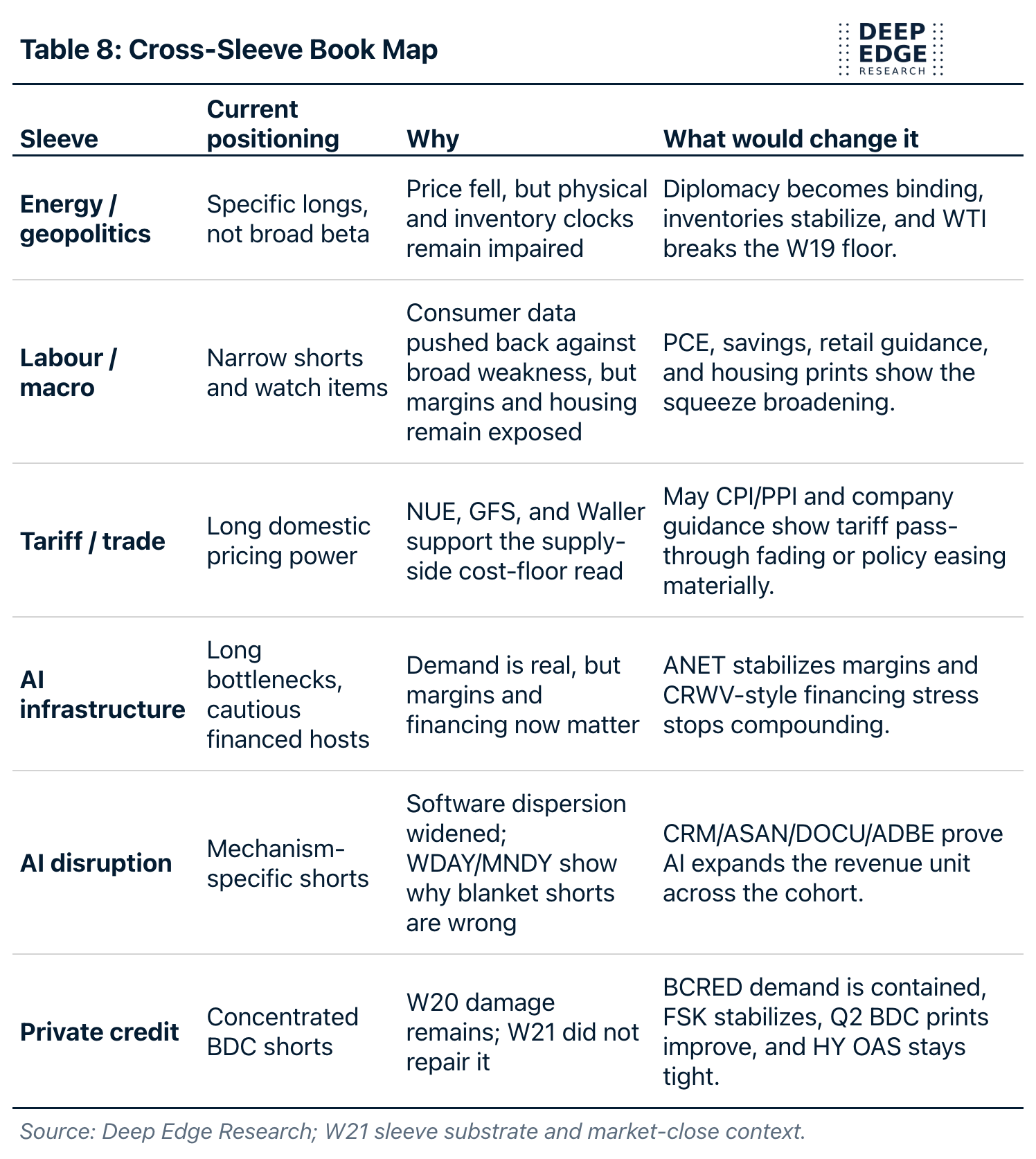
Our positioning after last week stays selective. AI still provides a real offset, and the consumer did not break cleanly enough to justify a broad risk-off turn. But the margin for error is smaller because long-end yields stayed high, tariffs strengthened, and the oil pass-through story has not gone away.
Table 8: Cross-Sleeve Book Map
Source: Deep Edge Research; W21 sleeve substrate and market-close context.
Position summary:
Keep long exposure in bottlenecks that convert demand into revenue, in power, in domestic pricing power, and in energy expressions with direct cash-flow transmission.
Keep short exposure in consumer names where margins are absorbing the pressure, in software models where AI compresses the revenue unit, and in BDCs where accounting stress has already appeared.
Do not chase broad risk just because oil fell. The long end is still setting the terms. But do not de-risk everything either. AI capex and selected earnings support are still strong enough to keep risk on the page.
What we are watching this week
This is not just another catalyst week. It is the first real test of whether last week’s oil relief turns into relief in the data.
Table 9: This Week’s Watchboard
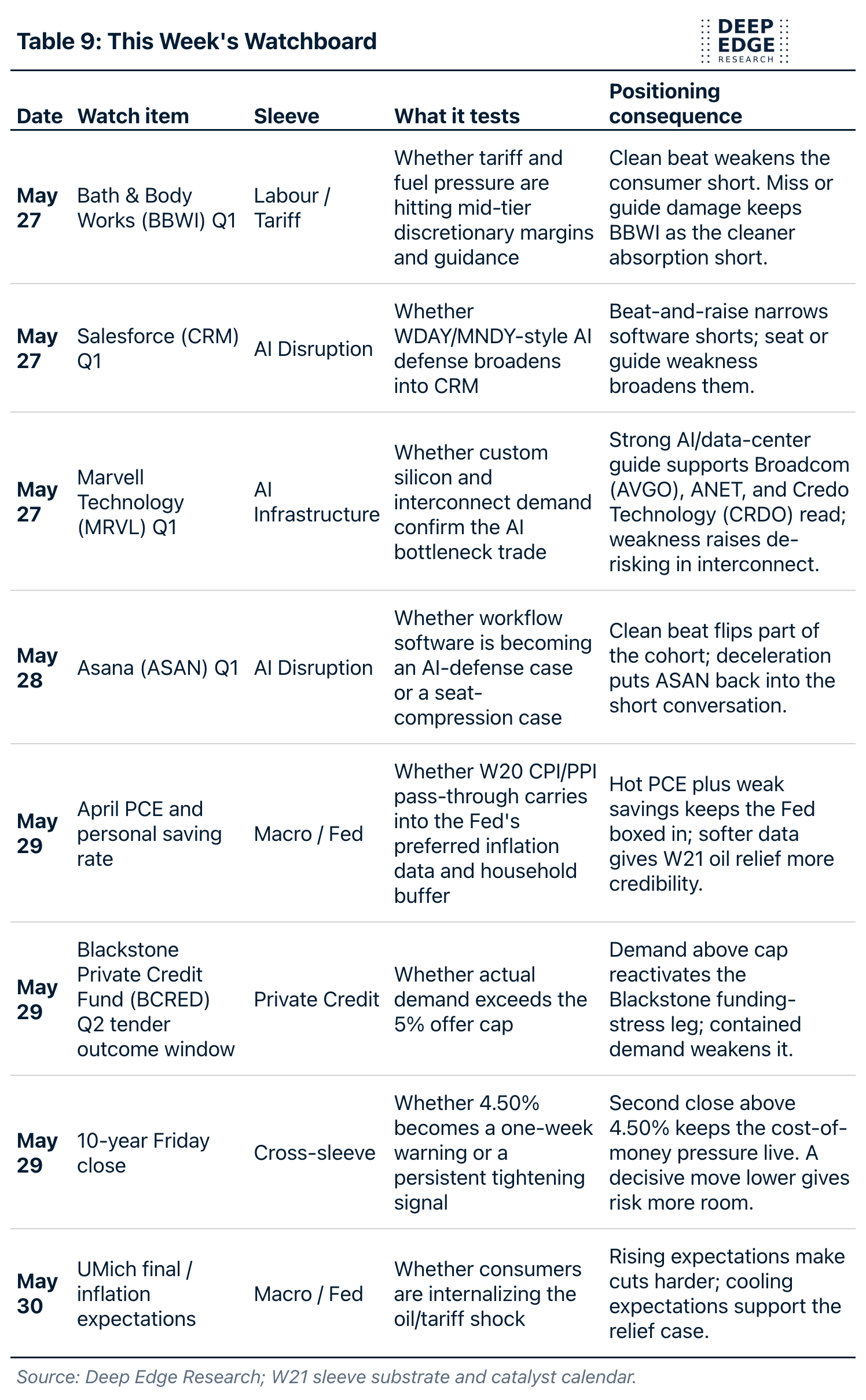
Source: Deep Edge Research; W21 sleeve substrate and catalyst calendar.
Falsification map: what would change the positioning
This week will tell us whether the current positioning still holds. We are watching five tests.
Relief case: lower oil needs to show up as lower PCE, softer inflation expectations, stabler inventories, and a 10-year that falls back below 4.50%. If that happens while Bath & Body Works (BBWI), Salesforce (CRM), Asana (ASAN), and Marvell Technology (MRVL) avoid fresh damage, selective risk can stay on.
Pressure case: if WTI rebounds, inventories keep drawing, tariffs keep feeding through, and the long end refuses to fall, especially alongside hot PCE or weak retail guidance, then last week’s oil relief was only a break in the price, not a change in the problem.
AI-offset case: AI capex still has to turn into backlog, revenue, power contracts, and cash flow. If ANET-style margin pressure broadens or CRWV-style financing strain becomes the dominant story, the AI offset becomes less protective.
Credit case: private-credit stress can stay contained only if BDC damage remains concentrated and high-yield spreads stay tight. If BCRED demand pushes past the cap, FSK support fails to steady the name, Q2 BDC prints worsen, and HY OAS widens through the macro data cluster, the book has to de-risk.
Fed communication case: a hawkish hold keeps the book selective but tight. An insurance cut would reopen duration and consumer relief. A hike, or even a higher dots path, would force de-risking across housing, debt-funded AI, and private credit.
Conclusion: last week gave the market a lower oil price, not a completed relief cycle. The book can still carry selective risk because AI demand is real and the consumer did not crack cleanly. The next move now belongs to the data: PCE, savings, retail guidance, software prints, BCRED demand, and whether the 10-year can fall back below 4.50%.
Final thought
Last week lowered the most visible input cost, but it did not lower the hurdle rate for risk. That is the distinction the portfolio has to respect.
If this week brings cooler PCE, an easing savings squeeze, contained prints from Bath & Body Works (BBWI), Salesforce (CRM), Marvell Technology (MRVL), and Asana (ASAN), no breach in Blackstone Private Credit Fund (BCRED) demand, and a 10-year back below 4.50%, then the oil move starts to look like real relief. In that case, the book can stay selective with more confidence: bottlenecks, domestic pricing power, and specific energy mechanisms still work.
If those tests fail, crude has not solved the problem. The pressure has simply moved from the oil screen into margins, financing costs, and credit marks. In that setup, lower oil is a headline, not relief.
Deep Edge Research © 2026
References
[1] Deep Edge Research, W21 Energy / Geopolitics sleeve substrate, 2026-W21.
[2] Deep Edge Research, W21 Labour / Macro Fragility sleeve substrate, 2026-W21.
[3] Deep Edge Research, W21 Tariff / Trade Architecture sleeve substrate, 2026-W21.
[4] Deep Edge Research, W21 AI Infrastructure sleeve substrate, 2026-W21.
[5] Deep Edge Research, W21 AI Disruption sleeve substrate, 2026-W21.
[6] Deep Edge Research, W21 Private Credit sleeve substrate, 2026-W21.
[7] U.S. Bureau of Labor Statistics, Consumer Price Index news release, April 2026: https://www.bls.gov/news.release/cpi.htm
[8] U.S. Bureau of Labor Statistics, Producer Price Index news release, April 2026: https://www.bls.gov/news.release/ppi.htm
[9] U.S. Energy Information Administration, Weekly Petroleum Status Report: https://www.eia.gov/petroleum/supply/weekly/
[10] Treasury/FRED rate series used for DGS10, 10Y/2Y, mortgage-rate, and HY OAS monitoring: https://fred.stlouisfed.org/series/DGS10, https://fred.stlouisfed.org/series/MORTGAGE30US, https://fred.stlouisfed.org/series/BAMLH0A0HYM2
[11] Deep Edge Research internal FRED-input regime model, W21 refresh. The model uses public FRED macro inputs across inflation pressure, oil shock, consumer strain, labour resilience, rates, and growth momentum. In W21, stagflation remained the dominant state while late-cycle gained share; this is our internal regime model, not a standalone public FRED series.
[12] Deep Edge Research transcript note from Earl Davis, BMO Global Asset Management, May 22, 2026 interview.
[13] Target Corporation, Q1 2026 earnings release, May 20, 2026: https://corporate.target.com/news-features/article/2026/05/q1-2026-earnings
[14] Walmart Inc., Q1 FY27 earnings release, May 21, 2026: https://corporate.walmart.com/content/dam/corporate/documents/newsroom/2026/05/21/walmart-releases-q1-fy27-earnings/q1-fy27-earnings-release.pdf
[15] Toll Brothers, FY 2026 second-quarter earnings release, May 19, 2026: https://investors.tollbrothers.com/~/media/Files/T/toll-brothers-ir-v2/documents/press-release/2026/tol-q2-2026-earnings.pdf
[16] Federal Reserve, Governor Christopher Waller speech, May 22, 2026: https://www.federalreserve.gov/newsevents/speech/files/waller20260522a.pdf
[17] CoreWeave, Q1 2026 earnings release / SEC exhibit, May 7, 2026: https://www.sec.gov/Archives/edgar/data/1769628/000176962826000220/coreweave1q26earningspress.htm
[18] Arista Networks, Q1 2026 earnings release and earnings-call transcript, May 5, 2026: https://investors.arista.com/Communications/Press-Releases-and-Events/Press-Release-Detail/2026/Arista-Networks-Inc–Reports-First-Quarter-2026-Financial-Results/