
Last week, September’s results made us more bullish on AI infrastructure.
This week, OpenAI’s apparent revenue gap and Samsung Electronics’ (005930.KS) preliminary disappointment challenged the demand behind those profits.
Thursday alone cost our portfolio c. 3.1 percentage points. Friday’s rebound passed Micron Technology (MU) and SanDisk Corporation (SNDK) by.[1]-[5][17]
Our read is that fear of weaker AI demand drove much of Thursday’s selling in memory and compute. Samsung gave investors a genuine reason to question how long exceptional profits can last: it missed the pre-announcement consensus on both revenue and operating profit.
But OpenAI’s revenue comparison is not like-for-like, and customers are still signing for capacity. We think those commitments and our suppliers’ guidance justify keeping our money invested, even as the Samsung miss strengthens the case for caution.[2]-[7][39]
We finished down c. 3.0% on price, against c. +1.2% for the SPDR S&P 500 ETF Trust (SPY), a c. 4.1-point shortfall on the same Monday-open-to-Friday-close window.[1] That loss deserves an explanation, and our decision to hold deserves a business case.
TLDR
Thursday did the most damage, and Friday’s rebound skipped memory and flash. The hard-disk drive (HDD) holdings were already weaker: Seagate Technology (STX) had fallen c. 7.8% and Western Digital (WDC) c. 5.8% before Thursday. The demand scare then hit memory and compute; Micron and SanDisk kept falling on Friday.[1]-[3]
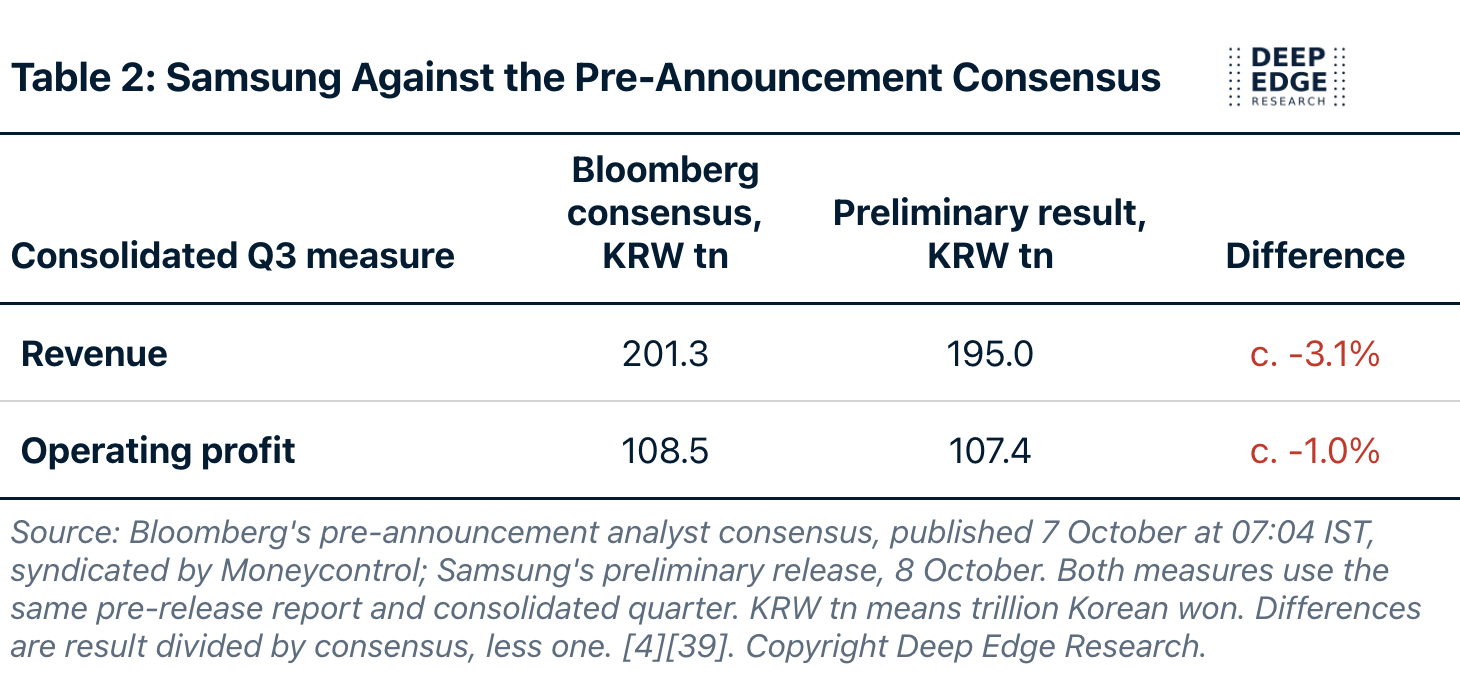
Samsung missed; a collapse in demand is a different claim. Revenue fell c. 3.1% short of Bloomberg’s pre-release analyst consensus and operating profit c. 1.0%. That matters. OpenAI’s figures reportedly count different revenue, while TrendForce still forecasts rising Q4 memory contract prices, with faster increases in enterprise solid-state drives (SSDs).[2][4][31][39]
The buildout still has buyers. Google’s existing-output and incremental-capacity agreements, plus Anthropic’s earlier procurement, support demand beyond OpenAI. Customers are committing to years of capacity.[6][7]
Our decision: hold every position, no purchases, c. 20.6% cash. WDC reports on 22 October: pricing growth above 5% year on year and gross margin (the share of sales left after production costs) above 50% remain our bars. An HDD add review needs prices of c. $747 for Seagate or c. $396 for WDC, with that company’s operating tests passing.[14][15][30]
What Changed Since W40
Our view: September strengthened our conviction in the suppliers. W41 challenged how long their earnings can last. We still favour the businesses; the coming pricing, orders and funding results must support that judgement.
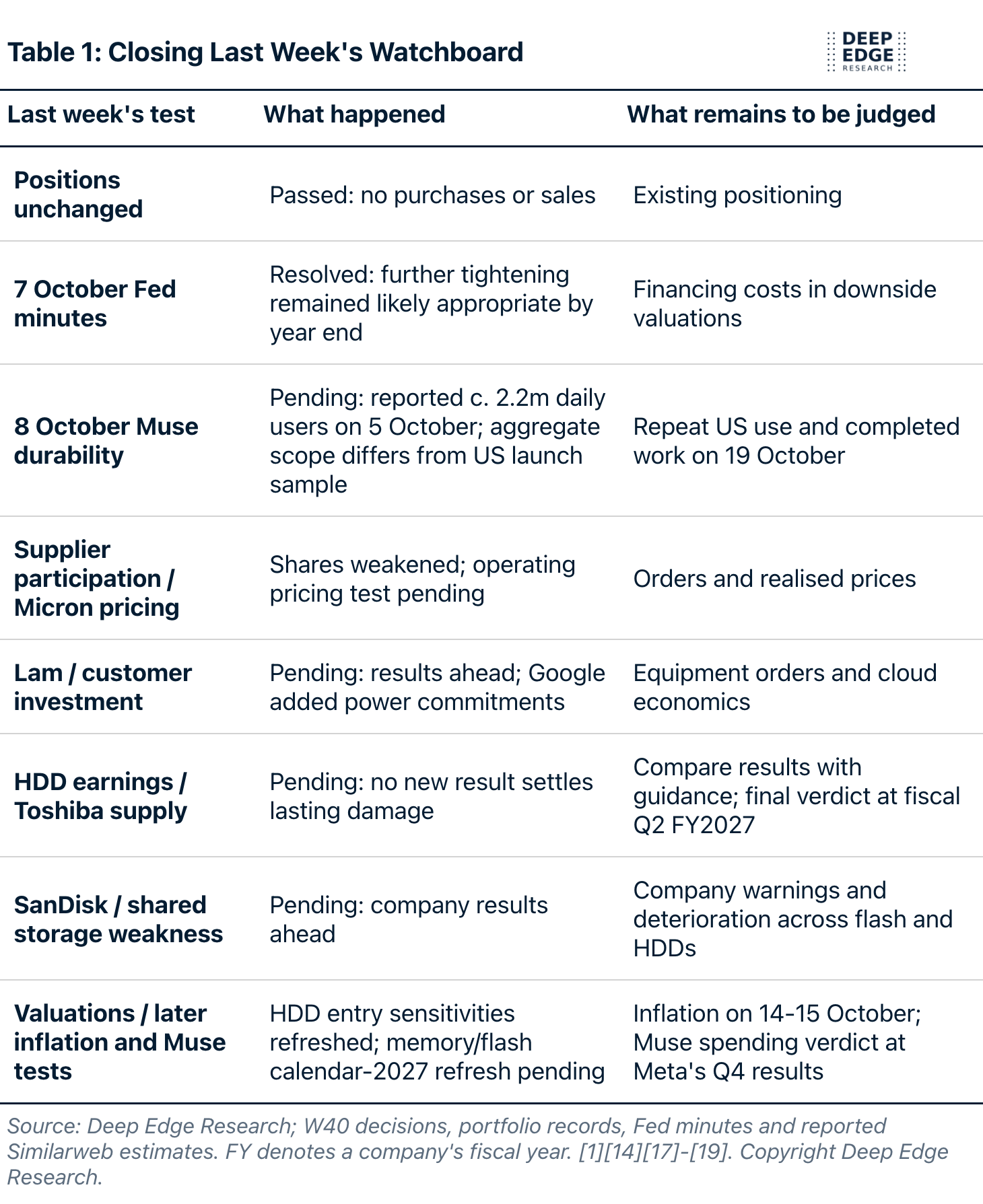
W40, September Just Made Our AI Case More Bullish, found broader operating support for the buildout. This week asks whether that demand will keep paying our suppliers at the prices and margins we expect. Table 1 shows where last week’s tests stand.[14][17]
Toshiba’s supply announcement still needs an earnings-damage verdict. Muse, Meta Platforms’ (META) personal AI agent, still needs to turn repeat use into infrastructure spending. Share prices cannot settle either call.[10][14][17]
Table 1: Closing Last Week’s Watchboard
Source: Deep Edge Research; W40 decisions, portfolio records, Fed minutes and reported Similarweb estimates. FY denotes a company’s fiscal year. [1][14][17]-[19]
The Fed minutes preserve our financing hurdle. The reported Muse user count does not match the earlier US sample, so the retention test stays open.[14][18][19]
Conclusion: Neither outstanding call has earned a win. The HDD valuation refresh identifies when to revisit an entry; supplier results must show whether the businesses still warrant our money.
1. Why We Are Holding Through the Demand Scare
Our view: Samsung’s miss makes the concern about lasting memory profits more credible. We still think an industry-wide demand-collapse reading goes too far: OpenAI’s revenue comparison is not like-for-like, and Micron’s guidance and the contract-price outlook support our holdings. We are keeping the positions, but Samsung must now show where the shortfall came from and what it means for future earnings.
The concern is serious. CNBC reported AI-stock selling around OpenAI; Investopedia reported memory and storage weakness after Samsung’s disappointment.[2][3] Fewer paying customers at a leading lab would matter well beyond its own revenue.
Less paid work would need less compute. Even with growing usage, weaker monetisation could make expansion harder to finance. Lower cloud utilisation or delayed purchases could then mean fewer hardware orders and weaker supplier pricing. That is how a lab’s revenue problem could become our holdings’ earnings problem.
Samsung appeared to reinforce that concern. With the profits already priced into our holdings, growth need only slow to cause damage. So we need to establish what each report measures.
OpenAI: what the revenue gap measures
CNBC reported that it had confirmed c. $50bn of annualised revenue at September’s end, against c. $68bn circulated earlier. Annualised means a year’s revenue at the current rate, not cash available to spend. CNBC’s source said the higher figure included gross partner revenue; CNBC credited the Financial Times with first reporting the lower figure.[2]
On that account, the c. $18bn difference is not like-for-like lost sales. CNBC also reported 77% Q3 growth in the total revenue run rate, attributed to the investor presentation. Without an audited reconciliation, these remain attributed private figures.[2]
The financing question remains, but the revenue gap is weaker evidence of lost demand. Samsung provides the separate supplier test.
Samsung: a real miss, with the memory outlook still to come
Samsung missed the pre-announcement analyst consensus. Bloomberg’s report published on 7 October, before the release, put expected Q3 revenue at 201.3 trillion Korean won (KRW) and operating profit at KRW 108.5tn. Samsung’s 8 October preliminary figures came in below both.[4][39]
Table 2: Samsung Against the Pre-Announcement Consensus
Source: Bloomberg’s pre-announcement analyst consensus, published 7 October at 07:04 IST, syndicated by Moneycontrol; Samsung’s preliminary release, 8 October. Both measures use the same pre-release report and consolidated quarter. KRW tn means trillion Korean won. Differences are result divided by consensus, less one. [4][39]
Both missed. Nearly ninefold year-on-year profit growth does not make that disappointment disappear.[5] It strengthens the concern that today’s exceptional earnings may not last: a modest quarterly shortfall can matter if it is the first sign of a weaker pricing cycle.
We still think reading this result as a collapse in AI demand goes too far. The consolidated figures do not locate the revenue weakness in memory volumes, pricing or Samsung’s other businesses. The division results and outlook on 29 October must do that work. If they show weaker memory pricing, rising inventory or a softer forward outlook, that would weaken our holding case; record group profit would not excuse it.[4][20]
Micron gives us a direct baseline. On 30 September it reported c. $54.2bn of fiscal fourth-quarter revenue and guided the next quarter to c. $61.5bn at the midpoint, with adjusted gross margin moving from 87.0% to 86.3%.[21] That supports strong demand entering W41, with some margin pressure despite the revenue growth.
The contract-price outlook also matters to Micron and SanDisk. TrendForce’s 30 September forecast puts Q4 conventional DRAM prices up 10-15% on the quarter and NAND flash up 15-20%. DRAM provides working memory; NAND retains data when the power is off. Conventional DRAM increases are slowing, but enterprise SSD price growth is expected to accelerate as cloud buyers add demand and much of the additional supply is already committed.[31]
The spot evidence is mixed: a standard DDR4 DRAM quote rose c. 0.2% from Monday to Thursday in thin trading; a NAND wafer quote in the 5 October update was down 2.9% from its previous reading.[32]-[34] These are different products from the enterprise contracts, without matched Friday observations for a full-week comparison.
We therefore give more weight to the contract outlook, then require company results to confirm realised pricing and the forward earnings case.
Conclusion: Samsung’s miss raises the risk that exceptional memory profits will fade sooner than expected. We are keeping Micron and SanDisk because their operating evidence and the contract-price outlook still support the positions. The 29 October disclosures must test that judgement. We think the industry-wide demand scare goes beyond what this result establishes; a weaker forward pricing outlook would give us a reason to change our mind.
2. Customers Are Still Signing for Capacity
Our view: We think Google’s power agreements and Anthropic’s compute procurement strengthen the case that demand extends beyond OpenAI. They also broaden our opportunity set: operating generators can earn from existing output while the larger buildout is still being financed and constructed.
A revenue comparison at OpenAI cannot settle industry demand. We also want to see what other customers are committing to buy.
On 6 October, Google and Constellation Energy (CEG) announced 20-year agreements for 890 megawatts (MW) of additional output at 11 existing nuclear units, plus 15-year agreements for 2,700MW of existing output. Constellation plans more than $4.3bn of investment; the first additional output is expected in 2028.[6]
An uprate increases an existing plant’s output. Google is securing both current power and future expansion. Existing output can earn sooner; the uprates support the longer-term buildout without guaranteeing demand next quarter.
Anthropic adds a different customer and a different kind of capacity. On 24 September, Akamai Technologies (AKAM) announced its $11.6bn, seven-year agreement for general-purpose processor workloads, with an additional $1.7bn of 2026 component investment expected, including memory.[7] That agreement predates W41. It still matters when we ask whether one lab’s revenue report should change our view of the whole buildout.
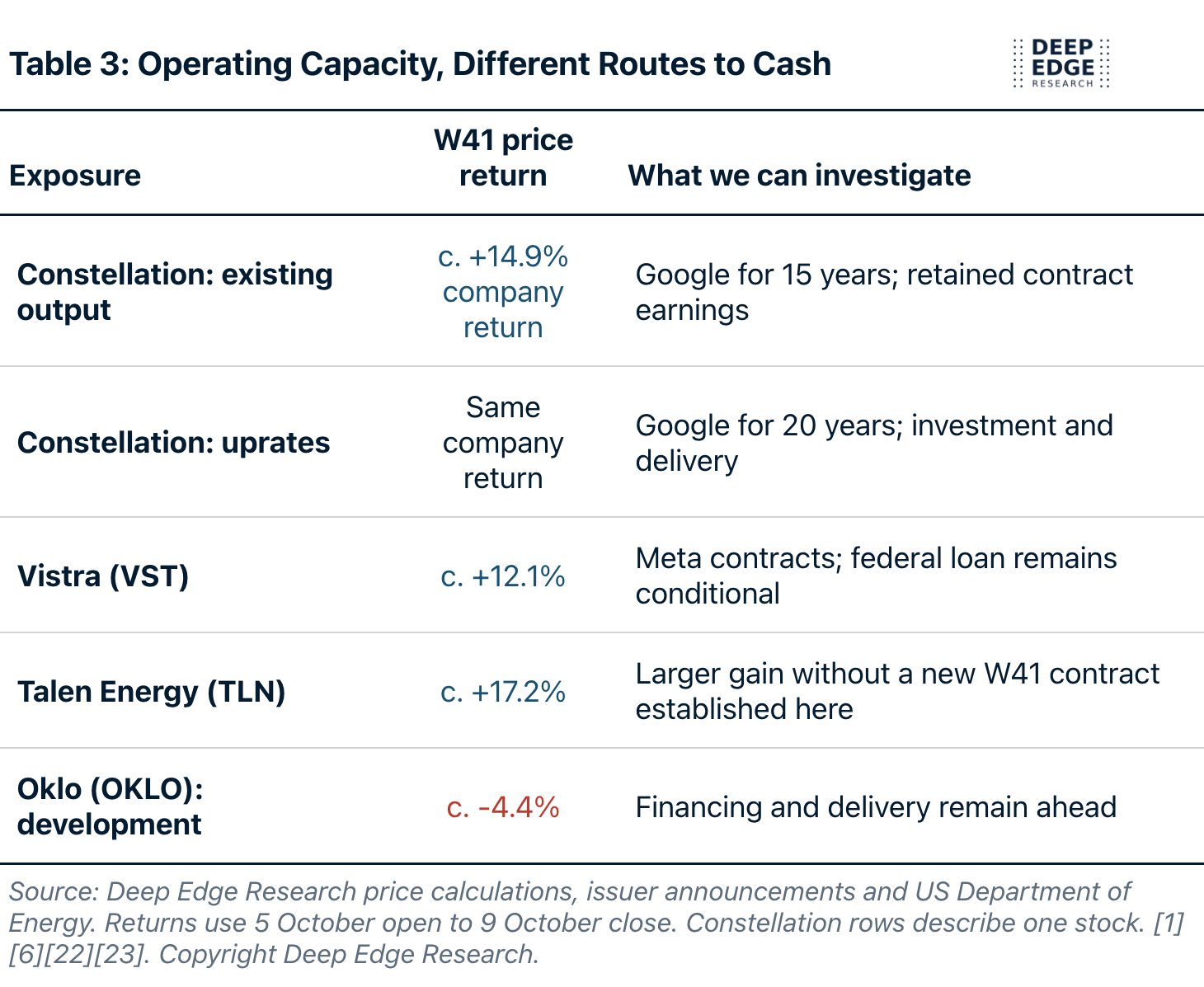
For new research, the power commitments point us towards businesses that already have plants and customers. Table 3 separates those operating assets from development projects that still have to secure funding and deliver generation.
Table 3: Operating Capacity, Different Routes to Cash
Source: Deep Edge Research price calculations, issuer announcements and US Department of Energy. Returns use 5 October open to 9 October close. Constellation rows describe one stock. [1][6][22][23]
Talen’s larger gain, without a new W41 contract established here, cautions against attributing the rally to these agreements. The ten-year yield also edged lower between 2 and 8 October, before the equity window ended.[24] The contracts earn research; the returns cannot isolate their price effect.
Vistra: financing an earlier commitment
Vistra illustrates why funding belongs in that investigation. On 5 October it received a conditional US Department of Energy (DOE) loan commitment of up to $4.2bn for modernisation and 433MW of uprates. Technical, legal, environmental and financial conditions precede funding.[22]
The associated 20-year Meta agreements date from January: 2,176MW of existing output plus the uprates. Purchases start late this year; additions extend through 2034.[23] W41 therefore advanced the financing of an earlier customer commitment. We should not count it as a fresh demand announcement as well.
Before we put money into Constellation, we need the profit it keeps from the contracts, split between existing output and uprates, against the investment schedule. For Vistra, we need the project’s cost, how much it must fund itself, the DOE borrowing terms and the extra Meta-linked cash left after operating and financing costs.
We can value the operating businesses now, excluding new agreement profits until quantified. That keeps the research moving without paying for unmeasured earnings.
Conclusion: These commitments strengthen our conviction in demand beyond OpenAI and give us two operating power businesses to research. Constellation and Vistra will earn a place in the book only if the cash they keep, after investment and financing, supports the price. We have not established that entry yet.
3. What the Week Means for Our Holdings
Our view: We think this week’s losses reflect different risks: extra HDD supply, the duration of memory profits and the funding needed to turn Nebius’s contracts into billable capacity. The businesses still justify holding, but a lower share price does not settle those risks or, by itself, justify adding.
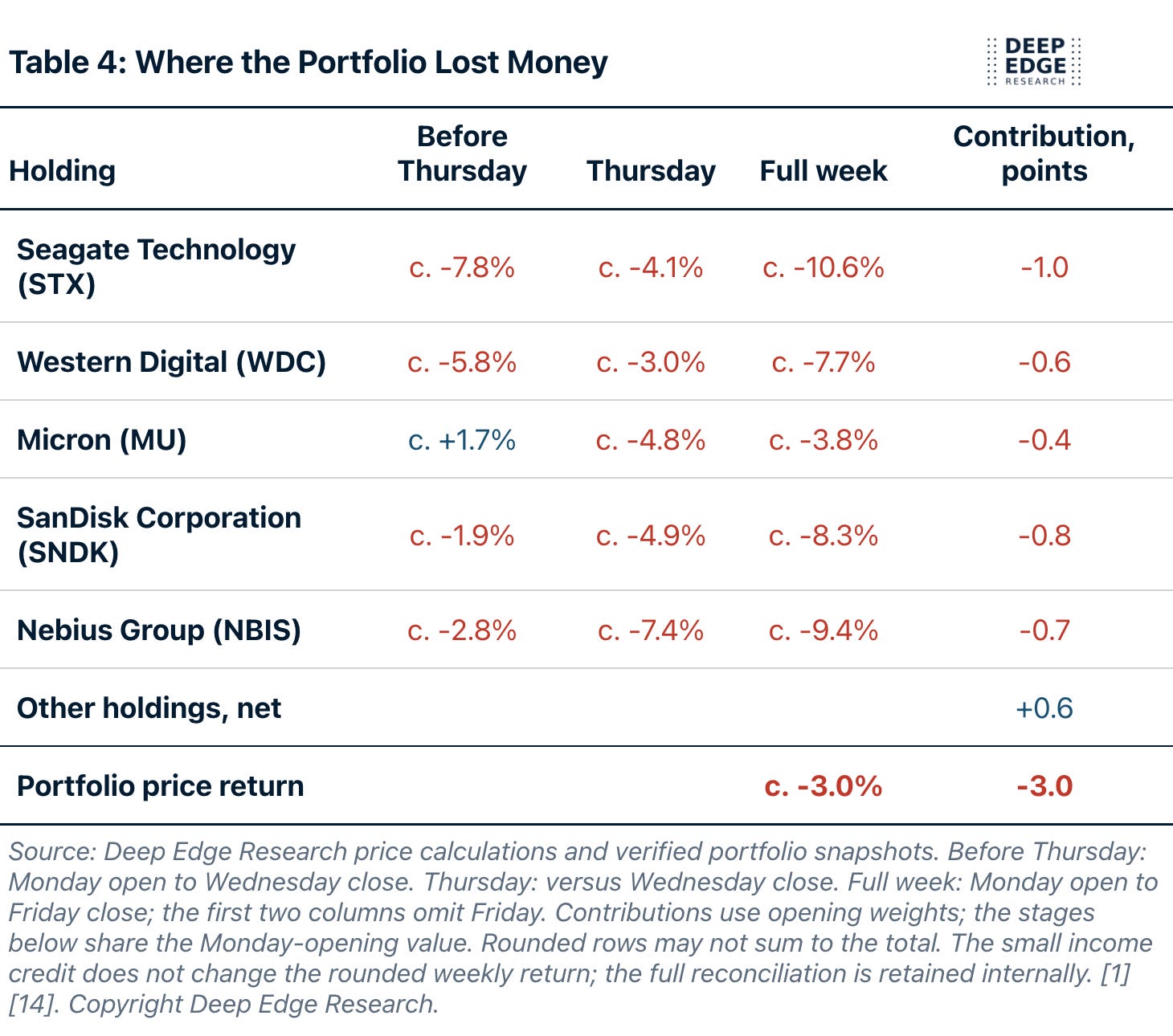
Those differences matter when we decide what to do with the positions. Micron entered Thursday positive, while SanDisk and Nebius Group (NBIS) were already weaker. Table 4 shows the earlier HDD damage and the sharp Thursday falls in all three memory, flash and compute holdings.
Table 4: Where the Portfolio Lost Money
Source: Deep Edge Research price calculations and verified portfolio snapshots. Before Thursday: Monday open to Wednesday close. Thursday: versus Wednesday close. Full week: Monday open to Friday close; the first two columns omit Friday. Contributions use opening weights; the stages below share the Monday-opening value. Rounded rows may not sum to the total. The small income credit does not change the rounded weekly return; the full reconciliation is retained internally. [1][14]
Before Thursday, we had lost c. 0.9 points. HDDs alone cost c. 1.2 points, partly offset elsewhere.[1] That selling followed the supply question Toshiba’s 2 October Philippine expansion reopened in W40.[10][17] By Friday, Seagate was still up c. 184.3% this year and WDC c. 130.6%, against SPY’s c. 14.2%, measured from the final 2025 close.[1] Supply reassessment and profit-taking after those gains are both plausible. We cannot identify the sellers’ motives from prices alone, so we would not put the entire HDD loss down to Thursday’s demand scare.
Thursday cost c. 3.1 points, the largest stage of the week’s loss. Friday recovered c. 1.0 percentage points, or c. 31.4% of that damage, mostly through networking and Sezzle (SEZL), a payments business.[1] Sezzle helped our return. Its rebound tells us nothing about memory demand.
Micron and SanDisk kept falling on Friday, while Nebius recovered only modestly.[1] Our read is that investors were questioning how long exceptional memory and flash earnings could last. Samsung’s real miss gives that concern more weight. Slower conventional DRAM price growth is another possible concern; the accelerating enterprise SSD forecast points the other way.[4][31][39] SanDisk’s 29 October result will test our holding directly, while Samsung’s division outlook supplies industry evidence for Micron. A recovery elsewhere in the book does not answer those questions.
Over the full week, storage and memory together cost c. 2.8 points. Ciena (CIEN) and Sezzle added c. 0.6 and c. 0.4 respectively; the iShares Semiconductor ETF (SOXX) fell c. 4.6%.[1] The stages before Thursday, on Thursday and on Friday share the Monday-opening value and add to our c. 3.0% price loss.
Our risk is not limited to a collapse in demand. At WDC’s August quarterly guidance midpoints, a 5% selling-price cut at unchanged volume removes c. $205m of revenue and c. 11% of earnings if dollar costs, financing, tax and shares stay fixed.[25] That is a sensitivity, not observed damage. It shows why we can remain bullish on the buildout and still insist on protection against weaker supplier pricing.
Why the positions retain our capital
So what still justifies holding the HDDs? Seagate has 44-terabyte (TB) Mozaic 4+ drives in volume production with two hyperscalers, the large cloud operators. WDC said its 40TB drives began shipping in June and were entering volume with two customers. Higher capacity improves customers’ space and power economics, although the two products do not offer identical protection.[11][13][14]
The customer agreements matter as much as the products. Seagate said most planned nearline output, the drives providing bulk cloud storage, was allocated into calendar 2028, with configuration and pricing terms through 2027. WDC described base volumes and prices, with different pricing possible for additional quantities. Demand has also reached cash: latest-quarter free cash flow, operating cash left after capital spending, was c. $1.1bn at Seagate and c. $1.3bn at WDC.[9][12][13][25] We are holding businesses with products, customers and cash generation, not relying only on an eventual AI opportunity.
SanDisk has its own evidence. Our August analysis examined agreements covering more than half of FY2027 bits and c. two-thirds of FY2028 bits; bits measure storage capacity. Adjusted quarterly free cash flow was c. $5.0bn excluding customer funding and joint-venture activity.[16] That coverage supports retaining the position through the next pricing result. It does not guarantee a margin floor, which is why SanDisk has its own warning thresholds.
Nebius: demand is real, but the build still needs funding
Nebius cost us c. 0.7 points and needs its own holding case. At its August Q2 update, the AI-cloud business reported $575m of revenue at a c. 50% adjusted EBITDA margin, before interest, tax and depreciation. Management reported c. $40bn of commitments and said prepayments would cover c. 50-60% of associated capex on new Q2 deals.[35][36] Customers are buying compute and helping fund delivery.
But the build is not self-funding. Q2 operating cash less capital spending was c. negative $3.4bn, and Nebius sold 12.7m shares.[35][36] July’s $775m secured facility showed that deployed infrastructure and contracted cash can attract lenders.[37] On 24 August, it also closed a $5.75bn convertible-note offering and exchanged $800m of older notes for c. 15.8m shares.[38] That supplies funding while adding debt and dilution exposure; the adjusted margin is not cash shareholders keep.
We are holding because signed demand and access to financing give Nebius a credible path to deployment, not because the funding burden has disappeared. Adding still needs billable capacity and a return left for shareholders. Slipping delivery alongside worsening financing or dilution reopens the position under our existing conditions. A bullish AI view cannot excuse that combination.[14][36][38]
What earns additional capital
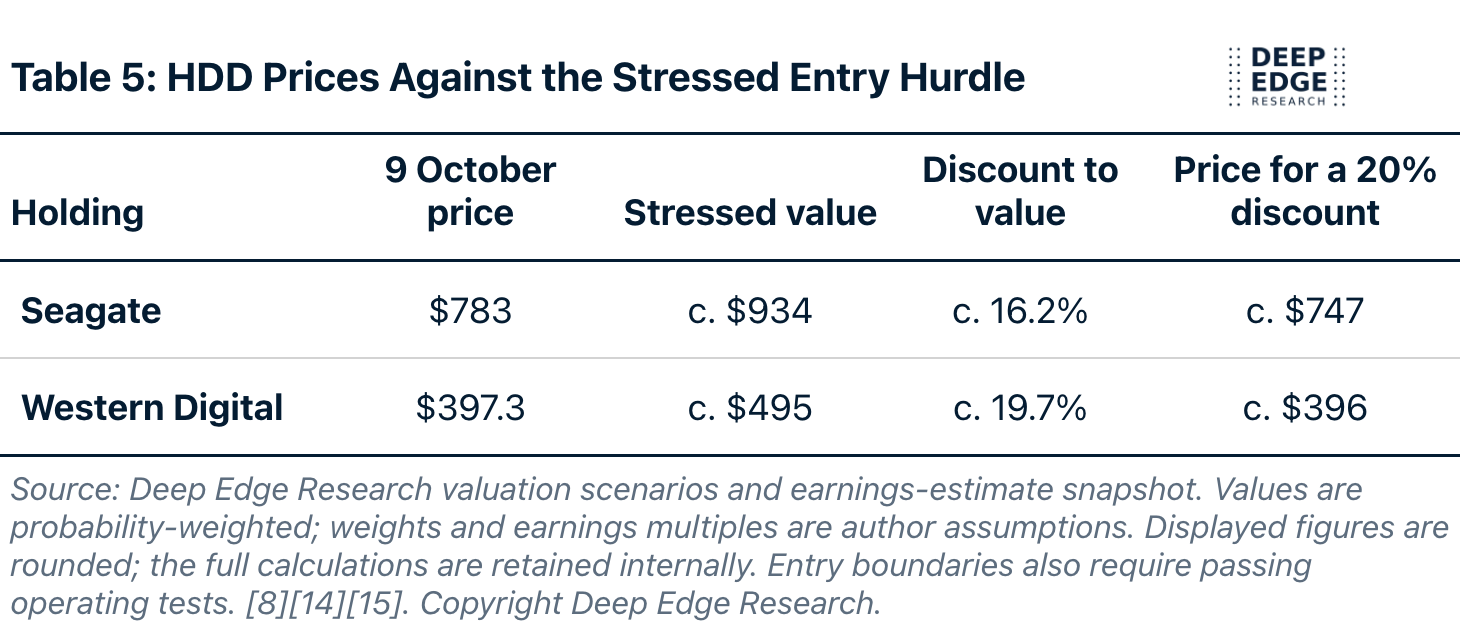
Holding those positions does not settle whether we should buy more. For the HDDs, we refreshed our valuation using 9 October closes and fiscal-2027 earnings estimates retrieved on 12 October. July’s bear/bull earnings, multiples and weights remain; the refreshed base case absorbs a 5% pricing cut with no cost relief. Table 5 combines those cases using our assumed probabilities and shows the entry hurdle after that stress.[8][15]
Table 5: HDD Prices Against the Stressed Entry Hurdle
Source: Deep Edge Research valuation scenarios and earnings-estimate snapshot. Values are probability-weighted; weights and earnings multiples are author assumptions. Displayed figures are rounded; the full calculations are retained internally. Entry boundaries also require passing operating tests. [8][14][15]
Without the 5% pricing stress, both holdings cleared our 20% discount hurdle: Seagate at c. 21.0% and WDC at c. 24.7%. With it, neither does. Seagate needs a further c. 4.5% price fall to reach its entry boundary; WDC needs c. 0.3%.
We would not put more money into WDC because of a c. $1 difference. That gap is smaller than the uncertainty in our model: using the lower base earnings multiple reduces its discount to c. 17.2%. We also need its allocation and price-cost evidence to pass. A small move in the quote cannot do that work for us.
The full memory/flash entry rules, company triggers, Nebius financing conditions and fixed HDD supply-call score are retained internally.[14]
Conclusion: Products, contracted demand and cash generation justify keeping the storage positions; Nebius’s demand and funding mix support retaining it under its own tests. Neither HDD clears our stressed entry hurdle. We will revisit an add at c. $747 for Seagate or c. $396 for WDC only with that company’s operating tests passing.
4. What Changes Our Decision
Our view: Supplier pricing and margins, and Nebius’s ability to deliver and finance capacity, will decide our next move. If that evidence weakens, we will reassess the money in the affected holding even while we remain bullish on AI infrastructure overall.
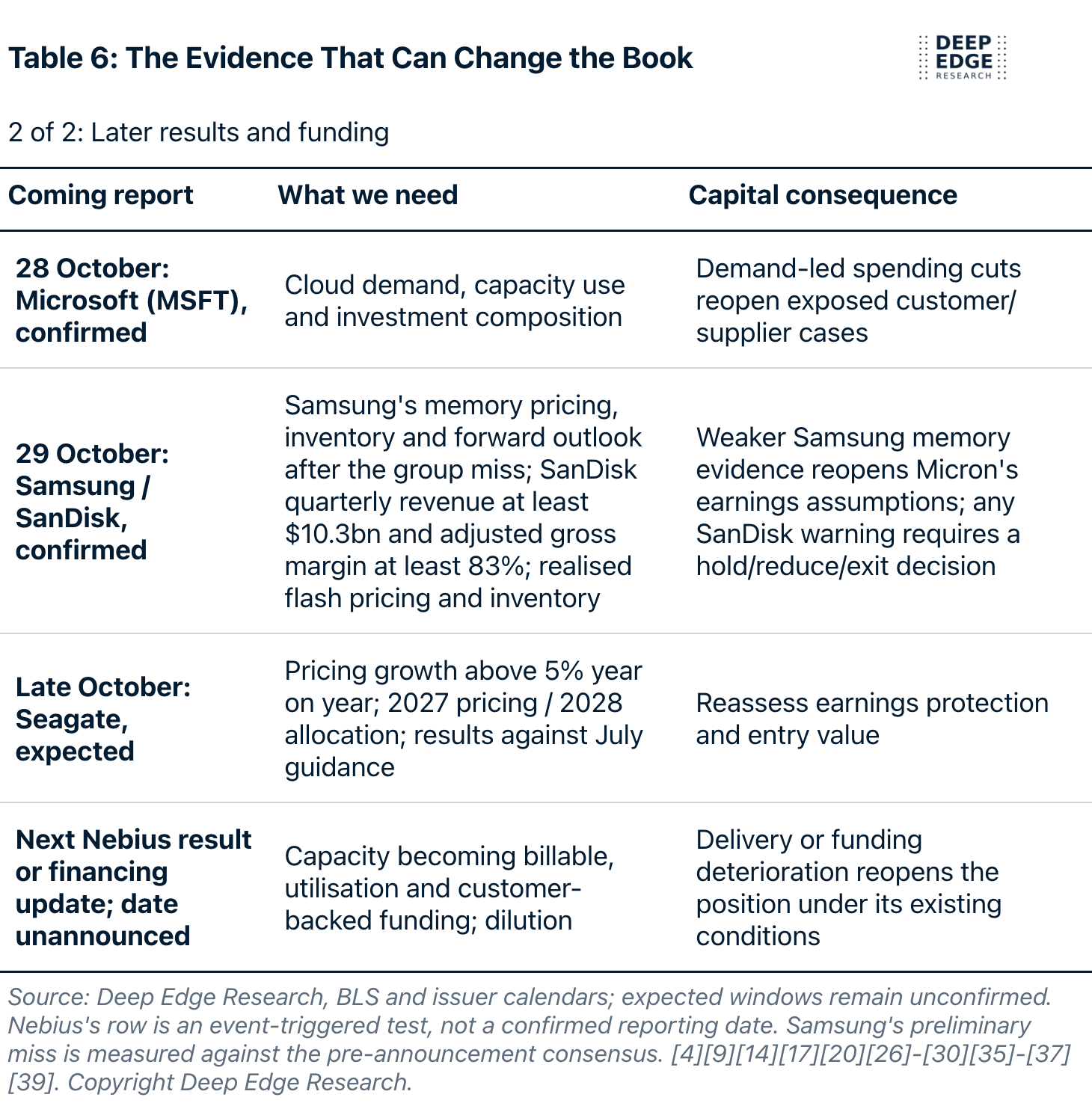
We are holding every position, making no purchases and retaining c. 20.6% cash. Cash rose from c. 20.0% without sales, mainly as equity prices fell.[1] Table 6 sets out the disclosures that can change that decision, including what a warning requires us to do.
Table 6: The Evidence That Can Change the Book
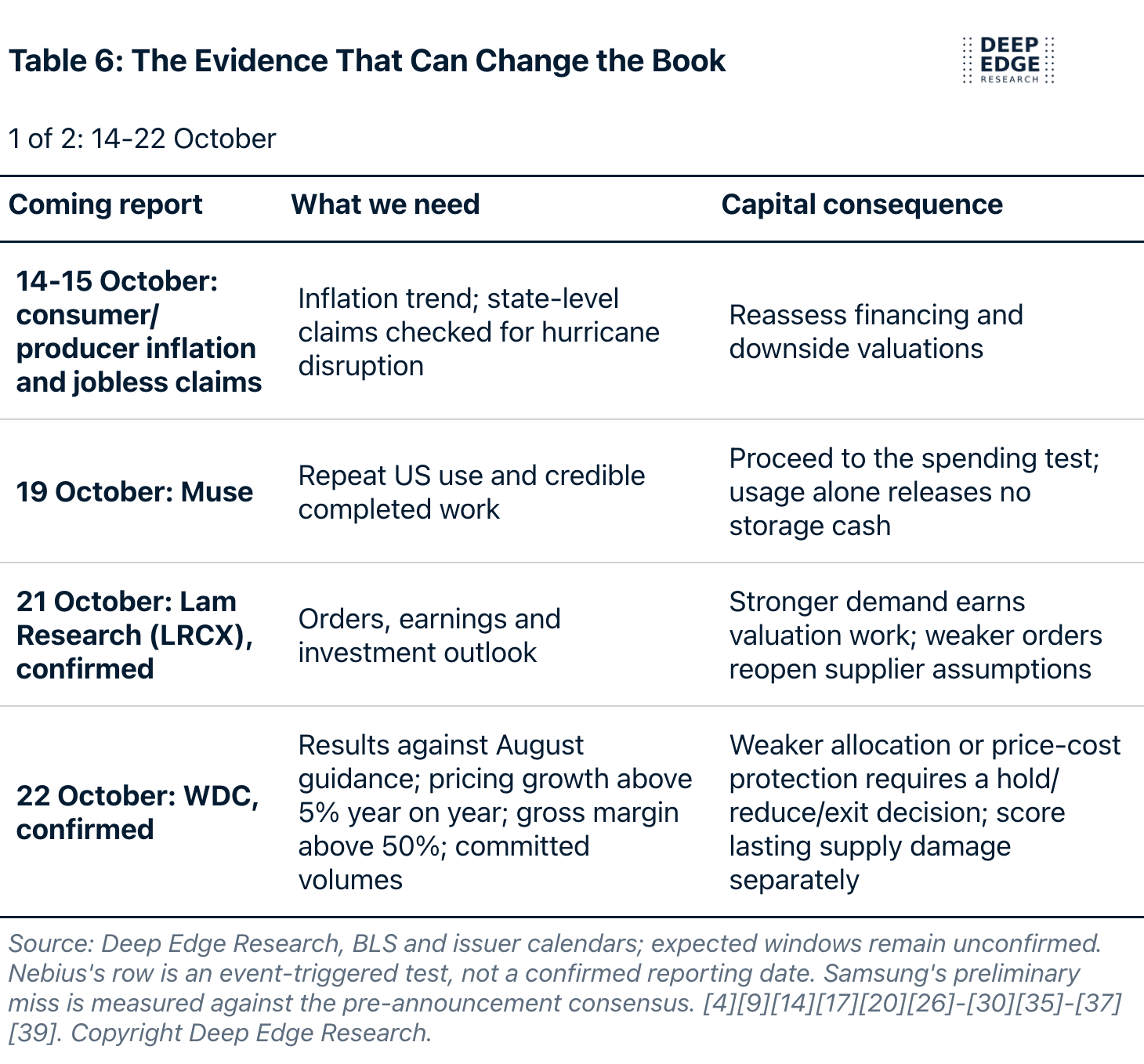
Table 6: The Evidence That Can Change the Book (2 of 2: Later results and funding)
Source: Deep Edge Research, BLS and issuer calendars; expected windows remain unconfirmed. Nebius’s row is an event-triggered test, not a confirmed reporting date. Samsung’s preliminary miss is measured against the pre-announcement consensus. [4][9][14][17][20][26]-[30][35]-[37][39]
After a warning, simply saying that we are reviewing the position is not enough. We must decide whether to hold, reduce or exit, using updated earnings and downside value. The next portfolio update will give that decision and any revised weight. If we keep the same size, we owe readers the reason.[14]
For SanDisk, one warning is enough: quarterly revenue below $10.3bn or adjusted gross margin below 83%, or negative realised flash pricing alongside rising inventory. WDC’s review turns on allocation or price-cost protection. We do not need to wait for the longer Toshiba verdict before acting on a weakened holding.[14]
Beyond those reports, we retain the storage-wide warning rule and the original deadlines:
Shared storage weakness: our storage sleeve comprises the flash and HDD holdings. We review it when at least two signals appear across both businesses: falling sequential prices; rising inventory with slower shipments; lower margin guidance.
Original deadlines: the HDD supply call closes at fiscal Q2 FY2027 results; Muse closes at Meta’s Q4 2026 results, both expected early 2027. HDDs require lasting earnings-damage evidence; Muse requires usage, agent-specific spending and supplier confirmation. Insufficient evidence closes the call as unproven, without extension.[14][17]
Conclusion: WDC on 22 October and SanDisk on 29 October are the next direct tests of our storage holdings. A warning requires a new hold, reduce or exit decision; a pass allows valuation work, not an automatic purchase. The longer Toshiba and Muse calls will still close at their fixed deadlines, including an unproven verdict if the evidence never arrives.[14][17]
Final Thought
Google is committing to additional nuclear output for 20 years. WDC reports on 22 October.
Samsung genuinely disappointed. We think that helps explain the pressure on memory shares, but it does not establish an industry-wide collapse in demand. Micron’s guidance, the contract-price outlook and customers’ signed commitments still give us a business case for holding. We are less willing to dismiss the earnings-duration concern; the next results must answer it.
That is why we are keeping our money invested. Now the companies must show that the demand we believe in can keep earning for their shareholders. If it cannot, our positions will change.
References
Deep Edge Research: price history and portfolio calculations. Market, portfolio and generator price returns use 5 October open to 9 October close. Year-to-date price returns use 31 December 2025 close to 9 October 2026 close; dividends excluded. Underlying observations, portfolio records and calculations retained internally.
CNBC: Nvidia, Oracle, CoreWeave and other AI stocks sink on OpenAI revenue report, Ashley Capoot and Kate Rooney, 8 October 2026. Original publisher report; private revenue/accounting and growth figures are attributed reporting.
Samsung Electronics: preliminary Q3 2026 guidance, 8 October 2026.
Reuters: Samsung’s preliminary profit and year-on-year growth, 8 October 2026.
Constellation Energy: Google power agreements, 6 October 2026.
Akamai Technologies: $11.6bn Anthropic agreement, SEC Exhibit 99.1, 24 September 2026.
Deep Edge Research: SanDisk versus Seagate versus Western Digital, July 2026.
Seagate Technology: fiscal Q4 results and fiscal Q1 guidance, 28 July 2026.
Toshiba: expanded Philippine nearline-HDD line, 2 October 2026, Japanese.
Seagate: 44TB Mozaic 4+ qualification and volume production, 3 March 2026.
Seagate: 28 July 2026 earnings-call remarks, third-party transcript.
Western Digital: 5 August 2026 earnings-call remarks, third-party transcript.
Deep Edge Research: Standing Portfolio Decisions: W41, retained internally. Full conditions, clarified position-size review, HDD valuation construction, fixed supply-call score and Muse spending test; underlying conditions unchanged.
Deep Edge Research: FY2027 annual STX/WDC earnings-estimate snapshot, retrieved 12 October 2026. Underlying inputs retained internally; scenario calculations and sensitivity assumptions are retained internally.
Deep Edge Research: SanDisk’s August results and margin reassessment.
Deep Edge Research: W40, September Just Made Our AI Case More Bullish, 4 October 2026. Locked article and standing decisions; HDD supply-call scoring and Meta Q4 2026 Muse expiry carried forward unchanged.
Federal Reserve: September FOMC minutes, released 7 October 2026.
Yahoo Finance via AOL: Similarweb’s Muse daily-user estimate, 8 October 2026.
Samsung Electronics: confirmed 29 October 2026 earnings call.
Micron Technology: quarterly fiscal Q4 and full-year 2026 results, 30 September 2026.
US Department of Energy: conditional Vistra nuclear financing, 5 October 2026.
Federal Reserve Bank of St Louis: ten-year Treasury yield, 2-8 October 2026; rate observations end before the equity window.
Western Digital: fiscal Q4 results and fiscal Q1 guidance, 5 August 2026.
US Bureau of Labor Statistics: October 2026 release calendar.
SanDisk: confirmed 29 October 2026 results, announced 29 September.
Western Digital: confirmed 22 October 2026 results, announced 8 October.
TrendForce: Q4 2026 memory contract-price outlook, 30 September 2026. Forecasts, not realised Q4 price increases; conventional DRAM and enterprise SSD trends differ.
TrendForce / DRAMeXchange: Daily Express, 5 October 2026. Public dated summary: DDR4 8G (1Gx8) 3200 average quote, rounded, $46.3.
TrendForce / DRAMeXchange: Daily Express, 8 October 2026. Public dated summary: the same DDR4 specification, rounded, $46.4; trading remained limited. Monday-to-Thursday quote change is c. +0.2%, not a full-week series or enterprise contract price.
DRAMeXchange: NAND wafer spot-price display, updated 5 October 2026. The 512Gb TLC session-average quote, rounded, was $18.8, with displayed change of -2.9% from the previous update. This is an entering-week observation, not the 5-9 October move. Complete matched Friday DRAM/NAND endpoints were not verified; historical price pages require member login. Public pages retrieved 12 October.
Nebius Group: Q2 2026 earnings release, 12 August 2026. Cash-after-capex illustration subtracts c. $5.657bn of property, equipment and intangible purchases from c. $2.246bn of operating cash, giving c. negative $3.411bn; customer funding is not shareholder free cash.
Nebius Group: Q2 2026 shareholder letter, 12 August 2026. AI-cloud revenue and adjusted margin are distinct from group measures. Customer-prepayment coverage is management’s expectation for associated new Q2 deals, not a guarantee that the whole build is funded.
Nebius Group: first $775m secured financing, 17 July 2026. Facility backed by deployed infrastructure and contracted customer cash flows; not a new W41 transaction.
Nebius Group: closing of $5.75bn convertible-note offering, 24 August 2026. The concurrent exchange converted $800m of older notes into c. 15.8m shares. Gross new issuance is not the net change in debt; neither transaction is new in W41.
Bloomberg: Samsung Investors Want Evidence Profit Boom Has Staying Power, syndicated by Moneycontrol, 7 October 2026 at 07:04 IST. Pre-announcement analyst estimates compiled by Bloomberg: consolidated Q3 revenue KRW 201.3tn and operating profit KRW 108.5tn. The report does not state analyst count or the exact estimate-freeze time; these are the published pre-release consensus figures, not a release-time terminal snapshot.