
Meta Platforms (META) rose c. 12.9% from Friday to Friday after Muse reached number one on the major US app stores.[1][2][12] Apptopia estimated 2.8 million installs in the product’s first 12 days and 642,000 daily active users in the US. Those are third-party estimates reported by TechCrunch, not Meta disclosures.[3]
Meta has found a different way into the agent race. OpenAI and Anthropic currently lead from coding and structured knowledge work. Meta and xAI are starting with consumer distribution and cloud agents that can keep working after the user leaves.[1][4]-[7]
Both routes can create more users, jobs, steps and simultaneous work. That matters to us because persistent use should increase inference, the compute consumed when a trained model runs, and eventually reach memory, networking, storage, power and cooling.
Eventually is doing a lot of work in that sentence.
Here is where we disagree with the easy reading of the week. Meta’s c. 13% rally does not give us permission to mark up every company that might one day benefit from agent demand. With c. 40% of our money in memory and storage, we need to know whether more agent use is becoming purchased capacity, pricing and margin for the companies we actually own.
From Monday’s open to Friday’s close, our portfolio rose c. 1.1%. The iShares Semiconductor ETF (SOXX) rose c. 5.1% and the VanEck Semiconductor ETF (SMH) c. 4.2%.[13][14]
The semiconductor rally was broad. Micron Technology (MU) rose c. 3.6%, while our storage holdings were approximately flat. The distinction matters: memory already has measurable inference revenue and a scheduled operating test; storage still needs retained state to become purchased capacity. SanDisk (SNDK) caused roughly half of the storage basket’s relative drag.[21]-[24]
The missing inputs for storage are daily users, completed jobs per user and retained state per completed job. Consumer agents can enlarge the market, but our holdings earn nothing from an app download unless repeated jobs create data that persists and turns into purchased capacity.
MU supplies the first operating test on 30 September.[9][10]
TLDR
Meta has opened a consumer route into the agent race. Muse reached number one on the US app stores.[1][2] Apptopia estimated 2.8 million installs in its first 12 days. The missing evidence is retention, completed jobs and monetisation.[3]
There is no honest single-number storage forecast. The current third-party US usage estimate places Muse below our 0.1% global-adoption case. At 1% adoption and five daily jobs, however, annual retained state ranges from c. 66 petabytes at 1 megabyte per job to c. 657 petabytes at 10 megabytes.[3][8]
The semiconductor rally was broad, but memory and storage produced different results. Micron rose c. 3.6%; the c. 28.5% storage basket was approximately flat and caused c. 1.47 points of the c. 1.8-point shortfall from our invested AI holdings. Memory has measurable inference revenue. Storage still needs proof of retained state.[13]-[25]
Our position is unchanged, but the tests are now sharper. Hold every position, make no new purchases and retain c. 19.9% cash. Micron has distinct weak, in-line and strong thresholds on 30 September. SanDisk has a separate position-size trigger tied to its guidance.[9][10][38]
This week’s positioning: fresh money still requires stronger operating proof and a refreshed valuation. Figure 1 shows what storage demand could become, but the usage we can measure today sits near its bottom. A persuasive agentic-demand story cannot cover for weak company evidence.
What Changed Since W38
Our view: The wider hardware tape improved, but the company evidence we carried forward did not arrive. We got a cleaner price signal and the same operating questions.
W38 asked whether a higher policy rate would interrupt strategic AI spending. The portfolio rose c. 7.3%, led by memory, storage and interconnect, while our 35-company Hardware, Equipment and Parts cohort remained weak.[39]
The wider hardware condition improved in W39. Amphenol (APH) rose c. 8.4% and Corning (GLW) c. 4.4% from Friday to Friday. Breadth, the share of the 35-company cohort with a positive weekly return, reached c. 74%. That clears the W38 threshold of more than 50%, although we will keep the test open through 2 October.[36][37]
The other questions remained open. No held company supplied a new memory-price, storage-volume or post-hike spending disclosure. The August Job Openings and Labor Turnover Survey (JOLTS) arrives on 29 September, Micron reports on 30 September and the September employment report follows on 2 October.[9][11]
Table 1: What W39 Resolved From the W38 Watchboard
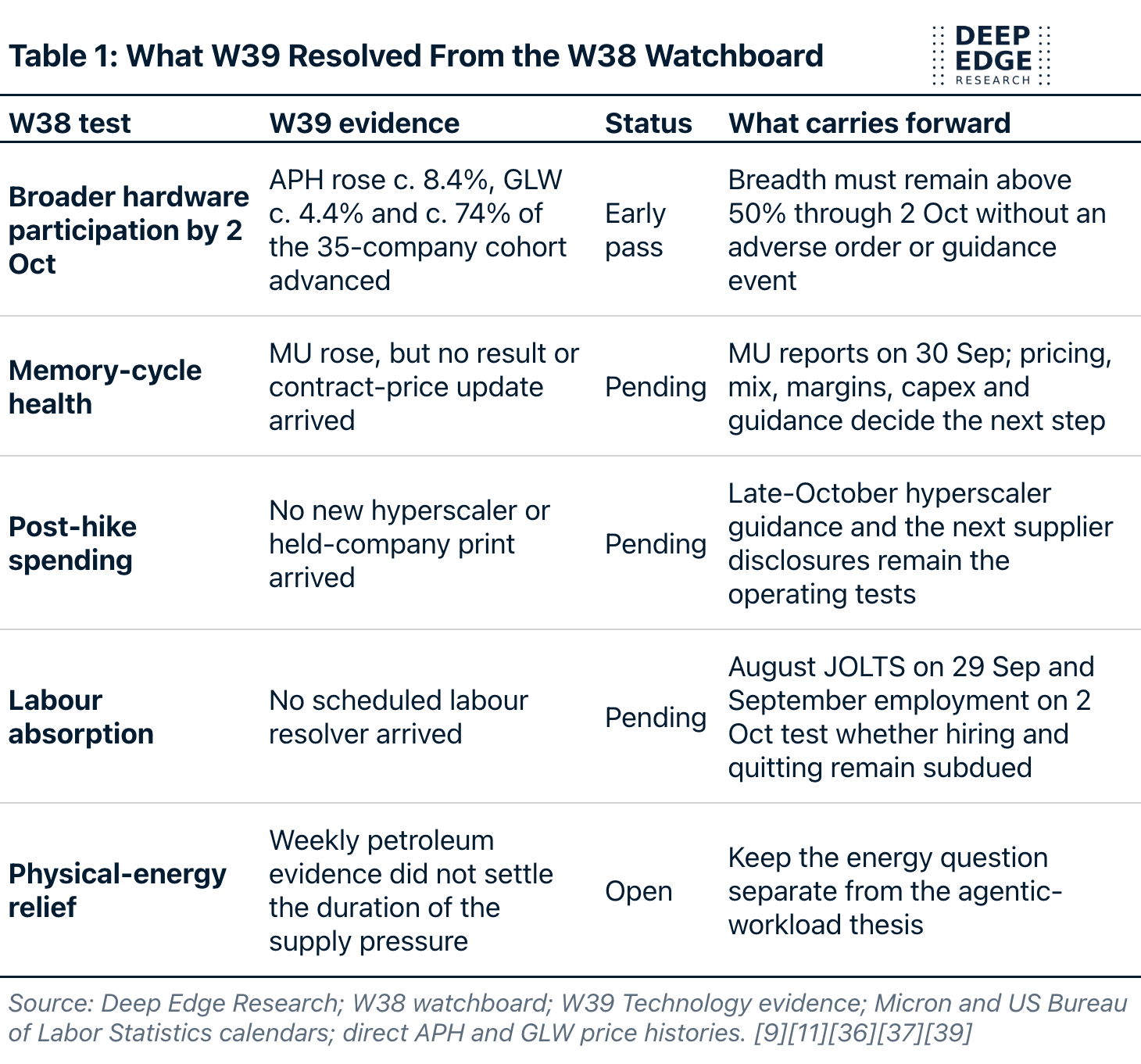
Conclusion: Hardware breadth cleared its first threshold. Memory pricing, supplier orders and labour remain open. Muse opens a new workload question; it cannot settle the supplier questions we carried from W38.
1. Meta and xAI Are Attacking a Different Adoption Gap
Our view: Coding-led and consumer-led agents can both expand inference. Coding agents can create heavier work per user. Consumer agents can use existing distribution to create far more users and simultaneous jobs.
Muse lets an ordinary user describe an outcome, leave the agent to plan it and return when approval is needed. The work can continue after the app closes, through a standalone app or WhatsApp.[1] Meta also starts with distribution that most AI companies would have to buy: 3.60 billion daily active people across its applications in June.[8]
xAI’s Grok Bot attacks the same adoption gap with cloud computers that can work across applications and run in parallel while the user is away.[4] OpenAI and Anthropic start from coding and professional work, where code search, long context, execution, testing and correction can make each job far heavier.[5]-[7] Consumer jobs may be lighter, but distribution can create far more of them.
The first usage estimate is still modest against Meta’s reach. Apptopia puts Muse at c. 642,000 US daily active users.[3] That estimate is third-party and US-only. Figure 1 shows what it means for workload; the app-store ranking alone does not move Muse into a material range.
These are starting positions, not permanent camps. The companies can cross the boundary. What matters for us is that each route should stress the infrastructure stack differently, which is why Table 2 separates where we expect the evidence to appear first.
High-bandwidth memory (HBM) sits beside AI accelerators, dynamic random-access memory (DRAM) provides working memory, and NAND is the flash memory used in solid-state storage.
Table 2: Two Product Wedges in the Agent Race
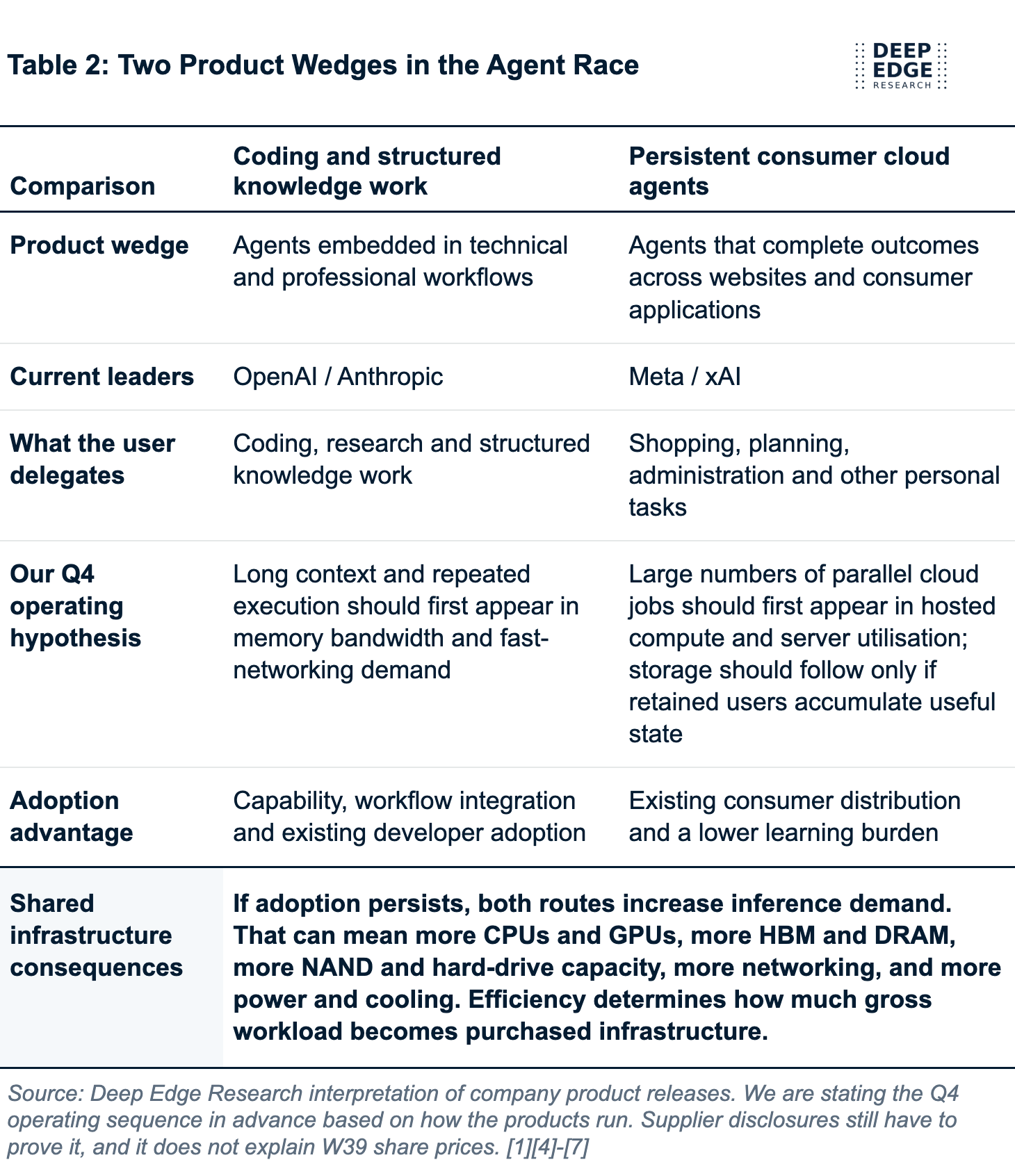
Meta has shown that it can get people through the door. We still need repeat use, completed jobs and attractive unit economics.[2][3] The first checkpoints are 8 October, 30 days from launch, and 19 October, four weeks after the ranking catalyst. Our proposed order fails if durable Muse use produces no quantified infrastructure response, or if storage suppliers report agent-driven bits or exabytes before compute suppliers identify incremental workload.
Conclusion: Meta can distribute Muse. We still do not know whether users return, how many jobs they delegate or how much state those jobs retain. The investment question is how many jobs become enough retained state to move supplier economics.
2. Compute Begins With a Job. Storage Begins With Retention.
Our view: This story reaches our money through workload. A persistent agent changes the unit of demand from an answer into a job, and that job can contain many steps, keep state and continue after the user leaves. That is the bridge from adoption to the physical infrastructure we own.
The simplest version of the workload is:
Agent workload = active users × jobs per user × steps per job × compute per step × duration and concurrency, offset by efficiency
Every term can move independently. Distribution raises active users, useful products create repeat jobs, and planning, tool calls, verification and correction add steps. Cloud hosting and parallel agents increase duration and concurrency.
The storage equation is narrower:
Persistent-state demand = completed jobs × retained state per job × retention period × replication, offset by compression, deletion and tiering
Compute is consumed while a job runs. The storage bridge is completed jobs to retained state to purchased capacity.
A single estimate would be false precision because adoption, daily jobs and retained state are unknown. Figure 1 shows annual logical inflow at 0.1, 1 and 10 megabytes per job. Ten megabytes is already generous for today’s browser-automation workload. We would add a 100-megabyte case only if agents start retaining rich media, recordings or complete visual work histories.
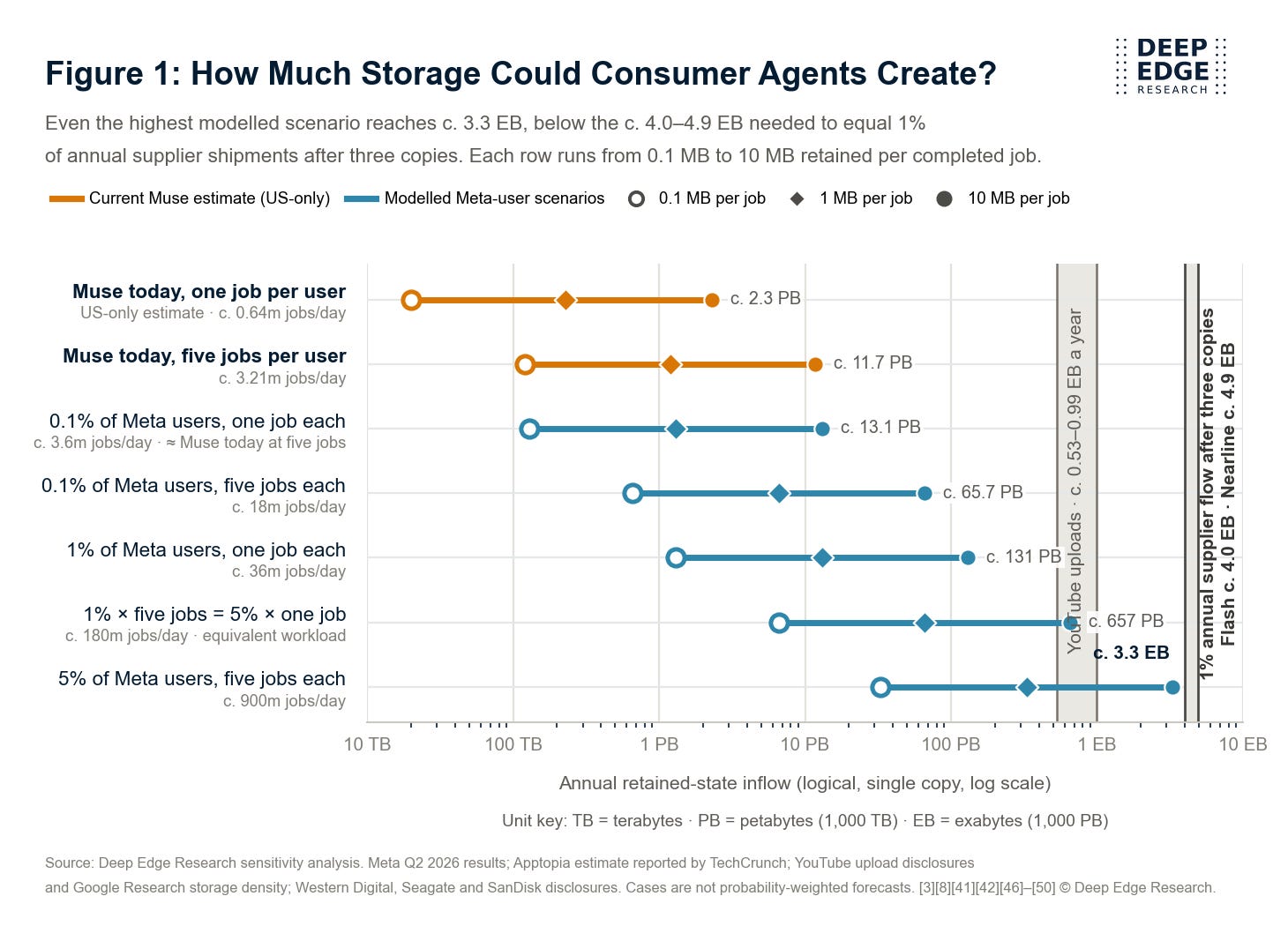
Put Muse on the table today and the scale is still small. Apptopia’s c. 642,000 US daily users imply c. 0.64-3.21 million jobs a day and, at 10 megabytes per job, c. 2.3-11.7 petabytes of annual logical inflow. The first headline threshold is c. 3.6 million jobs a day, equal to 0.1% of Meta’s daily users completing one job each.
Today’s estimate also sits well below YouTube’s c. 0.53-0.99-exabyte annual single-copy upload flow.[46][49] Those inputs date to 2022 and 2016, so the band is a conservative scale reference. Two 10-megabyte cases enter it: 1% adoption with five jobs per user and 5% adoption with one. The 5%-adoption, five-job case reaches c. 3.3 exabytes.
Supplier scale is less forgiving. Nearline drives are the high-capacity hard drives used in data centres. Western Digital and Seagate shipped a combined c. 1.48 zettabytes of nearline capacity in fiscal 2026.[41][42] The 5% adoption, five-job and 10-megabyte case becomes c. 9.9 exabytes with three copies, or c. 0.7% of that flow. Reaching one percentage point requires c. 1.35 billion jobs a day: c. 7.5% of Meta’s daily users completing five jobs, or c. 3.8% completing ten.
SanDisk’s August Investor Day presentation puts total 2026 flash shipments at c. 1.2 zettabytes.[50] Even at 10 megabytes per job and three copies, today’s Muse estimate is no more than c. 0.003% of that flow. The 1%-adoption, five-job range is c. 0.02-0.16%; the 5% upper case reaches c. 0.8%. State will also be split across flash, hard drives and other tiers. SanDisk’s bits, pricing, inventories and margins still decide whether shareholders get paid.
The measured usage therefore explains why we are not marking up storage today. Storage’s non-response only becomes surprising if global use, jobs per user and retained state move materially higher. That does not identify who sold SanDisk. It tells us when the operating thesis should begin to appear in the shares and, more importantly, in supplier economics.
Micron sits on a different evidence clock. Inference already consumes HBM and DRAM while jobs run, and Micron has measurable revenue, pricing and margin tests on 30 September. Storage still needs the hand-off from completed work to retained state. Table 3 sets out where each layer has to prove that it is being paid.
Table 3: How Delegated Jobs Reach the Physical AI Stack
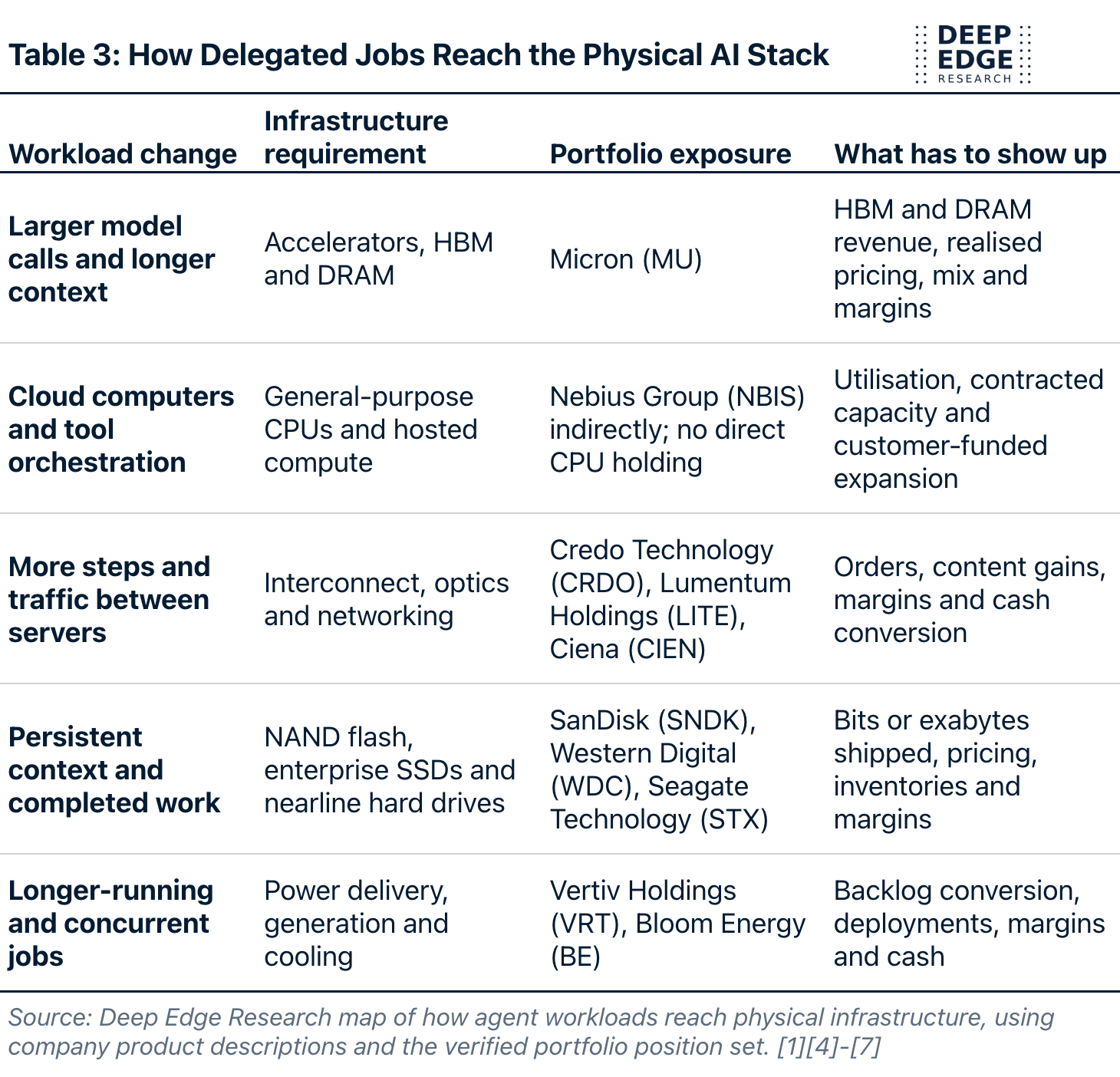
Efficiency pushes the other way. Better models can use fewer tokens, tool calls or units of compute, while lower costs can attract more users and make more jobs economical.[7] Utilisation, pricing, orders, shipments and margins will tell us which effect wins. We will score each company at its first relevant disclosure; one layer cannot stand in for another.
Conclusion: Figure 1 tells us what Muse could become, not where it is today. Memory can earn earlier credit because inference consumes it while jobs run. Storage earns credit only after adoption creates retained state and suppliers convert it into bits, exabytes, pricing or margins. The W39 price gap therefore needs its own attribution.
3. Semiconductors Rallied Broadly. Storage Explains Our Gap.
Our view: The semiconductor rally was broad. Micron rose, and our own attribution puts almost the entire shortfall inside the storage names.
Every return in this section runs from the US market open on Monday 21 September to the close on Friday 25 September.
Advanced Micro Devices (AMD) rose c. 8.0%, Intel (INTC) c. 5.6%, Arm Holdings (ARM) c. 5.4%, Qualcomm (QCOM) c. 11.8% and Micron c. 3.6%.[17]-[21] Intel, AMD and Micron contributed c. 1.62 points to SOXX’s c. 5.06% gain; the rest of the fund supplied c. 3.44 points.[13][15][17][18][21] In SMH, Nvidia (NVDA), AMD, Intel, Micron, Qualcomm and Arm supplied c. 1.65 points of the c. 4.24% gain, while the rest supplied c. 2.59 points.[14][16]-[21][25]
Those decompositions use end-of-week holdings as proxies for Monday-open weights, so they cannot identify every basis point. They are enough to establish that the rally extended well beyond a few CPU-linked names.
Our attribution points to a much more concentrated problem, and the combined sleeve label hides an important split between memory and storage.
Table 4: W39 Portfolio Attribution and Gap Versus SOXX
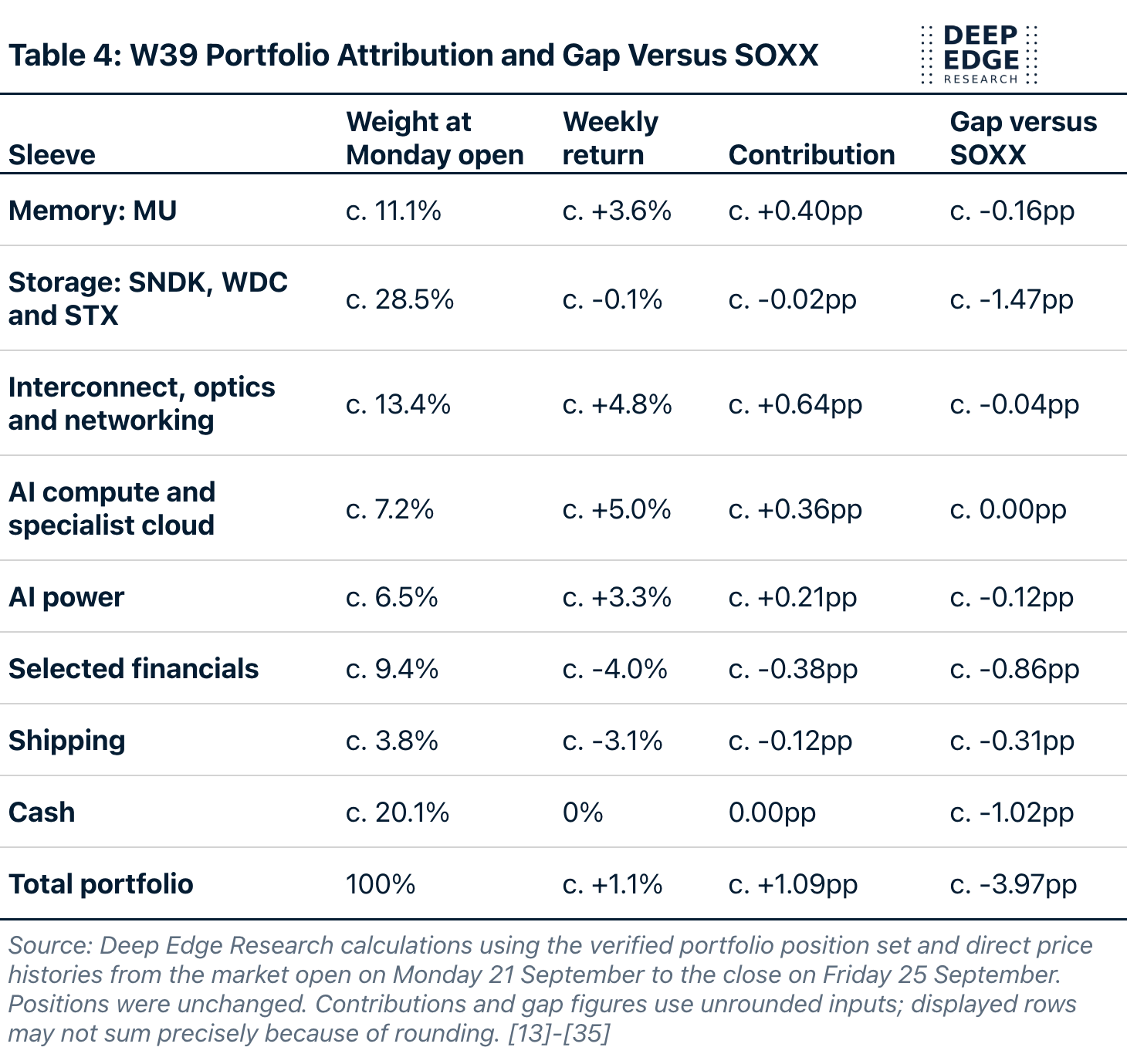
The c. 4.0-point gap has three parts. Cash cost c. 1.0 point against a fully invested semiconductor benchmark. Financials and shipping cost c. 1.2 points because they fell while SOXX rose. The composition of the AI book cost c. 1.8 points.
Memory and storage accounted for c. 1.63 points of that last figure, or c. 91% of the shortfall inside our invested AI holdings. But the split matters. Micron cost only c. 0.16 point relative to SOXX because it rose less than the benchmark. Storage cost c. 1.47 points, or c. 82% of the AI-book shortfall. The memory and storage holdings did not move together.
SNDK did most of the damage. Its c. 10.8% portfolio weight and c. 2.6% decline cost c. 0.83 point relative to SOXX. WDC cost c. 0.38 point and STX c. 0.25 point. MU still made money for the portfolio; its c. 0.16-point relative cost came only from rising less than the benchmark.[21]-[24]
We found no adverse storage disclosure or verified NAND-pricing reversal during W39 that settles the move. The data cannot identify why SNDK or the storage holdings lagged, so the price move remains unattributed.
The split still changes our work. Memory has a direct link to running inference and a scheduled company test. Storage depends on repeated jobs creating retained state. That earns the two groups different burdens of proof without pretending we know who sold the shares. Company evidence now has to tell us whether the weakness was noise, a refusal to price distant agent demand or the start of a cycle problem.
Conclusion: Semiconductors rallied broadly, and Micron participated. Storage did not. We cannot identify the seller or prove why the gap opened. Our read is that memory’s nearer operating bridge mattered, while storage’s agent-to-capacity hand-off remained unproven. Storage pricing, volumes, inventories and margins will show whether that difference deserves to become an investment difference.
4. Does the Storage Weakness Change the Book?
Our view: The weakness changes our order of work, but it does not yet change a position. SanDisk now carries a portfolio-level burden because of its size. The whole sleeve changes only if the evidence begins to deteriorate across flash and nearline storage together.
The portfolio decision remains simple:
Hold every existing position.
Make no new purchases.
Retain c. 19.9% cash at Friday’s close.
SanDisk: the position-size test
SanDisk is the second-largest individual position in the book at c. 10.8%, just behind Micron at c. 11.1%. It is c. 27% of the memory-and-storage sleeve and produced c. 51% of that sleeve’s relative drag last week.
This is not a new verdict on SanDisk. In our July comparison, we ranked it first but said the next dollar still needed a better entry or stronger proof that its contracts could protect margins. Our August Q4 note supplied both at c. $1,259 and moved the fresh-capital posture to attractive. The shares then rose. W33 cut the unchanged value gap to c. 10%, and by W36 it was c. 3%. W39 therefore begins from Hold because the margin of safety was largely used up, not because the business ranking reversed.
That weight is acceptable only while the SanDisk case continues to clear its own tests. For fiscal Q1 2027, management guided to revenue of $10.3-10.8 billion and non-GAAP gross margin of 83-85%.[38] Actual revenue below $10.3 billion or non-GAAP gross margin below 83% would trigger a SanDisk position-size review. So would negative realised flash pricing combined with rising company inventory. These are early-warning concentration triggers, not a new thesis-break threshold. They do not replace the formal rule in our August note: reassess ACT if gross margin falls below 50%, or if the run-rate points below 45% within two reported quarters without greater contract coverage. Clearing the early-warning tests preserves the case; it does not authorise an add.
That trigger is intentionally separate from the sleeve rule. If SNDK deteriorates while WDC and STX remain sound, we review SNDK rather than inventing a common cycle problem. If flash and nearline weaken together, the whole c. 39.6% allocation comes under review.
Micron: the operating and valuation test
Micron reports on 30 September. Its fiscal Q3 release guided to fiscal Q4 revenue of $50.0 billion, plus or minus $1.0 billion, and gross margin of approximately 86%.[9][10] Because “approximately 86%” leaves too much room for hindsight, we are setting a one-percentage-point band around it now:
Weak: revenue below $49 billion, gross margin below 85%, or next-quarter commentary that turns DRAM or NAND realised pricing sequentially negative. That triggers an immediate MU and SNDK review and keeps cash undeployed.
In line: revenue of $49-51 billion, gross margin of 85-87%, and forward realised pricing that is flat or positive. That keeps the memory case intact but does not authorise an add.
Strong: revenue above $51 billion, gross margin above 87%, and positive forward realised pricing. That earns a valuation refresh for MU and SNDK. It still does not prove the nearline case.
A mixed result is scored by its weakest operating component. Revenue in range with gross margin below 85%, or with negative forward pricing, is weak. Revenue in range with flat pricing is in line, not strong. No result can authorise an add unless both operating evidence and refreshed value clear.
The valuation test is deliberately harder than the earnings test. Mid-80s guided margins can mark exceptional cycle economics; they are not the earnings base we will capitalise indefinitely. W30 therefore tested MU and SNDK against calendar-2027 earnings compressed by 40% and 60%.[43]
We will refresh the same stress after the results. An add review opens only if the current price is below 12 times updated earnings after the 40% compression and the company evidence gives us no reason to treat the 60% case as the base case. Twelve times compressed earnings gives us a c. 8.3% starting earnings yield after already cutting the cycle estimate. That is the minimum return hurdle we require before reopening an add. It is a screen for reopening the full company valuation, not a replacement for the name-specific scenario work in our July comparison. A strong quarter can earn that work. It cannot clear it by itself.
WDC and STX remain separate. Their case depends on exabytes shipped in high-capacity nearline drives, pricing, inventories and margins. The company tests from our July comparison also remain open: Seagate still owes allocation durability, Mozaic revenue, density benefits retained in margins and cash conversion; Western Digital still owes ePMR and HAMR commercial proof alongside margin durability. We will not infer a hard-drive result from a DRAM-heavy quarter.
When storage becomes a sleeve problem
The sleeve-wide downside rule is also explicit. We review the whole allocation if at least two of the following three conditions occur across both flash and nearline storage: realised pricing turns sequentially negative; company inventories rise while shipments slow; or gross-margin guidance falls sequentially. This operationalises the correlated-deterioration rule we set in W35; it does not replace the company tests above. One weak company result stays a company problem. Correlated deterioration becomes a sleeve problem.
The rest of the book
The rest of the book keeps its own obligations. CRDO, LITE and CIEN need orders, content gains and cash conversion. VRT and BE need deployments, margins and cash. NBIS must fund its next capacity phase without issuing primary equity merely to proceed. Robinhood Markets (HOOD), Sezzle (SEZL), Atlanticus Holdings (ATLC) and International Seaways (INSW) remain separate cases rather than evidence for or against the AI thesis.
We are not buying the CPU names because they rose last week. AMD and Intel can earn deeper work if management quantifies incremental agent-driven server demand and the valuation leaves enough room for error.
Conclusion: SanDisk faces its own position-size test around the first week of November. The full sleeve moves only if at least two common cycle signals appear across flash and nearline. Nothing in W39 cleared either trigger, so we are not moving our money.
What the Next Tests Need to Prove
Our view: The watchboard keeps us honest about two things: whether adoption becomes workload, and whether that workload becomes supplier economics. It also stops a SanDisk problem from automatically becoming a storage-cycle call.
The dates matter because adoption evidence and supplier economics will not arrive together. We need to know which result can move which part of the book before those results land.
Commentary alone does not count as an adoption-to-infrastructure hand-off. Credible company or third-party data must first move Muse beyond today’s c. 642,000-US-user marker and into Figure 1’s global-adoption ranges. Meta must then raise the midpoint of its current $130-145 billion 2026 capital-spending guide and attribute the increase to Muse or agent workloads, or separately quantify Muse-related infrastructure spending.[8] A supplier must complete the chain through NBIS capacity growth of at least 10% sequentially tied to customers running agent workloads, or an AMD or Intel numerical disclosure of agent workloads.
General AI growth without agent attribution does not pass the Muse-specific test. If no agent-specific attribution arrives by Meta’s Q4 2026 results in early 2027, we will close that hand-off as unproven for capital allocation. We may continue to track general inference demand, but it will not release storage cash on the Muse thesis alone. The existing storage case remains governed by the company and sleeve tests above. Table 5 separates the adoption, spending and supplier tests so that one good number cannot answer all three.
Table 5: W40 and Forward Decision Watchboard
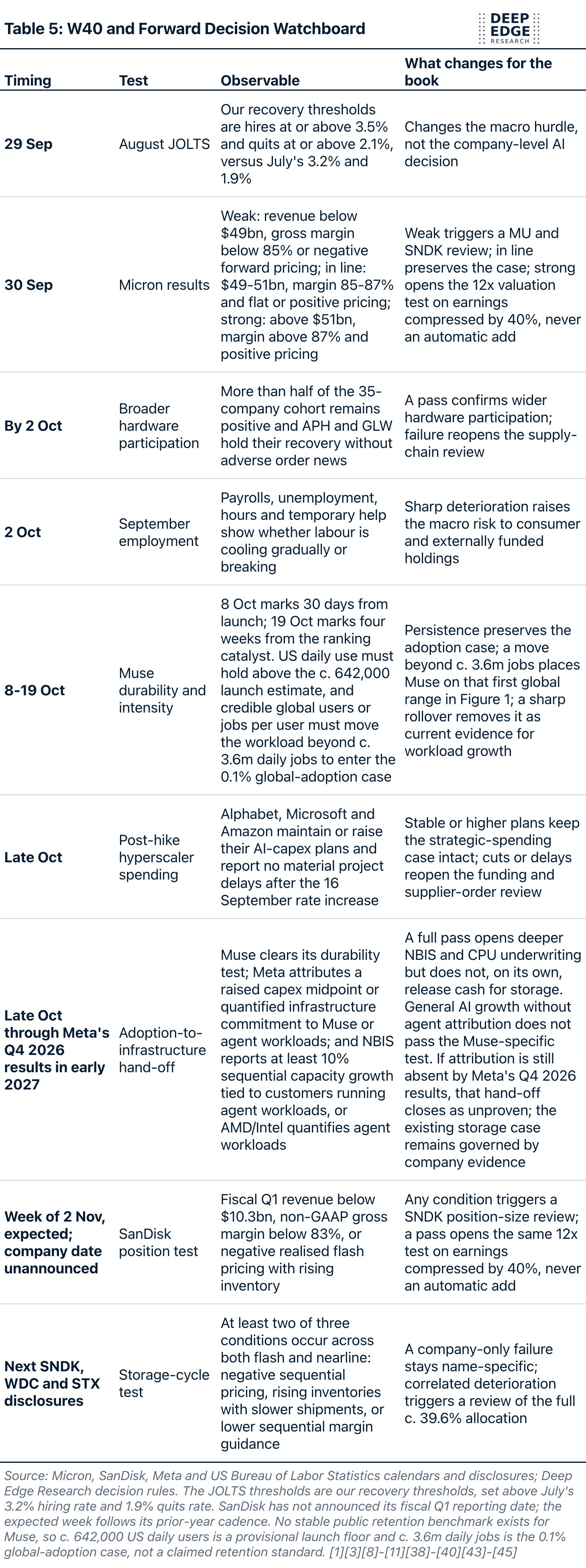
No company is likely to disclose infrastructure consumed per agent. Retention tells us whether Muse survives novelty. Processor and cloud demand tell us whether it creates workload. Supplier orders, pricing, margins and cash tell us whether our companies are being paid. The chain can still fail if a supplier loses share or mistimes capacity.
Conclusion: Micron can defend the memory case on 30 September. The 12x cycle stress then decides whether an add review opens. If the full adoption-to-infrastructure test clears later, we will do the valuation work on compute. If it does not, the cash stays where it is.
Final Thought
A prompt ends when the answer arrives.
A delegated job can keep working after the user has left. It can search, plan, call tools, retry, store context and run beside other jobs. That is why Meta’s week matters to a portfolio that does not own Meta.
The current US usage estimate sits below our 0.1% global-adoption case. A material supplier flow still requires much wider adoption, more jobs and more retained state. That matters because storage is where we have placed the most money.
Micron has the nearer bridge from inference to revenue. Its gain does not reveal buyer motive, but its memory economics face a measurable test on 30 September. SanDisk, Western Digital and Seagate need the later bridge from active use to retained state. Their W39 moves remain unattributed, and they must now defend flash and nearline pricing, volume and margins.
For now, the book stays still and the cash stays at c. 19.9%. Usage will tell us whether Muse moves into a material range. Our returns still depend on whether the companies we own get paid for it.
References
Meta: Introducing Muse: The World’s First Personal AI Agent Built for Everyone, 8 September 2026
Bloomberg: Meta’s New Muse AI App Tops Charts, Draws Strong Reviews, 21 September 2026
TechCrunch: Meta’s Muse Is Outpacing ChatGPT’s Early Mobile Launch, 21 September 2026
Micron Technology: Fiscal fourth-quarter results scheduled for 30 September 2026
Micron Technology: Fiscal third-quarter results and fiscal fourth-quarter guidance, 24 June 2026
SanDisk: Fiscal fourth-quarter 2026 results and fiscal first-quarter 2027 guidance, 5 August 2026
Deep Edge Research: W38, The Fed Raised Rates. Why Did Our Portfolio Rise c. 7%?, 21 September 2026
US Bureau of Labor Statistics: Job Openings and Labor Turnover, July 2026, 1 September 2026
Western Digital: Fiscal fourth-quarter 2026 earnings deck, quarterly nearline exabytes
Seagate Technology: Fiscal 2026 Form 10-K, nearline exabytes shipped
Deep Edge Research: W30, The Changing of the Guard: Why Google Fell After a Strong Quarter
YouTube: 20 Ways We’re Celebrating Two Decades of YouTube, 23 April 2025
SanDisk: Flash Market to Reach 1.2ZB in 2026, 2026 Investor Day, 13 August 2026
This article is for information and education only. It is not investment advice. Past performance is not indicative of future results.
(c) DeepEdge Research