
By Friday of last week, W37 (8-11 September 2026), futures implied c. 85% odds that the Federal Reserve would raise its 3.50-3.75% target range by 25 basis points on 16 September.
The two-year Treasury yield had risen 26 basis points. Our portfolio fell c. 3.3%, with memory and storage responsible for c. 2.59 points, roughly four-fifths of the loss.[2]-[9]
The easy story is “rates up, AI down”.
The book did not trade that way. Interconnect gained c. 1.4%, Bloom Energy (BE) rose c. 3.0%, and broad investment-grade and high-yield credit spreads narrowed.
Estimated short interest, the proportion of tradeable shares sold short, fell sharply in Sandisk (SNDK) and Nebius Group (NBIS) even as both shares declined. It rose alongside weaker prices in Seagate Technology (STX), Western Digital (WDC), Credo Technology Group (CRDO) and Vertiv Holdings (VRT).[2][9][10][20]
Our read is narrower: price damage arrived before business damage. W37 clearly raised the prospective-return hurdle. Spreads on CCC-rated bonds, the weakest end of public credit, showed where funding pressure could emerge. No holding disclosed worse financing terms and no company evidence established an operating break. The capital question is whether the businesses are weaker or merely cheaper. We want company evidence to answer before either fear or lower prices move our money.
TLDR
The Fed repriced the hurdle. Contemporaneous reports of CME FedWatch odds moved from c. 58% after the 4 September employment report to c. 85% after Friday’s CPI release. The two-year yield rose 26 basis points and the curve flattened.[5][8][9]
Memory and storage made the week look worse than the rest of the book. The price-only portfolio return was c. -3.46%. International Seaways’ dividend receivable added c. 0.18 point, producing an economic return of c. -3.29%. Memory and storage contributed c. -2.59 points; interconnect added c. 0.17 point.[2][21]
The evidence supports a valuation shock, a selective funding warning and no operating break. Broad credit spreads narrowed while CCC spreads widened. No company disclosed broad deterioration in orders, pricing or demand.[9][12]-[19]
Positioning amplified part of the move, not all of it. Estimated short interest rose in five of the seven names in our test, but fell sharply in Sandisk and Nebius even as both shares declined.[10]
This week’s positioning: we are holding every position, making no new purchases and keeping c. 20.9% in cash. Memory and storage gets the first sleeve review because it produced most of the loss. VRT, Robinhood Markets (HOOD) and NBIS carry the sharpest company-specific questions. The Fed decision can change the hurdle; only company evidence and refreshed valuations can move our money.
What Changed Since W36
Our view: We got one answer we did not want: our pre-registered short-interest test failed. Interconnect breadth repaired, but the inflation test did not clear. We now need to know where higher rates can reach company economics.
Last week we asked price, breadth, positioning, operating and macro questions. Table 2 closes the tests that could be observed in W37 and carries the rest forward.
Table 2: W36 Watchboard Closure
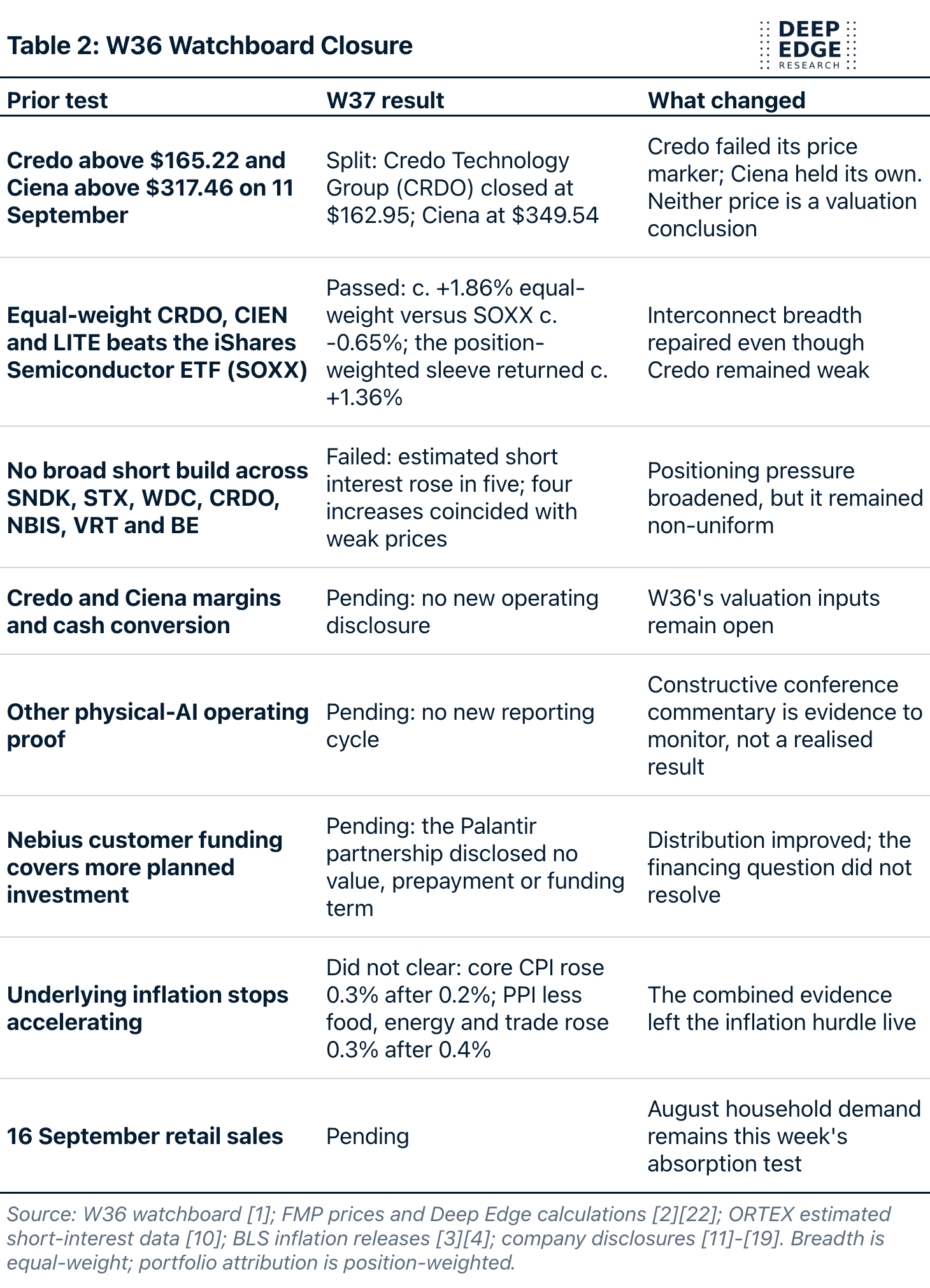
That leaves us with a split result. Ciena and Lumentum carried the breadth test even though Credo failed its own marker. No new Credo or Ciena result changed the margin and cash work set in W36. ORTEX did change: estimated short interest rose in five of seven names, and Seagate, Western Digital, Credo and Vertiv combined higher short interest with falling prices. Sandisk and Nebius moved the other way. A broader short build formed in part of the set, but it cannot explain the full portfolio loss.[1][2][10]
Conclusion: W37 closed one of last week’s open questions against us: positioning pressure broadened. Interconnect breadth improved at the same time, leaving company economics, rather than one blanket AI narrative, as the next test.
1. Memory and Storage Produced Most of the Loss
Our view: The c. 3.3% portfolio decline was mainly a memory and storage event. Interconnect resilience and shipping’s dividend-adjusted gain make a universal “rates up, AI down” explanation too broad for the book we actually own.
The portfolio fell c. 3.3% from Tuesday’s open to Friday’s close. Monday was Labor Day. Over the same four sessions, the SPDR S&P 500 ETF Trust (SPY) fell c. 0.6%, Invesco QQQ Trust (QQQ) c. 0.8%, SOXX c. 0.7% and the VanEck Semiconductor ETF (SMH) c. 1.8%.[2]
The attribution below shows why we are reviewing one sleeve first rather than treating every holding as if the same thing happened to it.
Table 3: W37 Portfolio Attribution
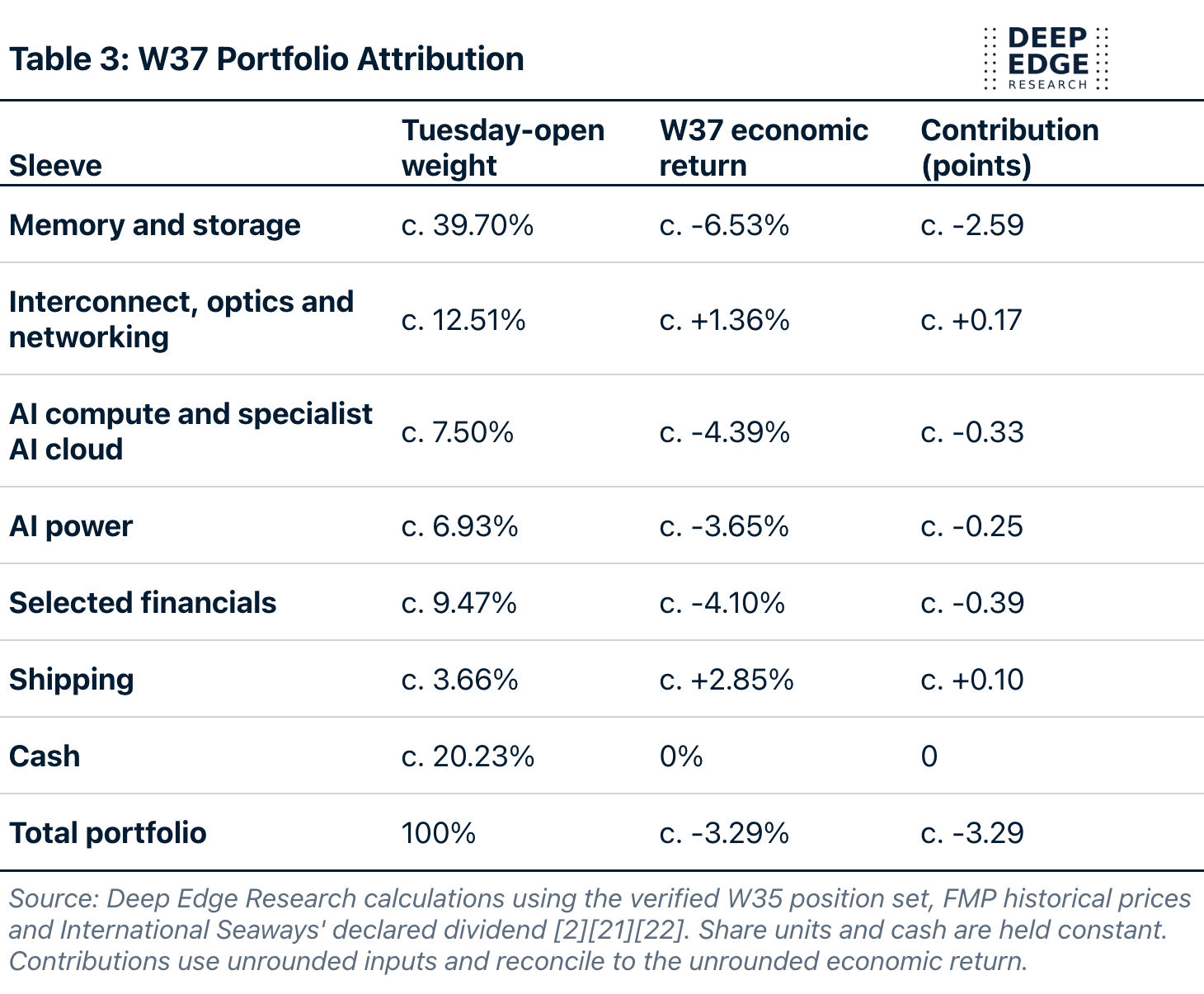
Sandisk fell c. 7.7%, Western Digital c. 6.8%, Micron Technology (MU) c. 5.9% and Seagate c. 5.7%. Together they cost c. 2.59 points, or roughly four-fifths of the portfolio decline. Nebius cost c. 0.33 point, Vertiv c. 0.35 and Robinhood c. 0.43.[2]
Interconnect moved the other way. Ciena gained c. 6.8% and Lumentum c. 3.3%, more than offsetting Credo’s c. 4.5% decline. The sleeve added c. 0.17 point and its equal-weight return beat SOXX by c. 2.51 points.[2]
Shipping also needs one adjustment that a price chart misses. International Seaways (INSW) closed c. 1.9% below Tuesday’s open, but went ex-dividend for $5.05 per share during the week. Including that receivable, its economic return was c. +2.8% and shipping added c. 0.10 point. The price-only portfolio return was c. -3.46%; the dividend receivable added c. 0.18 point, taking the economic return to c. -3.29%.[2][21]
Cash rose from c. 20.2% of opening value to c. 20.9% of ending economic value because the invested book declined. No capital was deployed.[2]
Conclusion: Memory and storage explain the portfolio’s underperformance. Interconnect breadth improved and shipping made money after its dividend, so the week’s loss does not support a single verdict on AI infrastructure.
2. Policy Repriced. Broad Credit Did Not Break.
Our view: By Friday, a September increase was the base case. The two-year Treasury yield led the sell-off in bonds, but investment-grade and broad high-yield spreads narrowed. The week raised the cost of money without producing a general funding event.
The inflation data gave the Fed a reason to act. August PPI rose 0.4% from July and 5.4% from a year earlier. Goods prices rose 1.1%, with final-demand energy up 4.2%. CPI rose 0.4% from July and 3.4% from a year earlier. Core CPI increased 0.3% for the month after 0.2% in July. The labour market still looked resilient: August payrolls rose by 162,000 and unemployment held at 4.1%.[3]-[5]
That sequence moved the policy price. Contemporaneous reports of FedWatch odds put a 25-basis-point increase at c. 58% after the employment report and c. 85% after CPI. The July FOMC had already held at 3.50-3.75% by a 9-3 vote, with all three dissenters preferring an increase.[6]-[8]
The cross-asset check below tells us what kind of shock followed. Option-adjusted spread (OAS) is the extra yield corporate borrowers pay over comparable Treasuries. If W37 had become a general funding break, investment-grade and high-yield OAS should have widened together.
Table 4: W37 Policy Repricing and Credit Check
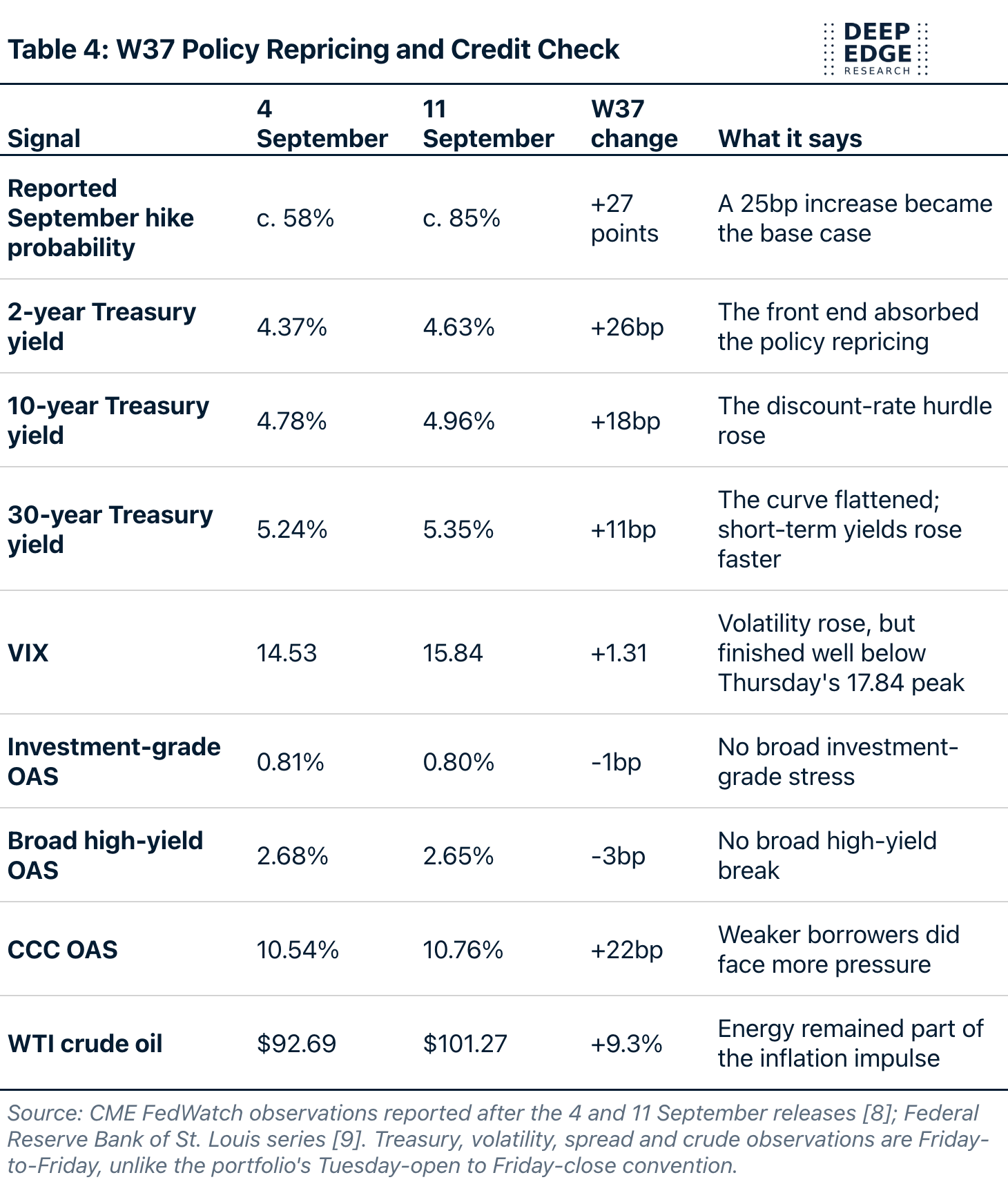
The two-year yield rose more than the ten- and thirty-year yields, so the curve flattened. That is consistent with policy repricing rather than a new surge in long-run nominal growth. Investment-grade and broad high-yield spreads narrowed even as CCC spreads widened. Lenders did not reprice every borrower alike.[9]
There is also a mismatch between the cause and the cure. Energy rose 2.1% in the CPI and gasoline 3.9%; WTI gained c. 9.3% over the week. A higher policy rate cannot produce more diesel or gasoline. It can suppress rate-sensitive demand, restrain second-round inflation and make distant cash flows worth less today. Those channels hit households, externally financed growth and high valuations with different force.[3][4][9]
Conclusion: The rate increase became the base case because inflation and employment left the Fed room to tighten. Broad credit did not confirm a general funding break; the CCC widening tells us to look first at the companies that still depend on outside capital.
3. Price Damage Arrived Before Business Damage
Our view: W37 clearly repriced valuation and identified the holdings where funding pressure would matter most. It did not show that portfolio financing had worsened or that company operations had broken.
A price move changes the valuation work immediately. We change the funding or operating diagnosis only when financing terms or business results move with it.
We use this distinction because each kind of damage demands a different response. A valuation shock lowers what investors will pay even if the business is unchanged. A funding problem appears in credit spreads, refinancing terms, dilution or missing customer finance. An operating break requires weaker orders, pricing, inventories, margins or credit quality. The channels can overlap and arrive in any order. Our standing rule is to record price damage immediately, then require financing or operating evidence before changing the diagnosis or the position.
Table 1: The Three-Channel Test Applied to W37
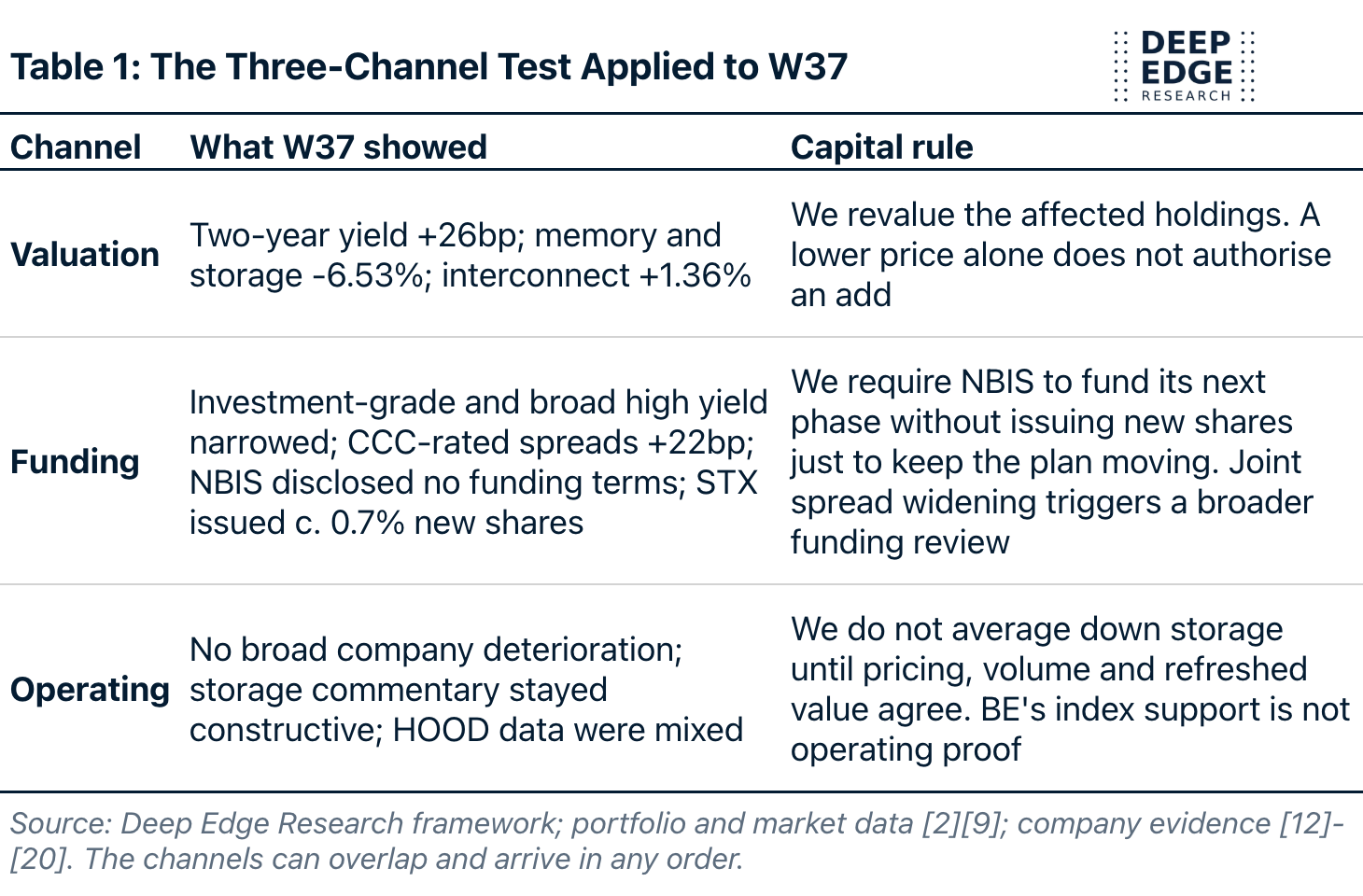
W37 clearly hit valuation. Funding pressure appeared at the weakest end of credit, but neither financing terms nor company results forced a trade.
Storage
Storage supplied most of the loss. Sandisk fell c. 7.7% on 0.73 times its prior 20-session turnover while its estimated short interest declined 1.39 percentage points. Management said data-centre demand had grown beyond half of the NAND market and that eight long-term partnerships covered about two-thirds of FY2028 bit supply. The company also extended a $1.5bn revolver to September 2031.[11][12]
Western Digital fell c. 6.8% on 0.78 times normal turnover. Management said demand exceeded supply and long-term agreements covered most of 2027, with some commitments extending further. Seagate’s note settlement was a genuine adverse capital-structure item: c. $151m of cash and 1,647,862 new shares, equal to c. 0.7% of the latest reported share count. It is too small to explain the whole sleeve move, but it belongs in the return calculation.[13]-[15]
Those observations do not prove that storage is cheap. They do say the weekly tape arrived before a reported deterioration in demand or pricing. At Friday’s closes, Sandisk and Western Digital sat c. 10% and c. 6% below their old W32 values. That is historical context, not current upside, and it carries no weight in the capital decision until the inputs are refreshed.[1][2]
The refresh divides by business. For Sandisk, it needs contracted-bit coverage, realised pricing protection and gross margin. Micron’s 30 September report is a memory-sector checkpoint for high-bandwidth memory (HBM) and DRAM mix, NAND pricing and margins. It is not a nearline HDD test, meaning it tells us little about the high-capacity drives used for data-centre storage. Western Digital and Seagate still need their own evidence on nearline exabyte growth, pricing, inventories and margins.[12][13][15][24]
Interconnect and power
Interconnect behaved differently. Ciena and Lumentum rose while Credo remained weak. Lumentum said AI demand exceeded supply and laser shortages could extend through 2027-28. That supports demand, but margins, cash conversion and refreshed value still decide whether the sleeve deserves more capital.[2][17]
Power split too. Vertiv is the strongest positioning candidate in the physical-AI book. It fell c. 9.8% on 1.84 times normal turnover while estimated short interest rose 0.52 percentage point. Management’s conference remarks described better pipeline visibility and a 20-22% organic-growth target through 2030. The mismatch puts valuation and positioning under review; it does not let us identify the sellers.[2][10][16]
Bloom’s c. 3.0% gain had an S&P 500 inclusion tailwind. That is useful price support, but it says nothing about backlog conversion, margins or cash generation.[2][20]
Funding and financials
Nebius carries the clearest funding question. Its Palantir partnership improved distribution but disclosed no contract value, prepayment or funding term. The funding test therefore remains open.[18]
Outside physical AI, Robinhood’s August operating data were mixed, not absent. Funded customers reached 28.6m and platform assets rose 8% from July to $383.7bn. Crypto activity increased, while options, event contracts and securities-lending revenue fell sequentially. The share price fell harder than the reported business changed.[19]
Atlanticus Holdings (ATLC) rose c. 2.4% and Sezzle (SEZL) fell c. 1.1%. Neither move dominated the financials sleeve; their cases remain tied to delinquencies, losses and funding spreads rather than one week’s price action.[2]
Conclusion: W37 produced a selective funding warning, not a portfolio funding break. Storage gets no averaging down until pricing, volume and refreshed value agree; power and interconnect still owe conversion evidence.
4. We Are Holding the Book, Not Excusing the Drawdown
Our view: The drawdown changes the order of work. Storage comes first, followed by the sharp company-specific moves in Vertiv and Robinhood. Macro data set the hurdle; company evidence determines whether capital moves.
Memory and storage began the week at c. 39.7% of the book and cost c. 2.59 points, so it comes first. Its historical W32 values no longer authorise an add. We split memory and flash from nearline HDD because one disclosure cannot settle both.[1][2][24]
After storage, Vertiv and Robinhood come next. Vertiv had the week’s clearest combination of heavy turnover and rising estimated short interest; Robinhood’s mixed August report leaves it on company-specific valuation review.[2][10][16][19]
Meanwhile, funding and interconnect remain separate reviews. Nebius stays on the Table 1 funding test; STX’s note settlement was real but limited. Interconnect gained on both a position-weighted and equal-weight basis, but W36’s margin, cash and valuation work remains open.[1][2][9][14][18]
The next tests run on two clocks: scheduled data and our own valuation work. The Fed and retail sales arrive first, but neither can release cash. On 20 September, the W38 brief will publish refreshed Credo and Ciena valuation ranges. Those ranges are our work, not a new company datapoint. Micron follows on 30 September with a memory-sector checkpoint; the nearline HDD test waits for Western Digital and Seagate.
Table 5: W38 Decision Watchboard
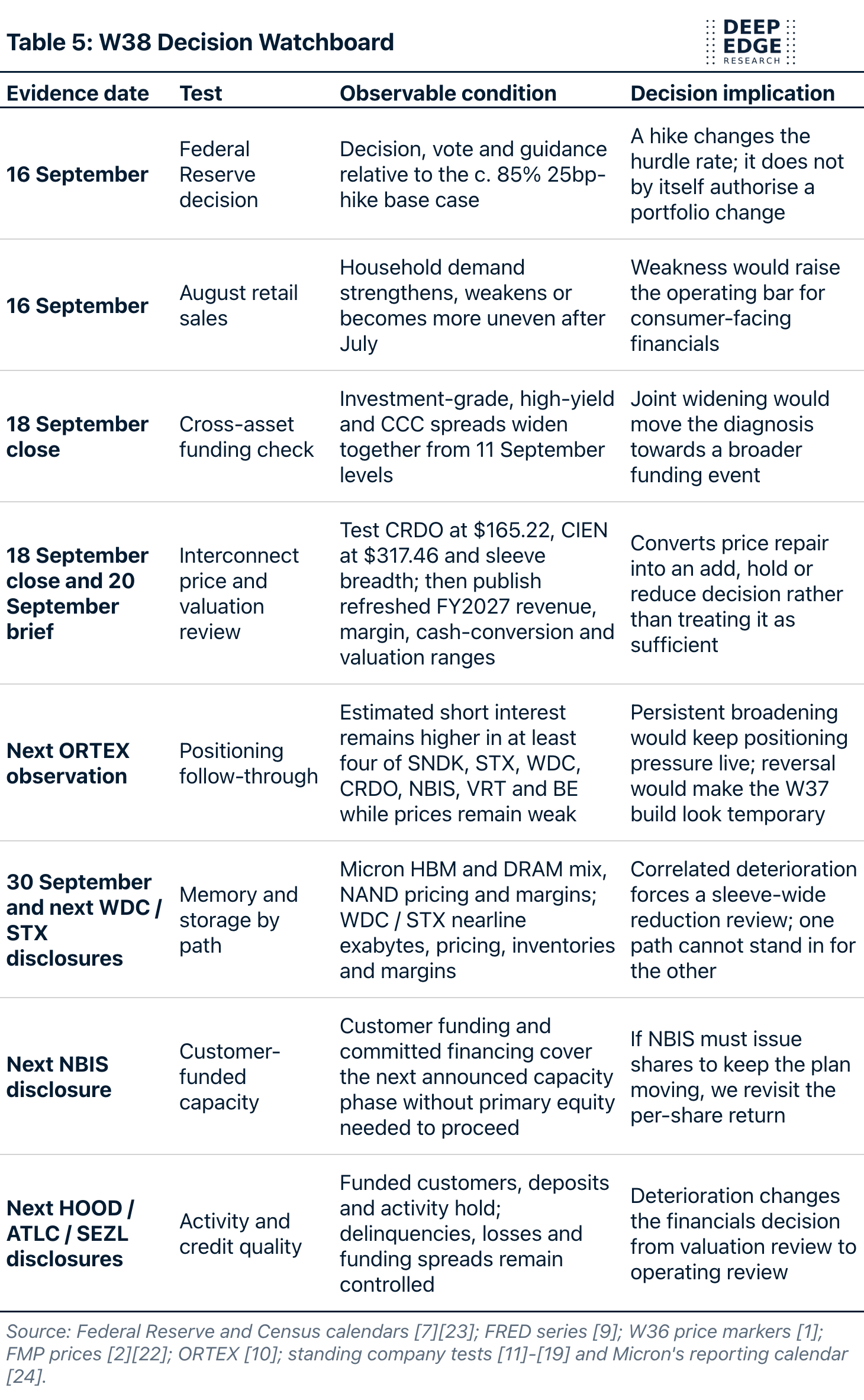
Cash closed at c. 20.9% of economic portfolio value. We will release it only after a holding clears its company-level operating test and a refreshed valuation leaves enough room for error. A Fed decision cannot satisfy either condition on a company’s behalf.
Conclusion: Hold every position, make no new purchases and keep c. 20.9% in cash. Storage gets the first sleeve review, VRT and HOOD get the sharpest company-specific reviews, and the Fed decision tells us how high the hurdle is rather than which holding clears it.
Final Thought
W37 gave us three different answers. The Fed repriced what investors would pay for distant cash flows. CCC spreads warned that weaker borrowers could feel funding pressure. The companies did not report a broad deterioration in orders, pricing or margins.
Those are different problems, so we are treating them differently. A share price can fall in a day. A funding problem appears in financing terms or equity dependence. An operating break requires the business to weaken.
So the capital decision is deliberately boring: hold every position, add nothing and keep c. 20.9% in cash. We have evidence of the first, a warning on the second and no evidence of the third. The Fed can raise the hurdle. It cannot decide which company clears it.
Methodology Note
Monday 7 September was Labor Day, so portfolio performance uses Tuesday’s open to Friday’s close. Share units and cash are held constant across the window. The calculation uses the verified position set carried into W37; its displayed two-decimal weights create immaterial rounding noise. Absolute account value, cash balance, share units and lot data remain internal.[1][2]
Portfolio return is economic total return. International Seaways went ex-dividend for $5.05 per share during the window. The declared dividend receivable adds c. 0.18 point to the price-only portfolio return of c. -3.46%, producing the c. -3.29% headline. The receivable is included in ending portfolio value but is not treated as cash already received.[2][21]
Sleeve returns are position-weighted. Contribution is value change divided by the whole Tuesday-opening portfolio, cash included. Equal-weight breadth asks whether the named companies participated; it cannot be interchanged with portfolio attribution. Table 3 displays rounded contributions calculated from unrounded inputs. The prefix c. marks rounded Deep Edge calculations and market observations; exact company disclosures and official series endpoints are shown without it.
FRED rate, volatility, spread and commodity comparisons use 4 September to 11 September observations. They are Friday-to-Friday macro gauges, not portfolio-return windows. FMP supplies historical open, close and volume data.[9][22]
ORTEX supplies estimated short interest as a share of free float, rather than exchange-reported settled short interest. It cannot identify sellers, measure long-side crowding or establish motive. The seven-name test is the set pre-registered in W36: SNDK, STX, WDC, CRDO, NBIS, VRT and BE.[1][10]
Management conference transcripts are used for contemporaneous commentary and are not audited financial results. Where a competing explanation would change the portfolio decision, we state the observation that would distinguish it.
References
Deep Edge Research: W36: Credo and Ciena Grew. Their Shares Fell. What Still Needs Proving?, 6 September 2026. Prior watchboard, price markers and unchanged W32 valuation anchors.
Deep Edge Research calculations using the verified W35 position set and FMP historical prices, 8-11 September 2026. Internal workpaper retained separately from this public draft.
US Bureau of Labor Statistics: August 2026 Producer Price Index
US Bureau of Labor Statistics: August 2026 Consumer Price Index
US Bureau of Labor Statistics: August 2026 Employment Situation
CME FedWatch observations reported by Kiplinger after the 4 September employment report and Axios after the 11 September CPI report
Federal Reserve Bank of St. Louis: two-year Treasury, ten-year Treasury, thirty-year Treasury, VIX, investment-grade OAS, high-yield OAS, CCC OAS and WTI, 4 and 11 September 2026 observations.
ORTEX: Estimated short-interest API methodology. Deep Edge observations for 4 and 11 September 2026.
Sandisk: Revolving credit facility amendment filed with the SEC, 9 September 2026
Sandisk: Goldman Sachs Communacopia + Technology Conference transcript, 9 September 2026
Western Digital: Citi Global TMT Conference transcript, 9 September 2026
Seagate: Note settlement filed with the SEC, 8 September 2026
Seagate: Citi Global TMT Conference transcript, 10 September 2026
Vertiv: Goldman Sachs Communacopia + Technology Conference transcript, 8 September 2026
Lumentum: Citi Global TMT Conference transcript, 9 September 2026
Nebius and Palantir: Sovereign AI partnership, 8 September 2026
International Seaways: Second-quarter results and dividend declaration
Micron: Fiscal fourth-quarter results scheduled for 30 September 2026
This article is for information and education only. It is not investment advice. Past performance is not indicative of future results.
(c) Deep Edge Research