
Credo Technology Group (CRDO) grew revenue 114.7% from a year earlier. Ciena Corporation (CIEN) grew 37%. Both guided to more revenue ahead. From Monday’s open to Friday’s close, their shares fell c. 26.5% and c. 15.2%.[2]-[6]
That is uncomfortable. It is also useful. Last week we said Nvidia (NVDA) had confirmed upstream demand, while its suppliers still had to show orders, margins and cash. Credo and Ciena have now supplied the first part: demand is reaching them. Their shares were already falling before the reports, so we cannot pin the week’s moves on a single reaction. We can test whether the growth produces enough margin and cash to earn a return at today’s prices.[1]-[6]
Our January 2026 Outlook calls the network and connectivity part of the physical AI buildout Utilise. It sits alongside Ship, the memory and storage needed to deliver a working system, and Energise, the power and cooling needed to run it.[10] These are ways to locate company evidence, not explanations for one day’s share prices.
The price problem runs in reverse in storage. Memory and storage added c. 3.0 points while interconnect took away c. 2.4. Sandisk (SNDK) gained c. 17.1% from Monday’s open to Friday’s close; its $1,740 closing price now sits only c. 3% below our unchanged W32 weighted value of c. $1,800. Better proof can leave less room to buy when the price moves faster than the valuation.[1][2]
TLDR
The portfolio rose c. 2.9%, but the gains came from elsewhere. Memory and storage added c. 3.0 points, AI power c. 0.9, and holdings outside the three physical-infrastructure arenas c. 1.5. Interconnect cost c. 2.4.[2]
Credo and Ciena delivered Utilise demand evidence. Credo’s cable shipments drove most of its annual growth. Ciena reported stronger cloud-provider revenue and optical orders. Both guided to further revenue growth.[3]-[6]
Growth still has to pay for itself. Credo used cash in working capital as inventory rose; Ciena guided next-quarter margins below the quarter just reported. Those facts belong in a new valuation, though neither tells us why the shares fell.[3]-[6]
No new purchases. Cash remains at c. 20.6%. Before we add, a holding must clear its operating test and its refreshed valuation must leave enough upside to allow for error. Sandisk’s old value gap has narrowed to c. 3%.[1][2]
This week’s positioning: hold every position, make no new purchases and keep c. 20.6% in cash. Revalue Credo and Ciena first, then test storage pricing and margins. Nebius, financials and shipping each have separate operating and valuation tests.
What Changed Since W35
Our view: Credo and Ciena strengthened the Utilise demand case. The breadth test we set last week failed, so we cannot yet call it a recovery across our AI-infrastructure holdings.
Table 1 is the audit trail for the tests we set in W35. The company and macro rows still marked pending carry into the next reporting window.
Table 1: W35 Watchboard Closure
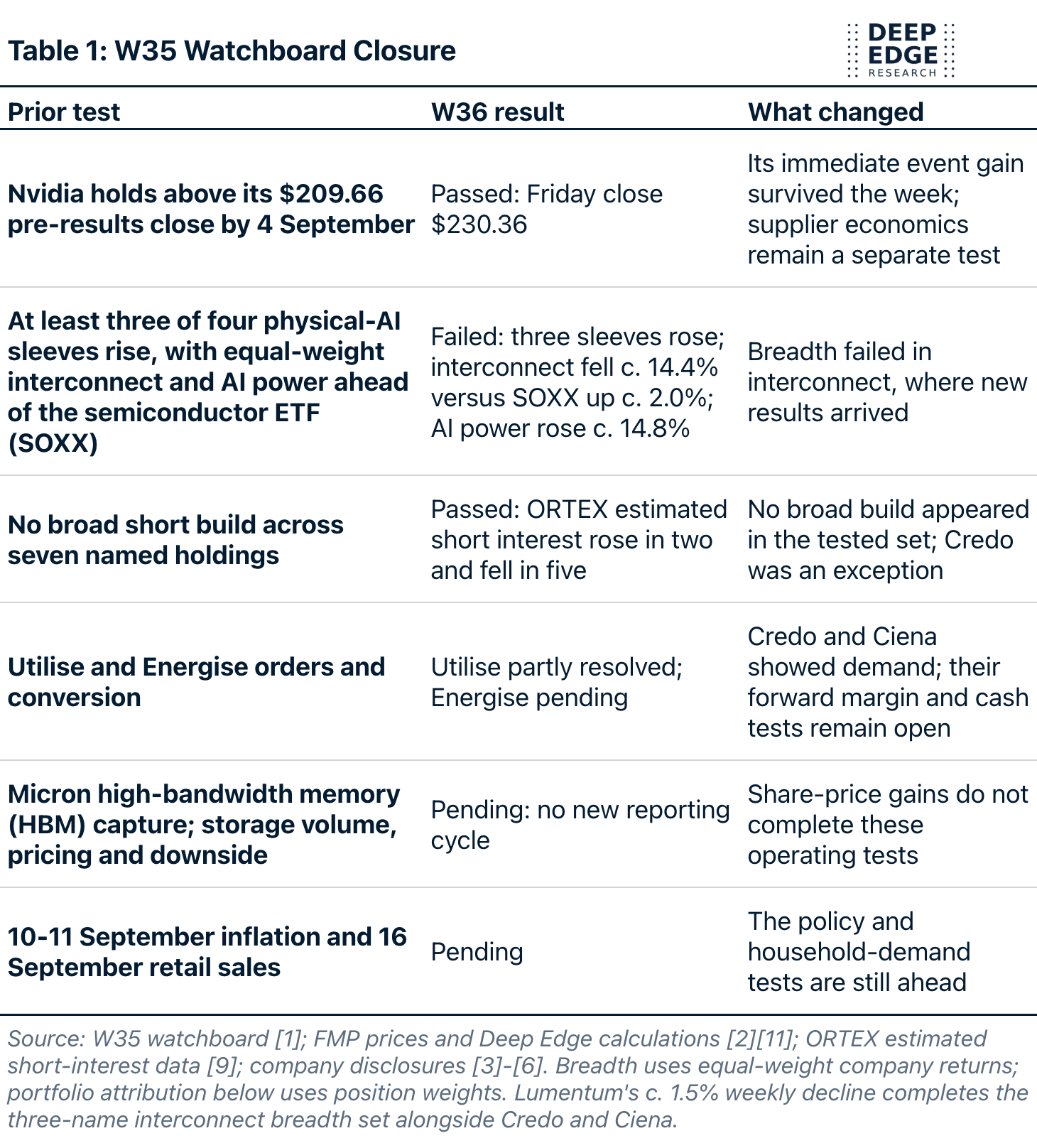
Credo’s estimated short interest (the proportion of publicly tradeable shares sold short) rose from 3.64% to 4.22%; Bloom Energy (BE) edged from 6.33% to 6.40%. The other five fell. Ciena was outside the set. ORTEX rejects a broad new short build across these seven holdings, though it cannot identify sellers.[9]
We score Ship, Energise and Utilise at company disclosure rather than by share return.[1] Credo’s cable growth and Ciena’s cloud and optical orders are the first positive Utilise evidence. Vertiv Holdings (VRT) and Bloom did not report comparable quarters, leaving Energise open. Sandisk and Micron’s Ship tests are still pending.[1]-[6]
Conclusion: The W35 watchboard recorded a split: Utilise demand improved, but interconnect breadth failed. The next company disclosures must show whether that demand reaches margins and cash.
1. The Portfolio Gained Despite Interconnect
Our view: We made money this week, but the first new Utilise results arrived alongside a large interconnect loss. That is the part of the return we need to examine first.
From Monday 31 August’s open to Friday 4 September’s close, the portfolio gained c. 2.9%. The SPDR S&P 500 ETF Trust (SPY) rose c. 0.4%, Invesco QQQ Trust (QQQ) c. 0.5% and the iShares Semiconductor ETF (SOXX) c. 2.0%.[2] Table 2 shows the gain and the interconnect loss on the same ledger. Its contributions total c. 2.95 points before rounding to the c. 2.9% headline.
Table 2: W36 Portfolio Attribution
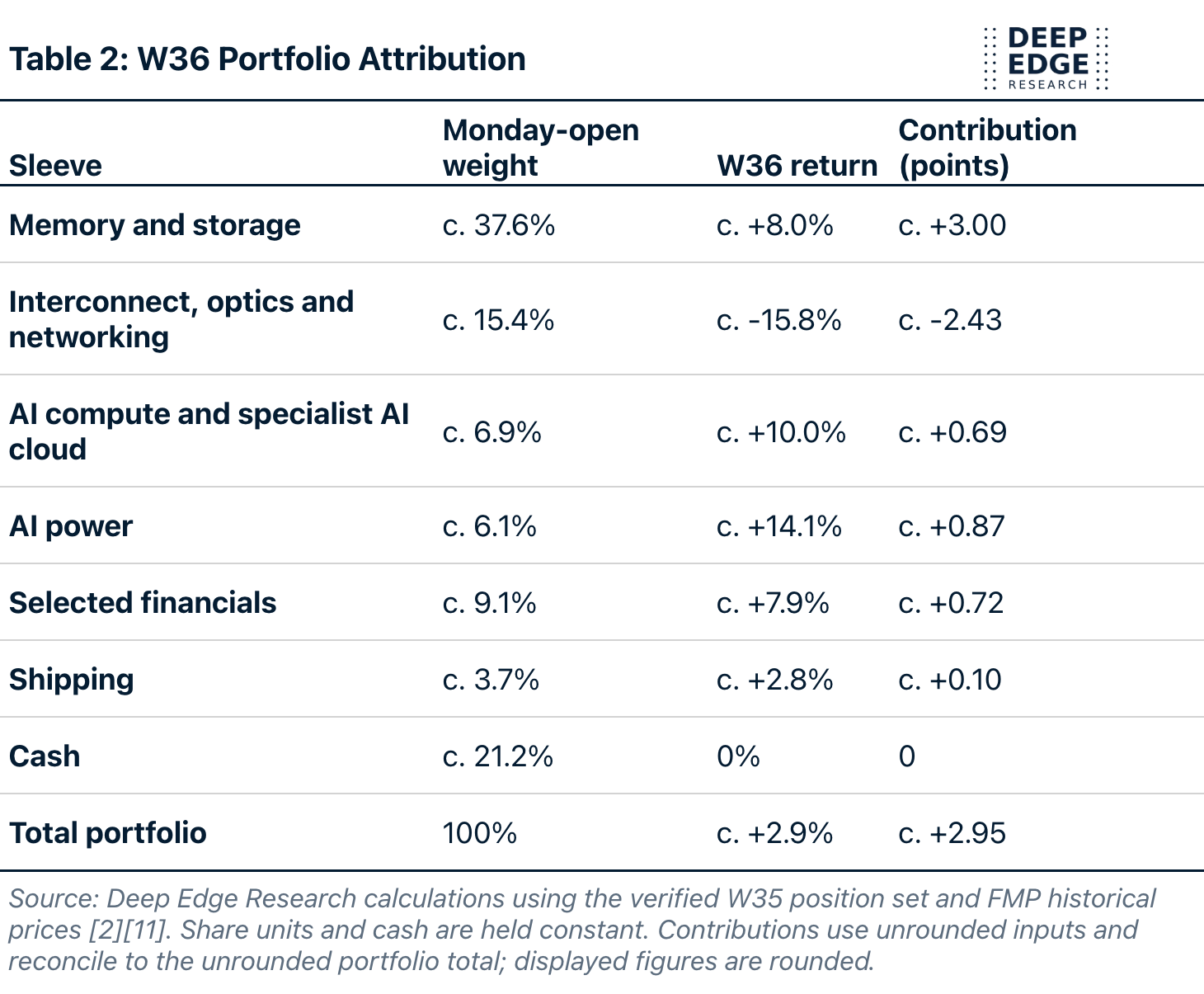
Sandisk added c. 1.59 points and Micron Technology (MU) c. 0.96. Credo cost c. 1.74, Ciena c. 0.62 and Lumentum Holdings (LITE) c. 0.07. Those three losses account for the interconnect sleeve’s c. 2.43-point drag.[2]
The three physical-infrastructure arenas do not describe the entire portfolio. Nebius Group (NBIS), our specialist AI-cloud holding, added c. 0.69 point, selected financials c. 0.72 and shipping c. 0.10. Together that is c. 1.5 points, roughly half the week’s gain. Robinhood Markets (HOOD) supplied most of the financial contribution; International Seaways (INSW) supplied shipping’s. Each has its own operating and valuation case. Their gains do not grade Ship, Energise or Utilise.[2]
The timing also matters. Credo and Ciena were already below their Monday opens before reporting. Their first post-results sessions then fell c. 20.0% and c. 10.4%, on c. 6.9 and c. 3.8 times their respective prior 20-session average volume. Many shares changed hands; the trading data cannot tell us whose expectations changed.[2]
With cash and share units constant, the invested book’s gain reduced cash’s weight from c. 21.2% to c. 20.6%.[2]
Conclusion: Memory, power and holdings outside the three arenas offset interconnect’s c. 2.43-point drag, explaining the positive portfolio week but not why Credo and Ciena fell.
2. Demand Is Here. The Return Still Depends on Margins and Cash
Our view: We have the demand evidence we wanted from both businesses. We will hold them while we test whether that growth can earn the margins and cash their share prices require.
Table 3 bridges the reported quarters and the valuation update. Its final column records the weekly sell-off without treating it as a verdict on either business.
Table 3: Credo and Ciena’s Demand and Economics
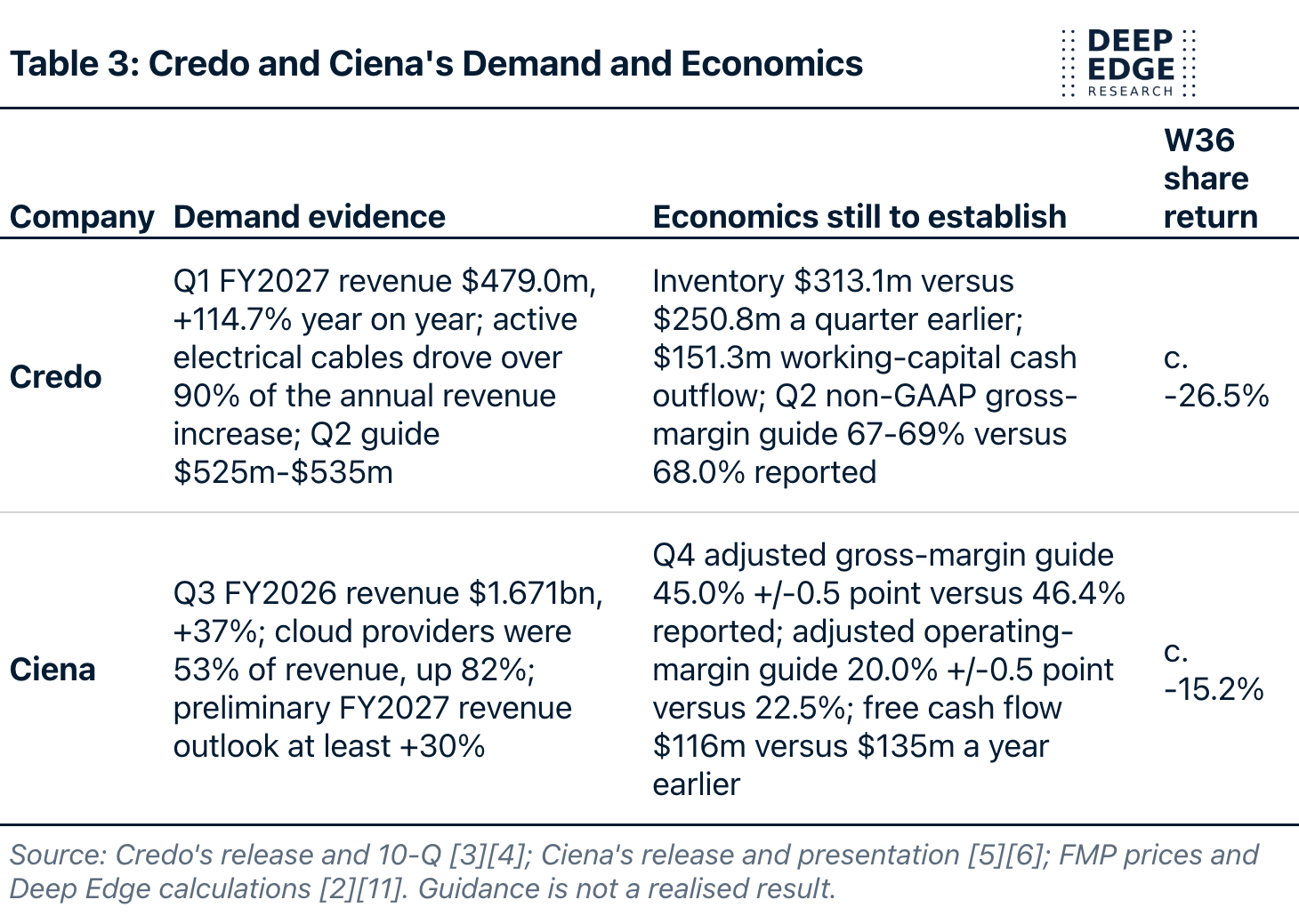
What we need to know at Credo is how much inventory the next leg of growth requires. It generated $90.2m of operating cash, up from $54.2m a year earlier, even as $151.3m went into working capital to support growth. Inventory rose c. $62m. GAAP operating margin fell from 35.7% to 25.2% sequentially; the non-GAAP measure eased from 49.6% to 48.2%.[3][4] Cash spent on DustPhotonics belongs to investing activity, not operating burn. Our valuation rebuild will use the FY2027 revenue path, realised margins, inventory needs and operating cash conversion together.
What matters for Ciena is how much of that growth turns into margin and cash. Q3 adjusted gross and operating margins improved sequentially to 46.4% and 22.5%, while its Q4 guide is lower on both measures. Management expects $1.75bn of Q4 revenue at the midpoint and gave a preliminary FY2027 growth outlook of at least 30%. It cited a direct performance-optics order and a second multi-rail win.[5][6] The lower Q4 margin guide could reflect customer mix, investment or timing rather than a turn in demand; the preliminary FY2027 operating-margin outlook of 25–27% is materially higher. Our rebuild turns on whether that FY2027 revenue and margin path becomes cash. Q3 free cash flow of $116m was below $135m a year earlier.[6]
Conclusion: Credo’s working-capital needs and Ciena’s margin-to-cash conversion now carry the valuation work. In W37 we will say how far each update has progressed and which inputs remain unsettled.
3. Interconnect Fell. The Broader Market Did Not.
Our view: Yields and high-yield spreads rose, but volatility barely moved and semiconductors gained. We will not let a modestly worse macro backdrop stand in for an explanation of Credo and Ciena’s declines.
From the prior Friday to 4 September, the two-year Treasury yield rose from 4.34% to 4.37%, the ten-year from 4.73% to 4.78%, and high-yield credit spreads from 2.60% to 2.68%. Volatility barely moved, and SOXX gained c. 2.0%.[2][8] August payrolls rose by 162,000 while unemployment stayed at 4.1%.[7] Higher rates could still weigh on expensive growth shares. They do not explain the contrast between interconnect and the rising memory and power sleeves by themselves.
Our read is narrower: Utilise demand arrived, but Credo and Ciena still face a tough price-to-value test. Credo’s estimated short interest rose and volume spiked, but neither series tells us whether existing shareholders sold or why.[2][9]
Conclusion: Credit and volatility did not confirm a general funding break. The small rise in yields left a slightly less forgiving valuation backdrop, but Credo and Ciena’s next margins and cash figures will tell us more than the week’s broad market moves.
4. Better Proof Can Leave Less Room to Buy
Our view: We will not buy Credo and Ciena merely because they fell, or chase Sandisk and Western Digital (WDC) towards our old values. The next dollar of cash needs both operating proof and room for a return at the new price.
Credo fell c. 26.5% and Ciena c. 15.2%; both are cheaper, but their new revenue, margin and cash evidence has yet to enter our valuations. Sandisk moved the other way: implied upside to its unchanged c. $1,800 W32 value shrank from c. 21% at the W35 close to c. 3% at Friday’s $1,740 close. Western Digital finished at $467.46, only c. 1% below its unchanged W32 value of c. $473.[1][2] Those old estimates are reference points, not new price targets. Micron’s gain improved the mark too, but we have no published Micron value anchor from which to claim a remaining upside figure.
Interconnect gets the first valuation review. It began the week at c. 15.4% of the book, cost c. 2.43 points and supplied two new reports that must now be reflected in our estimates. Memory and storage was larger at c. 37.6%, but Sandisk and Western Digital ended close to our unchanged W32 values. That sleeve needs fresh operating evidence and enough prospective return before more capital, even after a winning week.[1][2]
We do not impose a fixed sleeve ceiling because the same weight can contain very different company-level prospective returns. Yet correlated weakness in storage orders, pricing and margins would force a sleeve-wide review, including possible reductions. No holding receives fresh capital merely because its sleeve rose.[1][2]
The holdings outside the three arenas earned c. 1.5 points, but their gains cannot clear the physical-AI book’s pending tests. Nebius still needs customer funding to cover more planned investment without material new equity; Table 4 records that test. We would reopen selected financials if company earnings weakened, with the 16 September release of August retail sales also testing the backdrop for consumer-facing holdings. We would reopen shipping if its next company results weakened its earnings case. Neither sleeve has a new W37 company test in Table 4.[1][2]
Cash closed at c. 20.6%. We release it only when a holding clears its operating test and a refreshed valuation leaves enough room for error. Neither a strong demand print nor a lower price satisfies both conditions automatically.[1][2]
Table 4 starts with the share prices and breadth we can check next week. Even if both improve, those first two rows cannot authorise an add; the operating results and refreshed valuations still have to do that work.
Table 4: W37 Decision Watchboard
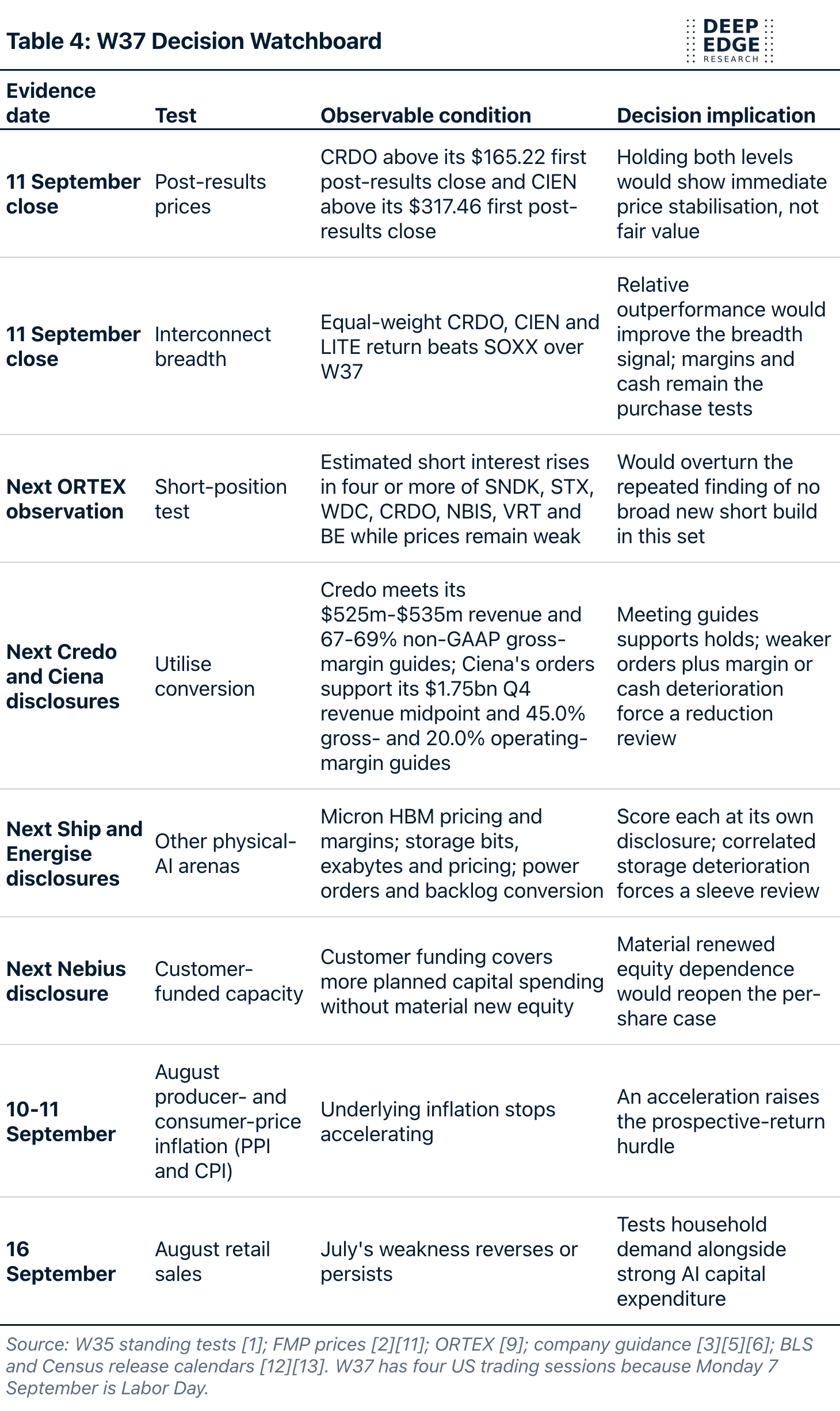
Conclusion: The interconnect drawdown makes Credo and Ciena urgent to revalue; the storage rally makes Sandisk and Western Digital harder to add. We hold every position, make no new purchases and keep c. 20.6% cash until operating proof and prospective return point to the same holding.
Final Thought
Credo and Ciena gave us the demand evidence we asked for, and their shares fell anyway. Trading data cannot identify the sellers or their reasons. The reports do tell us where to look next: margins and cash.
For now we hold the book, add nothing and keep c. 20.6% in cash. If orders and cash conversion hold, the new valuations may give us a reason to add later. If the operating data follow the shares down, we will reconsider what we own. The companies have made their case on demand. Our cash still requires a case on return.
References
Deep Edge Research: W35: Nvidia Confirmed the Buildout. What Does the Rest of AI Still Need to Prove?, 30 August 2026. Prior watchboard, capital rules and unchanged W32 valuation anchors.
Deep Edge Research calculations using the verified W35 position set and FMP historical prices, 31 August–4 September 2026. Internal workpaper retained separately from this public draft.
Credo: Q1 FY2027 results filed with the SEC, 1 September 2026
Ciena: Q3 FY2026 results filed with the SEC, 3 September 2026
US Bureau of Labor Statistics: August 2026 Employment Situation
Federal Reserve Bank of St. Louis: two-year Treasury, ten-year Treasury, VIX and high-yield spread, 28 August and 4 September 2026 observations.
ORTEX: Estimated short-interest API methodology. Deep Edge observations for 28 August and 4 September 2026.
Deep Edge Research: 2026 Outlook: AI Infrastructure Is Not a Bubble (Part 3 of 3), 29 January 2026.
US Bureau of Labor Statistics: September 2026 release calendar
This article is for information and education only. It is not investment advice. Past performance is not indicative of future results.
(c) Deep Edge Research