
Nvidia (NVDA) did exactly what W34 asked it to do.
Revenue reached $96.2 billion, up 106% from a year ago. Data-centre revenue reached $89.0 billion, up 117%. Management then guided to $108.0 billion for the third quarter, without assuming any data-centre compute revenue from China.[3][4]
The upstream demand question is settled for now. The capital question is not.
Nvidia rose c. 8.7% the next day. Our portfolio rose c. 0.7% over the same close-to-close window. Memory and storage fell c. 0.6%. Interconnect, optics and networking rose c. 2.8%. AI compute and neocloud rose c. 2.1%. AI power rose c. 1.1%.[2]
That dispersion is where we disagree with the easy reading of the quarter. Nvidia proved that the buildout is still accelerating. It did not prove that every supplier around the GPU should be bought at today’s price.
Much of our capital already sits across those suppliers, so this is not a semantic distinction. It determines whether we add, hold or reduce.
In our January 2026 Outlook,[22] we divided the physical delivery of AI infrastructure into three arenas. We call them Ship, Energise and Utilise.
Ship asks whether a balanced system can be delivered, including memory, packaging and storage. Energise asks whether the racks can be powered and cooled. Utilise asks whether the interconnect can make thousands of accelerators behave as one machine.
The framework maps operating transmission, not one-day price causation. Expectations, valuation, positioning, liquidity and de-grossing can all matter. De-grossing means shrinking total long and short exposure. We leave the session unexplained because a tidy story would make the operating claims that follow less reliable.
It shows where Nvidia’s demand should become company evidence: high-bandwidth memory (HBM) with accelerator shipments; flash and hard-disk demand as the data estate grows; power and cooling at deployment; interconnect as clusters scale.
Nvidia strengthened all three arenas. It did not tell us which supplier wins each order, when the revenue arrives or what margin survives.
Then Friday raised the price of waiting for those paths to become revenue.
At Jackson Hole, Federal Reserve Chair Kevin Warsh said that more than half of this year’s capital-expenditure growth was probably attributable to AI. He also said that 12-month PCE inflation stood at 3.7%, six-month inflation ran at a 4.1% annualised rate and the Fed still had work to do unless underlying inflation moved towards 2% clearly and fast enough.[15]
The two-year Treasury yield rose 14 basis points on Friday. Our portfolio fell c. 1.9%.[2][8]
Yet the VIX declined and corporate credit spreads narrowed over the week.[11]-[14]
Demand remained strong. The hurdle for turning it into shareholder value rose.
TLDR
Nvidia confirmed that the AI buildout remains exceptionally strong. Quarterly revenue rose 106% year on year to $96.2 billion, data-centre revenue rose 117% to $89.0 billion and third-quarter guidance reached $108.0 billion.[3][4]
The event response was far narrower than the operating result. Nvidia rose c. 8.7% after the report, while our portfolio gained c. 0.7%. Interconnect and AI power responded better than memory and storage, but neither repaired the full W34 decline.[2]
Our three-arena framework maps operating transmission, not the event-day tape. Ship covers memory, packaging and storage; Energise covers power and cooling; Utilise covers interconnect. It identifies where company evidence should appear, not why a share moved or which supplier captures the economics.
We are holding without adding. Nvidia settled the demand question, not the valuation, vendor-share, project-timing, storage-cycle or financing questions. Cash ended the week at c. 21.1% and remains available while those links become measurable.[2]
This week’s positioning: keep the physical-AI core, underwrite each arena and each path inside Ship separately, and require every company to show how category demand reaches its revenue, margins and prospective return.
What Changed Since W34
Our view: Nvidia answered the upstream demand question. Our W34 tests show why we are not treating that answer as a blanket signal to add: the physical-AI repair did not broaden across two weeks, even though ORTEX short-interest data again rejected a broad new short build.
Table 1 closes the W34 watchboard before we interpret the new week.
Table 1: W34 Watchboard Closure
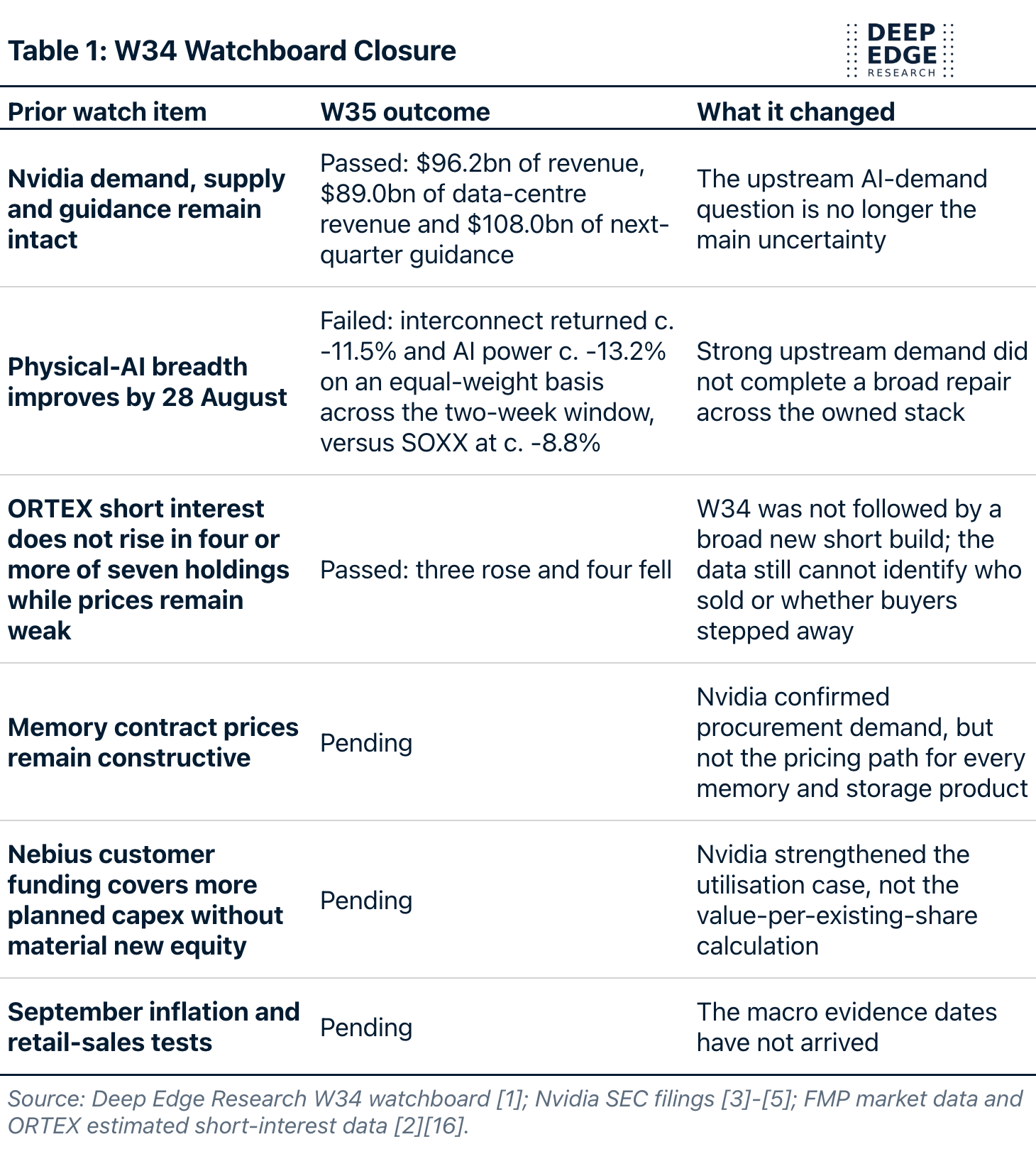
The table gives us two different answers. Nvidia closed the upstream demand question decisively. The failed breadth test stops us turning that answer into a conclusion about every supplier.
The breadth figures above are equal-weight group returns because the test asked whether participation widened across the names. They are different from the position-weighted sleeve returns used in the portfolio attribution below.
The positioning test tells us something narrower. Estimated short interest rose in Sandisk (SNDK), Credo Technology Group (CRDO) and Seagate Technology (STX), but fell in Nebius Group (NBIS), Western Digital (WDC), Vertiv Holdings (VRT) and Bloom Energy (BE). The largest move was a 3.5-percentage-point decline in Nebius short interest, although the absolute level remained high at 23.3% of free float.[16] That result stayed inside the threshold set in W34, so we still cannot blame one broad short build for the weak participation.
Conclusion: W35 rejected a broad demand failure and a broad new short build. It did not confirm a broad physical-AI recovery. The work now moves from proving that AI demand exists to measuring how it travels through Ship, Energise and Utilise and reaches the companies we own.
1. A Positive Week Hid a Narrow Result
Our view: The portfolio recovered c. 0.9%, but that number flatters the breadth of the move. Nvidia confirmed the buildout without producing a blanket re-rating across the companies we own.
The portfolio rose c. 0.9% from the market open on Monday 24 August to the close on Friday 28 August.[2]
Over the same window, the SPDR S&P 500 ETF Trust (SPY) rose c. 0.6%, the Invesco QQQ Trust (QQQ) rose c. 1.0%, the iShares Semiconductor ETF (SOXX) fell c. 0.7% and the VanEck Semiconductor ETF (SMH) was broadly flat.[2]
We outperformed the semiconductor benchmarks slightly and finished close to the broad technology market. That is better than W34, but only the attribution tells us which holdings actually worked.
Table 2: W35 Portfolio Attribution
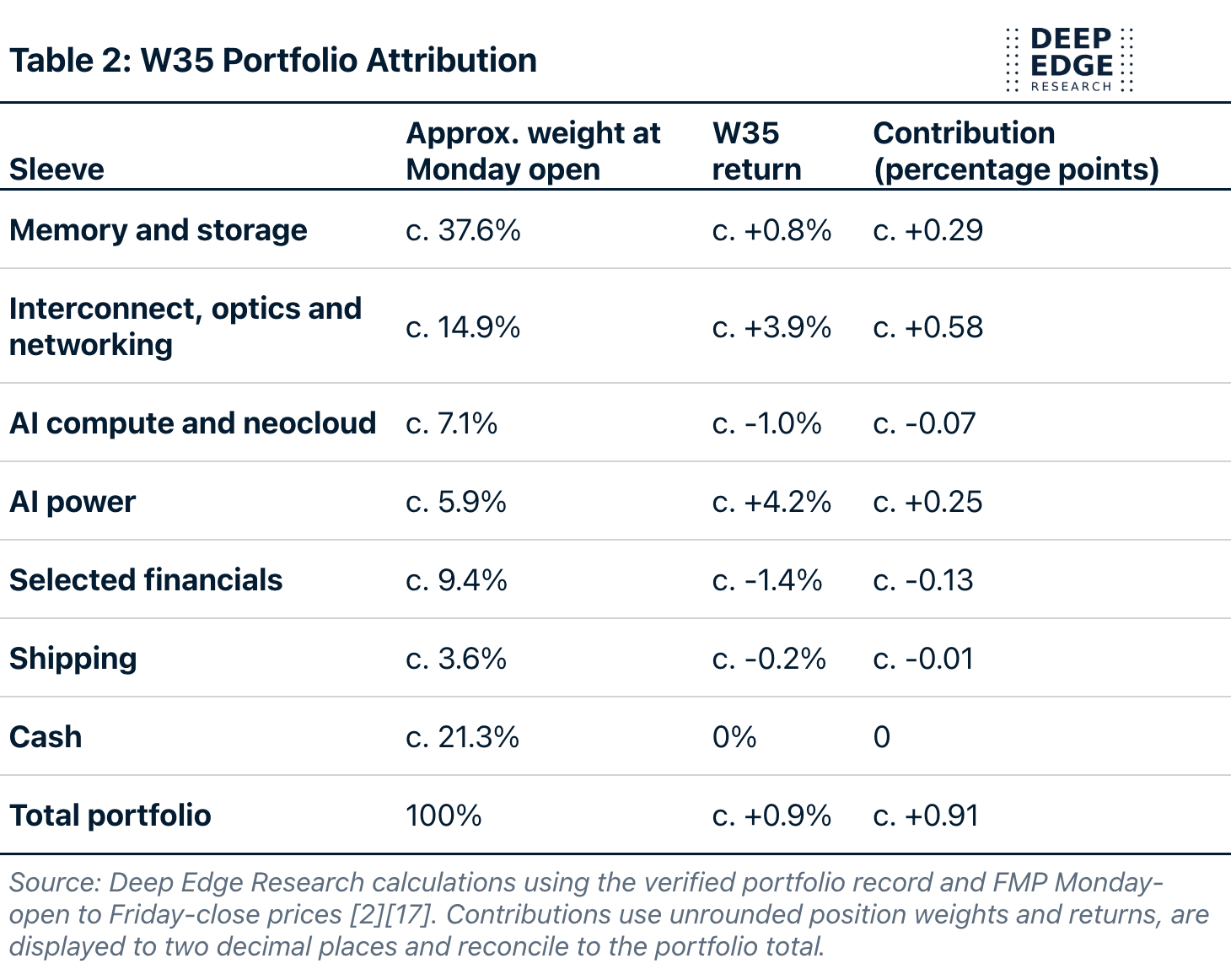
Interconnect and AI power supplied c. 0.83 of the portfolio’s c. 0.91 percentage-point gain. In other words, almost the entire weekly return came from two sleeves.
Lumentum Holdings (LITE) rose c. 8.7%, Credo rose c. 4.5% and Bloom rose c. 9.8%. Western Digital and Seagate added c. 2.9% and c. 1.4% respectively.[2]
The offsets were smaller but revealing. Atlanticus Holdings (ATLC) fell c. 4.9%, Robinhood Markets (HOOD) fell c. 2.4%, Ciena fell c. 2.0% and Nebius fell c. 1.0%.[2]
The weekly endpoints hide the event itself. From Wednesday’s close to Thursday’s close, Nvidia rose c. 8.7%. Our portfolio gained c. 0.7%. Memory and storage fell c. 0.6%, while interconnect rose c. 2.8%, AI compute and neocloud c. 2.1% and AI power c. 1.1%.[2]
On Friday, our portfolio fell c. 1.9%. Interconnect, AI compute and AI power each lost roughly 4% to 5%, while Nvidia fell c. 4.6%.[2]
The event-day tape rewarded Nvidia and selected suppliers. Friday’s reversal was consistent with a higher hurdle for supplier capture, valuation and the cost of capital, but one day cannot identify the cause.
Cash ended the week at c. 21.1%. The small decline from Monday’s c. 21.3% was mechanical: the invested book rose while the absolute cash balance was held constant.
Conclusion: W35 paid the book for selected interconnect and power exposures rather than for owning the physical stack indiscriminately. Each position now owes us evidence that its company captures the demand.
2. Nvidia Settled the Upstream Demand Question
Our view: Our read is straightforward: revenue, guidance and supply commitments moved together, making a near-term break in AI infrastructure demand much harder to argue. What we will not do is divide Nvidia’s disclosures mechanically among the suppliers around it.
Total revenue reached $96.2 billion, up 18% sequentially and 106% from a year earlier. Data-centre revenue reached $89.0 billion, up 18% sequentially and 117%. Hyperscale revenue increased 13% sequentially, while revenue from AI clouds, industrial customers and enterprises increased 25% sequentially and 138% year on year. Nvidia then guided to $108.0 billion of third-quarter revenue, plus or minus 2%, without assuming any data-centre compute revenue from China.[3][4]
The figures confirm demand across hyperscalers, specialist AI-cloud providers, enterprises and sovereign buyers. Nvidia’s supply and capacity commitments also increased from $119 billion in the previous quarter to $279 billion, primarily for memory, as it secured components needed over the next several years.[4][5]
That makes memory’s physical importance difficult to dispute. It still gives us no HBM-versus-flash split, delivery schedule or supplier allocation. We cannot calculate Micron Technology’s (MU) share or infer Sandisk’s revenue from it.
The same limit applies to networking. Nvidia reported $88.3 billion of combined compute and networking revenue, up 114% year on year.[4] The combined figure confirms enormous demand for moving data between processors. It does not show how much of the networking economics Nvidia captures itself or how much reaches Credo, Ciena or Lumentum.
That changes the burden of proof. A weak supplier can no longer point to uncertain accelerator demand as the main explanation. Each company must now show us how the buildout enters its own orders, revenue, margins and cash flow.
Conclusion: Nvidia made a broad AI-demand failure much less plausible and confirmed that memory procurement remains intense. It did not provide the product, supplier or timing detail required to value the rest of the stack. That work still belongs at company level.
3. Nvidia’s Demand Reaches the Three Arenas Differently
Our view: Nvidia’s demand should reach the owned suppliers through different operating evidence. Hot-path Ship has the shortest physical hand-off; Energise and Utilise depend on deployment and architecture.
Table 3 maps operating transmission, not price response. Its row order follows Ship, Energise and Utilise. The two Ship rows separate the accelerator’s hot path from context storage for working data and corpus storage for persistent data.
Table 3: W35 Transmission Across Ship, Energise and Utilise
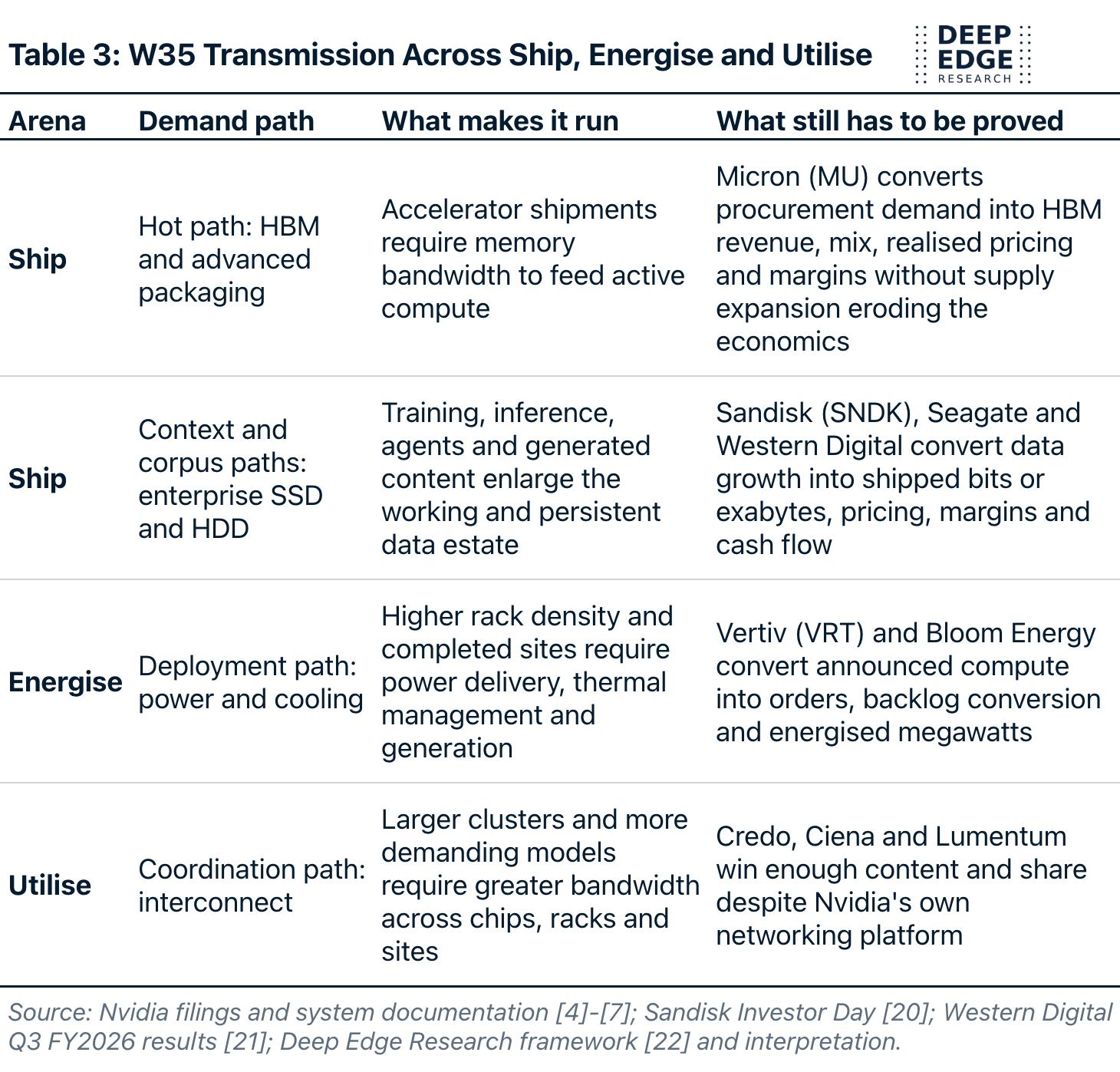
An HBM-equipped accelerator cannot ship without its memory stack. We will test Ship at Micron’s next disclosure through HBM revenue, mix, pricing and margins; Energise through deployment and backlog conversion; Utilise through orders and content gains. We will score the predicted evidence at each disclosure rather than the order of the earnings dates.
The company moves that follow are context for the dispersion, not evidence of capture.
Micron nevertheless fell c. 0.3% on the first trading day after Nvidia’s results and c. 0.2% across W35.[2] We cannot identify why it fell on one trading day. Expectations, valuation, positioning, de-grossing, liquidity and other flows may all have mattered. What we can establish is that Nvidia did not disclose Micron’s share, realised pricing or the margin effect of future capacity additions. The quarter confirmed category demand without clearing Micron’s company-specific proof point.
The next hand-off is Energise, when customers turn purchased compute into working infrastructure. A GPU order becomes a Vertiv order when racks are designed, sites are fitted and cooling architecture is selected. It becomes a Bloom order when the customer needs generation and chooses Bloom’s technology and project economics.
Vertiv rose c. 2.1% after Nvidia’s report, then fell c. 4.5% on Friday. Bloom was broadly flat after the report and fell c. 3.2% on Friday.[2] Their demand is tied to rack density and energised megawatts, which can lag the chip order and move with project schedules.
Once the racks are live, Utilise runs through the fabric. Larger clusters require more bandwidth and more complex connections, but topology and vendor choice determine who captures the spend. Credo rose c. 6.1% after the report and Lumentum c. 1.8%, while Ciena fell c. 1.0%.[2]
That spread is useful. More AI networking benefits the category, but Nvidia also sells its own networking systems and the three external suppliers address different parts of the fabric. Cluster growth is not an equal-share guarantee.
Conclusion: We will not treat event-day dispersion as a ranking of the three arenas. Category demand is established; vendor share, project timing and margins remain company questions, so every holding still has to produce its own operating proof.
4. Ship Includes the Data Estate, Not Only HBM
Our view: We would make the opposite mistake if we treated one muted week in Sandisk, Seagate or Western Digital as evidence that storage sits outside the critical stack. Storage belongs inside Ship, but its context and corpus paths follow data creation and retention rather than a fixed number of drives per GPU. That distinction matters because memory and storage is our largest sleeve.
Inside Ship, the 2026 Outlook distinguishes three tiers. HBM and advanced packaging form the hot path. Host memory and enterprise SSDs form the context path. Bulk storage, often HDD, forms the corpus path.[22]
That three-tier split matters because the data estate expands before training, during training and after deployment.
Context path. High-performance NAND flash and enterprise SSDs hold working datasets, model weights and checkpoints. They also support retrieval systems and the stored context that models reuse during inference, known as the KV cache. At its 13 August Investor Day, Sandisk projected that the enterprise data-centre flash market would reach 1.2 zettabytes by 2030 as token volumes and KV cache make AI data centres more storage-intensive.[20]
That is an issuer forecast supporting a position we hold, not an observed industry result. The company has nevertheless provided separate commercial evidence: its multiyear agreements cover approximately half of the bits it expects to ship in FY2027 and two-thirds in FY2028.[20]
Corpus path. Nearline HDDs are the high-capacity drives used for training corpora, archives, logs, generated media and data retained for future use. Western Digital had already stated that training, inference, agentic AI and physical AI all create data that must be stored persistently and economically.[21]
Scaling research supports the direction without giving us a universal multiplier. The Chinchilla work scaled model size and training tokens together and used four times as much training data as Gopher. It did not establish that every new model generation requires exactly ten times more data.[23]
Training is only part of the storage case. Agentic histories, tool outputs and generated content can enlarge the data estate even without a new model being trained. Retention, compression and tiering still determine how much becomes purchased capacity.
Those qualifications change the timing without making storage peripheral. Flash and HDD suppliers can still meet strong structural demand with poor shareholder outcomes if supply grows faster, prices fall or mix disappoints. Warm and cold storage remain critical; the open question is who captures the economics.
W35 rewarded the context and corpus paths least clearly. That does not establish that storage shares are mispriced. It tells us that Nvidia’s result alone was insufficient to settle product demand, pricing and margins for Sandisk, Seagate or Western Digital.
Conclusion: Storage is not a fourth arena. It is the context and corpus portion of Ship. Demand can begin with training and continue accumulating through inference and agentic use, but we will judge the holdings through flash bits, nearline exabytes, pricing, orders and margins rather than through one week’s sympathy trade.
5. Friday Raised the Hurdle Without Breaking the Market
Our view: Our read of Friday is that Chair Warsh validated the strength of AI investment and raised the hurdle for owning it in the same speech. That matters most where revenue arrives later or external financing carries more of the build.
Chair Warsh said business investment in equipment and intangibles had risen at its fastest rate since 2021, with more than half of this year’s capex growth probably attributable to AI.[15]
He then made the policy constraint explicit. Twelve-month PCE inflation stood at 3.7%. The six-month annualised rate was 4.1%. Summer data had not convinced him that the underlying trend had improved meaningfully. Unless inflation moved to target clearly and fast enough, the Fed had more work to do.[15]
The two-year Treasury yield rose from 4.20% on Thursday to 4.34% on Friday. The ten-year rose 6 basis points to 4.73%, while the thirty-year rose 3 basis points to 5.22%.[8]-[10]
That move matters to companies whose revenue follows a longer deployment schedule or whose economics depend on external finance.
We would need broader confirmation before calling that a market break. It did not arrive. Across the week, the VIX fell from 15.85 to 14.43. Investment-grade spreads narrowed from 0.81% to 0.79%. Broad high-yield spreads narrowed from 2.69% to 2.60%, and CCC spreads narrowed from 10.36% to 10.26%.[11]-[14]
Credit did not withdraw. Volatility did not surge. Friday’s rates move raised the price of time and financing.
That distinction matters most for Nebius. Nvidia’s results make strong utilisation of AI infrastructure more plausible, but they do not answer how much equity Nebius must issue, how much debt it must carry or how much customer funding offsets planned capex. The operating case improved just as the common-share calculation became stricter.
Conclusion: Friday did not reverse Nvidia’s demand evidence. It increased the cost of waiting for demand to move through Ship, Energise and Utilise, especially where deployment takes longer or the balance sheet has to finance the journey.
6. What W35 Changed for the Book
Our view: Nvidia increased our confidence in all three arenas, including the expanding storage estate inside Ship. It did not give us permission to treat those arenas, or four memory-and-storage holdings, as one position.
Table 4 is where the analysis becomes a capital decision. It records what we are doing now and the evidence each holding must produce before we change course.
Table 4: W35 Portfolio Decisions
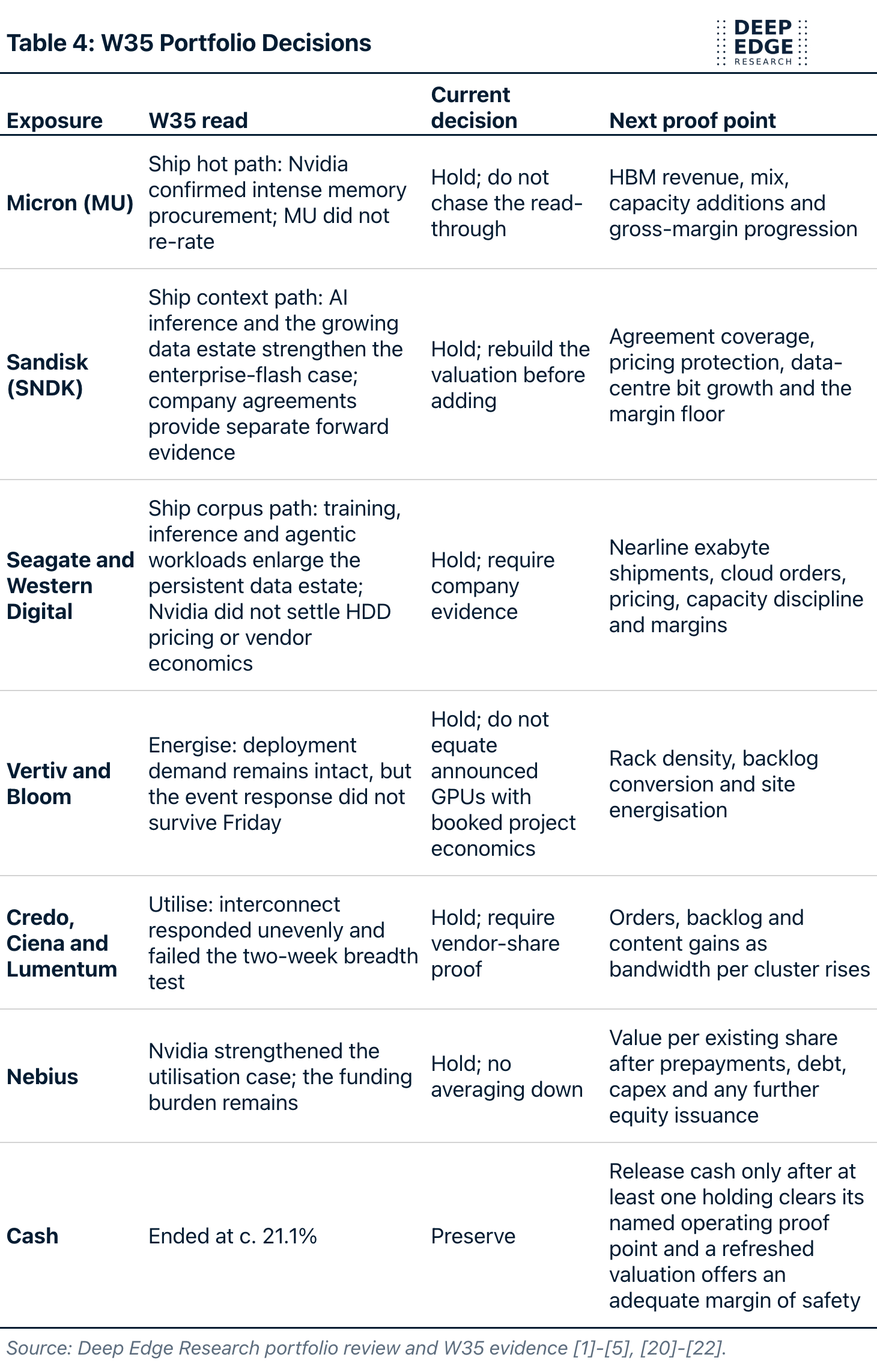
We are not managing the c. 37.6% memory-and-storage sleeve as one thematic wager. It contains Micron’s HBM exposure, Sandisk’s NAND and enterprise-flash economics, and two nearline HDD positions. They all sit inside Ship, but their demand paths, pricing, capacity and margin risks differ.
That is why we do not use a fixed sleeve ceiling: the same weight can conceal very different prospective returns. It is also why we will not let the structural storage thesis protect the positions from company evidence. Correlated deterioration in pricing, inventories, orders or margins would force a sleeve-wide review.
Sandisk closed at $1,484.98, still c. 10.5% above the pre-Investor Day marker set in W33. The unchanged c. $1,800 weighted scenario value now implies c. 21% upside, but the valuation still needs to be rebuilt around agreement coverage, pricing protection, data-centre bit growth and the margin floor. That prospective return is not yet an adequate margin of safety while those inputs remain unresolved. We are holding without adding.[1][2]
Nebius closed at $209.18, c. 8.3% above its pre-results marker. Nvidia’s report supports demand for the capacity Nebius is building. It does not remove the need to calculate that demand per existing share after funding.[1][2]
Western Digital closed at $459.45, still below the unchanged W32 weighted value of c. $473. The W34 reduction condition therefore remains inactive. We are not adding without a margin of safety.[1][2]
Conclusion: We are holding the physical-AI core, adding nothing and preserving c. 21.1% cash. The memory-and-storage weight is justified by four separately underwritten prospective-return cases, not by the claim that every byte of AI data automatically becomes supplier profit.
What W36 Needs to Prove
Our view: W36 should tell us whether demand across Ship, Energise and Utilise is beginning to reach company evidence. We also want the downside recorded in advance, so the watchboard includes the conditions that would force a sleeve-wide review.
The watchboard governs what we do next with the positions and the cash. Its operating rows implement that test at each arena’s next disclosure. The first three rows test the tape. The next four test operating capture and its downside. The final two test policy and household demand.
Table 5: W36 Decision Watchboard
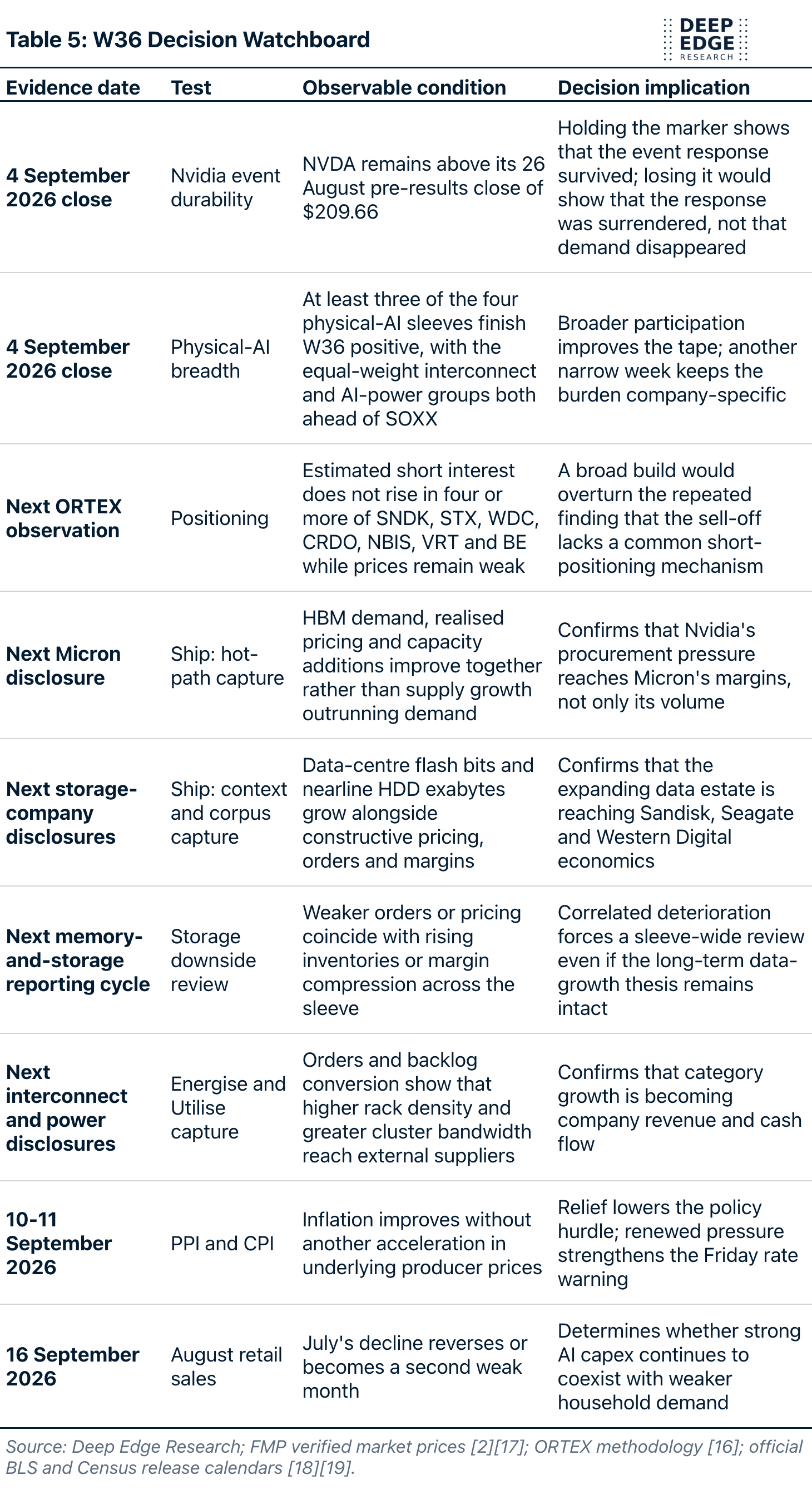
Holding a price marker for one week will not prove a durable re-rating. It will show whether the immediate conclusion survived long enough to be tested by company evidence.
Conclusion: Nvidia has done its part. The next proof must come from the suppliers, and the same evidence runs in both directions. Better orders, pricing and margins support the holds; correlated deterioration forces a review.
Final Thought
Nvidia settled the upstream demand question: the buildout is still accelerating. It did not settle the return available to us from every supplier at today’s price.
Our framework identifies the operating evidence still owed by each holding. It does not decide what to pay, which vendor wins or how quickly demand becomes cash flow.
That is the decision we own. We are holding the exposures that have earned their place, adding nothing, and preserving c. 21.1% cash while the suppliers prove their revenue, margins and prospective returns. We will not turn one extraordinary Nvidia quarter into permission to buy the whole stack.
References
Deep Edge Research: W34, Why Did AI Infrastructure Give Back Most of Last Week’s Gain?, 23 August 2026. Source for standing event markers, valuation work and the W34 decision watchboard.
Deep Edge Research calculations using the verified portfolio record and daily market prices, 24-28 August 2026.
Federal Reserve Bank of St. Louis: 2-Year Treasury Constant Maturity Rate
Federal Reserve Bank of St. Louis: 10-Year Treasury Constant Maturity Rate
Federal Reserve Bank of St. Louis: 30-Year Treasury Constant Maturity Rate
Federal Reserve Bank of St. Louis: ICE BofA US Corporate Option-Adjusted Spread
Federal Reserve Bank of St. Louis: ICE BofA US High Yield Option-Adjusted Spread
Federal Reserve Bank of St. Louis: ICE BofA CCC & Lower Option-Adjusted Spread
Federal Reserve: Chair Kevin Warsh, In Our Time, 28 August 2026
US Bureau of Labor Statistics: September 2026 release calendar
Sandisk: 2026 Investor Day growth strategy and long-term financial model
Western Digital: Fiscal third-quarter 2026 financial results
Deep Edge Research: 2026 Outlook: The AI Infrastructure Trade Is Not a Bubble (Part 3 of 3), 29 January 2026. Source for the Ship, Energise and Utilise framework and the hot, context and corpus paths inside Ship.
Hoffmann et al.: Training Compute-Optimal Large Language Models
This article is for information and education only. It is not investment advice. Past performance is not indicative of future results.
(c) DeepEdge Research