
Last week, our portfolio rose c. 11.7%.
This week, it fell c. 7.9%.
Because the loss came after the gain, roughly three-quarters of last week’s advance disappeared in five trading days. Across the two weeks together, the portfolio was still up c. 2.9%.[1][2]
That is uncomfortable.
It gives us a clean way to separate the company evidence from the concentration risk around it.
In W33, we argued that buyers returned because SanDisk (SNDK) and Nebius Group (NBIS) made future AI-infrastructure demand easier to underwrite. SanDisk supplied multiyear customer commitments. Nebius supplied signed contracts, customer prepayments and clearer payback economics.[1]
We then set two immediate tests. SanDisk had to remain above its pre-Investor Day close of $1,344.29. Nebius had to remain above its pre-results close of $193.23.
Both tests passed.
SanDisk closed Friday at $1,596.08. Nebius closed at $219.13. Their share prices fell during W34, but neither surrendered the entire event-driven re-rating.[2]
The rest of the physical AI stack was far less resilient. These are the memory, networking, compute and power companies needed to build AI capacity. Memory and storage fell c. 9%. Interconnect, optics and networking fell c. 12%. AI power fell c. 14%. Nebius fell c. 21%.[2]
The obvious explanation was the Federal Reserve.
Minutes released during the week showed that three members had wanted to raise rates by 25 basis points in July. Several participants thought policy should become more restrictive, while the Committee explicitly discussed high AI-linked equity valuations and the growing use of debt to finance the infrastructure buildout.[3]
If we stopped there, the story would be simple: hawkish Fed minutes raised the cost of capital and crushed technology companies whose valuations depend heavily on future cash flows.
The problem is that the rest of the market did not behave as though a general rates or credit shock had arrived.
The two-year Treasury yield rose c. 5 basis points, but the 30-year yield fell c. 4. Investment-grade and broad high-yield spreads were essentially unchanged. The VIX finished fractionally lower. The equal-weight S&P 500 was broadly flat, while healthcare, energy and gold rose.[2][4]-[10]
We disagree with the neat version of the story. The Fed mattered, but a broad rates or credit break does not fit the tape.
That distinction changes what we do with the book. We are not cutting the core simply because hawkish minutes hit expensive shares, and we are not averaging down simply because those shares are cheaper than they were on Monday.
Our read is that W34 repriced the parts of the market where concentration, valuation and funding risk had travelled furthest. Healthcare and gold attracted above-normal turnover, while the positioning evidence ruled out a broad increase in short positions. It did not identify who sold or whether buyers simply stepped away. Better evidence brought buyers back in W33; W34 reminded us that it cannot make price or financing risk disappear.[14][15]
TLDR
Our portfolio fell c. 7.9% after rising c. 11.7% in W33. The same AI-infrastructure sleeves that produced last week’s gain accounted for more than the whole of this week’s decline, partly offset by selected financials and shipping.
The two most important W33 tests passed. SanDisk and Nebius remained above their pre-event closing prices. Their forward evidence retained value even though both shares fell during W34.
The Fed minutes raised the hurdle, but the cross-asset and positioning evidence does not support a general break. Short-term Treasury yields moved higher while long bonds, broad credit spreads and volatility remained contained. Healthcare and gold rose on above-normal turnover, and estimated short interest did not build across most of the physical-AI names we checked.[4]-[10][14][15]
We are holding without averaging down. Western Digital moved back below our unchanged W32 weighted value, so its reduce condition did not fire. Cash ended the week at c. 20.8% and remains available while Nvidia supplies the next major demand test.
This week’s positioning: hold SanDisk and Nebius, keep Western Digital under review, and do not treat a lower share price as an automatic reason to add. We need the operating evidence to remain intact and the prospective return to improve together.
What Changed Since W33
Our view: Forward evidence brought buyers back in W33. This week’s reversal shows how quickly concentration, valuation and funding risk can overwhelm that confidence. The company-level event tests passed, but the broader physical-AI repair did not.
Table 1 closes what can be judged as of Friday: two tests passed, one remains open under pressure and three have not reached their evidence dates.
Table 1: W33 Watchboard Closure
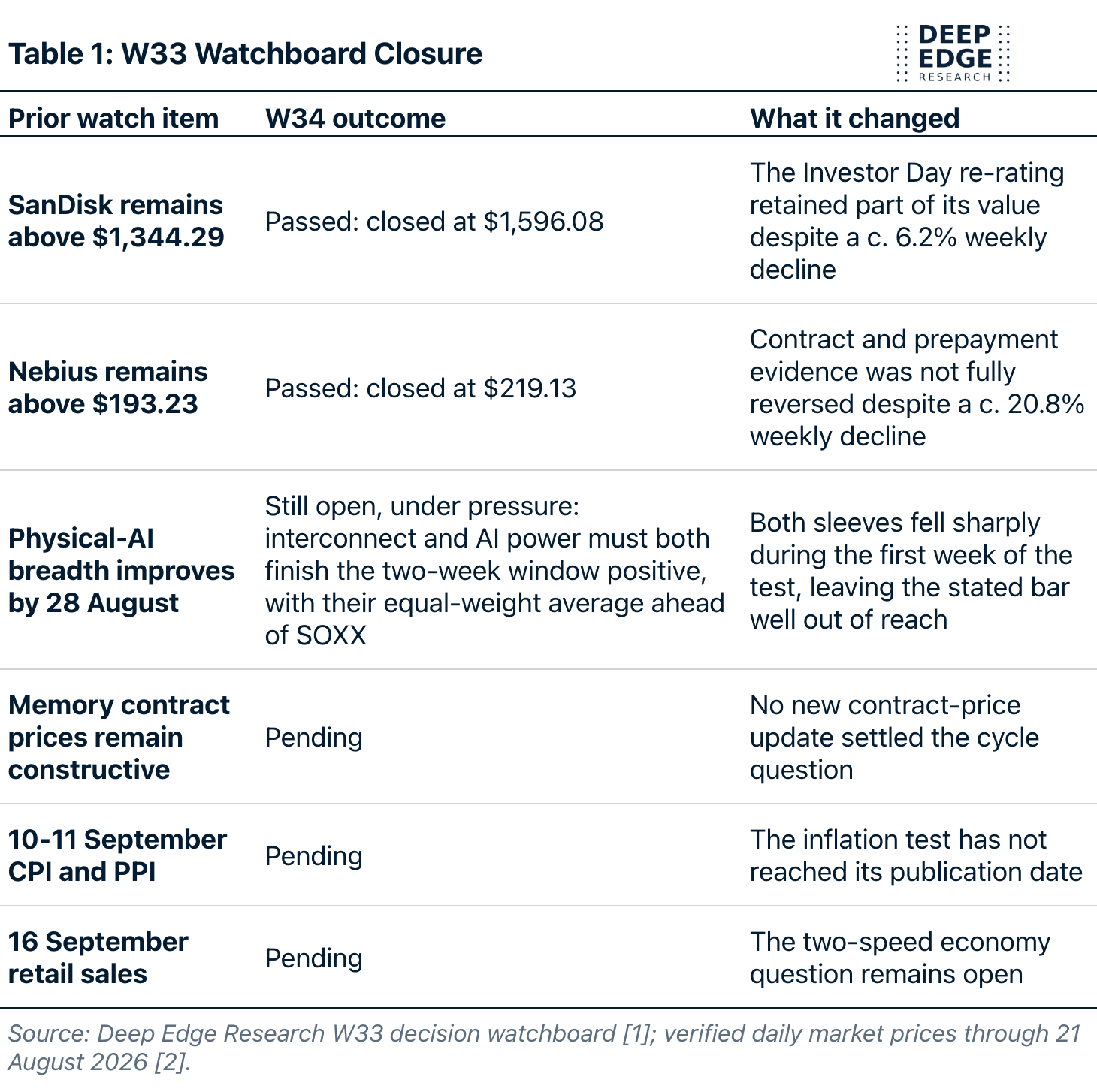
A share can fall and still pass an event test. The W33 markers asked whether the new information retained value, not whether either stock was cheap. Both passed.
The breadth test asked whether the repair spread beyond five names. It did not. Interconnect and power fell, leaving the 28 August hurdle well out of reach.
Conclusion: The W33 interpretation survived where the companies supplied fresh evidence, but it did not broaden into a durable repair across the physical stack. That keeps SanDisk and Nebius in the book while raising the burden of proof for adding anywhere else.
1. The Same Concentration Worked in Reverse
Our view: W34 made the concentration risk visible again. Memory, storage, connectivity, AI compute and power produced the W33 gain, then accounted for more than the whole W34 loss.
The portfolio fell c. 7.9% from the market open on Monday 17 August to the close on Friday 21 August. Over the same window, the SPDR S&P 500 ETF Trust (SPY) fell c. 1.3%, the Invesco QQQ Trust (QQQ) fell c. 2.7% and the iShares Semiconductor ETF (SOXX) fell c. 6.8%.[2]
We therefore underperformed the broad market and the semiconductor benchmark. This was not a week to claim that our individual selections protected the book.
Table 2 shows where the damage came from and places it beside the prior week’s move.
Table 2: W34 Portfolio Attribution
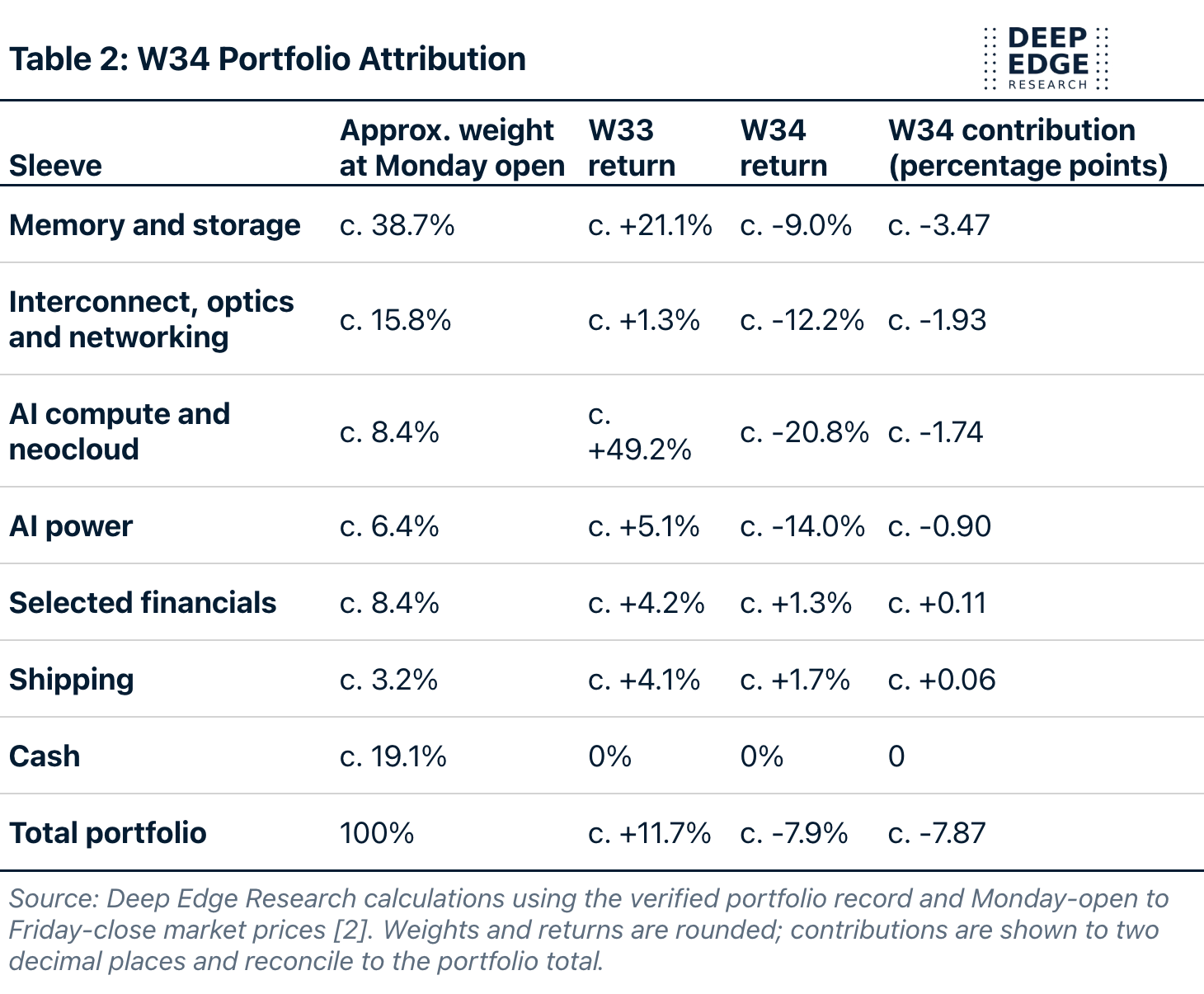
The individual losses were concentrated:
Nebius fell c. 20.8% and cost the portfolio c. 1.7 percentage points.
Seagate Technology (STX) fell c. 14.2% and cost c. 1.5 points.
Credo Technology Group (CRDO) fell c. 16.0% and cost c. 1.1 points.
Western Digital (WDC) fell c. 12.6% and cost c. 1.1 points.
SanDisk fell c. 6.2% and cost c. 0.6 points.[2]
Micron Technology (MU) represented the remaining c. 10.1% of the memory-and-storage sleeve’s Monday-opening portfolio weight. It fell c. 3.3% and cost another c. 0.3 percentage points.[2]
Ciena (CIEN) and Lumentum Holdings (LITE) supplied the remaining c. 8.8% of the interconnect sleeve and cost c. 0.4 points each. Vertiv Holdings (VRT) and Bloom Energy (BE) made up the AI-power sleeve and cost c. 0.4 and c. 0.5 points respectively.[2]
Together, the four physical-AI sleeves cost c. 8.0 percentage points. Selected financials and shipping offset a small part of the loss.
Robinhood Markets (HOOD) rose c. 13.9%, while International Seaways (INSW) rose c. 1.7%. Those gains were helpful, but they do not rescue the week or prove the broader macro thesis. They show why the non-AI sleeves remain useful inside a concentrated book.[2]
Cash also did what cash is supposed to do. We did not sell positions to raise it, but its weight increased mechanically to c. 20.8% as the invested book fell.
We do not use a fixed sleeve ceiling because the same percentage can conceal very different company-level prospective returns. At c. 38.7%, however, memory and storage must earn the next dollar company by company. No holding receives additional capital merely because the sleeve has fallen.
Conclusion: Concentration amplified W33 and W34 in opposite directions. The drawdown does not force a portfolio change on its own, but the current sleeve weight rules out casual averaging down. Each holding now has to justify fresh capital separately.
2. The W33 Evidence Survived Better Than the Shares
Our view: SanDisk and Nebius weakened without giving back their entire event-driven re-ratings. That means the new disclosures still matter. It does not mean either position now offers enough prospective return to justify more capital.
SanDisk fell c. 6.2% from Monday’s open to Friday’s close during W34. It had risen c. 36.4% on the same weekly convention during W33.
The shares closed at $1,596.08, still c. 18.7% above the 12 August close that preceded Investor Day. That figure uses the later pre-event close as its starting point, so it measures how much of the Investor Day re-rating survived rather than the full W33 portfolio return.[1][2]
The multiyear agreements, minimum financial guarantees and longer-term operating model therefore retained a meaningful part of their initial value in the share price.
The valuation problem remains. Our unchanged weighted scenario value was c. $1,800 at the end of W33. A lower share price has improved the prospective return from Friday’s level, but the scenario still needs to be rebuilt around three inputs: how much volume the agreements cover, how much pricing protection they provide and what gross-margin floor that supports in a weaker memory market. We are not going to call the stock cheap merely because it fell after a large gain.
Nebius presents the same issue in a more extreme form.
The shares fell c. 20.8%, but the $219.13 close remained c. 13.4% above the pre-results event level. The tape retained part of the value attached to the contract amounts, customer prepayments and shorter payback expectations, while demanding a lower price for the financing burden required to deliver them.[1][2]
That is exactly the distinction W33 asked us to preserve. Nebius can prove demand and still leave the common shareholder exposed to continuing capital expenditure, debt and dilution.
Western Digital supplies the control.
WDC rose in W33 without producing new forward disclosure. It then fell c. 12.6% and closed W34 at $459.44, just below our unchanged W32 weighted value of c. $473.[1][2]
Our stated reduce condition required WDC to remain above that value without producing new commercial evidence. WDC did not remain above it, so the reduction condition did not fire.
We are still not adding. A price returning to estimated value is not the same as a margin of safety.
Conclusion: The event evidence behind SanDisk and Nebius retained value, while WDC moved back below the level that would have forced a reduction. We are holding all three, rebuilding the SanDisk and Nebius economics, and refusing to mistake a lower share price for an adequate prospective return.
3. The Fed Minutes Mattered, but They Did Not Explain the Whole Sell-Off
Our view: The July minutes raised the probability of tighter policy and directly challenged the financing of the AI buildout. The cross-asset and positioning evidence, however, points to a selective technology repricing rather than a general rates, credit or liquidity break.
The company evidence explains why the SanDisk and Nebius event levels held. It does not explain why the rest of the physical-AI book sold off.
The obvious explanation was the Fed.
Wednesday’s minutes showed that nine members had voted to keep the target range at 3.50-3.75%, while three wanted an immediate 25-basis-point increase. Several thought policy should become more restrictive. Participants also warned that lower long-term earnings expectations could trigger a broader repricing in highly valued AI-linked companies, and noted the growing use of bank and non-bank borrowing to finance infrastructure.[3]
Those are direct risks to this book. But a broad rates or credit shock should also push up long yields, volatility and corporate spreads. That confirmation never arrived.
Our working conclusion is a selective valuation reset, not a general break. We were tempted to call it long-holder de-risking. The data will not let us say that with confidence: it rules out a broad increase in short positions, but cannot distinguish active selling from buyers stepping away.
Table 3 tests the Fed explanation against rates, credit, market breadth and positioning.
Table 3: W34 Cross-Asset Arbitration Test
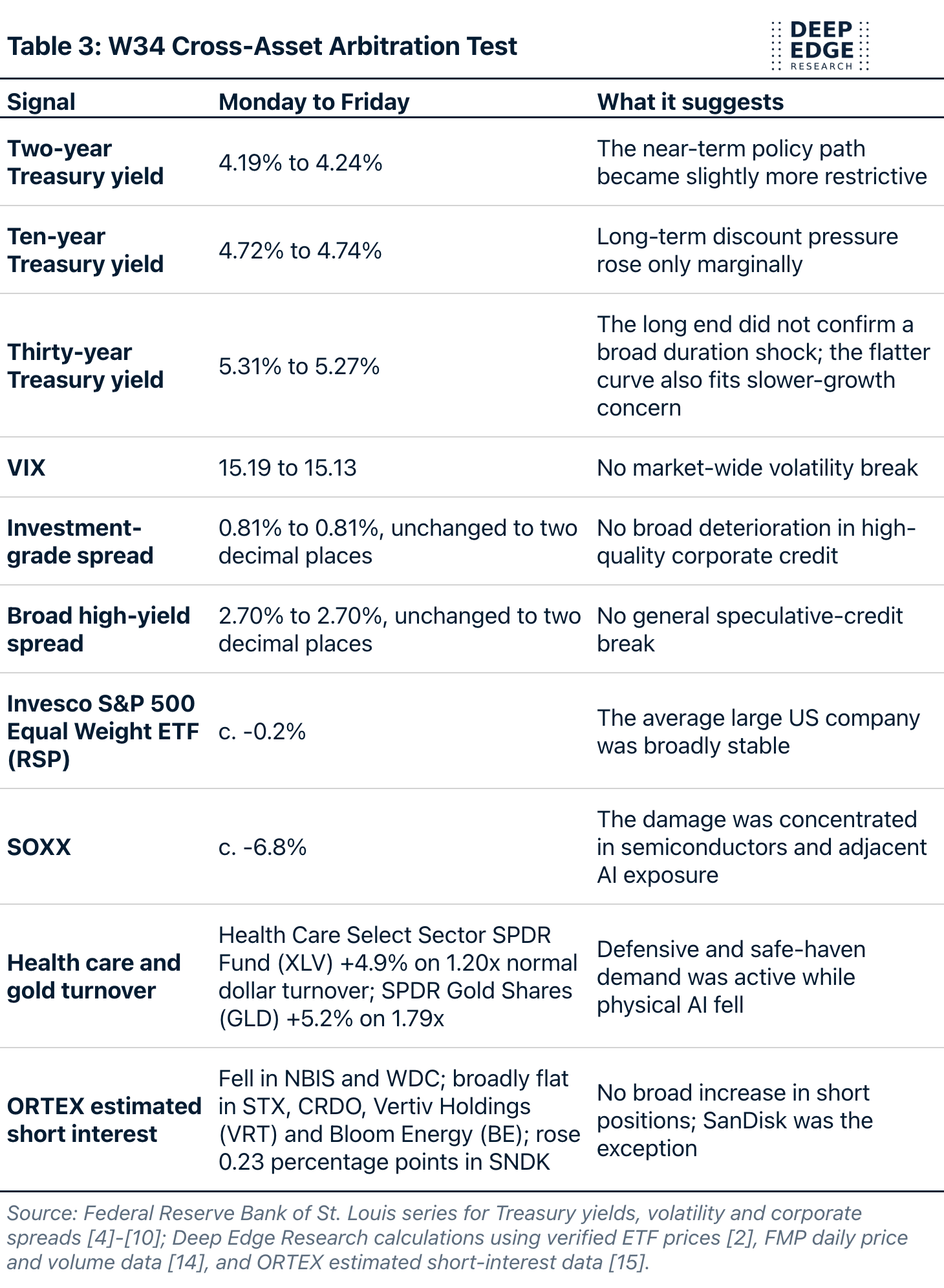
The weaker corner of credit did move. CCC spreads widened c. 19 basis points to 10.37%, leaving them 7.67 percentage points above broad high yield.[10] Broad high-yield and investment-grade spreads were unchanged. Pressure increased at the bottom of credit, not across the system.
The Technology Select Sector SPDR Fund (XLK) fell c. 3.9%, while XLV rose c. 4.9%, the Energy Select Sector SPDR Fund (XLE) rose c. 2.3% and GLD rose c. 5.2%.[2]
West Texas Intermediate spot crude rose c. 1.4% between the 17 August and 21 August observations, from $86.04 to $87.21, so XLE’s gain partly tracked a higher oil price. But crude can rise through supply constraints as well as demand. Energy strength therefore does not independently show that the market rejected a growth scare.[16]
The flatter curve, healthcare leadership and gold bid also fit a mild growth scare. We do not make that our primary reading because volatility fell, broad credit remained calm and the equal-weight market was broadly flat, but it probably helped the defensive rotation.
Turnover confirms that buyers were active in healthcare and gold: XLV ran at 1.20 times normal dollar turnover and GLD at 1.79 times. Most physical-AI holdings sold on ordinary or below-normal volume. Seagate and WDC fell double digits without unusually heavy turnover, which fits thin bids at least as well as active long-holder selling.[14]
The three material ORTEX moves were NBIS from 27.81% to 26.76% of free float, WDC from 7.13% to 6.83%, and SNDK from 4.76% to 4.99%. The other four surveyed holdings moved by no more than 0.04 percentage points.[15]
ORTEX therefore rules out a broad increase in short positions. It does not identify the sellers or distinguish de-risking from absent bids.
Conclusion: Rates, slower-growth concerns and valuation all mattered, but the selling did not spread into the instruments that would confirm a general break. We are treating W34 as a selective reset unless company evidence deteriorates or short positions begin building across the group.
4. What W34 Changed for the Book
Our view: W34 strengthened the case for patience rather than activity. The operating evidence did not deteriorate enough to force reductions, while the prices and funding questions did not improve enough to justify averaging down.
Table 4 records the decisions and their next resolvers. We set these standards before the drawdown; the share-price move does not get to rewrite them.
Table 4: W34 Portfolio Decisions
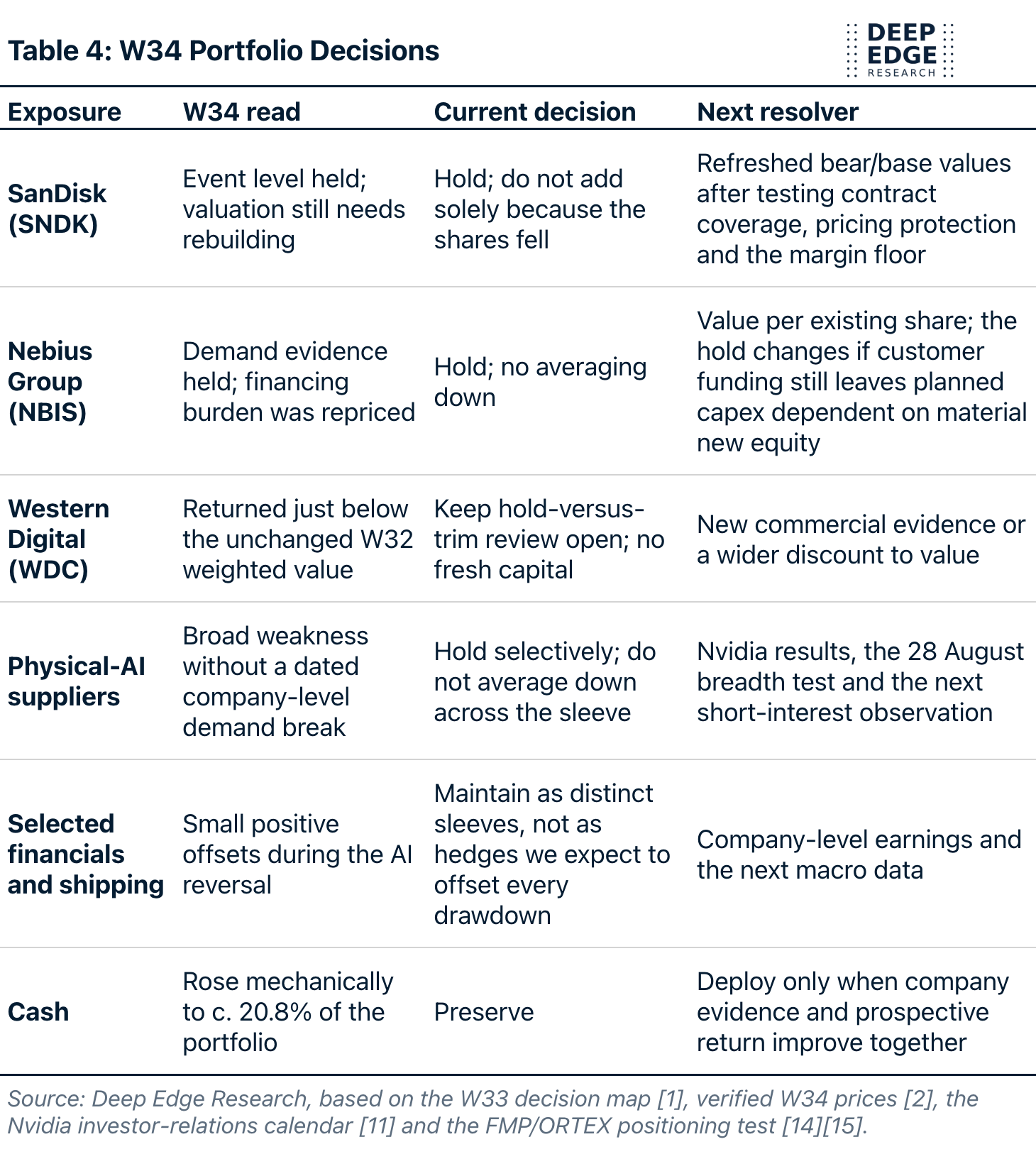
The next operating test is unusually clean.
Nvidia (NVDA) reports fiscal second-quarter results after the close on Wednesday 26 August. We do not own Nvidia, but its demand, supply and forward guidance sit upstream of memory, networking, power and cooling across our book.[11]
If Nvidia confirms that accelerator demand and the infrastructure buildout remain intact, W34 will look more like a valuation and positioning reset than an operating warning. If management identifies delayed deployments, weaker hyperscaler demand, slower backlog conversion or a meaningful change in the supply chain, we will have to revisit that interpretation.
Nvidia is not the only way this reading can fail. If memory orders and pricing roll over, supplier backlogs weaken or inventories rise while short interest remains stable, the price action is catching up with operating deterioration rather than positioning.
The positioning test remains open as well. If the next weekly ORTEX observation shows short interest building across several physical-AI holdings while prices remain weak, our selective-reset interpretation loses force.[15]
That is why we are not rushing to deploy the cash. A drawdown is not enough. We want a better prospective return supported by better company evidence.
Conclusion: We are holding the positions whose evidence survived, keeping WDC under review and preserving cash for the next operating test. Nvidia can tell us whether the industry still supports the thesis; the next positioning data can tell us whether the sellers have changed.
What the Next Tests Need to Prove
Our view: W35 needs to distinguish an AI valuation reset from the beginning of an operating deterioration. Nvidia supplies the immediate industry test; the existing breadth, memory, positioning and macro commitments remain open until their evidence arrives.
Table 5 turns that distinction into the tests we will carry into W35.
Table 5: W35 Decision Watchboard
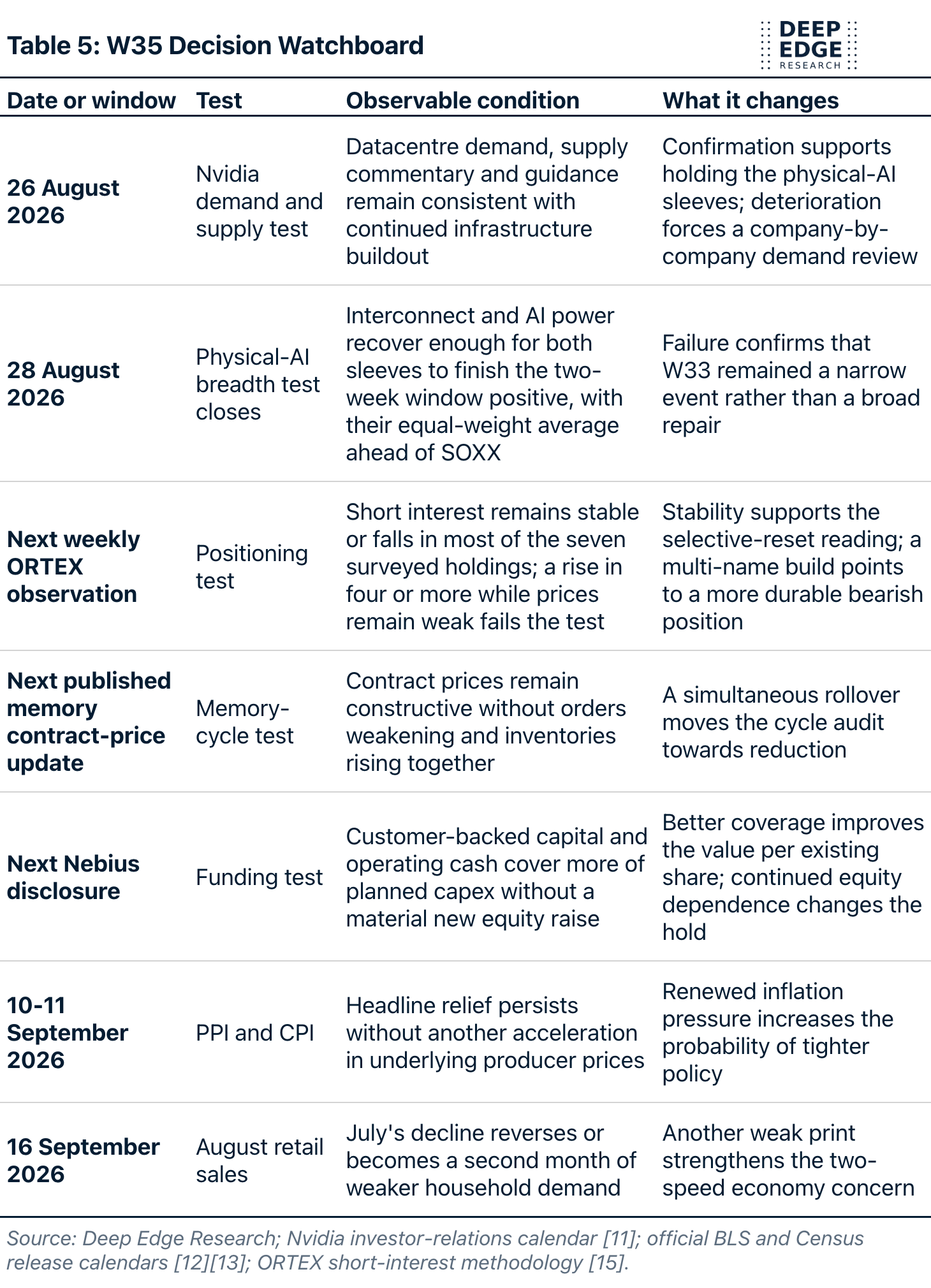
The first three rows can change how we interpret W34 quickly. The remaining tests decide whether that interpretation deserves more capital.
Conclusion: W35 is not asking whether the shares can bounce. It is asking whether demand remains intact and whether the selling broadens into a genuine bearish position. We will respond to those two pieces of evidence, not to the discomfort created by a red week.
Final Thought
The buyers who returned in W33 had not committed to stay.
The Fed minutes help explain why the hurdle rose. They do not tell us whether the physical-AI companies are beginning to lose orders, suffer deployment delays or convert backlog more slowly. Nothing reported during W34 settled those operating questions.
Nvidia now gets the first chance to do so.
If its demand, supply and guidance remain consistent with the infrastructure buildout, the W34 reversal belongs inside the valuation and positioning audit. If management describes delayed deployments, weaker hyperscaler demand or slower conversion through the stack, the operating conclusion changes with it.
Until then, our capital decision is plain. We are holding SanDisk and Nebius, keeping Western Digital under review, adding nothing across the physical-AI sleeve and preserving c. 20.8% cash.
W33 brought buyers back. Nvidia will help decide whether W34 merely shook them out or warned us that they had arrived too early.
References
Deep Edge Research: W33, What Finally Brought Buyers Back to AI Infrastructure?, 16 August 2026. Source for the event markers, standing valuation work and W33 decision watchboard.
Deep Edge Research calculations using the verified portfolio record and daily market prices, 17-21 August 2026.
Federal Reserve: Minutes of the Federal Open Market Committee, 28-29 July 2026
Federal Reserve Bank of St. Louis: 2-Year Treasury Constant Maturity Rate
Federal Reserve Bank of St. Louis: 10-Year Treasury Constant Maturity Rate
Federal Reserve Bank of St. Louis: 30-Year Treasury Constant Maturity Rate
Federal Reserve Bank of St. Louis: ICE BofA US Corporate Option-Adjusted Spread
Federal Reserve Bank of St. Louis: ICE BofA US High Yield Option-Adjusted Spread
Federal Reserve Bank of St. Louis: ICE BofA CCC & Lower Option-Adjusted Spread
Nvidia: Conference call for second-quarter fiscal 2027 results, scheduled for 26 August 2026
US Bureau of Labor Statistics: September 2026 release calendar
Financial Modeling Prep: Comprehensive stock price and volume data API
Federal Reserve Bank of St. Louis: Crude Oil Prices, West Texas Intermediate
This article is for information and education only. It is not investment advice. Past performance is not indicative of future results.
(c) DeepEdge Research