
Last week, we said that the semiconductor sell-off was starting to make more sense.
The broad sector had begun to repair. The operating evidence still supported the AI infrastructure thesis. However, SanDisk (SNDK) and Western Digital (WDC) had shown that strong current earnings were no longer enough on their own. Each company still had to prove that today’s exceptional economics could survive long enough to justify its valuation.[1]
This week, buyers returned.
But they did not return to the whole sector.
From Monday’s open to Friday’s close:
The SPDR S&P 500 ETF Trust (SPY) rose c. 0.5%.
The Invesco QQQ Trust (QQQ) rose c. 1.2%.
The VanEck Semiconductor ETF (SMH) rose c. 0.3%.
The iShares Semiconductor ETF (SOXX) rose c. 0.8%.
Our portfolio rose c. 11.7%.[2]
That is an extraordinary gap.
It also tells us immediately that this was not simply another broad semiconductor rebound. Our largest gains came from Nebius Group (NBIS), SanDisk, Seagate Technology (STX), Western Digital and Micron Technology (MU). Those five holdings produced c. 91% of the portfolio return.[2]
It would be easy to treat a week like that as vindication. We disagree. Much of our capital is already in the companies that moved most, so enjoying the mark-up is not enough. We have to decide whether the evidence improved enough to justify the new prices.
Our read is that W33 answered one part of the audit and made that next capital decision harder.
Buyers returned when companies reduced uncertainty about future demand. SanDisk provided multiyear volume commitments, a longer-term operating model and a clearer route from AI storage demand to shareholder cash. Nebius provided signed contracts, economics per megawatt and shorter payback expectations.
That is the main point: both companies made demand beyond the current quarter easier to underwrite. Within that evidence sat another encouraging feature. Customers were not merely expressing interest; some were accepting financial obligations today to secure scarce physical infrastructure tomorrow. We think of that narrower mechanism as customer-funded capacity. SanDisk received enforceable minimum financial guarantees. Nebius received cash before the associated infrastructure had been built.
Our read is that this is what the tape rewarded during W33. Forward visibility mattered more than another strong quarter.
At the same time, the price of that evidence changed dramatically. SanDisk rose c. 36% and Nebius rose c. 49% during the trading week. The proof improved, but so did the price we were being asked to pay for it.
The new disclosures explain why buyers returned. They do not yet demonstrate that business value increased by more than the shares did. For us, that distinction is the difference between holding the winners and putting more capital behind them. We are holding rather than adding.
TLDR
our portfolio rose c.11.7%, while SOXX gained less than 1% . memory and storage contributed c.7.5 percentage points, while NBIS contributed another c.3.1 points. 5 holdings produced c.91% of the weekly run.
Buyers paid for evidence that demand extends beyond the current quarter. SanDisk disclosed eight multiyear customer agreements covering c. 50% of its projected FY2027 storage volume and c. two-thirds of FY2028. Nebius disclosed four AI-cloud contracts worth more than $1 billion each, with customer prepayments covering 50-60% of the associated capital expenditure.[3]-[5]
The improved evidence came with a harder valuation decision. SanDisk’s unchanged c. $1,800 weighted scenario value offered c. 49% upside at the end of W32. After the W33 rally, that fell to c. 10%. Nebius proved demand, but its c. $5.7 billion quarterly investment programme still required customer cash, debt and new equity.[1][2][4][5]
We will not chase the week. SanDisk remains our preferred storage business, but it needs a refreshed valuation. Nebius needs a per-share funding model. Western Digital rallied without supplying the missing forward evidence, and its price now sits above our unchanged weighted scenario value.
This week’s positioning: hold the companies that improved the evidence, keep the cycle audit open and preserve cash. The next dollar requires both forward proof and a price that leaves us enough room to be wrong.
What Changed Since W32
Our view: W32 showed that the broad semiconductor market could repair once forced-selling pressure eased. W33 showed something more useful: buyers would pay for forward visibility even while the wider sector barely moved.
Last week’s article left us with three open questions:
Would weaker inflation and labour data reduce the pressure from long-term rates?
Would the storage companies provide evidence about the next part of the cycle rather than another strong description of the current quarter?
If the evidence improved, would the marginal buyer actually return?
We now have part of the answer.
The first question moved slightly in our favour. Headline inflation moderated, producer prices were flat at the headline level and retail sales weakened. However, the more important change for our portfolio came from the companies themselves. SanDisk and Nebius changed the quality of the evidence.
SanDisk moved the discussion beyond one strong quarter. Its customer agreements now cover a meaningful part of the next two fiscal years, and management supplied a long-term model that connects storage demand to margins, free cash flow and capital returns.[3]
Nebius moved the discussion beyond undated demand. It disclosed signed contracts, economics per megawatt, customer prepayments and a shorter expected payback period for the associated infrastructure.[4][5]
Put together, the disclosures made future demand easier to underwrite. The guarantees and prepayments strengthened that evidence by showing that customers were prepared to commit financially, but the broader change was forward visibility. Investors finally had a denominator beyond the next quarterly earnings beat.
Conclusion: W33 supports our view that July’s sell-off was not caused by a broad break in current AI demand. Buyers returned when companies made future demand easier to underwrite. Our capital decision now depends on whether the value of that improved visibility kept pace with the share prices.
1. This Was Not a Broad Semiconductor Rally
Our view: The c. 11.7% portfolio return came from a concentrated re-rating in memory, storage and AI compute. SOXX gained less than 1%, so the benchmark cannot explain the week.
Table 1 reconstructs the c. 11.7% return by sleeve and shows which exposures produced it.
Table 1: Memory, Storage and Nebius Produced Most of the W33 Gain
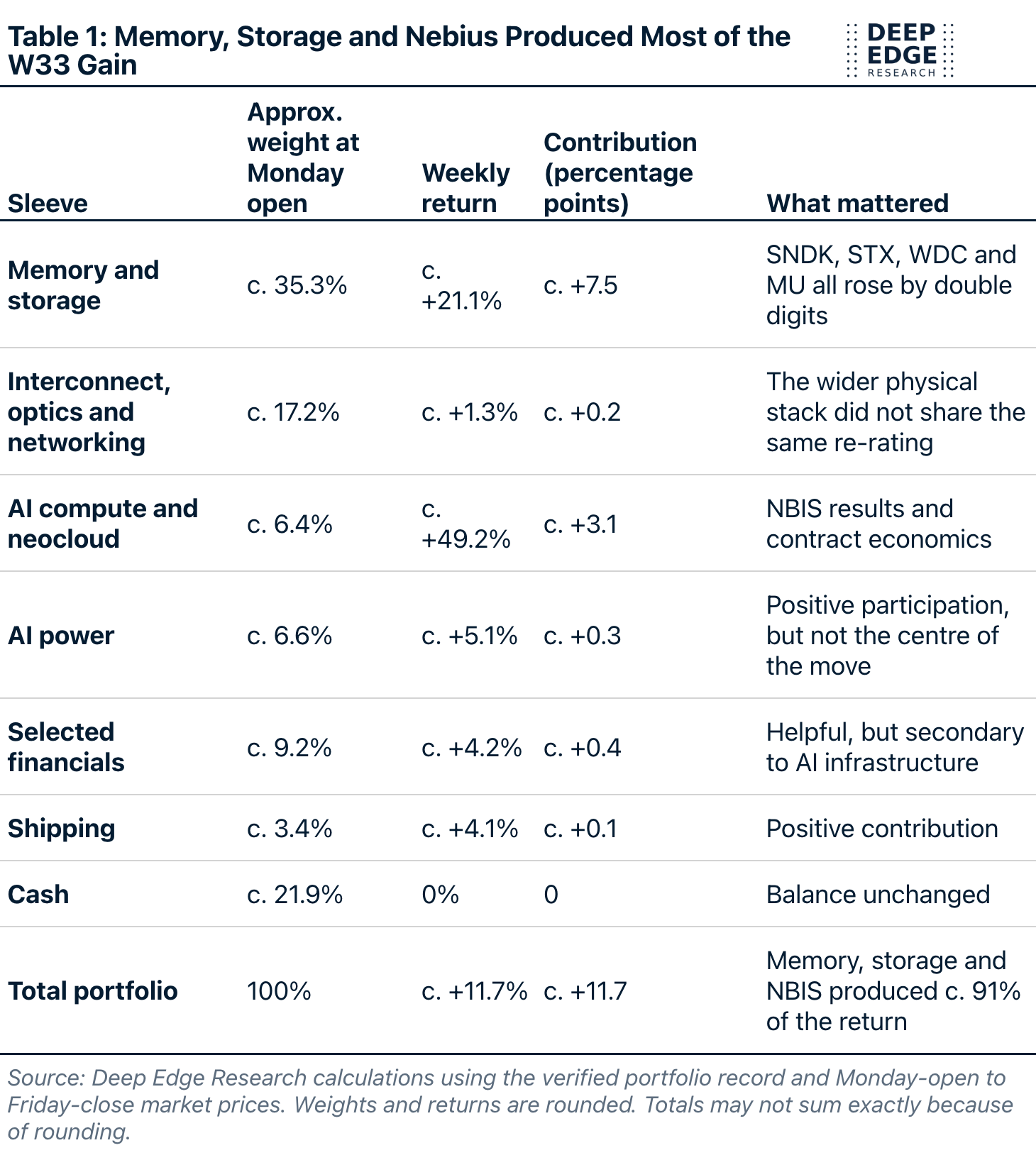
The individual contribution tells the same story:
NBIS rose c. 49.2% and contributed c. 3.1 percentage points.
SNDK rose c. 36.4% and contributed c. 2.8 points.
STX rose c. 21.2% and contributed c. 2.0 points.
WDC rose c. 17.1% and contributed c. 1.4 points.
MU rose c. 12.5% and contributed c. 1.2 points.[2]
Together, those five positions produced c. 10.6 of the portfolio’s c. 11.7 percentage points.
That concentration makes an easy macro explanation difficult to defend. A lower-inflation, lower-rate rally should have spread more evenly across technology businesses whose value depends on cash flows further in the future. A broad semiconductor rebound should also have carried SOXX and SMH much further.
But WDC stops us from taking the argument too far. It rose c. 17% without a new company disclosure during the week. Part of the move was clearly shared storage exposure and recovery from the prior sell-off. SNDK and NBIS moved further, and both supplied new forward evidence alongside the rally.
That distinction matters to the book. If the memory-and-storage sleeve surrendered the gain it produced during W33, the portfolio would give back c. 7.5 percentage points before allowing for any second-order effect elsewhere. The same concentration that produced the week can reverse it.
The cash weight also fell mechanically from c. 22% at Monday’s open to c. 19.6% at Friday’s close because the invested book rose. We did not deploy that cash.
Conclusion: The portfolio outperformed because our largest positions sat where the evidence and storage exposure were rewarded. That tells us more than a broad sector rally would, but it also leaves the book exposed to a reversal in the same small group of names.
2. SanDisk Made the Next Two Years Easier to Underwrite
Our view: SanDisk answered the question investors had been asking since July: how much of today’s storage strength is visible beyond the next quarter? The answer improved materially. The unchanged valuation bridge now offers only c. 10% upside after the rally.
Last week, SanDisk’s quarterly result was strong enough for us to rank it ahead of the other memory and storage businesses for fresh capital.
But the share price fell anyway. SanDisk reported an 84.6% gross margin, stronger datacentre revenue and c. $5 billion of adjusted free cash flow, yet the result did not bring buyers back immediately. We therefore had to ask whether the shares were warning that the current economics sat too close to the top of the cycle.[1]
The Investor Day supplied a more useful answer than another backward-looking quarter.
SanDisk disclosed eight New Business Model agreements. That is SanDisk’s name for multiyear contracts in which customers commit volumes and provide enforceable minimum financial guarantees. The agreements cover approximately half of the storage bits it expects to ship in FY2027 and approximately two-thirds in FY2028. They also include structured pricing.[3]
Traditional memory suppliers repeatedly add capacity into strong pricing and then suffer when supply overtakes demand. A contract cannot stop competitors from building. It can give SanDisk more visibility over volumes and pricing while the industry adjusts.
The agreements may therefore raise the floor underneath the next downcycle. They do not tell us exactly where that floor sits. SanDisk did not disclose enough about the pricing protections to calculate what happens if spot prices fall sharply, and eight agreements can still leave meaningful customer concentration if the largest contracts dominate the covered volume.
Management also presented a long-term FY2028-FY2030 model:
Mid-to-high-teens revenue growth.
Approximately 80% non-GAAP gross margin.
Approximately 75% non-GAAP operating margin.
Approximately 50% adjusted free-cash-flow margin.
A plan to return 100% of excess cash after investing in the business.[3]
The targets are exceptional. For now, they remain targets.
We would not take an 80% gross-margin model and capitalise it as though the memory cycle had disappeared. The contracts, product roadmap and capital-efficient manufacturing provide evidence for a structurally better business. They do not allow us to ignore future supply or normalising prices.
The price now matters more than it did last week. Table 2 keeps the W32 operating assumptions and scenario weights unchanged, then replaces only the share-price denominator with SanDisk’s W33 closing price of $1,641.11.[1][2]
Table 2: SanDisk’s W32 Valuation Bridge at the W33 Price
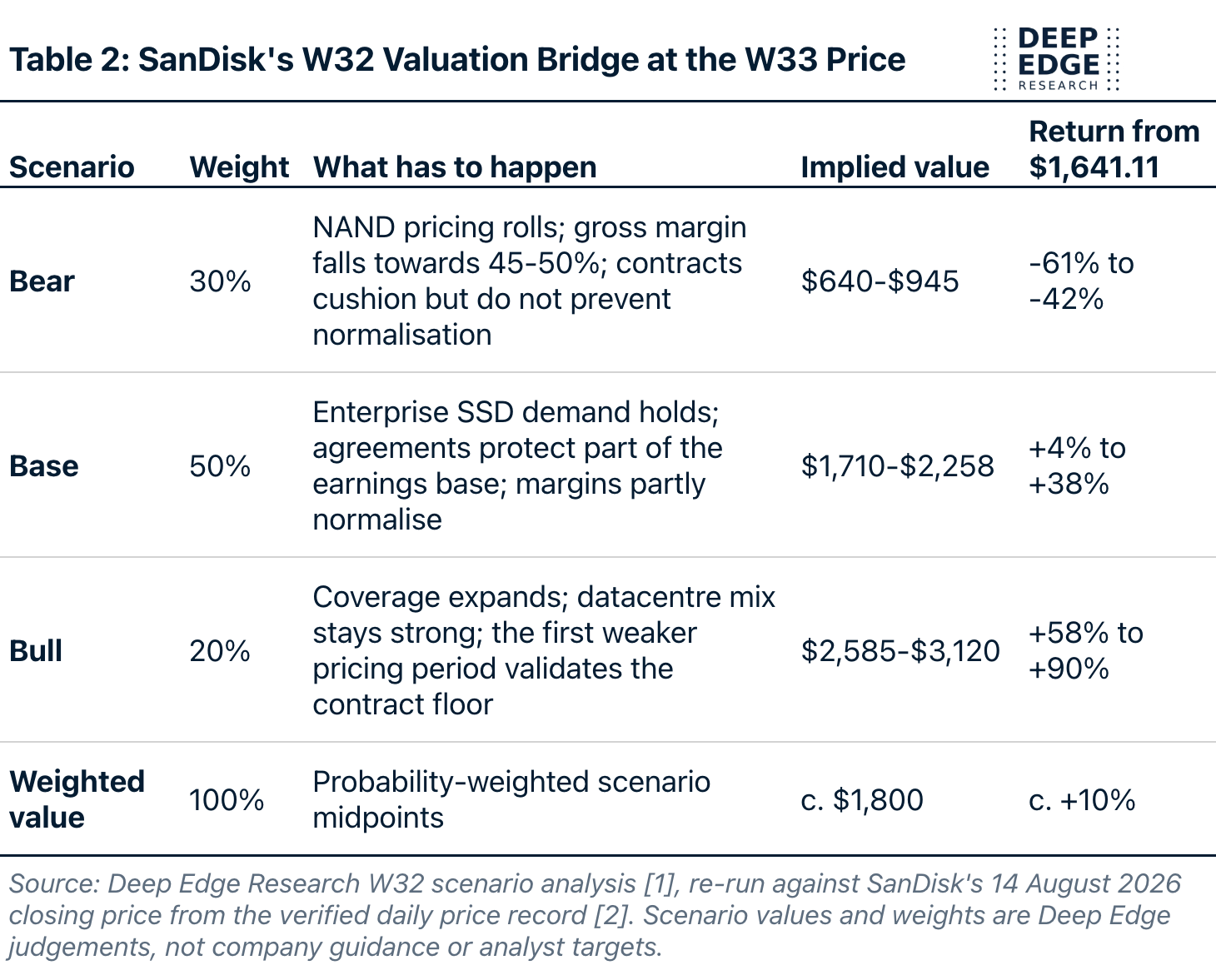
At the end of W32, the same c. $1,800 weighted value offered c. 49% upside from the $1,212.21 close. One week later, the prospective return had fallen to c. 10%.
Investor Day may have added value by lifting our bear or base case. However, we have to rebuild those cases before taking credit for that improvement. Raising the target simply because the share price rose would be moving the goalposts after the fact.
Conclusion: SanDisk supplied the strongest forward evidence in the storage sleeve, but its unchanged valuation no longer clears the fresh-capital decision. We are holding the position. We will add only if a full refresh shows that the contracts raised business value enough to restore an attractive range of outcomes, or if the price again supplies that margin of safety.
3. Nebius Proved Demand but Left the Funding Question Open
Our view: Nebius showed that AI-compute demand is contracted and willing to prepay. The result also showed why demand is only half of the investment case: the common shareholder still has to fund a vast physical buildout before most of the revenue arrives.
At c. 3.1 percentage points, Nebius was the largest individual contributor to the portfolio last week.
Second-quarter group revenue increased 454% to $582 million. Nebius AI Cloud revenue grew 514% to $575 million and reached a $3 billion annualised run rate. The AI-cloud business reported a 50% adjusted EBITDA margin.[4][5]
More importantly, management attached commercial terms to future demand:
Four landmark AI-cloud contracts with an average total contract value above $1 billion each.
Annual contract value of $20-25 million per megawatt.
Customer prepayments in approximately 70% of new deals, covering 50-60% of associated capital expenditure.
An expected payback period of one year and ten months for the associated capital and operating costs, down from the previous two-to-three-year range.
More than $9 billion of expected customer prepayments during 2026.[5]
This is why the figures mattered. Nebius did not simply say demand was strong. It showed how much customers had contracted, how much they would prepay and how quickly new capacity was expected to earn back its cost. The prepayments made that evidence stronger because customers were helping finance the capacity they had contracted.
For us, though, they settle only half of the question. The funding denominator remains. Table 3 therefore places the demand evidence beside the capital required to deliver it. The periods are different, so we cannot net the figures into a valuation. The table exists to show what today’s shareholder is underwriting before we put more capital behind the business.
Table 3: Nebius Demand Versus the Capital Required
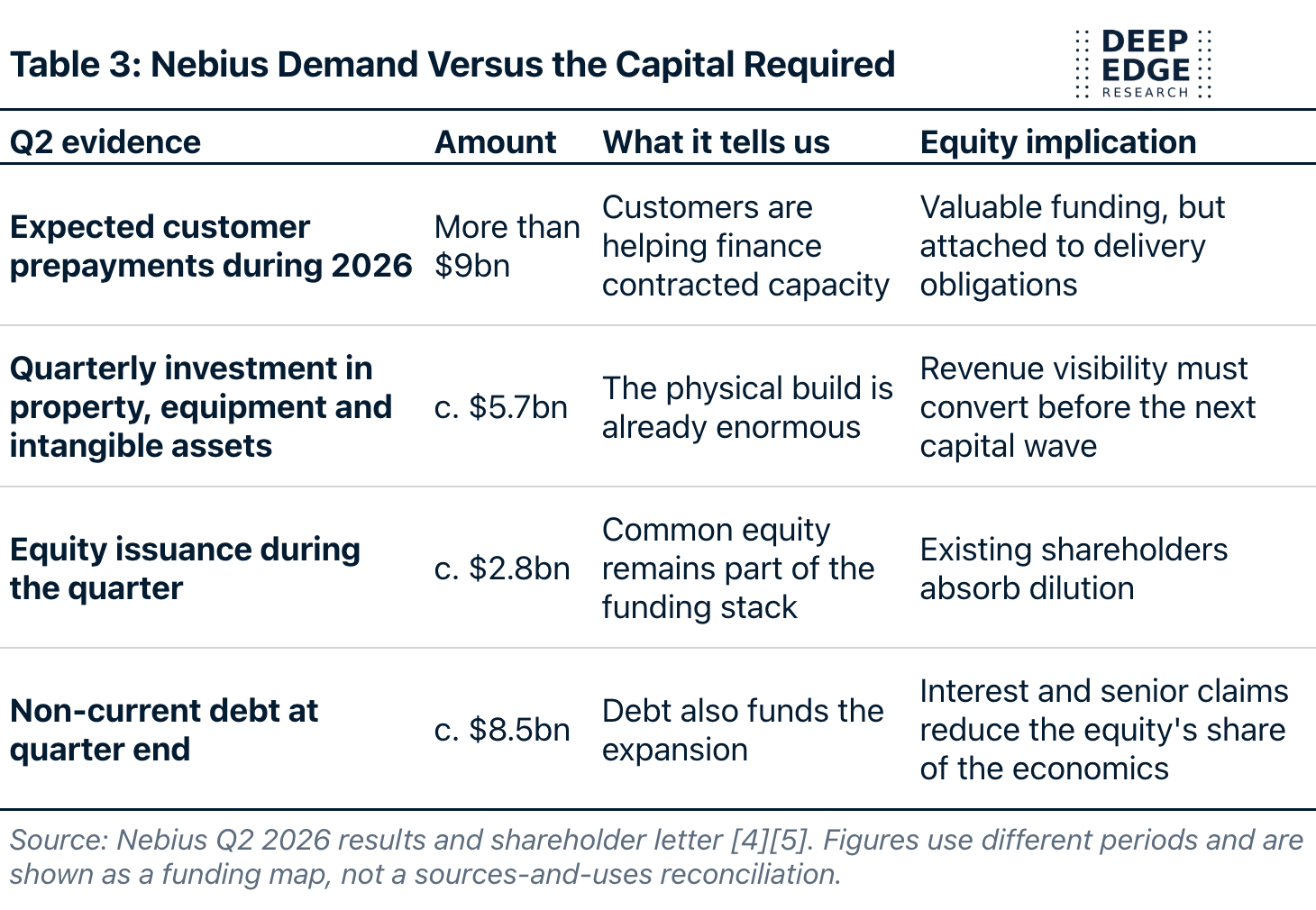
The contracts improve Nebius’s ability to finance growth. Neither the contracts nor the prepayments tell us, on their own, how much of the eventual value belongs to today’s shareholders after debt, new shares and continuing investment.
The c. 49% weekly rise therefore raises the burden on the next dollar. We are not selling a position simply because the shares responded to better evidence. We are also not chasing it before we rebuild the per-share economics around the new contracts and financing.
Conclusion: Nebius passed the demand test and improved the funding test. It has not yet completed the shareholder-return test. We will hold while rebuilding the value per existing share after customer funding, debt, continuing capital expenditure and dilution.
4. CoreWeave Shows Why Demand Alone Is Not Enough
Our view: CoreWeave reported c. $104 billion of backlog and c. $640 million of quarterly net interest expense. Both figures are real, and together they show why contracted demand cannot be treated as value for common shareholders.
We do not own CoreWeave (CRWV), but it is the clearest external test of our Nebius reasoning because the demand is enormous and so is the financing burden.
CoreWeave reported second-quarter revenue of c. $2.6 billion and revenue backlog of c. $104 billion. That backlog excluded more than $25 billion of net new customer commitments added early in the third quarter. Active power reached 1.5GW and contracted power reached c. 3.7GW.[6]
The same quarter produced an operating loss of $49 million, a net loss of $626 million and net interest expense of $640 million. Adjusted EBITDA was $1.5 billion, but adjusted operating income was only $128 million after the cost of building and running the platform.[6]
Customers clearly want the capacity. The harder question is who finances the assets, how quickly they become productive and how much cash remains after interest and continuing capital expenditure.
That distinction matters directly for Nebius. Its customer prepayments and contract economics are better than investors previously assumed. CoreWeave shows why that improvement is necessary rather than optional. A capacity provider can fill every megawatt and still disappoint common shareholders if the funding structure absorbs the return.
Conclusion: CoreWeave makes the W33 demand signal more credible and our NBIS underwriting stricter. We will not capitalise contracted demand until we can see how much of it survives financing and reaches common equity.
5. The Macro Backdrop Removed One Obstacle
Our view: The macro data removed some immediate rate pressure, but it also raised a different concern: AI investment remained exceptionally strong while household demand weakened.
Retail sales fell 0.6% in July, the first decline in nine months and the largest monthly fall in more than a year. Sales were still 5% higher than a year earlier, so one report is not enough to declare that the consumer has broken.[9]
Inflation was also less hostile at the headline level. Consumer prices rose 0.1% during July and 3.4% over the previous year. Core CPI rose 0.2% during the month and 2.5% over the year, while energy prices fell 1.5%.[7]
The producer-price report was mixed. Headline final demand was unchanged because a 0.7% decline in goods prices offset increases in services and construction. However, final demand excluding food, energy and trade services rose 0.4% during the month and 4.7% over the year.[8]
This matters to the book because the price we are willing to pay for SanDisk, Nebius and the rest of the AI infrastructure sleeve cannot be separated from the rate environment. The company evidence did most of the work during W33, but a less hostile macro backdrop removed one obstacle.
Taken together, the releases reduced the immediate pressure for higher rates without showing that underlying inflation had disappeared. That helped the valuation of businesses whose cash flows sit further in the future.
The split beneath the data may become more important than the headline relief. Strategic AI investment continued because hyperscalers and capacity providers were competing for scarce infrastructure. Household demand, by contrast, showed its first meaningful monthly decline in some time.
We are not calling a two-speed economy from one retail-sales report. We are watching whether consumer demand continues to soften while AI capital expenditure remains difficult to interrupt. If that happens, lower rates may help valuation before they resolve the pressure on households.
Conclusion: The macro backdrop became less hostile, but it did not settle the economic question. The next CPI, PPI and retail-sales releases need to show whether July was clean disinflation or the beginning of weaker household demand.
6. What We Are Doing With the Book
Our view: We are holding the companies that improved the evidence, but a strong week does not lower our fresh-capital hurdle. The next dollar still has to clear valuation, financing and cycle risk.
Table 4 translates the week into company-level decisions. The first two columns explain what changed. The final two matter for our capital because they state what we are doing now and what would make us change course.
Table 4: W33 Portfolio Decisions
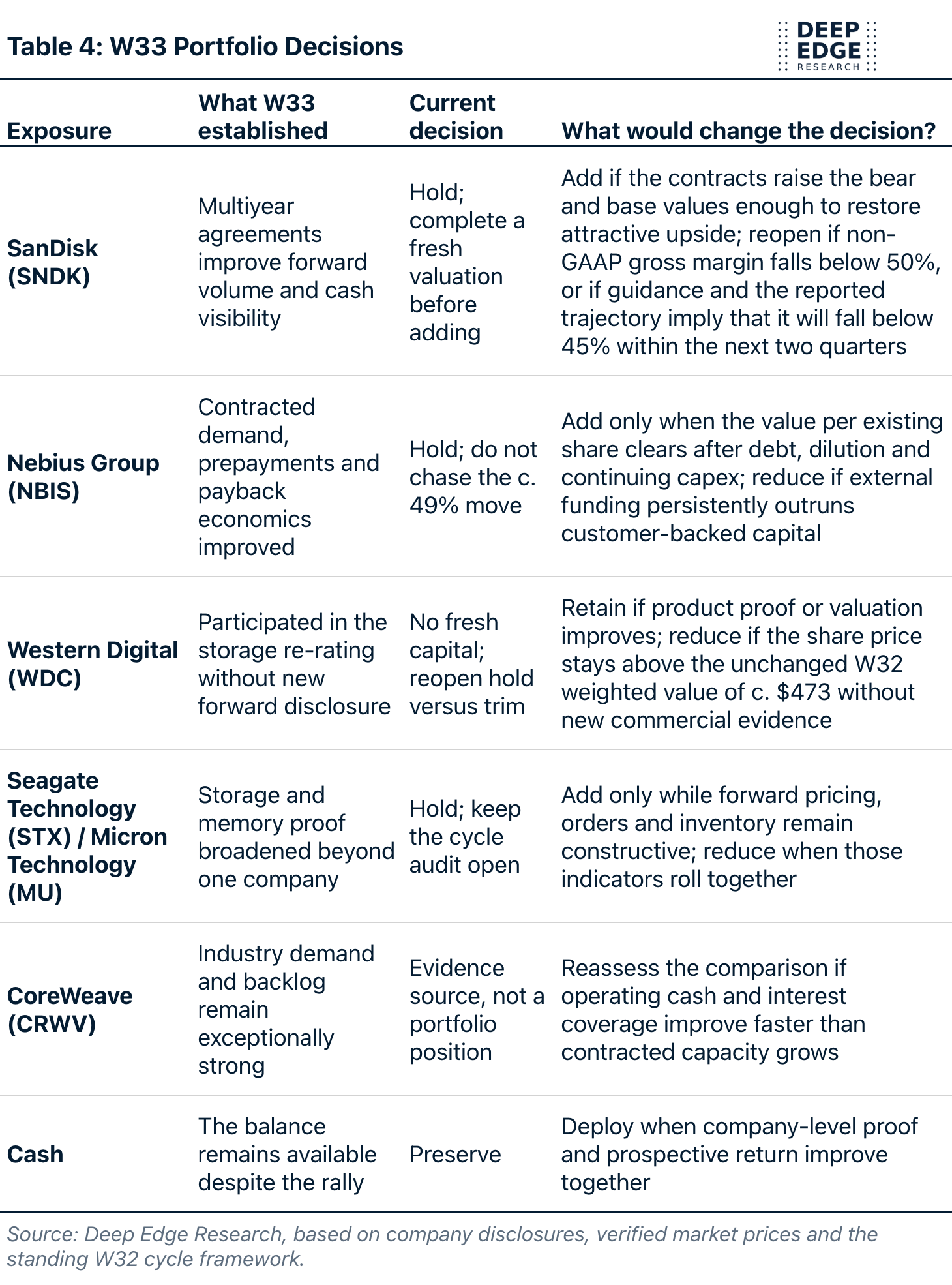
Western Digital is the clean comparison. It rose c. 17% without supplying fresh company evidence, and its $508.80 Friday close now sits above our unchanged W32 weighted value of c. $473. We are not treating a sympathetic storage rally as a reason to add. The hold-versus-trim decision is now open again.[1][2]
SanDisk remains our preferred storage business, but the unchanged scenario bridge now offers c. 10% rather than c. 49%. We need to find out whether Investor Day raised the value of the company before allocating more capital.
Nebius supplied stronger forward demand evidence than any other position in the book. That earns more underwriting, not an automatic larger position after a c. 49% move.
Cash therefore keeps its job. Its percentage fell because the book rose, not because we spent it. We will use it when the operating proof and the valuation point in the same direction.
Conclusion: W33 strengthened the company evidence but made several new purchases less attractive. SanDisk stays first but no longer clears on its unchanged valuation. Nebius needs a per-share model. Western Digital now requires an explicit hold-versus-trim review.
What the Next Tests Need to Prove
Our view: The immediate test is whether the event-driven gains survive once the disclosures are no longer new. The longer test is whether company fundamentals and macro data validate the prices before the next reporting cycle.
Table 5 turns those open questions into dated commitments. The first three rows test the immediate market response. The final three test the operating and macro evidence behind our W33 interpretation. Where a company or data provider has not published a fixed date, we use the next named release rather than inventing one.
Table 5: W33 Decision Watchboard
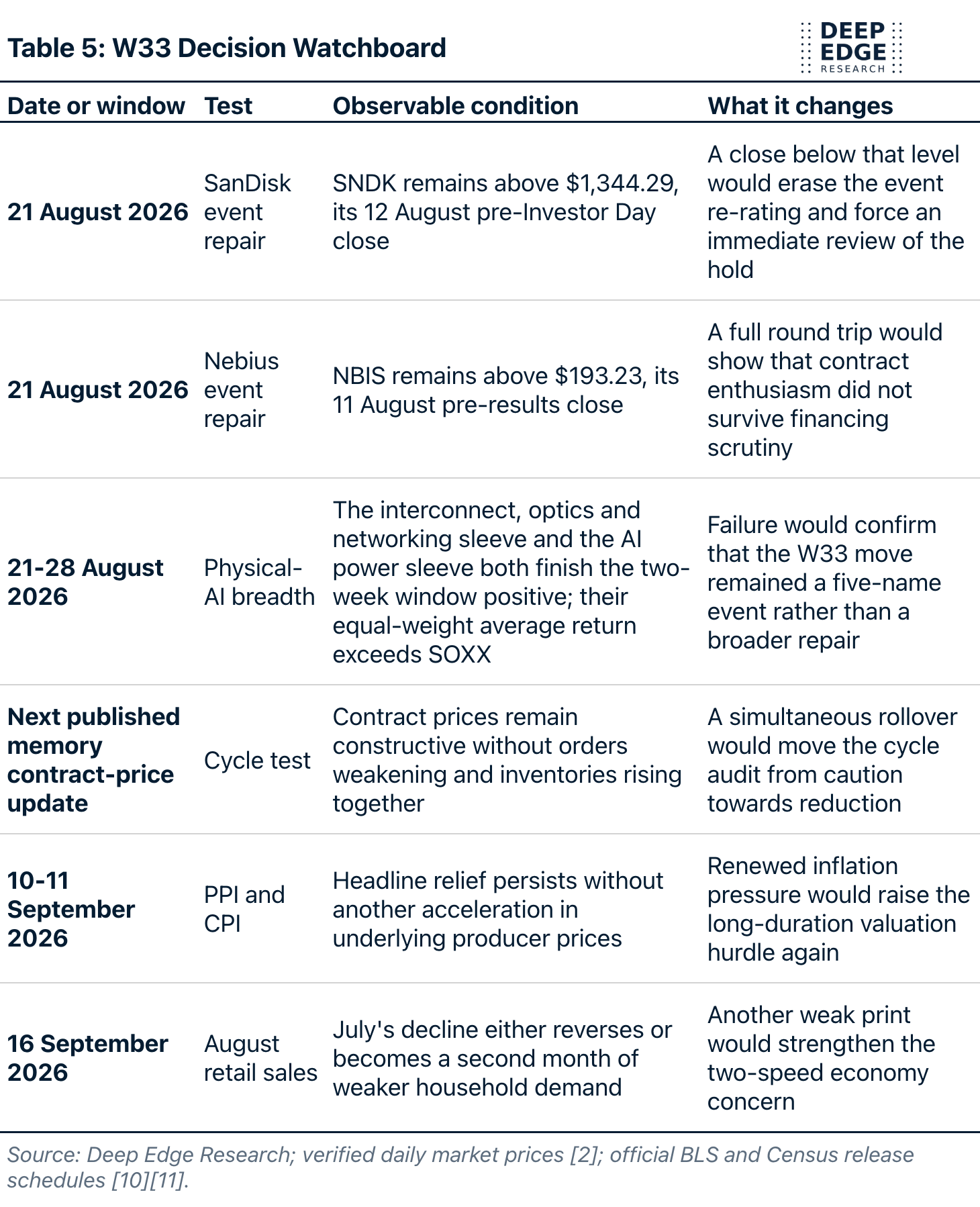
The price levels are not fair-value targets. They are event markers. Holding them for one week would show that the immediate reaction survived; it would not prove that the re-rating was durable. The operating, pricing and macro tests need longer to answer that question.
Conclusion: We have put dates and observable conditions around the W33 interpretation. If the event gains survive their first test, the interpretation remains open while the fundamental evidence develops. If the prices round-trip before the fundamentals change, we will treat W33 as a temporary rush of enthusiasm rather than confirmation.
Final Thought
W33 gave us the clearest answer so far to why buyers had refused to return during July.
They needed more than another strong quarter. They needed evidence that demand extended into future years and that customers were prepared to assume part of the commitment required to secure scarce capacity.
SanDisk and Nebius supplied that evidence. The shares then moved far enough to change the capital decision.
That is why the marginal buyer returned.
SanDisk’s frozen weighted upside fell from c. 49% to c. 10% in one week. Nebius became more credible while leaving the funding burden unresolved. Western Digital became more expensive without producing the missing forward evidence.
So our position is clear. We are holding SanDisk and Nebius without adding, reopening the Western Digital hold-versus-trim decision, and preserving cash. We will deploy it only when the forward evidence and the prospective return point in the same direction.
We now understand why buyers returned. Whether we join them at today’s prices is a separate decision.
References
Deep Edge Research: W32, The Semiconductor Sell-Off Is Starting to Make More Sense, 10 August 2026. Source for the re-audited SanDisk and Western Digital scenario bridges and standing cycle tests.
Deep Edge Research calculations using verified portfolio records and daily market prices, 10-14 August 2026.
SanDisk: SanDisk Details Growth Strategy and Long-Term Financial Model at 2026 Investor Day, 13 August 2026
US Bureau of Labor Statistics: Consumer Price Index, July 2026
US Bureau of Labor Statistics: Producer Price Index, July 2026
US Census Bureau: Advance Monthly Sales for Retail and Food Services, July 2026
US Bureau of Labor Statistics: September 2026 release calendar
This article is for information and education only. It is not investment advice. Past performance is not indicative of future results.
(c) DeepEdge Research