
Five weeks ago, our AI-infrastructure exposure fell c. 11% over two sessions while the S&P 500 barely moved.
We could not find an equivalent break in hyperscaler spending, supplier orders or memory pricing. The move was too large and too concentrated to dismiss, so we opened a formal audit of the thesis.[1]
That audit became more urgent during July. The semiconductor sector fell c. 20%, even as Alphabet, Microsoft, Meta and Amazon maintained or increased their investment plans and companies across networking, storage and power continued converting that spending into revenue, margins and cash.[2] The gap between market behaviour and operating evidence widened rather than narrowed.
Last week gave us the first proper test of that working hypothesis.
The broad semiconductor market began to repair. SOXX and SMH rebounded c. 8%, while long-duration rate pressure eased and weaker employment data reduced the immediate pressure for higher rates.[3]-[5] Our read is that the forced-selling phase began to lose intensity. One week does not prove that explanation.
At the same time, the companies we were watching across networking, storage and power largely passed their operating tests.[6]-[14]
However, the storage names did not repair with the wider sector.
SanDisk and Western Digital both reported strong operating results that reinforced the current storage-demand and cash-generation picture. Yet neither participated in the broader recovery.[3][7]-[12]
That divergence narrowed the investment question.
Current operating demand has largely passed the test. The harder question is whether the return available at today’s prices compensates us for the cycle risk, the valuation and the evidence we still do not have.
That shift has practical consequences for capital allocation.
After rebuilding both valuation cases from first principles, SanDisk now clears our fresh-capital hurdle.
Western Digital still does not.
This week’s brief explains how we reached that conclusion in six parts:
The Broad Semiconductor Market Began to Repair.
The Businesses Still Say the AI Buildout Is Strong.
Why Strong Storage Results Were Not Enough.
The Forward Evidence Still Decides Whether July Was Early.
What We Are Doing With the Book.
What This Week Needs to Prove.
TLDR
The broad semiconductor market began to repair. SOXX and SMH rebounded while the 30-year Treasury moved back below 5.25% and weaker employment data reduced the immediate rate pressure. That is consistent with the forced-selling phase losing intensity.
The operating thesis strengthened again. Arista, SanDisk, Western Digital, Constellation and Vistra all showed some combination of stronger revenue, margins, commitments, guidance or cash. Current AI-infrastructure demand still does not explain July’s c. 20% semiconductor decline.
Storage was judged differently from the wider sector. SanDisk and Western Digital both reported strong current economics, but the shares fell after the results. The question has moved from whether demand exists to how long the current margins can last and whether the current price pays us for that uncertainty.
SanDisk now clears our fresh-capital hurdle. Revenue growth is slowing and pricing supplied most of the latest acceleration. However, demand still exceeds supply, multiyear customer agreements probably raise the through-cycle floor and, even after rebuilding the bear case, the Friday price leaves c. 49% upside to our weighted scenario value.
Western Digital does not yet clear the same hurdle. Q4 settled the cash-conversion question and moved its current-generation 40TB HDD into volume production. However, exabyte growth slowed, heat-assisted magnetic recording (HAMR) still lacks disclosed commercial volume and our re-audited bridge offers only c. 9% upside at Friday’s price, or c. 13% after giving Q4 modest additional base-case credit.
The cycle audit remains open. We now have strong earnings followed by weak shares. A persistent rollover in forward contract prices, orders and inventories would complete the warning that the shares were early. That evidence has not arrived.
This week’s positioning: allocate fresh capital to SanDisk ahead of the other persistent-media names, hold Western Digital without adding and keep the broader book selective. Cash remains useful because the inflation releases can reopen the rate pressure and the first genuinely weaker memory-pricing environment will test whether SanDisk’s contracts protect the economics we are underwriting.
1. The Broad Semiconductor Market Began to Repair
Our view: last week’s rebound supports the idea that the broad forced-selling phase is easing. It does not close the audit: the sector remains well below its June highs, and the storage names failed to participate. Market structure may increasingly explain the broad break, but it cannot explain the remaining storage weakness on its own.
During July, semiconductors fell while the wider market held together. Last week, the ETFs that led the decline outperformed the S&P 500, while the storage names continued to struggle.
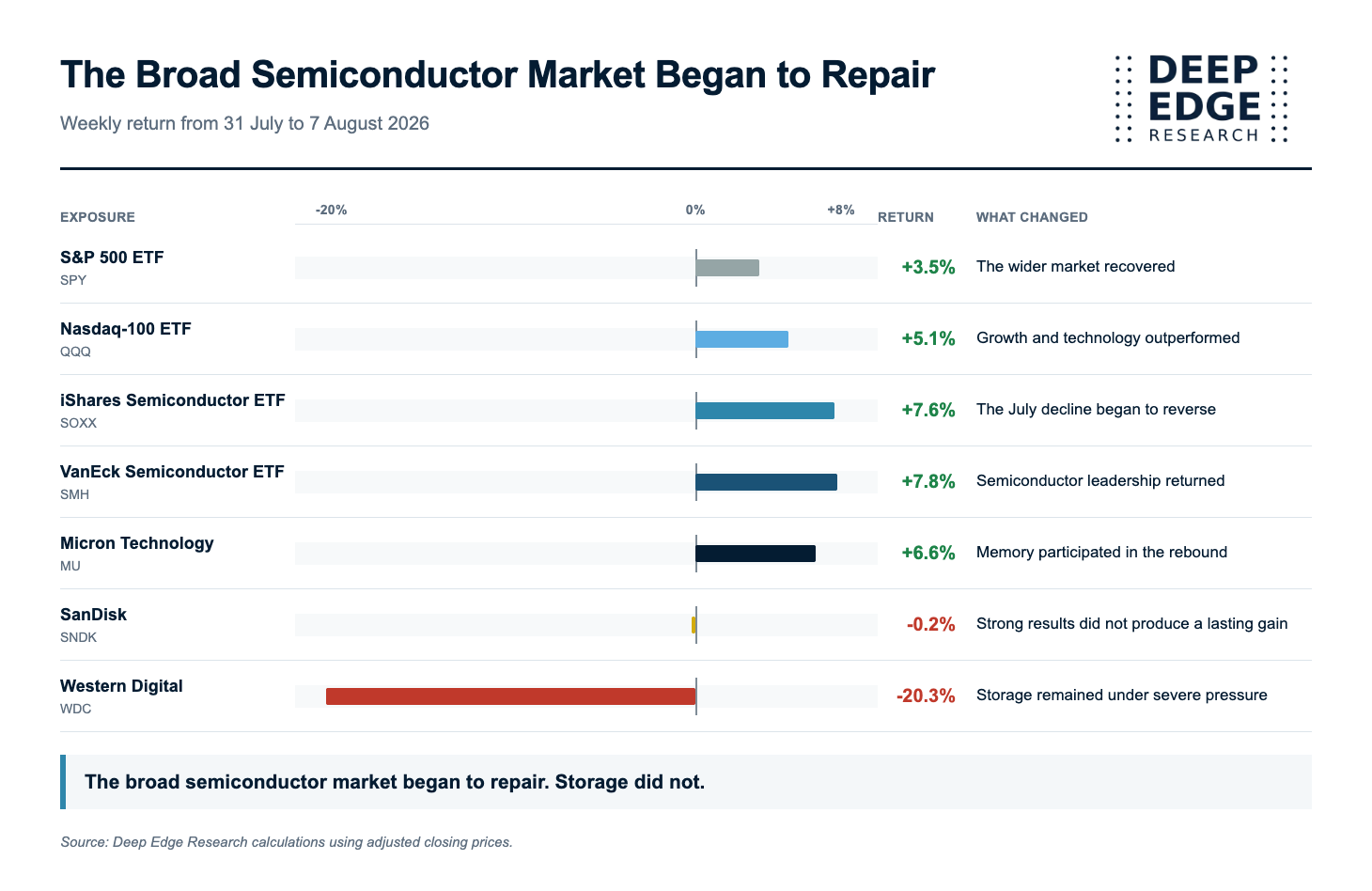
Figure 1: The Broad Semiconductor Market Began to Repair. Adjusted-price performance from 31 July to 7 August 2026. Source: Deep Edge Research calculations.[3]
The broad semiconductor ETFs outperformed the wider market, and Micron participated in the recovery. SanDisk finished broadly flat, while Western Digital fell another 20.3%. The sector began repairing, but storage did not.
The rate backdrop also became less restrictive. The 30-year Treasury had ended the previous week at 5.27%, just above the level at which we said long-duration pressure would become more restrictive. It stayed below 5.25% throughout last week and closed at 5.19%.[4]
The employment report reinforced that relief. Payrolls fell by 23,000 in July, unemployment was 4.1% and May and June were revised down by a combined 103,000.[5] That does not remove the inflation problem or guarantee lower yields. It does reduce the immediate case for another rate increase.
This matters because our W31 hypothesis had two linked parts. Mechanically, a crowded and leveraged trade broke, then dealer hedging, leveraged-product resets and wider de-grossing made the initial decline more violent. Economically, peak-cycle concerns, hyperscaler funding, future supply and higher rates gave the next buyer reasons to wait rather than repair the trade immediately.[2]
Last week’s broad rebound fits that sequence. As the immediate rate pressure eased and the forced-selling impulse weakened, semiconductor ETFs attracted buyers again.
We are not treating one positive week as proof. The rebound does not identify the original sellers or repair the technical damage created during July. The sector also remains well below its June highs. However, it does show that SOXX and SMH were capable of outperforming once the immediate pressure eased, while the remaining weakness became far more concentrated.
So what: the broad rebound gives us more confidence that market structure amplified July’s decline. However, SanDisk and Western Digital’s failure to participate means market structure cannot explain their remaining weakness on its own. Before turning to valuation, we first need to establish whether their results, or the evidence from the wider physical AI supply chain, showed any current break in demand.
2. The Businesses Still Say the AI Buildout Is Strong
Our view: the operating tests we carried into W32 largely passed. Networking and storage converted AI investment into revenue, margins and cash, while contracted power demand continued supporting earnings and guidance. We still have no evidence of an industry-wide break in orders, utilisation or current AI-infrastructure demand.
Last week mattered because we had already defined what each part of the book needed to prove.
Arista had to show that hyperscaler bandwidth demand was becoming revenue and margin. SanDisk and Western Digital had to establish whether Seagate’s storage evidence reflected broader industry conditions. Constellation and Vistra had to show that datacentre power demand was becoming contracted earnings. The Treasury refunding and employment report had to test the long-duration headwind. Memory pricing had to show whether the warning had moved from weak shares into forward operating evidence.
The scorecard below brings those tests together. Five weeks into the audit, the operating evidence still points in the opposite direction from July’s share-price damage.
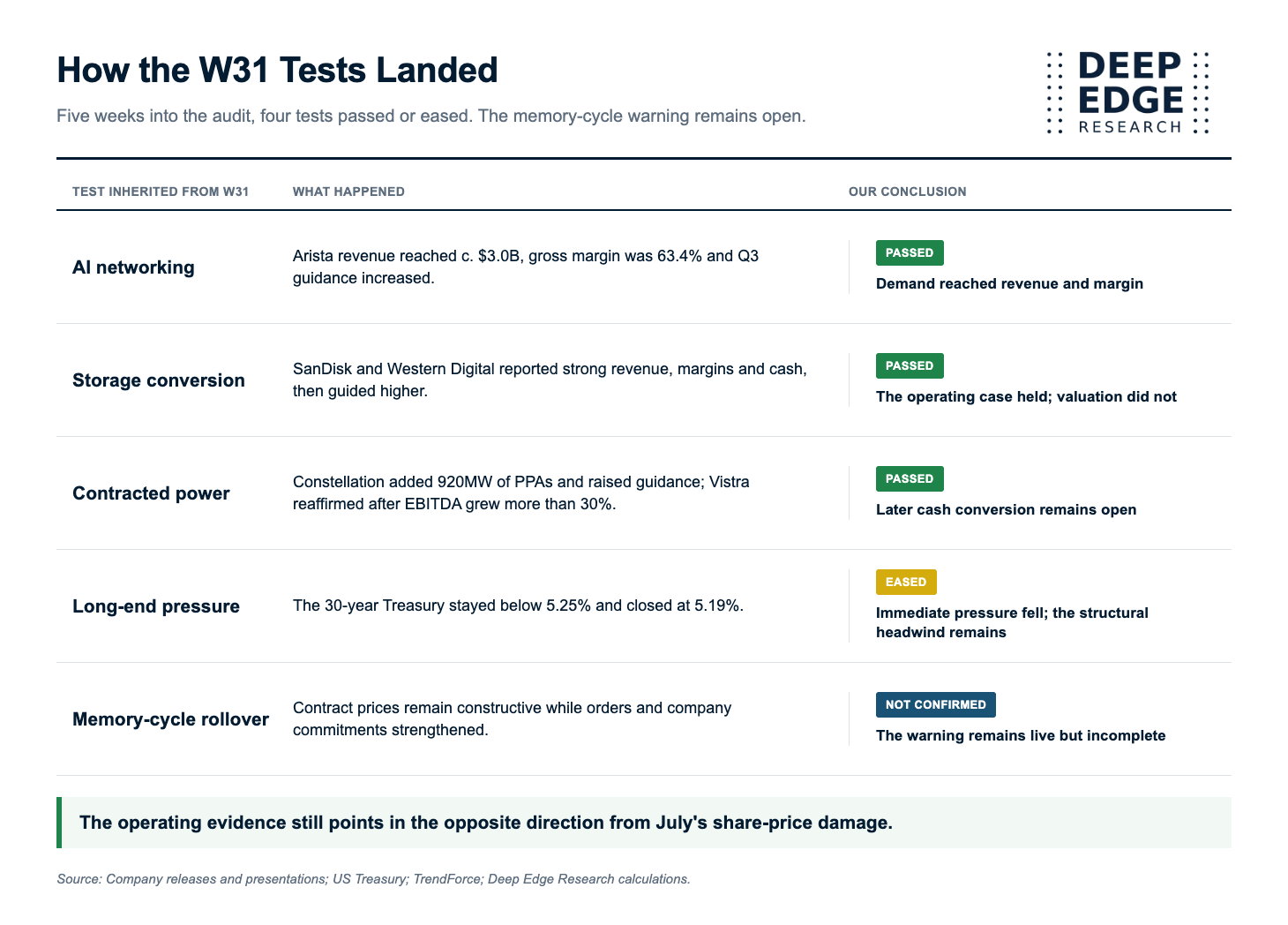
Figure 2: How the W31 Tests Landed. Four of the five tests passed or eased; a memory-cycle rollover was not confirmed. Sources: company disclosures, US Treasury and TrendForce.[4][6]-[15]
A. Networking passed the conversion test
Arista cleared the operating hurdle we established in W31. Revenue reached c. $3.0 billion, up 38% year on year. Its 63.4% non-GAAP gross margin cleared our 62% threshold, and Q3 revenue guidance moved to c. $3.3 billion.[6]
That is a clean operating pass. Hyperscaler spending is reaching the network layer.
The share-price gain faded as the week progressed, and Arista did not explicitly restate the previous c. $3.5 billion 2026 AI-networking target in the earnings release. Those are reasons to keep the company-level test open. They are not evidence that AI-networking demand broke.[2][6]
B. Storage converted scarcity into cash
SanDisk and Western Digital had to establish whether Seagate’s storage evidence reflected broader industry conditions. Both reported unusually strong current economics.
SanDisk’s revenue rose 51% sequentially to c. $9.0 billion. Datacentre revenue more than doubled, gross margin reached 84.6% and adjusted free cash flow reached c. $5.0 billion after removing customer funding and Flash Ventures joint-venture activity.[7]-[9]
Western Digital’s revenue rose 12% sequentially to c. $3.7 billion. Non-GAAP gross margin reached 54.4% and free cash flow reached c. $1.3 billion, equivalent to c. 0.93x adjusted earnings.[10]-[12]
Those results settle an important question. The scarcity economics are reaching reported profit and cash.
They do not settle whether the shares are attractive. That requires us to separate current business performance from the earnings period a buyer is being asked to fund. We turn to that next.
C. Power demand continued becoming contracted earnings
Constellation and Vistra had to show that datacentre power demand was continuing to become contracted earnings. Constellation increased adjusted earnings per share to $2.55, raised its full-year guidance to $11.50–$12.50 and signed another 920MW of long-duration power purchase agreements. Vistra increased ongoing adjusted EBITDA by more than 30% to c. $1.8 billion and reaffirmed its full-year ranges for EBITDA and free cash flow before growth.[13][14]
That passes the immediate earnings and contracting tests. The remaining job is cash conversion: Constellation did not explicitly restate its previous c. $8.4 billion 2026–27 free-cash-flow target, while Vistra’s AWS agreement remains a later-dated conversion.[2][13][14]
D. Rates gave the book some relief
The Treasury refunding and employment report had to test whether the long-duration headwind was becoming more restrictive. The Treasury kept nominal coupon and floating-rate-note auction sizes broadly unchanged, the 30-year stayed below 5.25% and the employment report weakened.[4][5][16]
That gave long-duration assets room to recover without removing the cost-of-capital problem. A 30-year yield of c. 5.2% still places a heavy discount on earnings several years into the future, particularly when current-cycle margins are already unusually high.
Taken together, last week’s operating evidence largely passed the tests we carried into W32. Networking, storage and contracted power continued to show that AI investment is reaching reported results, while memory pricing has not yet confirmed a cycle rollover. That does not settle how long the current economics can last or what investors should pay for them. Those are the questions we now need to answer.
So what: the current operating evidence still supports the AI buildout. SanDisk and Western Digital’s weak share-price reactions therefore require an explanation beyond a current break in demand. We now need to separate the strength of their reported results from the return available at today’s prices.
3. Why Strong Storage Results Were Not Enough
Our view: SanDisk and Western Digital both passed the current operating test, but fresh capital also requires the return available at today’s price to compensate us for the cycle and the evidence each company still needs to provide. SanDisk now clears that hurdle. Western Digital does not.
The current operating evidence does not explain the storage reactions. SanDisk fell 6.8% in the first session after reporting, while Western Digital fell 13.0%.[3] Rather than assuming that strong results made both lower prices attractive, we went back through each investment case and rebuilt the return available across the cycle.
That work produced two different conclusions:
SanDisk: the quarter strengthened the business, the contracts may protect more of the eventual downturn and the lower share price now offers enough prospective return. We are allocating fresh capital with cycle discipline.
Western Digital: the quarter settled the cash question, but exabyte growth slowed, the next HDD architecture remains commercially unproved and the return is still too thin beside the bear-case downside. We are holding without adding.
A. What the current prices pay us to own
Because both companies are cyclical, the latest-quarter P/E cannot settle the decision. We need to ask what happens to earnings and valuation across a wider range of outcomes. The weighted-value rows are the quickest way to read Tables 1 and 2: SanDisk now offers c. 49% upside, while Western Digital offers c. 9%, or c. 13% after modest additional credit for Q4.
The post-earnings review then exposed two problems in our previous bridge. SanDisk’s bear case assumed gross margin would fall below 50%, but the old $110–$130 EPS range required a materially higher margin at the Q1 revenue run-rate. Western Digital’s base case said the multiple would partly normalise, but retained 27–30x against a current c. 26–28x run-rate multiple. In other words, the multiple had not actually normalised.
We therefore reopened the entire bridge. We rebuilt all six EPS ranges from revenue, gross margin, operating expenses, tax and diluted shares, then retested the multiple attached to each operating state. The original scenario weights remain unchanged.
Table 1: SanDisk Scenario Values at 7 August Prices
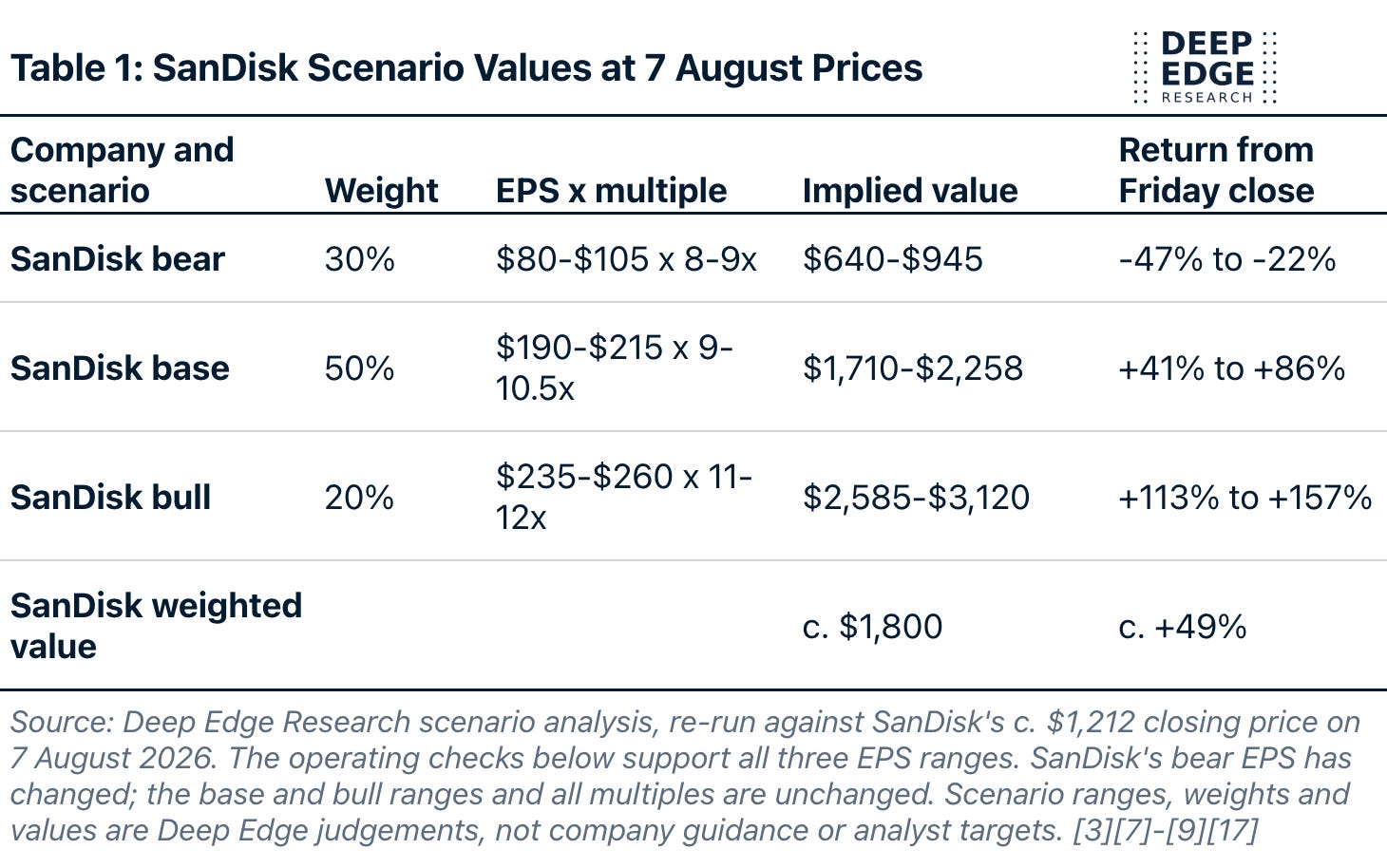
SanDisk’s expected return does not depend on an oversized bull probability. Half of the weight remains in the base case and 30% remains in the bear case.
Western Digital’s distribution is much less forgiving.
Table 2: Western Digital Scenario Values at 7 August Prices
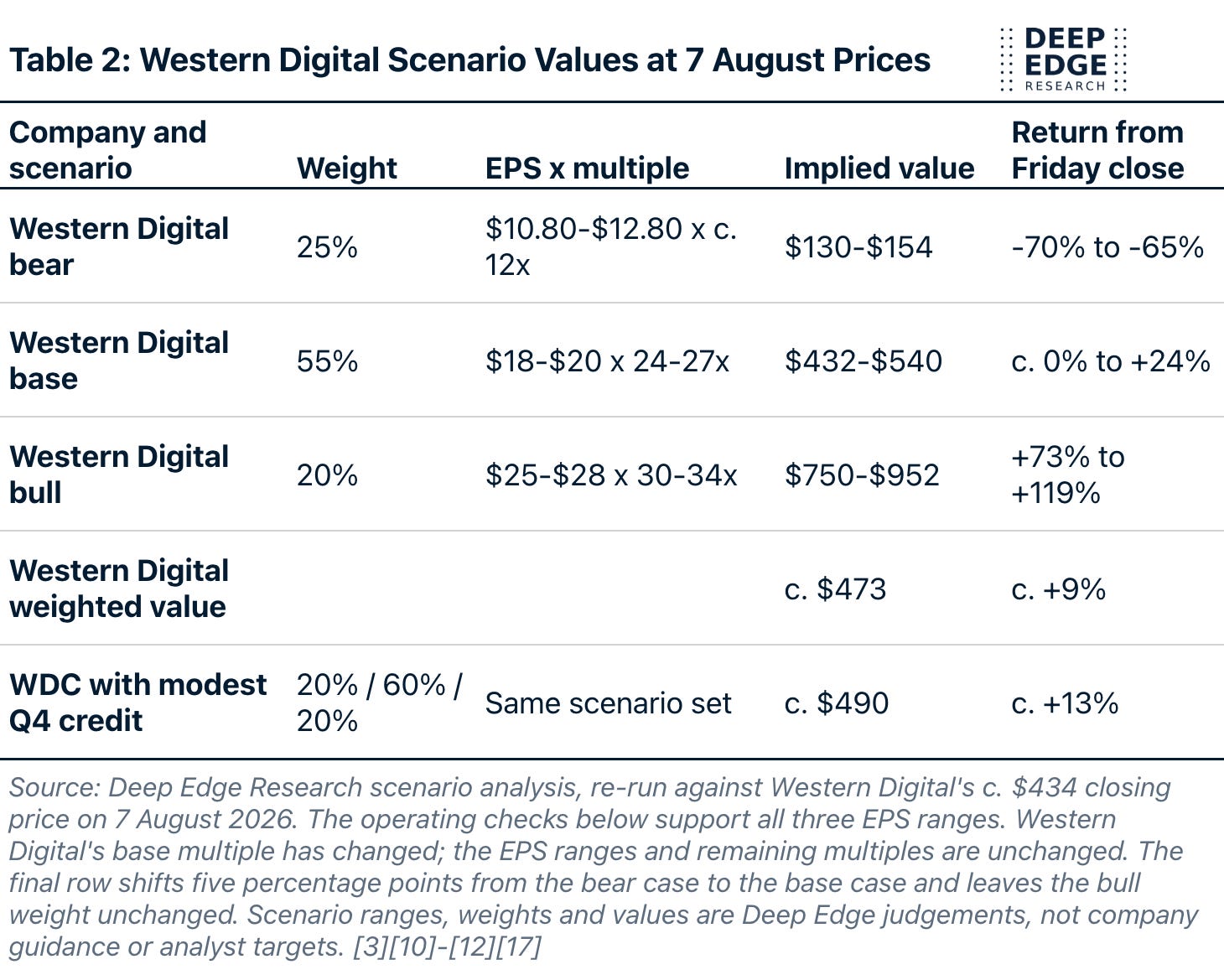
Its bear case combines $10.80–$12.80 of normalised earnings with c. 12x, so the company would be hit twice if margins normalised before ePMR and HAMR protected the earnings base: earnings would fall and the multiple would compress. Even shifting more probability into the base case creates only c. 13% weighted upside.[3][10]-[12][17]
That is why two strong quarters can still produce very different capital decisions. SanDisk’s lower price absorbs a severe earnings reset and leaves enough prospective return. Western Digital still asks us to fund favourable cycle earnings and an unfinished technology transition for much less upside.[3][7]-[12][17]
The company guides give us a clean starting point. Annualising SanDisk’s Q1 midpoint produces c. $42.2 billion of revenue and c. $183 of EPS. Annualising Western Digital’s Q1 midpoint produces c. $16.4 billion of revenue and c. $16 of EPS. Our models reproduce both figures before we change the cycle assumptions.[7][10]
The six operating ranges then reconcile as follows:
SanDisk: the bear case uses c. $38–$42 billion of revenue and a 45–50% gross margin, producing c. $80–$105 of EPS. The base case uses c. $46–$50 billion and an 80–82.5% margin, supporting $190–$215. The bull case uses c. $54–$58 billion and an 83.5–85.5% margin, supporting $235–$260. All three use c. $2.0–$2.3 billion of operating expenses, a 15% tax rate and c. 155 million diluted shares.
Western Digital: the bear case uses c. $15–$16 billion of revenue and a 45–47% gross margin, supporting $10.80–$12.80 of EPS. The base case uses c. $18–$19 billion and a 55–57.5% margin, supporting $18–$20. The bull case uses c. $23.5–$25 billion and a 56–58.5% margin, supporting $25–$28. All three use c. $1.5–$1.65 billion of operating expenses, c. $60 million of net interest expense, a 17% tax rate and c. 388 million diluted shares.
Those checks do not turn the scenarios into forecasts. What they do is ensure that the earnings ranges actually describe the operating states attached to them.
With the earnings ranges rebuilt, the multiples do a separate job. SanDisk moves from 8–9x in a commodity reset to 9–10.5x when contracts cushion normalisation and 11–12x if the floor proves more structural. Western Digital moves from c. 12x when follower economics reassert themselves to 24–27x when current demand holds but the cycle multiple partly normalises. Only the bull case retains 30–34x, because that outcome requires commercial HAMR proof, stronger exabyte growth and structurally better margins.
The SanDisk correction remains material. Its revised bear case represents a c. 43–56% decline from annualised Q1 EPS. It is still a bear case rather than a worst case. If annual revenue fell to c. $34 billion and gross margin reached 40%, the same model would produce c. $62 of EPS. We have not assigned that tail outcome a separate probability because SanDisk’s contract floors, customer guarantees and covered bits should provide some protection. However, the disclosures are not detailed enough for us to claim that $80 is a contractual floor.
The current multiples do not make either company automatically cheap. Both are calculated from Friday’s share price and annualised Q1 guidance: SanDisk trades at c. 6.6–6.9x and Western Digital at c. 26–28x.[3][7]-[12] For a cyclical company, a low multiple can be exactly what peak earnings look like. We are allocating because the lower price still offers c. 49% upside after a more severe downside case, not because a single-quarter P/E says the shares are cheap.
B. SanDisk: revenue growth may have peaked, but the NAND cycle probably has not
The valuation bridge tells us that SanDisk now offers enough prospective return. The operating evidence tells us what we are being paid to own.
For a NAND manufacturer, SanDisk’s 84.6% gross margin is extraordinary. It is also not a number we are prepared to treat as permanent.
Management said c. two-thirds of the sequential revenue increase came from pricing. Only one-third came from volume.[9] Q1 FY2027 guidance still implies c. 18% sequential revenue growth, but that is much slower than Q4’s 51% increase.
The external pricing evidence points in the same direction. TrendForce expects NAND contract prices to rise c. 10–15% sequentially in Q3, after an estimated c. 70–75% increase in Q2.[15][18] Prices are still rising. The rate of improvement is slowing sharply.
That sharply slower rate of improvement sits alongside SanDisk’s inventory days increasing to c. 178.[9][15][18] Those are genuine late-cycle warnings. They explain why a buyer can look through a strong reported quarter and ask how much of the current margin survives.
However, that is not the same as evidence that the NAND cycle has already turned.
SanDisk says demand remains ahead of supply, with allocation extending beyond calendar 2027. Q1 gross-margin guidance of 83–85% points to a plateau near the current level rather than an immediate collapse. Data-centre revenue doubled, and its higher-density QLC Stargate enterprise-SSD platform moved from qualification into revenue shipments.[7]-[9]
The contracts matter even more. SanDisk now has ten New Business Model agreements across eight customers. More than half of FY2027 bits and c. two-thirds of FY2028 bits are covered. Across agreements with a weighted-average duration of more than four years, minimum revenue at floor pricing totals $93.9 billion, supported by $16.5 billion of guarantees.[9]
We cannot yet translate that bit coverage into a precise through-cycle revenue or margin floor. The contracts have also not been tested in a genuinely weaker NAND environment. Our read is simply that customer capital, guarantees and floor pricing probably make the next trough shallower than it would otherwise have been.
The share price now gives us room to be wrong about the exact floor.
At Friday’s c. $1,212 close, SanDisk is c. 37% below the price used in our previous persistent-media comparison. We have not increased the valuation assumptions to reward the quarter. The downside review has instead lowered our weighted value from c. $1,870 to c. $1,800.[3][17]
That is enough for us, not because we think an 84.6% gross margin can last, but because current demand has not broken, the contracts probably improve the downside economics and the lower price now compensates us for an eventual cycle turn.
C. Western Digital: the quarter strengthened the base case, not the bull case
Western Digital’s quarter improved our confidence in the base case, but it did not create enough additional return to justify fresh capital.
The c. $1.3 billion of free cash flow represented c. 0.93x conversion against adjusted earnings. That closes the cash-quality objection. The company also moved 40TB energy-assisted perpendicular magnetic recording (ePMR), its current HDD architecture, into volume production with two customers and expects it to exceed half of nearline datacentre bits by Q3 FY2027.[10]-[12]
The current economics are real. Western Digital’s price per terabyte rose by the high teens year on year while cost per terabyte fell c. 8%. Gross margin and operating margin expanded with that spread.[12]
The problem is that much of this was already visible.
Our reconstructed Western Digital and Seagate pricing series shows that both suppliers moved to decisively positive price-per-terabyte growth in Q3. We calculated each series from the companies’ disclosed datacentre revenue and exabytes shipped; the absolute price levels use different revenue bases, but the direction and rate of change within each company are comparable.[10]-[12][19][20] The 40TB ramp was also already included in our base case. Q4 made that case easier to trust, but it did not create a new earnings mechanism.
The missing evidence remains important. Nearline exabyte growth slowed to 22%. Western Digital’s 44TB HAMR programme, the next HDD architecture, has positive qualification feedback but no disclosed commercial volume. Seagate already has HAMR shipping in volume to two hyperscale customers.[12][21]
Valuation then decides how much of that uncertainty we are prepared to own. At Friday’s close, the original scenario weights produce c. $473 of weighted value, or c. 9% upside. Giving Q4 modest additional base-case credit raises that to c. $490, or c. 13%. That is still not enough for us to fund favourable current-cycle earnings and an unfinished technology transition at the same time.[3][17]
Western Digital therefore remains a hold, not an add. A lower price could create the required margin of safety. Commercial HAMR volume, stronger exabyte growth or better contract economics could raise our weighted value. We do not have enough of any of those today.
D. What the two reactions tell us about the marginal buyer
Those company-level decisions complete the progression from the broad sector rebound. Buyers returned at index level as SOXX and SMH recovered, but the storage names still had to justify their own cycle risk and prospective return.
W31 asked why the marginal buyer did not return after the initial semiconductor unwind. Last week gives us a more precise answer. Once the broad pressure began to ease, strong current demand was not sufficient on its own. A new buyer also had to underwrite the slope of future pricing, the durability of margins, the next supply response, the technology transition and the return available from the current share price.
SanDisk now offers enough prospective return to own those questions. Western Digital does not.
So what: the storage reactions do not prove that AI demand has broken. They show that reported strength and investment attractiveness are different tests. SanDisk now passes both. Western Digital passes the business test but not our fresh-capital test.
4. The Forward Evidence Still Decides Whether July Was Early
Our view: we now have the first two stages of a possible memory-cycle warning: strong earnings followed by weak shares. We do not yet have the third and decisive stage, which is a persistent deterioration in forward prices, orders and inventories.
The valuation work tells us that SanDisk now pays us to own the uncertainty. It does not tell us whether July was only a positioning unwind or the first warning of a cycle turn. That distinction requires a different test.
This is where we need to be careful. The SanDisk allocation cannot become an excuse to label every future decline as market structure. Semiconductor equities often turn before earnings and margins, which means a positioning unwind and a genuine cycle turn can look almost identical for several months.
The dangerous sequence is:
Strong earnings → shares continue falling → forward contract prices roll over.
The first step confirms how good current conditions are. The second tells us that current conditions are no longer enough to support the shares. Neither tells us, by itself, whether the price action came from positioning or an approaching cycle turn.
The forward evidence decides between them.
This is not a framework invented for last week’s price action. In W29, we examined four completed memory cycles across Micron and SK hynix. That work found that the shares peaked c. 1.4 quarters before operating margins in the median cycle and were down c. 25% six months after the equity peak.[22]
That was useful, but it answered an economic sequencing question using fiscal quarter-end dates. It did not answer the investable question because those margins were not public at quarter end.
We have therefore rerun the study from the dates on which investors could actually see the results. Each observation now begins at the first tradable close after the peak-margin result became public. We then tested the share-price path after the first lower-margin result and the later ten-percentage-point margin break.
The answer is less comfortable for both the bull and the bear.
After the peak-margin result became public, the median completed cycle fell 6.4% over three months, but then gained 4.4% over six months and 0.6% over twelve months. Five of eight issuer observations were negative after three months; only four were negative after twelve.
Waiting for the first reported margin decline did not improve the signal. The median cycle gained 7.6% over the following three months and 6.6% over six months, before ending 5.2% lower after twelve months. Four of eight issuer observations were negative after three months and three were negative after six months. The 2014 cycle was the only one in which both companies were materially lower across all three horizons.
That changes how we use the history. Peak profitability is a warning zone because the shares can begin discounting the next cycle before reported earnings deteriorate. It is not, by itself, a sell signal. Nor is the first sequential margin decline. Forward prices, orders and inventories still have to confirm that the mechanism has turned.
Panels A-D below show the investable path across each completed cycle. Micron and SK hynix are separately indexed to 100 at the first tradable close after their peak-margin results became public. The gold marker shows the first lower-margin result; the red marker shows the first ten-point break.
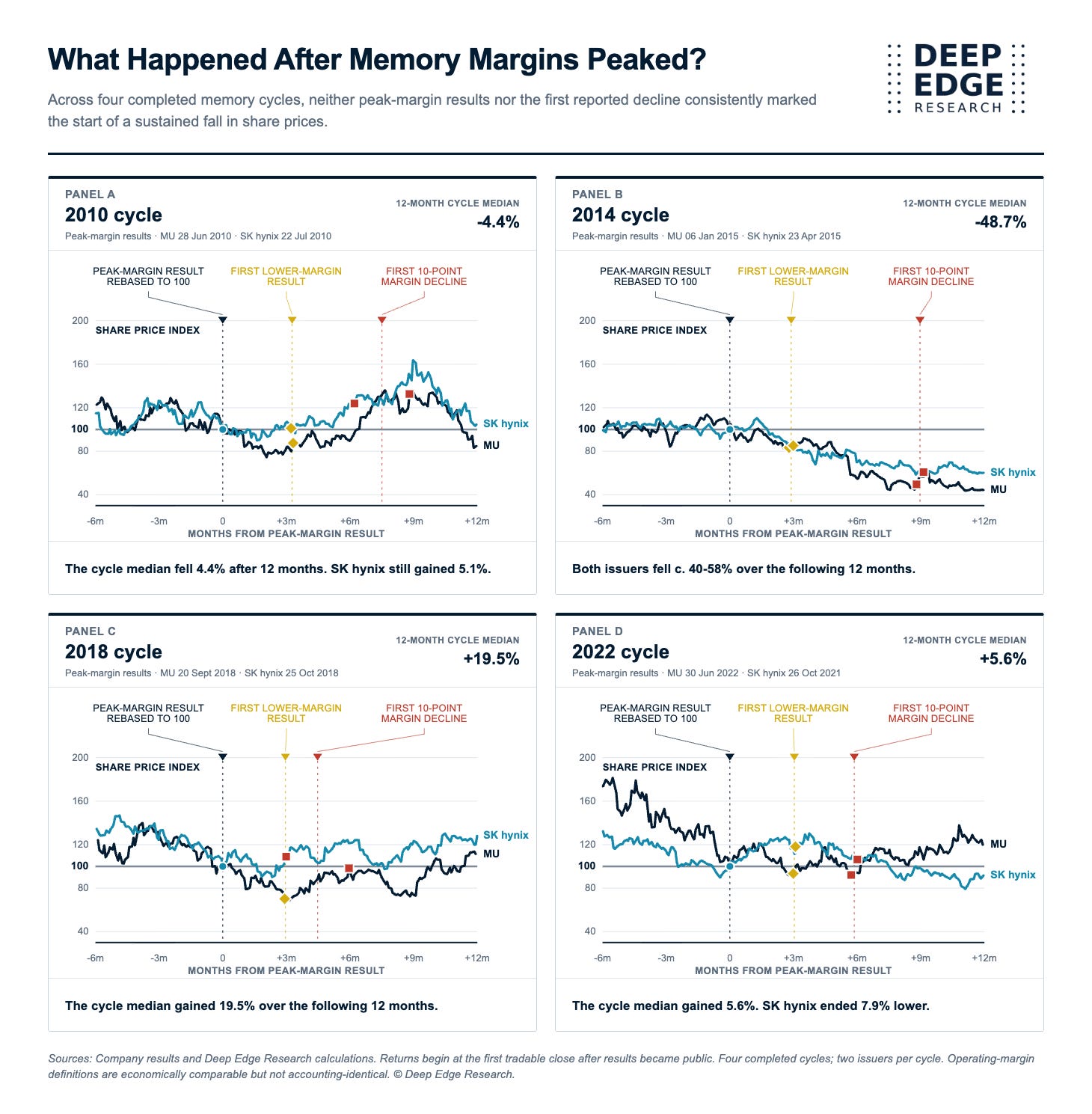
Figure 3: What Happened After Memory Margins Peaked? Panels A-D index Micron and SK hynix to 100 at the first tradable close after each peak-margin result became public, then mark the first lower-margin result and the first ten-point margin decline. Sources: company results and Deep Edge Research calculations.[22]-[25]
Figure 3 therefore gives us a warning zone, not a sell signal. The shares often weakened after peak profitability became visible, but the timing and severity varied too widely to turn the history into a fixed countdown.
That tells us how previous cycles behaved. It does not tell us whether today’s weak storage shares reflect a re-rating or the first warning that this cycle is turning.
Table 3 translates that historical lesson into the forward evidence we can monitor now.
Table 3: The Evidence That Separates a Re-Rating From a Cycle Turn
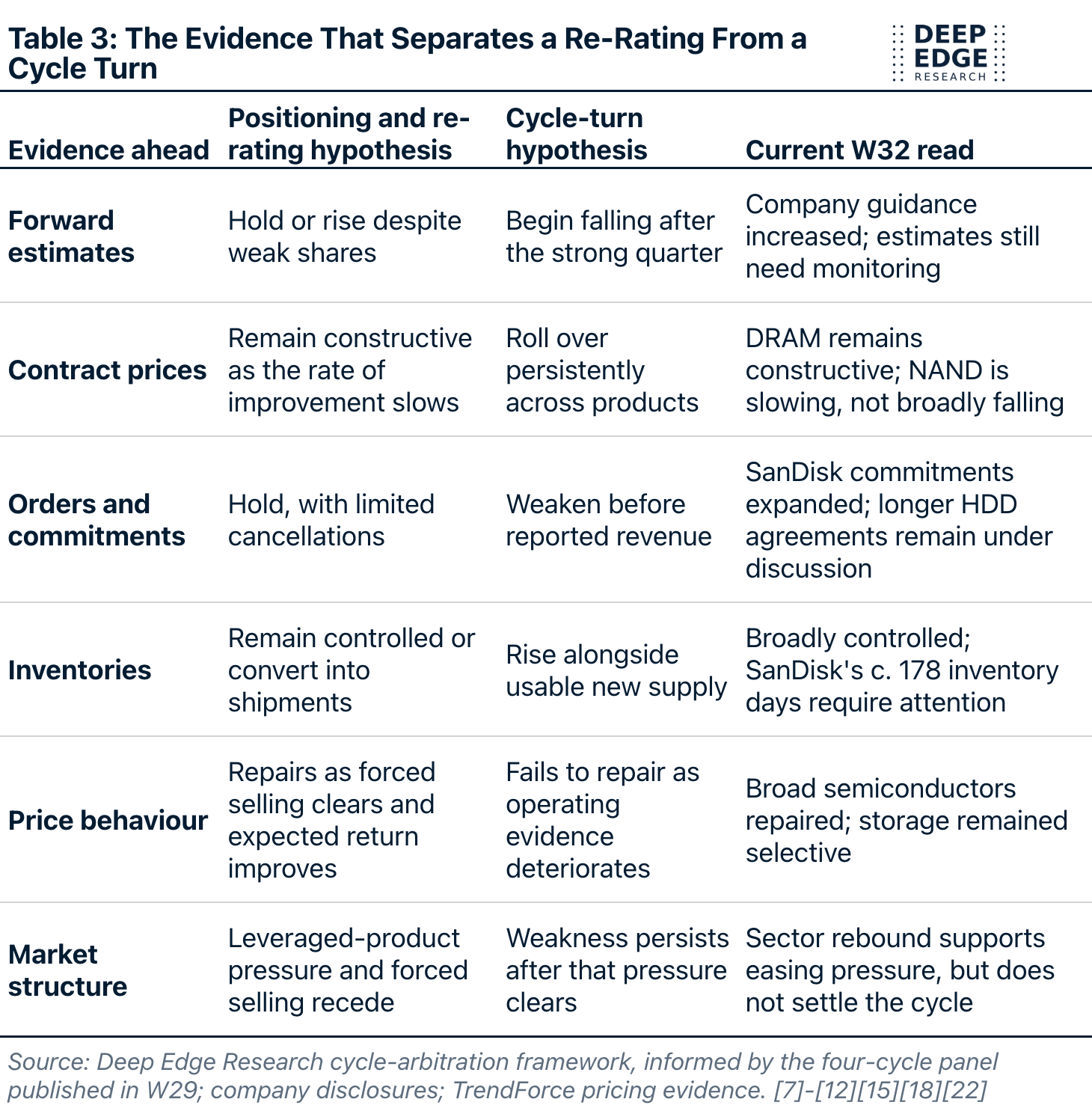
Table 3 prevents us from making either of the easy mistakes.
We cannot call a cycle turn simply because SanDisk and Western Digital fell after strong results. Contract prices have not rolled over persistently, commitments strengthened and management guidance increased.
We also cannot call every decline a positioning unwind simply because the reported numbers remain strong. NAND pricing is decelerating and SanDisk’s inventory days have increased. W31 already established that CXMT is a credible future commodity-memory supply risk, without showing that current HBM, DRAM or enterprise-storage demand has broken. Nothing in W32 changed that distinction.[2]
That is why the SanDisk decision comes with cycle discipline.
The investment does not require us to know the exact quarter in which NAND peaks. It requires the current price to pay us for that uncertainty and the forward indicators to remain constructive enough that our downside assumptions are still credible.
If contract prices remain positive, orders hold, inventories convert and SanDisk’s agreements protect the downside economics, July increasingly looks like a market-structure unwind followed by a re-rating of peak expectations.
If strong earnings are followed by further share-price weakness and then contract prices fall, orders weaken and inventories rise, the shares were not simply wrong. They were early.
So what: current operating evidence has not confirmed a cycle turn. Reported earnings are not sufficient on their own. Forward prices, orders and inventories now govern the memory allocation and determine whether the SanDisk decision continues to earn fresh capital.
5. What We Are Doing With the Book
Our view: W32 earned selective deployment. We are allocating fresh capital to SanDisk, holding Western Digital without adding and keeping cash available while the cycle and rate tests remain open.
W31 ended with c. 28% cash and a clear rule: the companies had to confirm orders, pricing, margins and cash before we deployed more of it.[2]
Last week supplied that confirmation in several places. It did not make every company equally attractive.
Table 4: Positioning After the W32 Tests
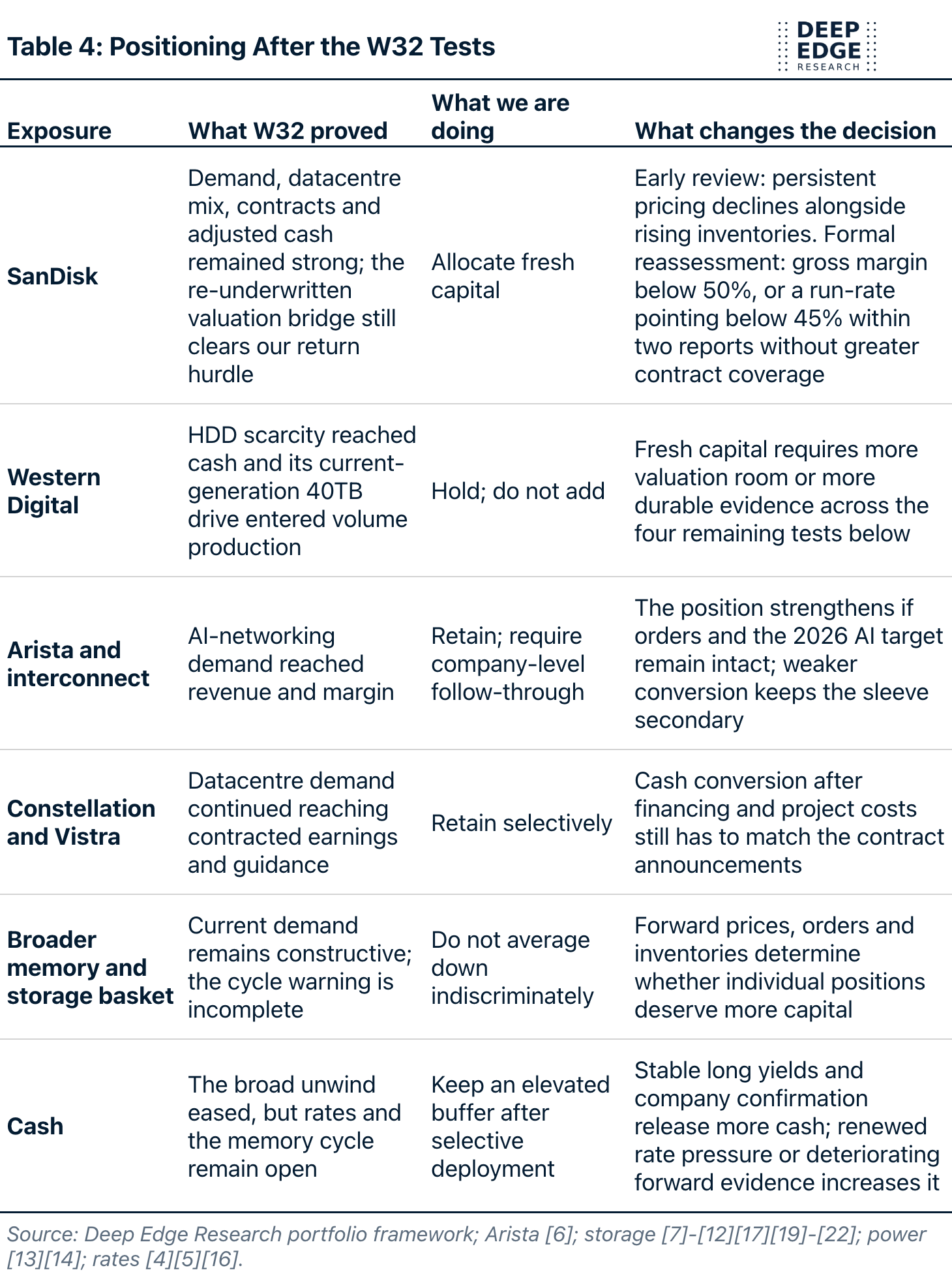
For Western Digital, the decision now comes down to four pieces of evidence. Unless the price creates a wider margin of safety, we need:
a third consecutive quarter above 50% non-GAAP gross margin in Q1 FY2027, showing that the current margin is durable rather than one strong print;
year-on-year price-per-terabyte growth above 5% at both Western Digital and Seagate;
40TB ePMR to remain on course for more than half of nearline bits by Q3 FY2027; and
at least one HAMR qualification programme to move into disclosed commercial volume before the planned first-half 2027 launch.
SanDisk is the important change. We previously preferred a better entry because our c. $1,870 weighted value sat c. 2% below the old c. $1,916 reference price. The prospective return was slightly negative. The operating evidence has improved since then, and our more severe downside review has lowered the weighted value to c. $1,800. Even after that change, the lower price now pays us to own uncertainty that we would not fund at the previous price.
Western Digital shows why we are not treating the sector rebound as permission to buy everything. The company delivered the cash and 40TB evidence we requested. Even after the additional decline and modest additional base-case credit, the re-audited bridge offers only c. 13% upside. That remains too thin beside the bear-case downside and unfinished HAMR transition.
The same discipline applies elsewhere in the book. Arista passed its immediate operating threshold, but the individual interconnect holdings still need to show that the read-through reaches their own orders, margins and cash. Constellation and Vistra passed the current power test, but long-duration PPAs still have to produce attractive returns after construction and financing costs.
Cash therefore remains part of the position. We are using some of it where the evidence and expected return now align. We are not spending it merely because the sector suffered a large drawdown.
So what: July’s drawdown created one actionable opportunity in SanDisk. Western Digital and the remaining sleeves still have specific work to do before they earn additional capital. Those conditions now determine what we need to learn this week.
6. What This Week Needs to Prove
Our view: this week tests the two remaining pressures directly. SanDisk’s Investor Day must show how much downside protection its contracts actually provide, while CPI, PPI and retail sales determine whether last week’s duration relief can survive.
The W32 earnings cluster is now behind us. The next decision window is smaller, but the catalysts are more concentrated.
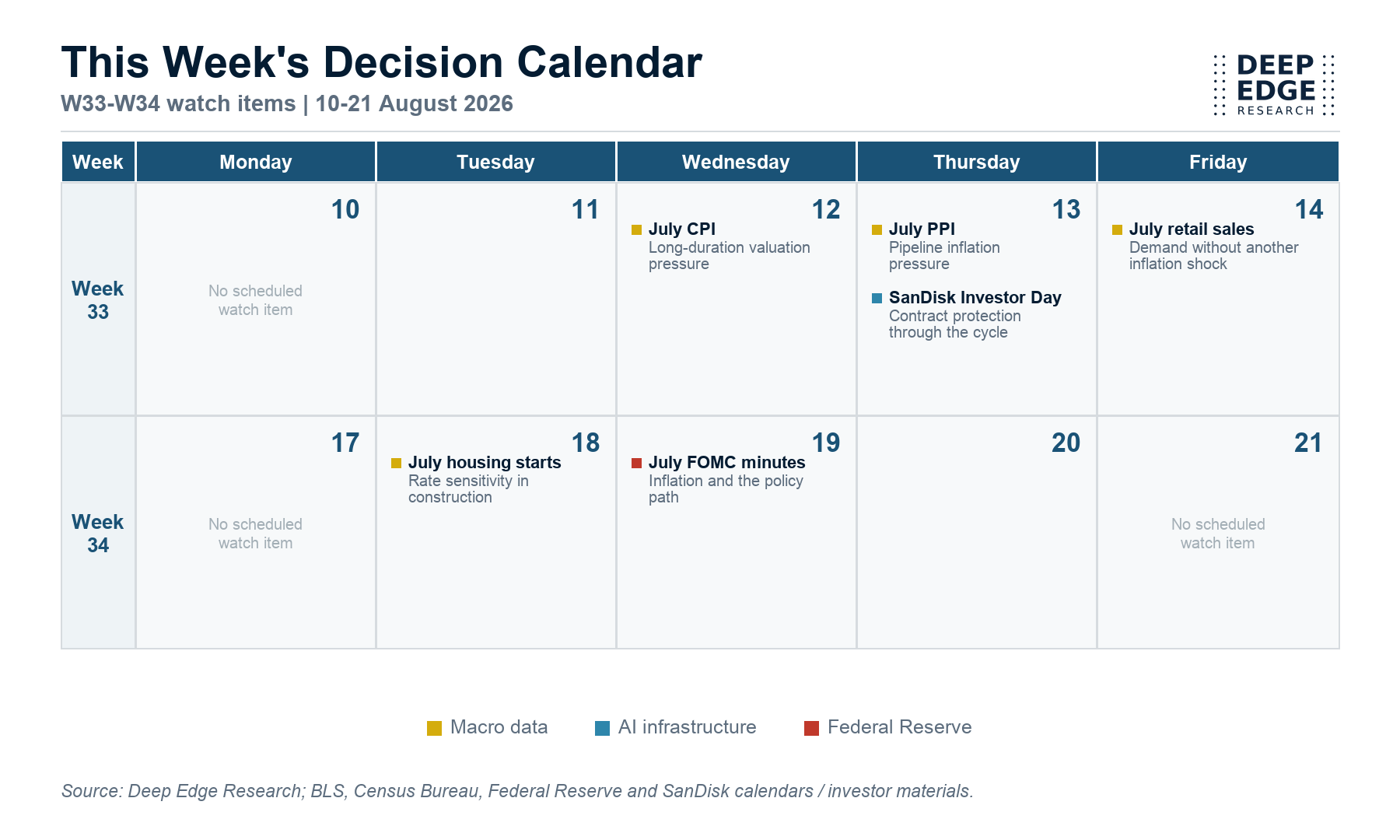
Figure 4: This Week’s Decision Calendar — W33-W34, 10-21 August 2026. SanDisk’s contract protection and the inflation path are the immediate tests; housing starts and the July FOMC minutes extend the rates test into next week. Sources: US Bureau of Labor Statistics, US Census Bureau, SanDisk investor relations and Federal Reserve.[26]-[30]
12 Aug: July CPI tests whether the 30-year Treasury can remain below our 5.25% pressure threshold. A hotter print keeps more cash on the sidelines.
13 Aug: July PPI tests whether pipeline inflation is rebuilding. Renewed pressure raises the return hurdle for long-duration holdings.
13 Aug: SanDisk’s Investor Day tests how much protection its commitments and guarantees provide through the cycle. Better disclosure strengthens the fresh-capital case.
14 Aug: July retail sales test whether demand can hold without producing another rates shock.
18 Aug: July housing starts test whether rate pressure is reaching construction activity.
19 Aug: the July FOMC minutes test how concerned the committee was about inflation and the policy path.
SanDisk’s Investor Day is the most important company event.
We already know that more than half of FY2027 bits and c. two-thirds of FY2028 bits are covered by the New Business Model agreements, which last more than four years on average. What we do not know is how that bit coverage maps to annual revenue, how much supply remains exposed to spot and contract pricing, or whether the c. 80% margin expectation represents genuine through-cycle economics.[9][29]
The presentation cannot fully prove the contracts. Only a weaker NAND-pricing environment can do that. It can tell us whether the protections are economically meaningful enough to support the floor we are underwriting.
The inflation data tests the other side of the decision.
Last week’s employment report gave long-duration assets some relief. CPI and PPI can either extend that relief or reverse it. If the 30-year moves sustainably back above 5.25%, the hurdle rises for every company whose valuation depends on earnings several years into the future.
Retail sales then show whether the consumer can absorb the price environment without creating another reason for yields to rise. We are not trying to become macro forecasters. We are using the data to decide how much valuation pressure the companies in our book must overcome.
The memory-cycle test continues beyond the calendar. Forward contract prices, orders and inventories remain more important than one management presentation or one week of share-price repair.
So what: SanDisk’s Investor Day can strengthen or weaken the downside protection in our valuation bridge. The inflation data and the 30-year Treasury can extend or reverse last week’s duration relief. Together, those tests decide whether we deploy more cash or raise the return hurdle again.
Final Thought
The semiconductor sell-off is starting to make more sense because the broad and company-specific parts of the move are finally separating.
The operating evidence has strengthened since we opened the audit. Hyperscalers kept building, and the spending continued to reach revenue, margins, cash and contracted earnings across the physical supply chain. Last week, SOXX and SMH also recovered as the long end became less hostile. That supports our working hypothesis that market structure amplified the broad decline without a corresponding break in the businesses.
It does not make every company attractive. Once the broad pressure began to ease, storage still had to answer the harder questions about pricing, cycle duration, technology and prospective return.
SanDisk now gives us enough return to own those risks, even after we rebuilt the bear case around a much steeper earnings decline. Western Digital does not, especially after correcting the base multiple so that it genuinely reflects some cycle normalisation. We are therefore allocating to SanDisk and holding Western Digital without adding.
The cycle question remains open. Strong earnings followed by falling shares can still be the first warning that the tape has moved before the businesses. If forward prices roll, orders weaken and inventories rise, we will revisit the SanDisk allocation and the wider memory exposure.
Until then, we will keep doing what the audit was designed to make us do: follow the operating evidence, demand enough prospective return for the risks we cannot resolve and let each company earn the next dollar.
Methodology Note
Weekly returns compare adjusted closing prices on 31 July and 7 August 2026. Post-earnings reactions use the closing price immediately before the company reported and the first full trading-session close after the result. SanDisk reported after the 5 August close, so its correct next-session reaction is the 6 August move of -6.8%; the larger decline measured from 4 August is not used as the earnings reaction.
For Western Digital, we re-derived all three EPS ranges using the operating assumptions stated in Section 3. The earnings ranges survived, but the old 27–30x base multiple did not: it contradicted the stated assumption that the multiple partly normalises. We reduced the base range to 24–27x. At the original scenario weights, weighted value is now c. $473; shifting five percentage points of probability from bear to base produces c. $490.
For SanDisk, we re-derived all three EPS ranges using the same operating model. The base and bull ranges held; the bear range did not. We rebuilt bear EPS from $110–$130 to $80–$105 because the old range was inconsistent with its own assumption that gross margin falls below 50%. The resulting weighted value is c. $1,800.
Company-adjusted free cash flow is used where reported figures contain material customer-funding, joint-venture or non-operating items. SanDisk adjusted free cash flow removes customer prepayments and Flash Ventures activity. Western Digital cash conversion is assessed against adjusted earnings because GAAP profit included a material gain on the retained SanDisk interest and transaction costs.
For Figure 3, each issuer is indexed to 100 at the first tradable close after its peak-margin result became public. We then measure the path after the first lower-margin result and the first disclosed ten-percentage-point margin break. Each cycle is the median of Micron and SK hynix; the final row is the median of the four cycle medians, so no single regime dominates the result. Samsung is excluded because its conglomerate structure weakens the memory-equity comparison.[23]-[25]
References
Deep Edge Research — W27: Thesis Audit — The AI Compute Scare
Deep Edge Research — W31: Why Did Semiconductors Fall c. 20% When AI Spending Accelerated?
Historical adjusted-close data for SPY, QQQ, SOXX, SMH, Micron, SanDisk and Western Digital
US Bureau of Labor Statistics — July 2026 Employment Situation, archived 7 August 2026 release
Stock Analysis — Western Digital Q4 FY2026 earnings-call transcript
Deep Edge Research — SanDisk vs Seagate vs Western Digital: Who Turns AI Storage Demand Into Cash Flow?
Seagate — Seagate Delivers Industry’s Highest-Capacity Hard Drives with Next-Generation Mozaic 4+
Deep Edge Research — W29: Why Are Memory Stocks Falling When Demand Is Still Strong?
Micron official results releases: Q3 FY2010, Q1 FY2015, Q4 FY2018 and Q3 FY2022
SK hynix official results releases: Q2 2010, Q1 2015, Q3 2018 and Q3 2021
US Bureau of Labor Statistics — July 2026 CPI release schedule
US Bureau of Labor Statistics — July 2026 PPI release schedule
Federal Reserve — August 2026 calendar, including the 19 August FOMC-minutes release
This article is for information and education only. It is not investment advice. Past performance is not indicative of future results.