
Last week, W28 (6-11 July 2026), gave us the first real answer to the audit we started after the W27 selloff. It was encouraging, but it was not an all-clear.
In W27, our AI infrastructure exposure fell c. 11% over two days while the SPDR S&P 500 ETF Trust (SPY) barely moved. When the book falls that hard without the wider market, we have to ask whether the investment case has changed or whether price action is trying to become a story before the operating evidence has moved.
W28 weakened the most aggressive version of the bear case. SanDisk (SNDK), Micron Technology (MU), Western Digital (WDC) and Seagate Technology (STX) recovered. Arista Networks (ANET) also gave us a stronger read on interconnect with its 1.6-terabit Ethernet launch and higher 2026 revenue guidance. Meanwhile, credit stayed calm and volatility remained low.
But we need to be careful about what that rebound proves. One good week cannot validate a multi-year scarcity thesis. What it does tell us is that buyers returned first to the parts of the book closest to physical bottlenecks, while the existing pricing, contract and demand evidence remained intact.
That still leaves the harder question: who keeps funding all of this? We own the companies receiving the capex, not the companies writing the cheques. Memory, storage, interconnect, optics and power all get paid while the hyperscalers keep building.
The 10-year Treasury closed back above 4.50%, and the 30-year moved above 5.00% [1]. That does not mean the funding chain has broken, but it does mean the hurdle is higher. From here, the funders have to show that record spending can become revenue, margin and free cash flow quickly enough to justify the capital committed.
Put those two things together and W28 gave us a narrower answer than the rebound might suggest. The physical bottleneck thesis still has support, but the next real test is whether the funding behind it remains durable.
TLDR
W28 weakened the clean-break bear case. Memory and storage recovered, while ANET gave us stronger operating evidence for interconnect. That was supportive, but one week of price action is not the same thing as fresh operating proof.
Most of our book sits on the receiving end of AI capex. SNDK, MU, WDC, STX, Credo Technology (CRDO), Ciena (CIEN), Lumentum (LITE), Vertiv (VRT), Bloom Energy (BE), TeraWulf (WULF), and Nebius Group (NBIS) are paid by the buildout. The hyperscalers fund that budget.
We still prefer the receivers, but the spenders have to keep spending. Amazon (AMZN), Microsoft (MSFT), Alphabet (GOOGL), Meta Platforms (META), Oracle (ORCL), and others keep the buildout moving.
The scale of that funding is now impossible to ignore. Amazon disclosed Q1 cash capex of $43.2B and $59.5B of financing proceeds; Meta guided to $125-145B of 2026 capex and disclosed large data-centre lease obligations; the 30-year Treasury moved above 5.00% [1]-[4]. This is not evidence of distress. It is evidence that the return hurdle is rising.
Specialist AI-cloud operators remain the amber bucket. These companies are often called neoclouds. Graphics-processing-unit (GPU) pricing evidence is mixed, so capacity monetisation, customer concentration and financing cost are now live tests for NBIS, WULF and the CoreWeave (CRWV) comparator [5]-[11].
The next earnings cluster matters. The Consumer Price Index (CPI) and Producer Price Index (PPI) set the rate backdrop. The July 28-29 Federal Open Market Committee (FOMC), Ares Capital (ARCC), hyperscaler earnings and early-August company prints then show whether higher funding costs remain a background risk or start reaching orders, utilisation and guidance.
This week’s positioning: we are staying with the strongest bottleneck holdings, but we are not chasing the rebound. We want more proof from the neocloud and power names, and we are retaining c. 20.7% cash for the late-July and early-August catalyst cluster. If the hyperscalers keep capex intact and our holdings confirm pricing and cash conversion, we can lean further into the recovery. If spending slows or utilisation weakens, we narrow the book.
1. What W28 Actually Answered
Our view: W28 made a clean break in AI infrastructure demand less likely. What mattered was not simply that the book recovered, but where the recovery happened and what evidence came with it.
Memory and storage recovered first. Across the names we track, MU rose c. 4.6%, STX c. 7.6%, WDC c. 12.5%, and SNDK c. 16.4%. These are also the names where we have the clearest connection to the physical bottleneck: memory supply, NAND flash memory, enterprise storage, contract duration and pricing power.
We saw something similar in interconnect. ANET rose sharply after launching its 1.6T 7060X7 Ethernet switch and raising its FY26 revenue guide to $11.5B, including c. $3.5B of AI revenue. We do not own ANET, but its results matter for CRDO, CIEN and LITE because they show that demand across the AI networking layer is still building. Those three holdings still need to produce their own evidence.
So the first answer is encouraging, but still incomplete. Memory and storage found buyers, while ANET gave us fresh operating evidence for interconnect. Everything else still has to come from company results, not the tape.
Table 1: W27 Audit Closure
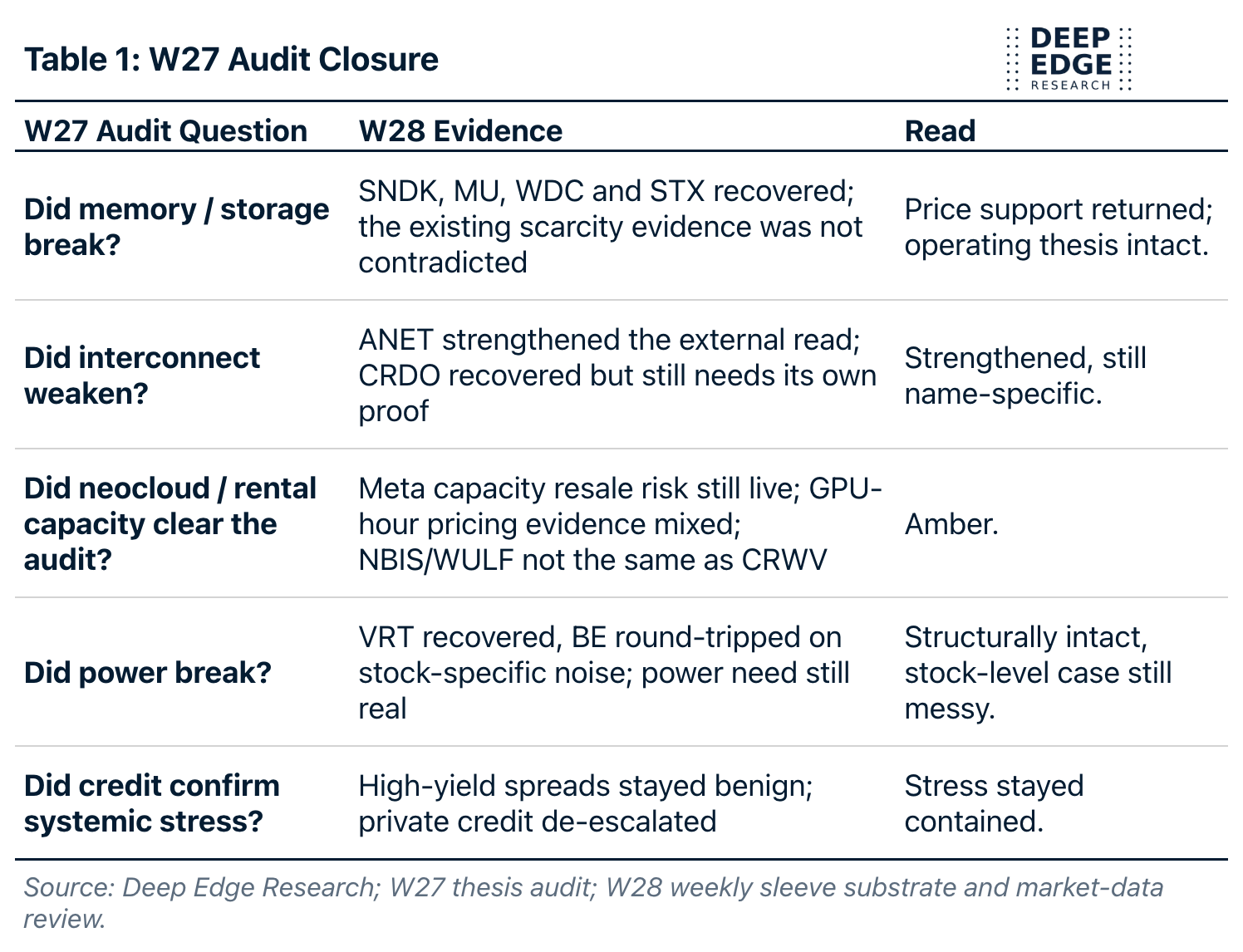
So what: the W27 selloff has not turned into a clean demand break. Memory and storage still have the strongest combination of price support and operating evidence. Interconnect looks better than it did a week ago. Neocloud and power still need to prove themselves.
2. Why Funding Is The Next Test
Our view: the buildout still looks real, but this is what we keep coming back to: can the companies funding it turn record capex into enough revenue and cash flow to keep spending at this pace?
We own the capex receivers, while the hyperscalers are the capex spenders. That distinction matters because our holdings get paid only while the hyperscalers keep building. Their orders flow into memory, storage, interconnect, optics, power and cooling. If they slow the buildout, the pressure eventually reaches us too.
The numbers are now too large to treat as ordinary growth spending.
Amazon reported Q1 cash capex of $43.2B, up from $24.3B a year earlier, and $59.5B of financing proceeds in the quarter [2]. Meta reported Q1 capex of $19.84B, raised its 2026 capex outlook to $125-145B, and disclosed c. $182.88B of lease obligations not yet commenced, much of it tied to data centres, colocation and network infrastructure [3][4]. Alphabet’s Q1 capex was c. $35.7B, mostly technical infrastructure for AI, while free cash flow was c. $10.1B [12].
None of these companies is distressed. They generate enormous cash flow and have deep access to capital. However, their investment case is becoming more capital intensive, which means the next dollar of spending has to become revenue, margin and free cash flow quickly enough to justify the old multiple.
The rate backdrop makes that conversion more important. The 10-year Treasury closed around 4.54-4.56% last week, and the 30-year moved around 5.05-5.06% [1]. We are not arguing that AI issuance caused that move; fiscal supply, term premium and the Fed matter far more. But a higher long-end rate still raises the hurdle for every long-duration, capital-heavy project, including AI infrastructure.
If funding pressure does start moving through the chain, we do not expect reported revenue to be the first warning. We would look for it in orders, backlog conversion, order intake relative to shipments, pricing concessions and guidance language. That lag is why one week of stronger receiver stocks cannot settle the funding question for us.
Figure 1: The AI Funding Chain
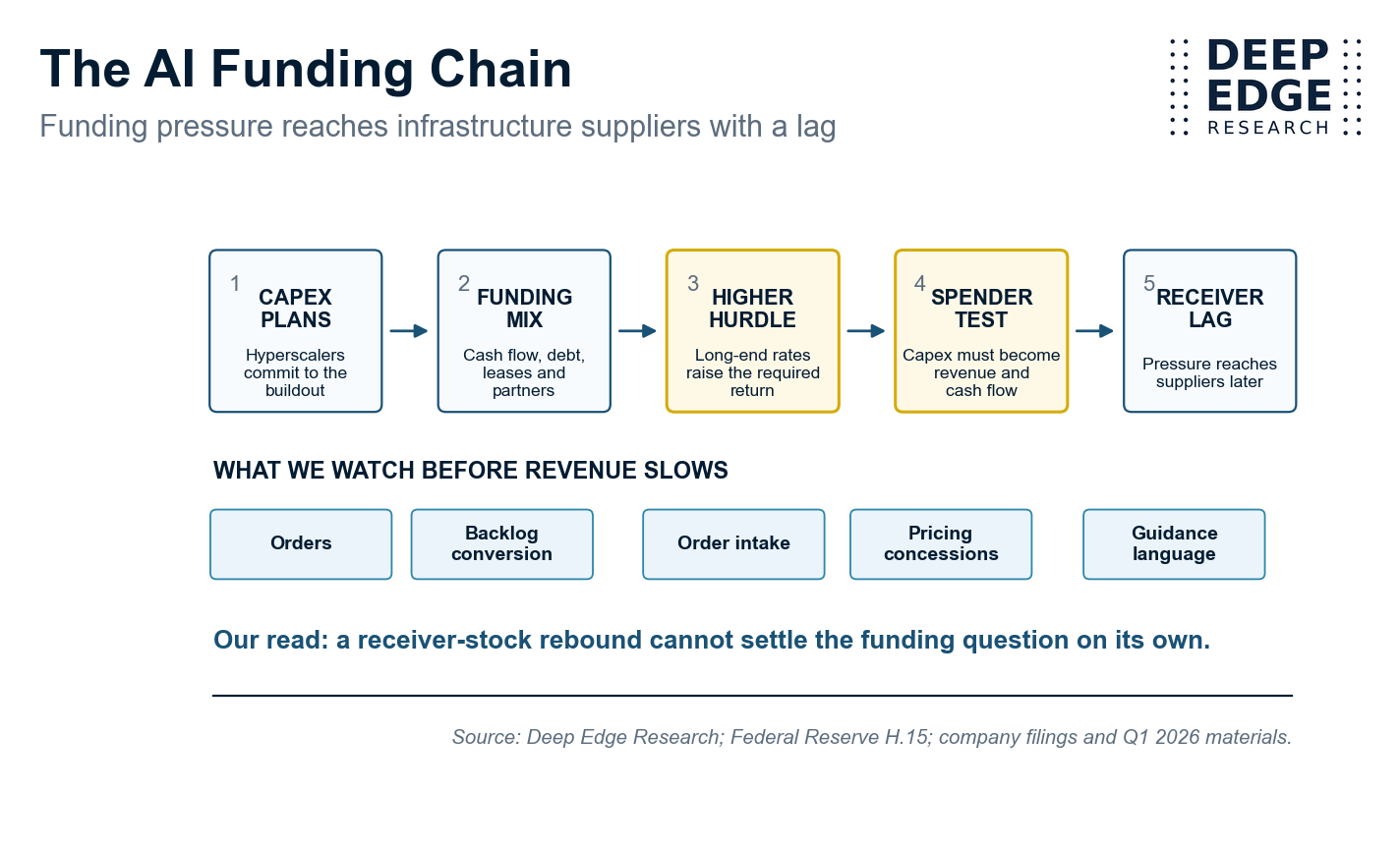
So what: we are staying with the strongest receivers while capex and company-level economics hold. But if the hyperscalers start cutting or delaying projects, and that shows up in weaker orders, slower backlog conversion or pricing concessions, we will reduce exposure rather than wait for reported revenue to confirm it.
3. How We Are Reading The Current Book
Our view: once we look at the book through the funding chain, the differences between the holdings become much clearer. Some already have pricing, contract or margin evidence. Others still depend on utilisation, financing or company-specific execution.
At the latest refresh, the book held 13 names, no shorts and c. 20.7% cash [13]. Our largest exposures remain in memory, storage and other AI infrastructure bottlenecks, which is also where W28 gave us the most reassuring answer.
Table 2: Current Book Audit Map
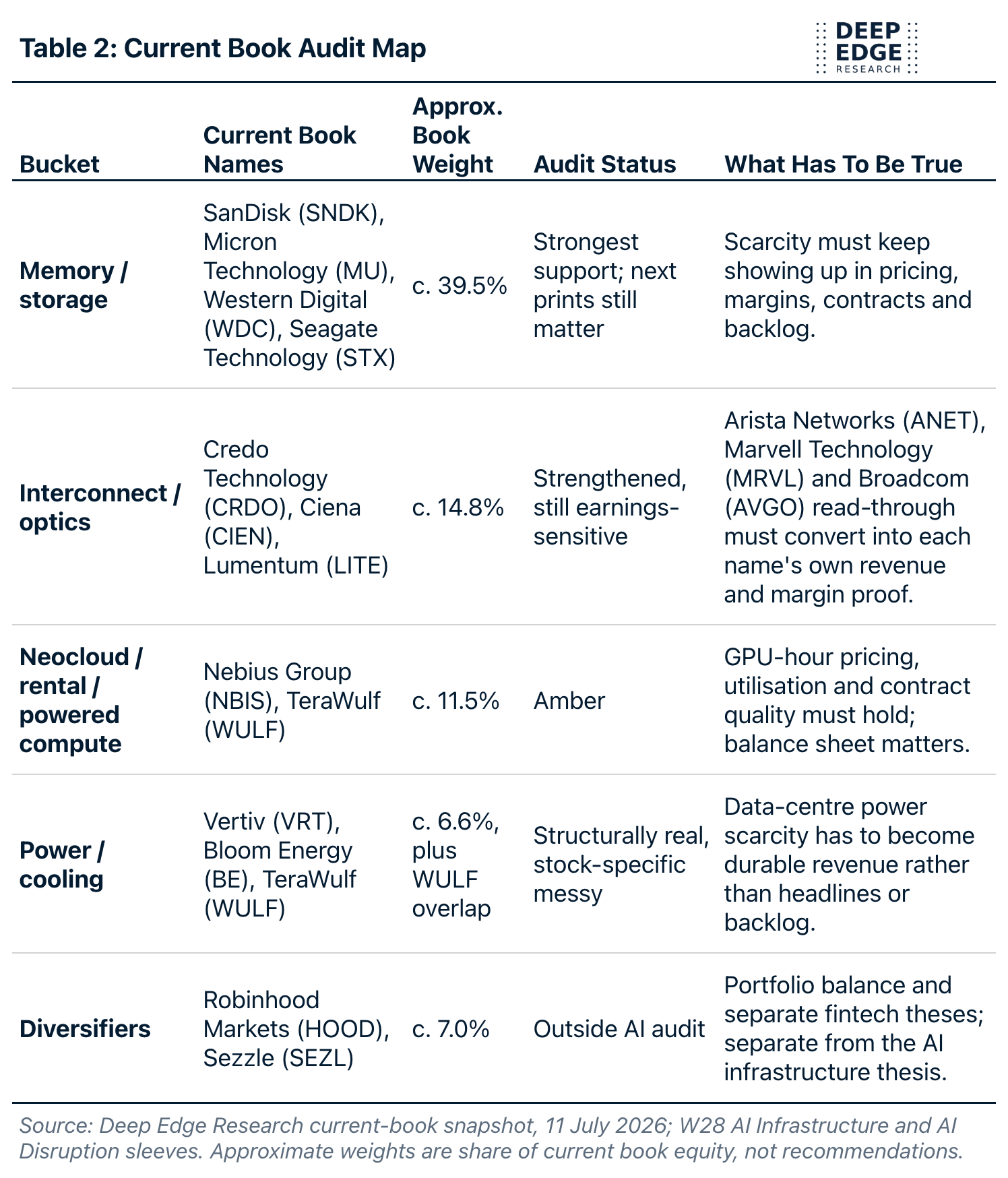
Here is how we are reading those buckets now:
Memory and storage have the cleanest evidence. W28 gave back a meaningful part of the W27 damage, but pricing, contracts and the 2027-28 supply imbalance remain the more important support. The rebound helped; it did not replace that evidence.
Interconnect comes next. ANET gives us a stronger read across the layer, although CRDO, CIEN and LITE still have to produce their own revenue and margin proof.
Neocloud and power remain conditional. NBIS and WULF should not be collapsed into CRWV, just as VRT should not be collapsed into BE. Even so, all four still need to show that capacity, power access or backlog can become durable revenue and cash flow.
HOOD and SEZL sit outside this audit. They are live positions in the public book, but they come from separate fintech theses rather than the AI funding chain.
So what: we are not treating the W28 bounce as permission to add across the board. Memory and storage have the strongest support and interconnect is improving, while neocloud and power still need more proof. That is why the c. 20.7% cash balance still has a job—and why the neocloud bucket deserves a closer look.
4. Why Neoclouds Stay Amber
Our view: neoclouds are where our two biggest questions collide. They need enough demand to keep expensive capacity utilised, and enough contract quality to justify the cost of owning or financing it.
Meta’s reported plan to sell excess AI compute capacity put that question straight back on the table. If one of the largest capex spenders is trying to sell spare compute, useful capacity may be less scarce than we assumed. The report also hit the neoclouds directly: Reuters, citing Bloomberg, reported that CRWV and NBIS fell on concerns that Meta could use less of their capacity and become a competitor [11].
The W27 concern now splits into two possible paths:
Bad version: capacity owners have overbuilt, utilisation weakens, GPU-hour pricing falls, and the weakest balance sheets get squeezed.
Manageable version: lower prices unlock more demand, frontier labs absorb capacity, and high-quality contracted power still gets monetised.
We will need the next earnings cycle to tell us which version is closer to reality.
For now, the evidence points in both directions. Nebius raised prices for several key GPU instances, while RunPod and Lambda advertise cheaper H100 alternatives in parts of the market [5][9][10]. WULF’s Anthropic lease also shows that high-quality powered capacity can still secure long-duration demand [6]. This is why we care as much about the balance sheet and the contract as we do about the GPU count. NBIS and WULF do not carry the same risk profile as debt-heavy CRWV.
Table 3: Neocloud Audit
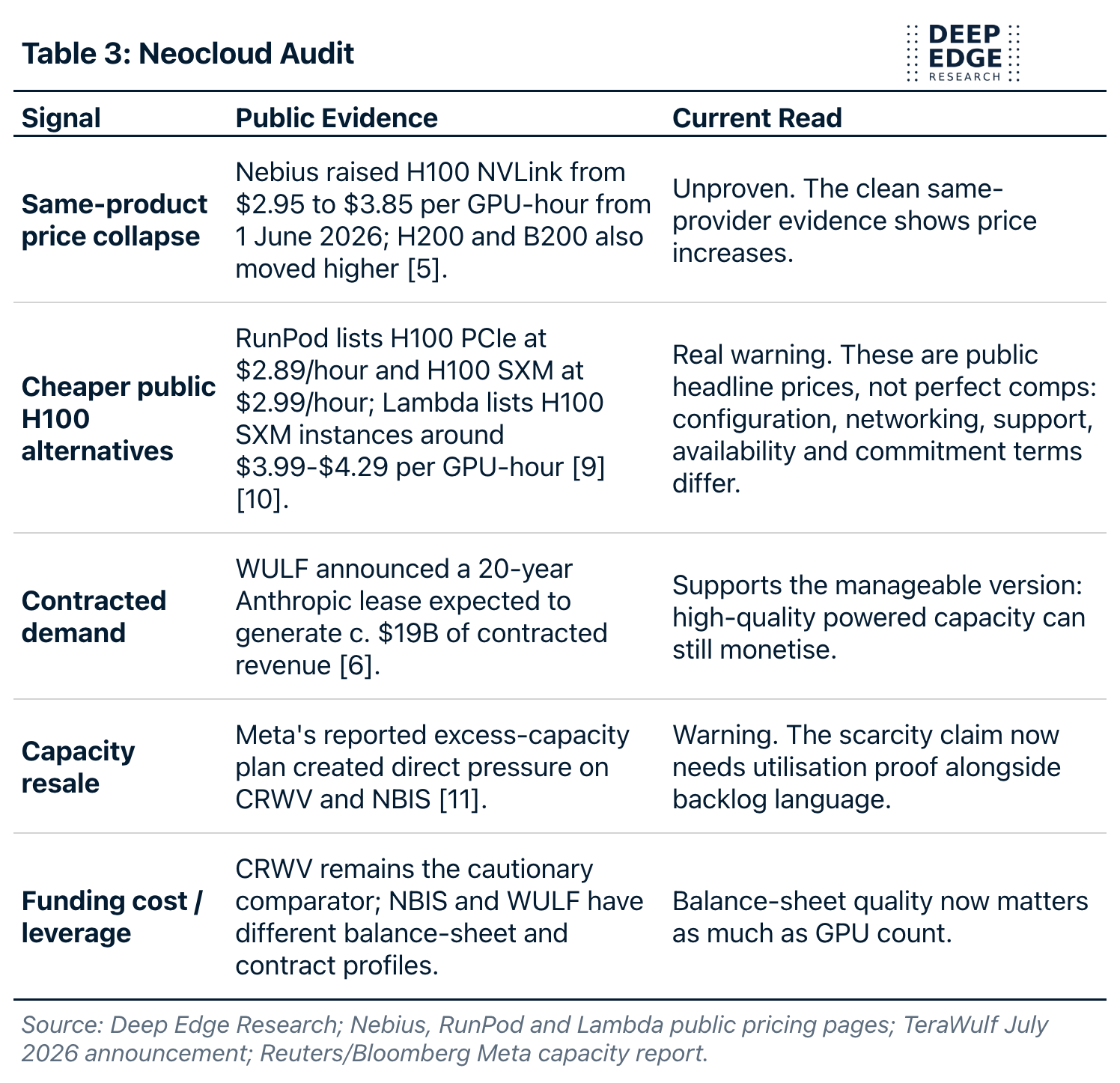
So what: neoclouds stay amber for now. We need pricing, utilisation and contract quality to show that NBIS and WULF really are different from CRWV. But even if the funding side holds, there is still a broader question about how much compute future AI demand will require.
5. Inference Efficiency Is The Demand-Side Check
Our view: there is another side to the funding debate. Even if the money remains available, what happens if inference suddenly requires much less compute?
The Information reported that OpenAI engineers found a way to more than halve inference costs for part of ChatGPT traffic. Public summaries describe the initial use case as logged-out ChatGPT traffic, and we have not seen evidence that the same reduction applies across paid API, enterprise or reasoning workloads [7][8].
There are two ways this can go. If software efficiency reduces compute per unit of output faster than usage expands, hardware demand flattens. But if lower inference costs unlock enough new usage, total compute demand can still rise. That is the Jevons effect, and we do not yet know which force dominates outside the narrow traffic described in the report.
So what: we are watching where the savings actually land. If paid, enterprise, API and reasoning workloads all begin using materially less infrastructure, the receiver thesis gets harder. If lower costs mostly unlock more usage, the bottleneck thesis can keep working. The upcoming catalyst window should start giving us evidence on both the funding and demand sides.
6. The Catalyst Window
Our view: we are not waiting for one print to settle this. CPI and PPI set the rate backdrop this week. The late-July hyperscaler and credit cluster then tests funding and capex conversion, before the early-August company results test the holdings themselves.
Table 4: Forward Watchboard
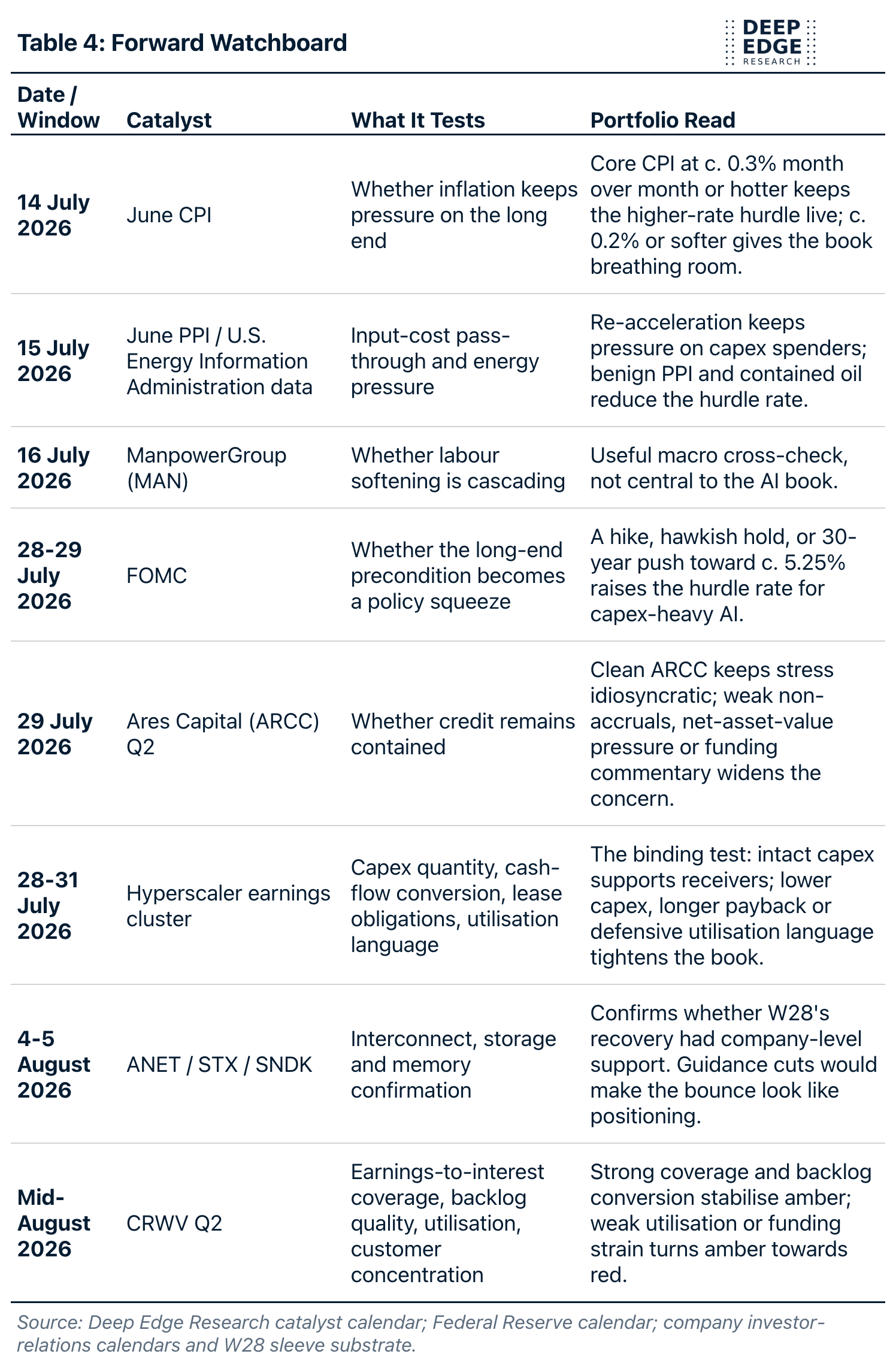
Across that window, we are looking for three things:
Stronger confirmation: hyperscalers keep capex intact, the long end calms and our holdings confirm pricing power. That would give us more confidence in staying with the bottleneck exposure.
A funding warning: hyperscalers cut capex, financing terms worsen or neocloud utilisation weakens. That would tell us the pressure is moving from the companies writing the cheques towards the companies receiving them.
A narrower AI trade: memory and interconnect keep working while neoclouds deteriorate. In that case, the broader thesis may remain intact, but the book still needs to narrow.
Kill switch: we narrow the book if hyperscalers cut or delay capex and that pressure reaches receiver orders, backlog conversion or pricing—or if neocloud utilisation weakens while financing terms worsen.
So what: we are staying selective. We keep the best bottleneck holdings, demand more proof from neocloud and power, and hold cash through the catalyst window rather than forcing every bounce into a buy signal.
Final Thought
After a week like W28, the easy mistake is to treat the recovery as an all-clear.
We are not there yet. Memory and storage found support without contradicting the existing operating thesis, while interconnect gained fresh operating evidence and credit stayed calm. The AI infrastructure case remains intact, but the evidence is still uneven.
What keeps us cautious is that the next warning may not show up first in our share prices or reported revenue. We are more likely to see it in orders, backlog conversion, pricing concessions, lease language or hyperscaler capex guidance. That is what the coming catalyst window is designed to test.
The buildout is real, but the funding test has only just started.
References
[1] Federal Reserve H.15, Selected Interest Rates, July 2026. https://www.federalreserve.gov/releases/h15/
[2] Amazon.com, Inc. Form 10-Q for quarter ended 31 March 2026, cash capex and financing activity. https://www.sec.gov/Archives/edgar/data/1018724/000101872426000014/amzn-20260331.htm
[3] Meta Platforms, Inc., Q1 2026 results, capital expenditure outlook. https://investor.atmeta.com/investor-news/press-release-details/2026/Meta-Reports-First-Quarter-2026-Results/default.aspx
[4] Meta Platforms, Inc. Form 10-Q for quarter ended 31 March 2026, lease obligations and commitments. https://www.sec.gov/Archives/edgar/data/1326801/000162828026028526/meta-20260331.htm
[5] Nebius AI Cloud, compute pricing in Nebius AI Cloud, GPU prices from 1 June 2026. https://docs.nebius.com/compute/resources/pricing
[6] TeraWulf, “TeraWulf Announces Anthropic Lease at Justified Data Campus and Sale of Majority Interest in Abernathy Joint Venture to Fluidstack,” 6 July 2026. https://investors.terawulf.com/news-events/press-releases/detail/142/terawulf-announces-anthropic-lease-at-justified-data-campus-and-sale-of-majority-interest-in-abernathy-joint-venture-to-fluidstack
[7] The Information, “OpenAI Discovers New Way to Cut Inference Costs in Half,” AI Agenda, 30 June 2026. https://www.theinformation.com/newsletters/ai-agenda/openai-discovers-new-way-cut-inference-costs-half
[8] AI Weekly, “OpenAI engineers say they’ve more than halved inference costs,” 30 June 2026, summarising The Information reporting. https://aiweekly.co/alerts/openai-engineers-say-theyve-more-than-halved-inference-costs
[9] RunPod, GPU cloud pricing. https://www.runpod.io/pricing
[10] Lambda, GPU cloud pricing. https://lambda.ai/service/gpu-cloud/pricing
[11] Reuters / Bloomberg via SRN News, “Meta building cloud business to sell excess AI capacity,” 1 July 2026. https://srnnews.com/meta-to-sell-excess-ai-computing-capacity-via-cloud-business-bloomberg-news-reports/
[12] Alphabet Investor Relations, Q1 2026 earnings call / release materials. https://abc.xyz/investor/events/event-details/2026/2026-Q1-Earnings-Call-2026-nW8kCrBAKS/default.aspx
[13] Deep Edge Research analysis from W27 thesis audit, W28 weekly memo, W28 AI Infrastructure and AI Disruption sleeves, and current-book snapshot captured 11 July 2026.