
Last week, W26 (22-26 June 2026), gave investors the first proper break in the AI surface since the W25 melt-up. The headline number was ugly: the AI and semiconductor complex de-rated by roughly $1.3-1.4 trillion. Nvidia (NVDA) fell c. 8.6% on the week. Amazon (AMZN), Microsoft (MSFT), and Meta Platforms (META), the companies funding a large share of the AI buildout, all closed below their 200-day moving averages. Compute, power, storage, and AI infrastructure names were hit much harder than the index [1][2][3].
At index level, that can look like a broad market break. We argue that the breadth rejected that.
The SPDR S&P 500 ETF Trust (SPY) fell c. 2.4% but held above its 200-day. The iShares Russell 2000 ETF (IWM) rose c. 1.4%. The SPDR Dow Jones Industrial Average ETF (DIA) rose c. 0.4%. Money did not simply flee equities. It came out of the most crowded AI leadership trade and moved into areas the market had ignored.
Our read is that last week was not simple de-risking. It was three different trades underneath the same AI selloff.
De-grossing: crowded longs get cut, shorts and laggards bounce, and exposure comes down. That clearly happened in AI.
De-rating: the market lowers the multiple because the business model is starting to look more capital-intensive. That is the hyperscaler story.
Debt-stress warning: financing risk becomes equity risk. That is the CoreWeave version of the same AI funding question.
The second point is the most important one for the next month. The old hyperscaler investment case was built on free-cash-flow expansion: asset-light platforms, huge margins, fortress balance sheets, and capital-light compounding.
The AI buildout changes that.
If growth now requires hundreds of billions of dollars of capex, and if that capex starts eating free cash flow or pushing companies toward more debt and equity financing, the old multiple has to be re-tested.
That is why July matters.
Conclusion: The late-July hyperscaler earnings cluster is not just another earnings season. It is the next test of whether the AI buildout is still cash-funded, whether capex is converting into revenue, and whether the market should keep valuing the funders like software compounders rather than infrastructure builders. We go deeper on that six-month framework in the H1 Outlook refresh on Wednesday; this weekly brief is the tactical read on what the tape did last week.
TLDR
The week was not broad de-risking. Volatility rose and credit spreads widened, but small caps and the Dow rose. That is not what a clean market panic usually looks like.
The crowded AI trade de-grossed. The biggest damage was in the most owned, most extended AI leadership: Nvidia, semiconductors, hyperscaler funders, compute, power, and storage.
The hyperscalers were de-rated. The market started charging the funders for the capex burden. The issue is not whether AI demand exists. The issue is whether capex keeps outrunning free-cash-flow conversion.
CoreWeave is the debt-stress warning. If hyperscalers are the clean balance-sheet version of the AI funding question, CoreWeave (CRWV) is the high-leverage version.
Positioning: We are staying selective and not treating this as a blanket equity sell signal while breadth holds. Be more careful with capex funders, avoid levered AI financing risk, and keep exposure where revenue, margins, contracts, or cash flow prove that the buildout is becoming owner economics.
Fact of the week: roughly $1.3-1.4 trillion came out of the AI and semiconductor complex while small caps and the Dow rose.
That is a Deep Edge Research estimate across Nvidia, hyperscalers, semiconductors, compute, power, storage, and AI infrastructure names, cross-checked against the public index tape. The point is not false precision. It is the shape of the damage. If investors were abandoning risk broadly, small caps should not have caught a bid.
Instead, the damage concentrated in the crowded AI leadership and the hyperscaler funders. Nvidia fell c. 8.6%; AMZN, MSFT, and META all closed below their 200-day moving averages. Inside the AI infrastructure sleeve, the damage showed up in named pressure points rather than a neat index move: Bloom Energy (BE) fell c. 18.5%, IREN (IREN) was down c. 30% over one month and below its main moving averages, and CRWV sat c. 44% below its high. At the same time, IWM and DIA finished higher [1][2][3].
The conclusion is not that AI broke. It is that the market started separating three different problems: crowded positioning, capex-heavy business-model pressure, and balance-sheet risk.
What changed from W25
W25 argued that AI infrastructure had rallied through a hawkish Fed because the long end stayed calm and oil relief gave investors a disinflation story to underwrite. The instruction was selective participation, not a victory lap. We wanted evidence that the rally had earnings cover, that PCE would not re-open the inflation problem, and that credit would stay calm.
W26 answered that setup in a very specific way. Micron Technology (MU) gave the rally fundamental cover. Core PCE did not give the Fed clean relief. Credit widened, but from benign levels. And the AI trade sold off anyway.
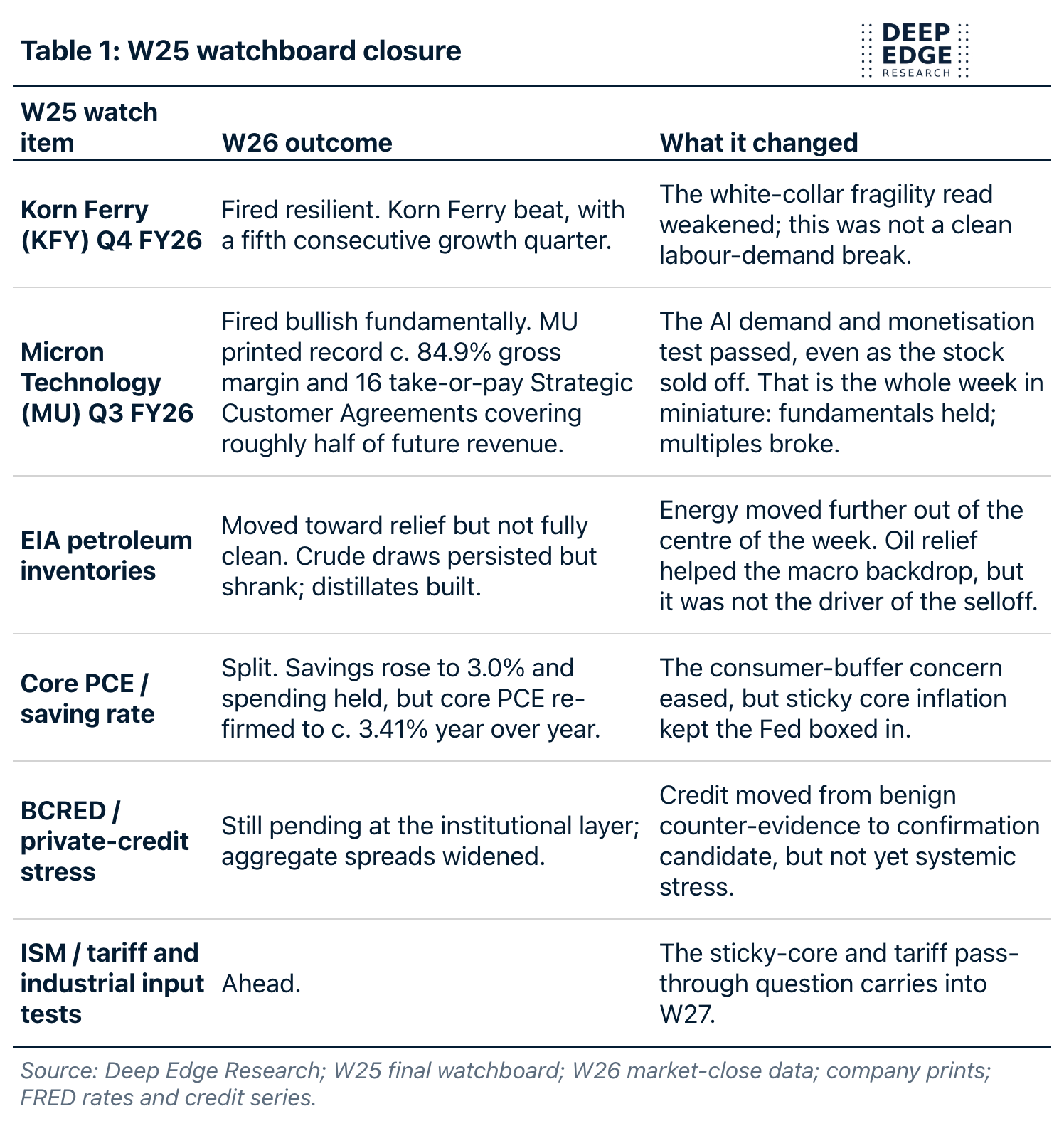
Table 1: W25 watchboard closure
Our view: W26 did not refute W25. It clarified it. Last week we said the AI rally needed earnings cover. It got that cover from MU. The problem is that the market stopped paying the same multiple for the funders and crowded leaders anyway.
Why: when a stock falls after the fundamental test passes, the issue has usually moved from “is demand real?” to “what multiple should we pay for that demand?” That is what happened in AI last week.
So what: the weekly frame has moved. W25 was about whether AI infrastructure could rally through a hawkish Fed. W26 is about whether the AI funding model deserves the old multiple.
1. The climate board looked risk-off, but not panic-off
Our view: the cross-asset board showed stress, not capitulation. That distinction matters because it tells us whether to sell risk broadly or diagnose where the pressure actually landed.
At the surface, the week looked risk-off. Volatility rose. Credit spreads widened. The dollar rose. Gold fell hard. The Treasury curve rallied, with the 2-year down c. 12bp, the 10-year down c. 8bp, and the 30-year down c. 3bp.
That is not a clean fear pattern. A classic de-risking tape usually gives you broad equity weakness, a bigger volatility shock, a stronger haven bid, and pressure across small caps.
W26 gave us something messier. Gold fell rather than catching a safe-haven bid. Small caps rose. The Dow rose. The S&P held its 200-day.
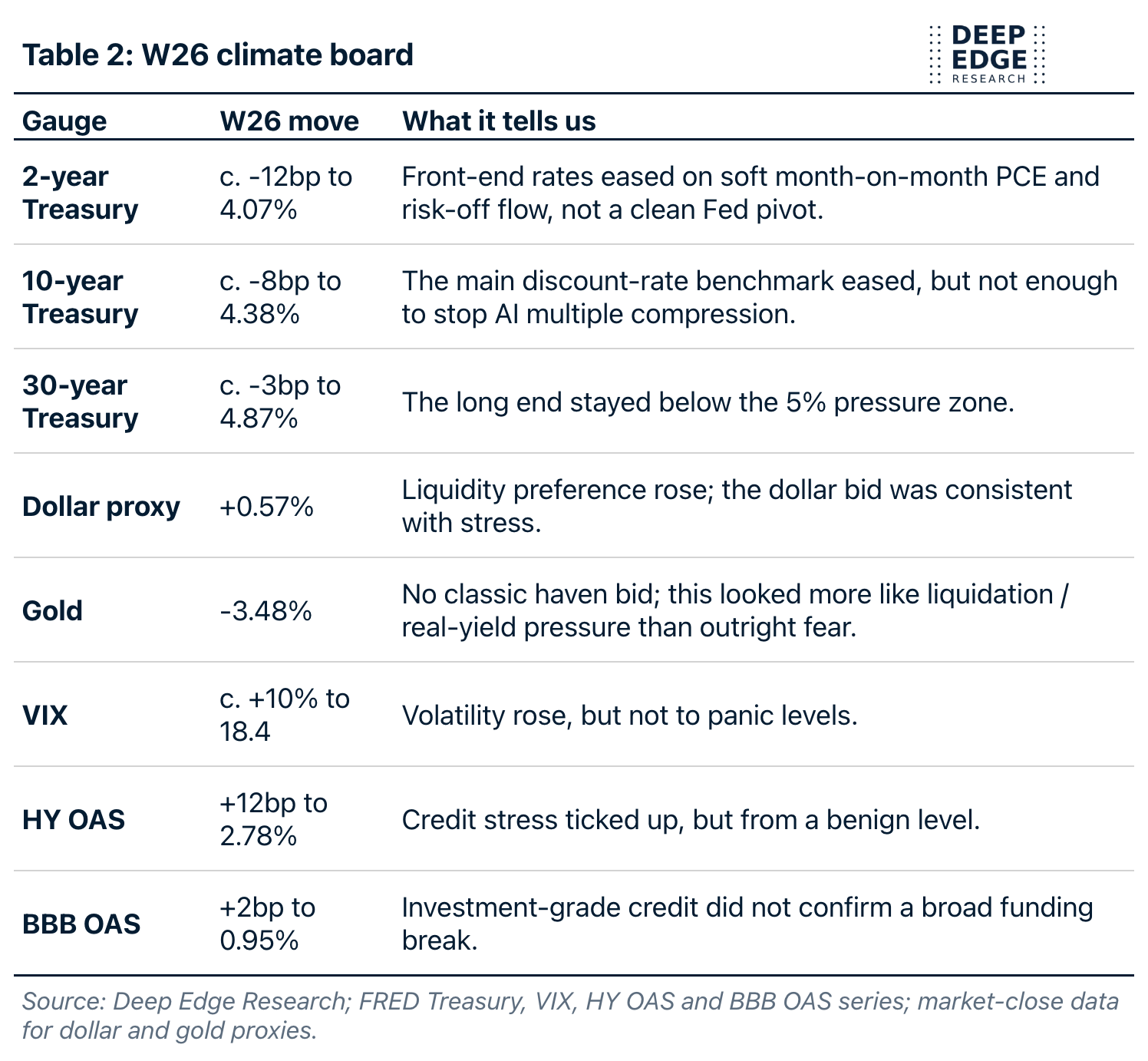
Table 2: W26 climate board
Why: de-risking and de-grossing can both make volatility rise. The difference is where the selling lands and where the money goes. If the entire market is being de-risked, small caps usually do not lead higher. If the most crowded trade is being unwound, laggards can rally because capital is being rebalanced rather than withdrawn.
That is why the climate board needs the rotation board. The gauges show stress. The rotation tells us what kind.
So what: the climate board does not justify a blanket equity sell signal. It says stress rose, but the stress was concentrated enough that we should sort the market rather than abandon it.
2. The rotation board says de-grossing, not broad de-risking
Our view: the rotation board is the reason we are not calling W26 a market break. The market sold the narrow AI surface and bought some of the ignored interior.
The key evidence is simple:
SPY fell c. 2.4% but held its 200-day.
Invesco QQQ Trust (QQQ) fell much harder, down c. 4.6%.
NVDA fell c. 8.6%.
IWM rose c. 1.4%.
DIA rose c. 0.4%.
That is not a market fleeing risk evenly. It is a market cutting the dominant long.
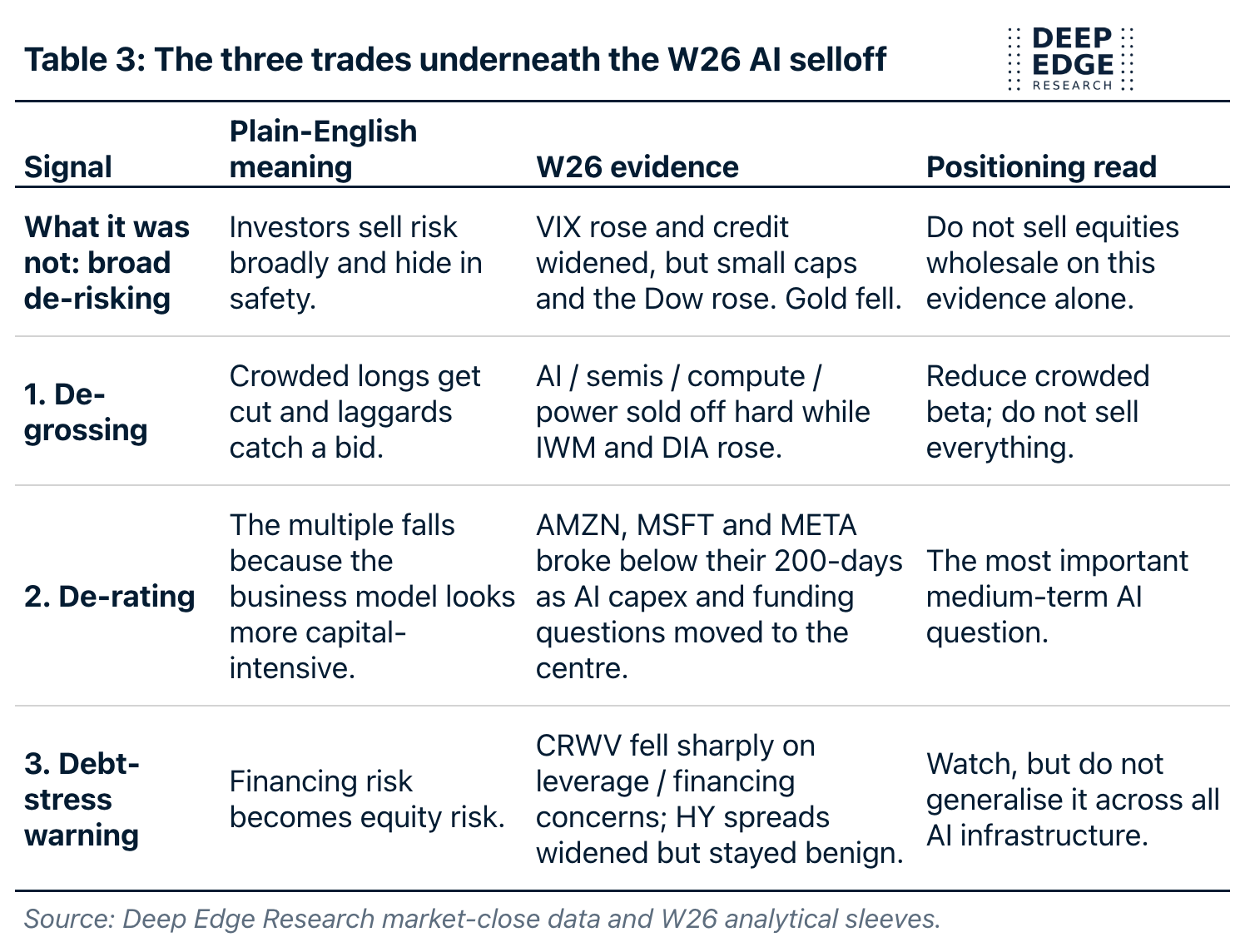
Table 3: The three trades underneath the W26 AI selloff
This table is the bridge from the tape to the article. A reader who only sees “AI sold off” misses the mechanism. De-grossing is about positioning. De-rating is about the multiple. Debt stress is about the balance sheet. They can happen in the same week, but they do not mean the same thing.
What consensus is missing is the separation. The easy headline is that AI sold off. Our read is more specific: the crowded AI winners de-grossed, the capex funders de-rated, and the most levered AI infrastructure names started to trade like funding risk matters.
So what: this is a tightening week, not a panic week. We should be reducing exposure to crowded AI beta and balance-sheet fragility, while keeping focus on the names where the buildout is still converting into margins, contracts, and cash flow.
3. De-grossing: the crowded AI trade got cut
Our view: the first trade was de-grossing. The market cut exposure to the most crowded AI leadership after a powerful run.
This is the cleanest explanation for why the selloff was so concentrated. W25’s rally had become narrow. Memory, storage, semiconductors, compute, and power were carrying more of the tape. When that leadership cracked, the index-level damage looked dramatic because the winners were large, crowded, and heavily owned.
But the fundamental evidence did not crack in the same way.
MU printed record gross margin of c. 84.9% and disclosed 16 take-or-pay Strategic Customer Agreements covering roughly half of future revenue. That is not a demand collapse. It is the opposite. The market got the evidence W25 asked for, then sold the stock anyway. That tells us the selloff was not mainly about whether AI demand exists.
It was about how much good news was already owned.
The same idea applies to NVDA and the semiconductor complex. After a long run, the burden of proof shifts. Strong companies can fall if the position is crowded and the multiple has no room for disappointment. That is de-grossing.
Why: when the dominant long trade becomes too large, the exit door narrows. Investors do not need a thesis break to reduce gross exposure. They only need less room for error, tighter funding conditions, or a reason to rebalance away from the trade that has done all the work.
The useful distinction is that de-grossing can reverse. If fundamentals keep beating, the same names can stabilise. A fundamental break is different. That requires capex cuts, margin deterioration, cancelled orders, financing stress that spreads, or demand that no longer shows up in revenue.
W26 did not give us that yet.
So what: do not read the AI drawdown as a full thesis break. Read it first as a positioning unwind. The risk rises if July confirms that the funders are cutting capex or that financing stress is spreading beyond the levered names.
4. De-rating: hyperscalers are being repriced as capex funders
Our view: the hyperscaler selloff was not just AI beta. It was the market testing whether the old hyperscaler multiple still fits a more capital-intensive business model.
The old hyperscaler thesis was simple: asset-light platforms, expanding free cash flow, fortress balance sheets, and capex as an optional growth tool. AI makes that harder. Data centres, chips, memory, networking, storage, power, cooling, and energy supply all have to be paid for before the revenue payoff is fully visible.
AMZN, MSFT, and META all closing below their 200-day moving averages matters because these are not fringe AI names. They are the funders. If their stocks break trend, the market is not only punishing speculative AI. It is asking whether the companies underwriting the buildout deserve the same multiple they carried when free cash flow was the cleaner story.
The table below is the weekly version of the mechanic. It does not need to be the full H1 framework. It only needs to show why the same company can have real AI demand and still deserve a lower multiple if the funding burden changes.
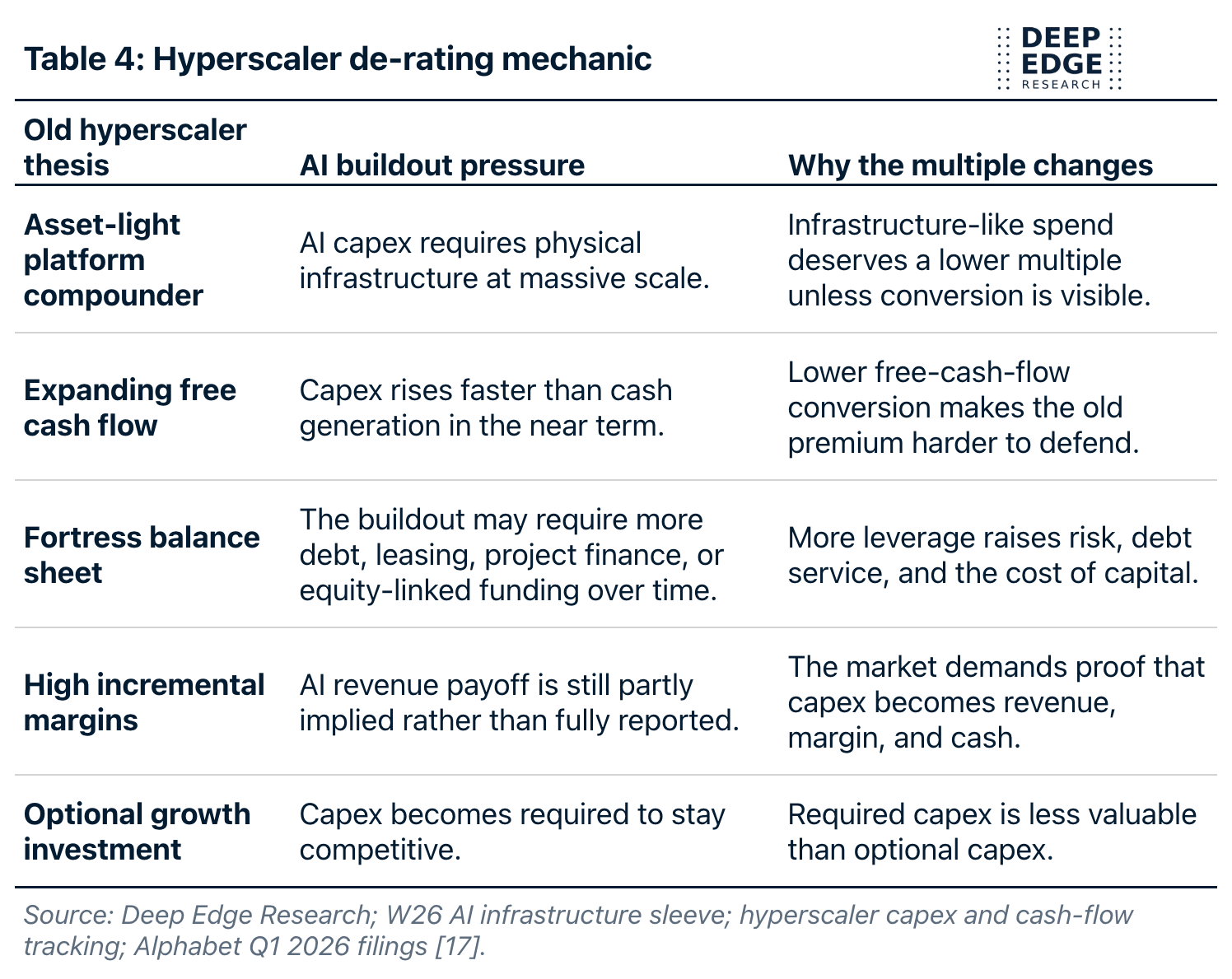
Table 4: Hyperscaler de-rating mechanic
Alphabet is the cleanest example of the mechanism we will expand in the H1 Outlook refresh: Q1 free cash flow fell to $10.1 billion while the company raised FY26 capex guidance to $180-190 billion [17]. That does not make Alphabet a weak company. It means the market has to decide whether a capital-light multiple still fits a more capital-intensive earnings path.
For the weekly, the tactical point is narrower. If capex keeps rising and AI revenue conversion remains vague, the de-rating can continue. If the July earnings cluster shows that capex is becoming cloud revenue, margin, product monetisation, and durable cash flow, the market can stabilise the funders.
So what: the AI debate has moved from “is the buildout real?” to “who pays for it, and what multiple do they deserve while paying for it?” That is a more serious question than a one-week selloff.
5. Debt-stress warning: CoreWeave is the label
Our view: CoreWeave is not the whole AI trade, but it is the clearest public warning label for the financing layer.
If the hyperscalers are the clean-balance-sheet version of the AI funding question, CRWV is the high-leverage version. Demand can be real and the equity can still suffer if the balance sheet has too little room for error.
That distinction matters because it links AI infrastructure to private credit. The AI buildout needs capital. Some of that capital is coming from companies with huge cash flows. Some is coming through debt, leases, project finance, equipment financing, and structures that make the residual value of GPUs and other AI infrastructure more important.
The W26 evidence makes the warning more concrete. CRWV closed at $96.58, down c. 44% from its high and below its main moving averages. The public balance sheet explains why the equity is so sensitive to financing: current and non-current debt totalled c. $24.9 billion at Q1, and the company priced another $1.25 billion plus EUR2 billion of senior notes in June [18][19]. That is not a verdict on the whole AI buildout. It is the financing-stress version of the trade.
Last week, credit spreads widened. HY OAS moved c. 12bp wider to 2.78%, and BBB OAS widened c. 2bp to 0.95%. Those are not distressed levels. But the direction changed. It was the first aggregate credit move toward the private-credit broadening thesis in weeks.
The discipline is not to over-read it. A 2.78% HY OAS is still benign. The BDC interior stabilised in places. Trinity Capital (TRIN), a cleaner comparison name for software-linked credit, strengthened back above its main moving averages. That means we do not have a systemic credit call yet.
CRWV is still important because it shows the path.
Why: when a company has real AI demand but relies heavily on financing, the equity becomes a bet on both utilisation and capital-market access. If the market begins to question residual values, debt service, refinancing, or project economics, the stock can de-rate even while end-demand remains strong.
That is the private-credit version of the hyperscaler problem. The hyperscalers have more balance-sheet room. CRWV has less. The mechanism is the same: capex has to become cash flow before the funding burden becomes the story.
So what: keep CRWV-style financing stress separate from the whole AI infrastructure trade. It is a warning signal, not a universal verdict. The signal gets louder if credit spreads keep widening, if AI financing names cannot refinance cleanly, or if hyperscalers start cutting capex.
6. The sleeves we are not making the story
Our view: energy, labour, tariffs, and private credit matter most this week as guardrails, not as a new table of contents. They tell us what the selloff was not.
The guardrails are useful because they stop us from overclaiming:
Energy moved toward relief. Crude fell below $70, the war premium unwound, and Hormuz / supply normalisation kept moving in the right direction. W26 was not an oil-shock selloff.
Labour and consumer data did not confirm recession stress. The personal saving rate rose to 3.0%, spending held, and the consumer budget looked better than it did in W22.
Tariff and sticky-core pressure still matter because core PCE re-firmed to c. 3.41% year over year. That keeps the Fed boxed in, but tariff pass-through was not the reason AI sold off.
Private credit matters where it touches AI financing. Aggregate spreads widened, but not enough to call systemic stress.
So what: the non-AI sleeves stop us from overclaiming. They tell us the economy did not break, oil was not the problem, the consumer did not collapse, and credit is not yet systemic. That leaves the AI funding model as the cleanest explanation for the week’s damage.
7. Positioning after last week
Our view: tighten AI exposure, do not abandon the asset class. The practical call is to stop treating every AI name as the same trade.
This is not a week to sell equities wholesale. It is also not a week to pretend every AI drawdown is a buying opportunity. The distinction matters.
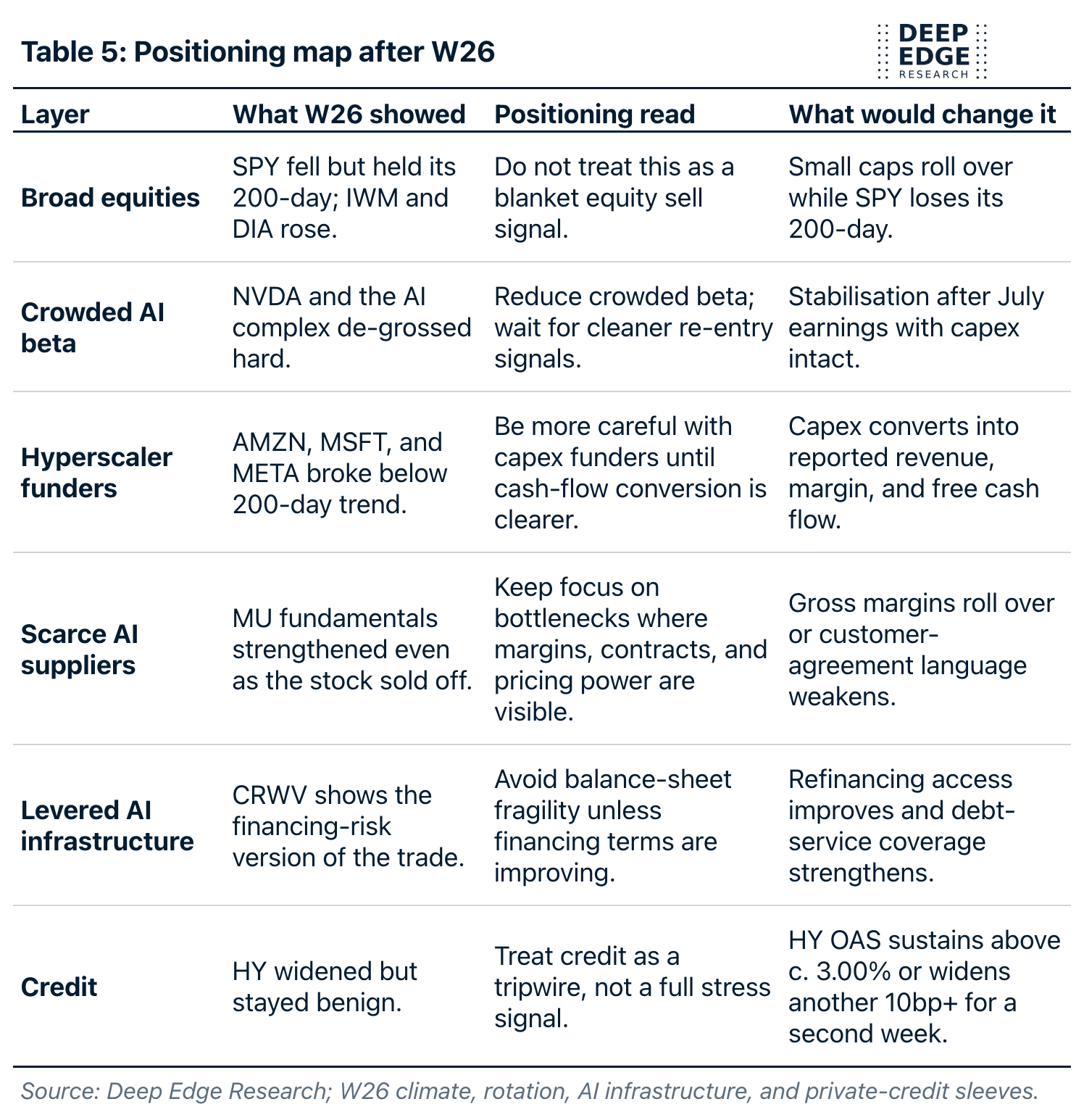
Table 5: Positioning map after W26
Why: W26 did not say “AI is over.” It said the market is no longer willing to pay the same multiple for every form of AI exposure. The right response is to sort the exposure by mechanism.
The highest-quality long exposure is still where AI spend becomes visible economics: margins, contracts, backlog, cash conversion, or pricing power. The riskiest exposure is where the same spend becomes a funding burden before the payoff is visible.
Our weekly desk call is deliberately narrow: existing holders can stay with scarce suppliers where the economics have already shown up, especially where margins and contracts are doing the work. Fresh money should be more patient. MU confirmed the demand story, but the stock still sold off; that tells us the July hyperscaler cluster now matters more than chasing the first dip.
So what: keep the book involved, but move up in quality. Own the bottlenecks where the economics are visible. Be more cautious with funders until July proves conversion. Avoid levered AI names where financing stress can overwhelm demand.
8. What we are watching this week
This week is a bridge to July. The biggest tests arrive later in the month, but the next few days still matter because they tell us whether W26 was a contained unwind or the start of a broader funding problem.
The immediate watch is breadth. If small caps keep holding while AI stabilises, the de-grossing read strengthens. If small caps roll over and credit keeps widening, the move starts looking more like broad de-risking.
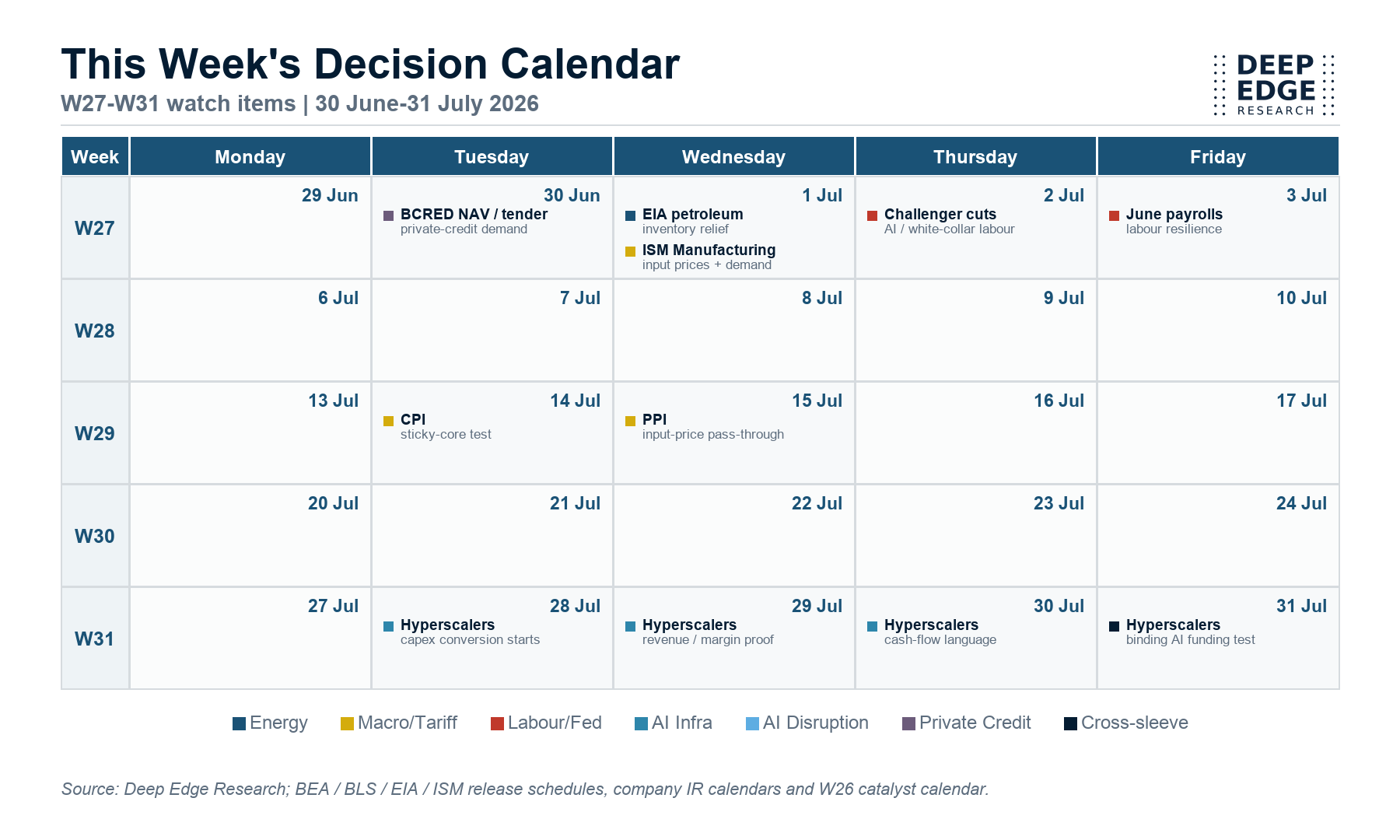
So what: July decides whether W26 was a crowded-trade unwind or the start of a proper AI funding-model reset. Until then, breadth, credit, and hyperscaler cash-flow language are the tells.
What would change the positioning
Kill switch: the de-grossing read fails if small caps roll over, SPY loses its 200-day, HY OAS keeps widening, and the late-July hyperscaler cluster cuts capex or fails to show cash-flow conversion.
The de-grossing read holds if:
small caps and the Dow remain firm;
SPY holds above its 200-day;
credit widening stays contained;
MU’s record-margin signal is not contradicted by other AI infrastructure prints;
hyperscalers keep capex intact and show clearer conversion.
The move becomes broad de-risking if:
IWM rolls over with QQQ;
SPY loses its 200-day;
VIX moves from elevated to stressed;
gold catches a real haven bid;
HY OAS widens toward or above c. 3.00%.
The move becomes a deeper AI de-rating if:
AMZN, MSFT, Meta Platforms, or Alphabet (GOOG) raise capex while free-cash-flow conversion weakens again;
AI revenue disclosures remain vague;
debt or equity financing becomes more visible;
CRWV-style funding stress spreads to other AI infrastructure names;
the July 28-31 earnings cluster cuts capex guidance.
Final thought
The cheapest mistake after W26 is to treat every selloff as the same selloff.
De-risking is what last week was not. The broad market did not break, small caps rose, and credit widened from benign levels rather than flashing system stress.
What W26 did give us was three different trades in different places: crowded AI de-grossing, hyperscaler de-rating, and CoreWeave showing what happens when the same AI buildout meets a tighter balance sheet.
That is why July matters so much. If the hyperscalers can show that capex is becoming revenue, margin, and free cash flow, W26 looks like a violent reset in a still-working buildout. If they cannot, last week was the market’s first serious warning that the AI funding model deserves a lower multiple.
Deep Edge Research (2026)
For informational purposes only. Not investment advice. Past performance is not indicative of future results.
References
[1] AP News, “Wall Street drifts lower as oil prices tumble and Nvidia weighs on the market,” 27 June 2026: https://apnews.com/article/23adc65bcbdcc464633316e712612548
[2] Investor’s Business Daily, “Amazon Stock Falls Below 200-Day Line As Cloud Growth, Hyperscale Memory Concerns Weigh,” 26 June 2026: https://www.investors.com/news/technology/amazon-stock-falls-200-day-cloud-hyperscale-memory-concerns/
[3] Deep Edge Research market-close dataset and W26 analytical sleeve synthesis, 22-26 June 2026.
[4] Federal Reserve / FRED, 2-Year Treasury Constant Maturity Rate (DGS2): https://fred.stlouisfed.org/series/DGS2
[5] Federal Reserve / FRED, 10-Year Treasury Constant Maturity Rate (DGS10): https://fred.stlouisfed.org/series/DGS10
[6] Federal Reserve / FRED, 30-Year Treasury Constant Maturity Rate (DGS30): https://fred.stlouisfed.org/series/DGS30
[7] ICE BofA US High Yield Option-Adjusted Spread via FRED (BAMLH0A0HYM2): https://fred.stlouisfed.org/series/BAMLH0A0HYM2
[8] ICE BofA BBB US Corporate Option-Adjusted Spread via FRED (BAMLC0A4CBBB): https://fred.stlouisfed.org/series/BAMLC0A4CBBB
[9] CBOE Volatility Index (VIX) via FRED (VIXCLS): https://fred.stlouisfed.org/series/VIXCLS
[10] Micron Technology fiscal Q3 2026 results and SEC Form 8-K, 24 June 2026.
[11] Deep Edge Research AI Infrastructure sleeve, W26 2026.
[12] Deep Edge Research Private Credit sleeve, W26 2026.
[13] Deep Edge Research Labour / Macro Fragility sleeve, W26 2026.
[14] Deep Edge Research Energy / Geopolitics sleeve, W26 2026.
[15] Deep Edge Research external market-conversation summary, W26 2026.
[16] Company investor-relations calendars and public release schedules for W27 / July catalysts.
[17] Alphabet Inc., Q1 2026 results, SEC Exhibit 99.1, 29 April 2026: https://www.sec.gov/Archives/edgar/data/1652044/000165204426000043/googexhibit991q12026.htm
[18] CoreWeave, “CoreWeave Reports Strong First Quarter 2026 Results,” 7 May 2026: https://investors.coreweave.com/news/news-details/2026/CoreWeave-Reports-Strong-First-Quarter-2026-Results/
[19] CoreWeave, “CoreWeave Announces Pricing of $1.25 Billion of Senior Notes and EUR2 Billion of Senior Notes,” 11 June 2026: https://investors.coreweave.com/news/news-details/2026/CoreWeave-Announces-Pricing-of-1-25-Billion-of-Senior-Notes-and-2-Billion-of-Senior-Notes/default.aspx