
Last week, W25 (15-21 June 2026), should have been a difficult week for long-duration equities. The Federal Reserve held rates at 3.50-3.75%, but the dot plot hardened, the 2026 median rate moved up, and the easing bias was stripped out of the statement [1].
In plain English: the Fed did not cut, did not sound eager to cut, and did not give investors the easy-money confirmation they wanted.
That normally matters for AI and other growth stocks because a large part of their value sits in future cash flows. When investors believe rates will stay higher for longer, those future earnings are worth less today. That is why the W23 selloff hit AI, semiconductors, software, and long-duration growth so hard.
Last week did something more interesting. The shorter-maturity bond market listened to the Fed: the 2-year Treasury rose 14bp. The long end did not follow: the 10-year barely moved and the 30-year fell 5bp [2][3][4]. That curve split gave AI infrastructure room to rally through a hawkish Fed.
The reason is oil. The US-Iran interim framework was signed, Hormuz began reopening, and WTI moved down toward the mid-$70s [5][6][7]. The Fed cannot declare victory on inflation just because spot crude falls for a week. The bond market can move faster. It can start pricing the possibility that lower oil will pull future inflation lower before that relief shows up in official data.
That is the setup for the week. The Fed sounded stern. The long end called part of that bluff. AI infrastructure used the opening. But the rally was narrow, and that is where the useful work begins.
TLDR
The core call: W25 was a narrow AI-infrastructure rally through a hawkish Fed, made possible by a calm long end. The Fed tightened the message; the 30-year yield did not tighten with it.
Why that matters: high-growth equities usually struggle when rate-cut hopes fade. Last week, investors bought the parts of AI tied to physical bottlenecks: memory, storage, semiconductors, compute, and power.
What did not work: workflow software, consulting, parts of mega-cap tech, energy beta, and publicly listed private-credit names did not confirm a broad risk-on move.
The oil link: lower oil and the Hormuz reopening gave bonds a reason to look through the Fed’s near-term hawkishness. That helps explain why the long end stayed contained.
Positioning: stay involved in AI infrastructure, but do not chase every AI label. Keep cash available into Micron, PCE, EIA, and the next credit tests. This is a week for selective participation, not a victory lap.
Fact of the week: Over the five trading sessions into the W25 close, Western Digital (WDC) rose c. 41%, Seagate Technology (STX) rose c. 23%, SanDisk (SNDK) rose c. 16%, and Micron Technology (MU) rose c. 14% [8].
That happened in the same week the Fed pushed back against easy-money hopes. This is the cleanest evidence that investors were not simply buying “growth.” They were buying a specific part of the AI stack: memory and storage bottlenecks where demand is visible, supply is scarce, and pricing power can still be underwritten [9].
If the rally had been broad duration relief, software and mega-cap tech should have joined more cleanly. They did not.
What changed from W24
Last week closed two of the big questions from W24 and carried two others forward.
W24 argued that the relief rally was running ahead of reality. Oil had fallen, the 10-year had eased, and AI bottlenecks had recovered, but Hormuz had not physically reopened and the FOMC was still ahead. W25 changed that balance.
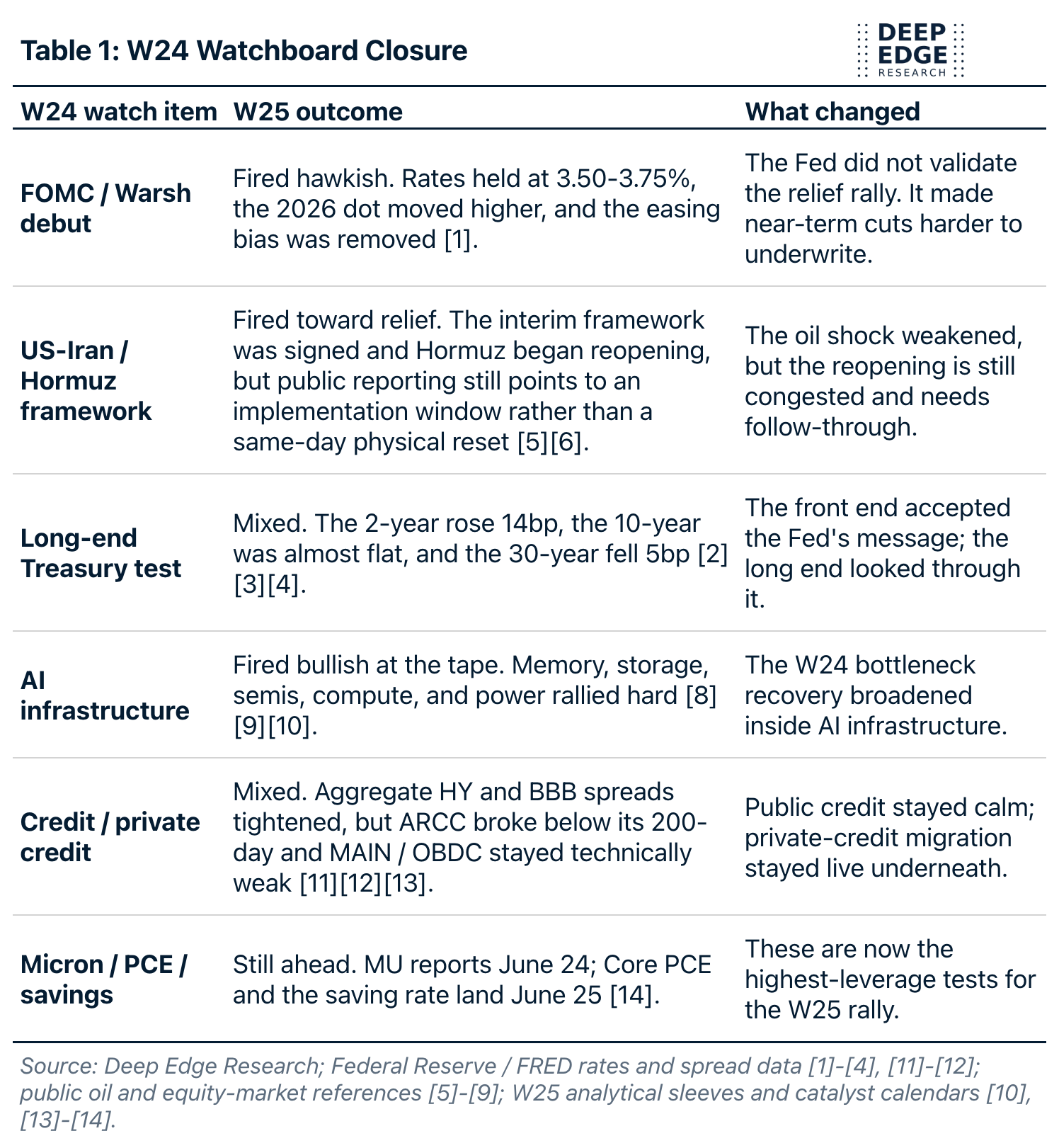
Table 1: W24 Watchboard Closure
Our view: W25 weakened the W24 “paper relief only” concern, but it did not retire it. Oil relief became more real because the framework was signed and Hormuz began reopening. The Fed side moved the other way: policy stayed restrictive, the dots hardened, and the 2-year repriced. The interesting part is that the long end refused to panic.
Why: the market can split policy from inflation. The Fed has to stay focused on realised inflation and credibility. The bond market can start pricing future disinflation if oil keeps falling and the physical reopening continues. That split created the opening for AI infrastructure.
So what: last week was not an all-clear. It was a permission slip for one part of the market. The relief trade is still conditional on oil flow, inflation data, and AI monetisation, but the bottleneck side of AI has earned the right to stay in the book.
1. The Fed was hawkish. The long end did not behave like it.
Our view: the most important macro signal last week was the curve split. The Fed hardened the near-term message, the 2-year Treasury reacted, but the long end did not sell off. That is what made the AI-infrastructure rally possible.
The Fed held rates at 3.50-3.75% at Warsh’s first FOMC meeting [1]. The headline rate decision was not the story. The message was. The dots moved higher, the easing bias disappeared, and inflation risk stayed front and centre. That is a tougher setup for equities than the policy-rate hold alone suggests.
Normally, that would pressure long-duration stocks. The reason is straightforward. A company whose value depends on earnings many years out is more sensitive to the discount rate than a company producing cash today. When the market thinks rates will stay high, those future earnings get discounted more heavily.
That is what happened in W23. Strong labour data pushed yields higher, and long-duration equities de-rated.
W25 did not repeat that move. The 2-year repriced, rising 14bp. The long end stayed calm: the 10-year moved only 1bp and the 30-year fell 5bp [2][3][4].
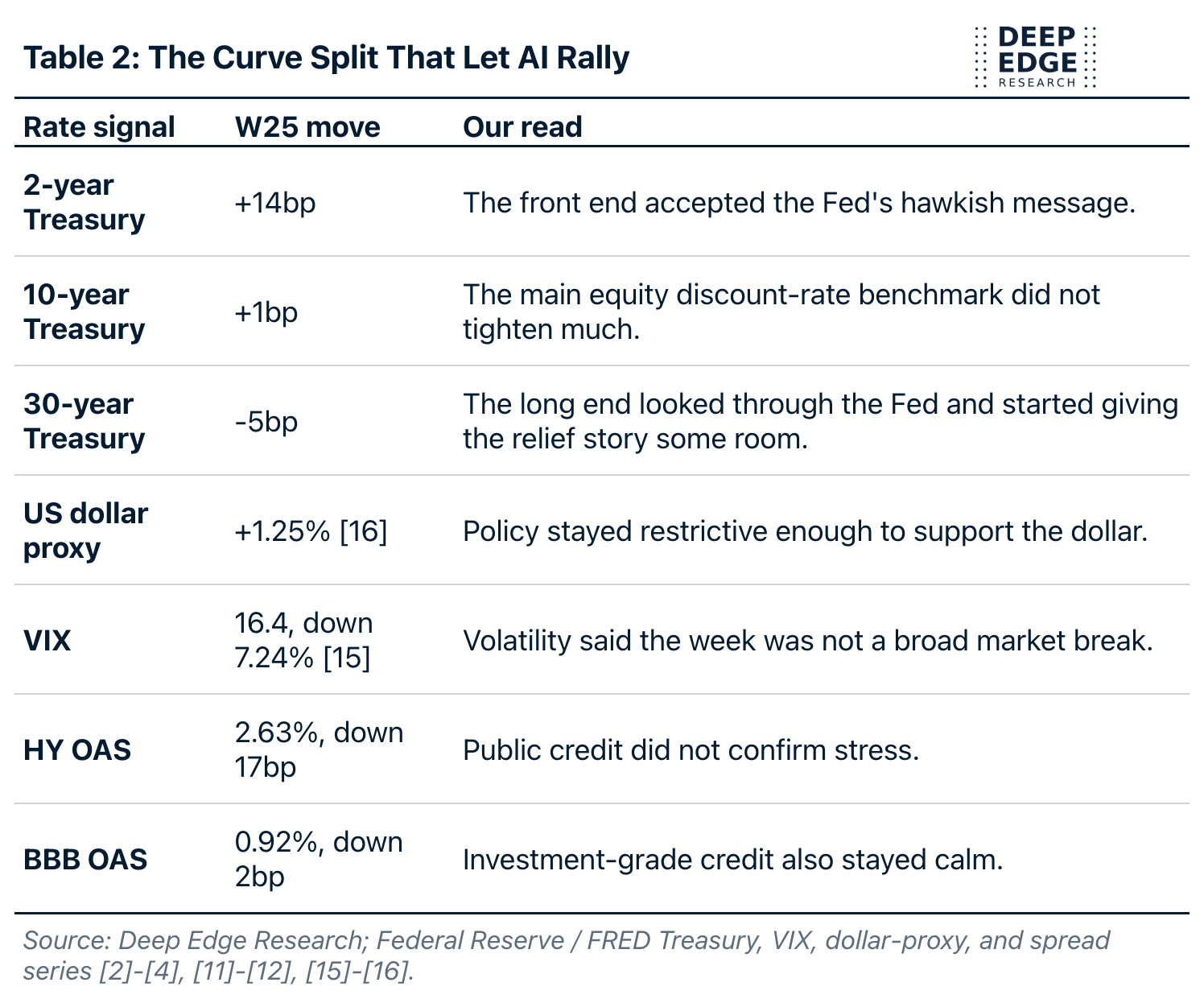
Table 2: The Curve Split That Let AI Rally
The curve split matters because equities do not trade only off the Fed’s words. They trade off the price of money across the curve. A hawkish Fed with a rising 30-year is one setup. A hawkish Fed with a calm or falling 30-year is different.
Oil explains part of the difference. W25 was the first week where the energy shock looked meaningfully less threatening. The interim US-Iran framework was signed, Hormuz began reopening, and WTI moved toward c. $76-77 [5][6][7]. The physical reopening is not complete, but the direction changed.
The Fed cannot simply say, “oil fell, therefore inflation is solved.” It has to protect credibility. The bond market can move earlier. If lower oil starts pulling future inflation lower, the long end can ease even while the Fed sounds hawkish.
So what: the long end is now the hinge. If the 30-year stays contained and oil relief keeps feeding the disinflation story, AI infrastructure can keep working even without a dovish Fed. If the 30-year moves back toward 5% while the Fed remains hawkish, the rally becomes much harder to sustain.
2. AI infrastructure rallied because the market bought bottlenecks, not slogans
Our view: the W25 rally was not broad AI relief. It was a bottleneck rally. Investors paid for memory, storage, semiconductors, compute, and power; they kept punishing workflow software and consulting.
This is the part of the week that matters most for equity positioning. If a hawkish Fed should hurt long-duration stocks, why did some of the highest-beta AI infrastructure names rally so hard?
Because the long end gave them room, and because the market was not buying AI indiscriminately.
Over the five-session W25 window, Western Digital rose c. 41%, Seagate rose c. 23%, SanDisk rose c. 16%, and Micron rose c. 14% [8]. CoreWeave (CRWV), Nebius (NBIS), Talen Energy (TLN), Vistra (VST), and Vertiv (VRT) all rallied strongly too. The iShares Semiconductor ETF (SOXX) rose c. 9% [10].
At the same time, Accenture (ACN) fell c. 24%, Adobe (ADBE) fell c. 11%, Workday (WDAY) fell c. 10%, monday.com (MNDY) fell c. 10%, and Salesforce (CRM) fell c. 9% [10]. Microsoft (MSFT) was down on the week; Amazon (AMZN), Alphabet (GOOGL), and Meta Platforms (META) were only modestly positive.
That is not the tape of a market buying every stock with AI exposure. It is the tape of a market separating physical bottlenecks from exposed revenue models.
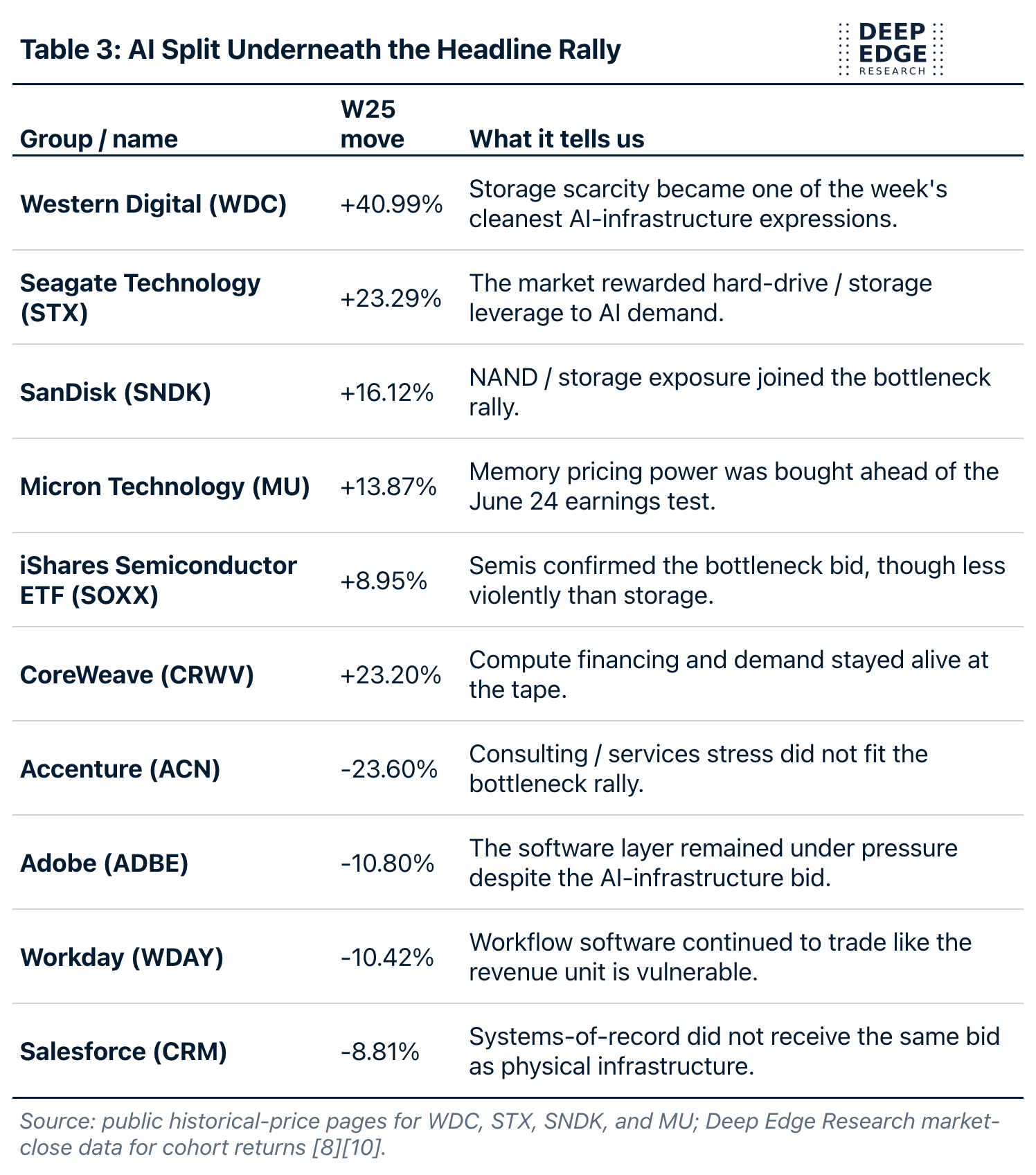
Table 3: AI Split Underneath the Headline Rally
The most interesting detail is that storage led memory. WDC and STX moved more violently than MU because the market could underwrite the storage-scarcity story immediately, while MU still has to prove the gross-margin leg on June 24. That is a useful distinction, and it is not just a momentum squeeze. The public bull case is supply-demand: data-centre and AI-inference demand for hard drives is rising faster than available supply, with analysts pointing to multi-year HDD shortages and pricing power [9]. Storage was rewarded for scarcity now; memory was rewarded for a margin test that is still forward.
The teaching point is simple. AI is not one trade.
The bottleneck side has a direct link to capex: if hyperscalers and AI labs keep building, they need memory, storage, GPUs, interconnect, power, cooling, and data-centre infrastructure. Those companies can benefit even when the Fed is not friendly, provided long-end rates do not rise enough to break the valuation case.
The software / disruption side faces a different problem. AI can help some software companies, but it can also compress seats, services, renewal value, task matching, or consulting demand. The revenue unit is less clean. That is why workflow software and consulting did not join the rally.
Micron now becomes the first clean test. The stock is up c. 62% over one month and reports June 24 [8][14]. The tape is already pricing a lot of good news. A strong gross-margin print can help memory close the gap to storage. A miss would matter because the rally is narrow, extended, and already leaning on the idea that bottleneck pricing power will show up in gross margin.
So what: stay close to the AI bottlenecks, but do not let the word “AI” do the work. The long side belongs in names where demand converts into revenue, margins, backlog, or financing access. The short / caution side stays in names where AI can pressure seats, workflow value, consulting demand, or software pricing.
3. Oil gave the bond market permission. It did not free the Fed.
Our view: oil relief is now the proof chain, not the whole argument. The long end stayed calm because crude fell and Hormuz started reopening. The Fed still cannot become dovish until the inflation data follows.
The caveat is physical delivery. Public reporting points to a signed interim agreement and a commitment to restore commercial traffic, but full restoration is still an implementation window, not a same-day macro reset [5][6]. The reopening still depends on routing, mines, insurance, shipping behaviour, and inventory refill. EIA data still showed a large crude draw in the latest reported week [17].
So we should not write this as “oil solved inflation.” It did not. A better formulation is that oil created a plausible disinflation path. That was enough for the long end to stop fighting the rally.
So what: oil has moved from the centre of the problem to the centre of the proof chain. If Hormuz flow keeps normalising and the next EIA prints show inventories refilling or draws slowing, the long end can keep giving AI infrastructure room. If the reopening stalls or crude re-tightens, the Fed’s hawkish message becomes much harder for equities to ignore.
4. What this means for positioning
Our view: this is still a selective participation market. The W25 rally gives us a reason to stay involved, not a reason to chase every rebound.
The cleanest position is to keep exposure where the mechanism is strongest: AI bottlenecks with visible demand and pricing power. That means memory, storage, semiconductors, compute infrastructure, power, cooling, and the parts of the data-centre stack where capex becomes revenue.
The second part is discipline. A narrow rally can be right and still be dangerous if the next print disappoints. MU is up sharply before earnings. The 30-year remains the key discount-rate tell. PCE and the saving rate land June 25. Private credit is calm at the aggregate spread level, but listed BDCs still show dispersion: Ares Capital (ARCC) broke below its 200-day, while Main Street Capital (MAIN) and Blue Owl Capital (OBDC) remained technically weak [13].
That argues for a book with skin in the game and cash still available.
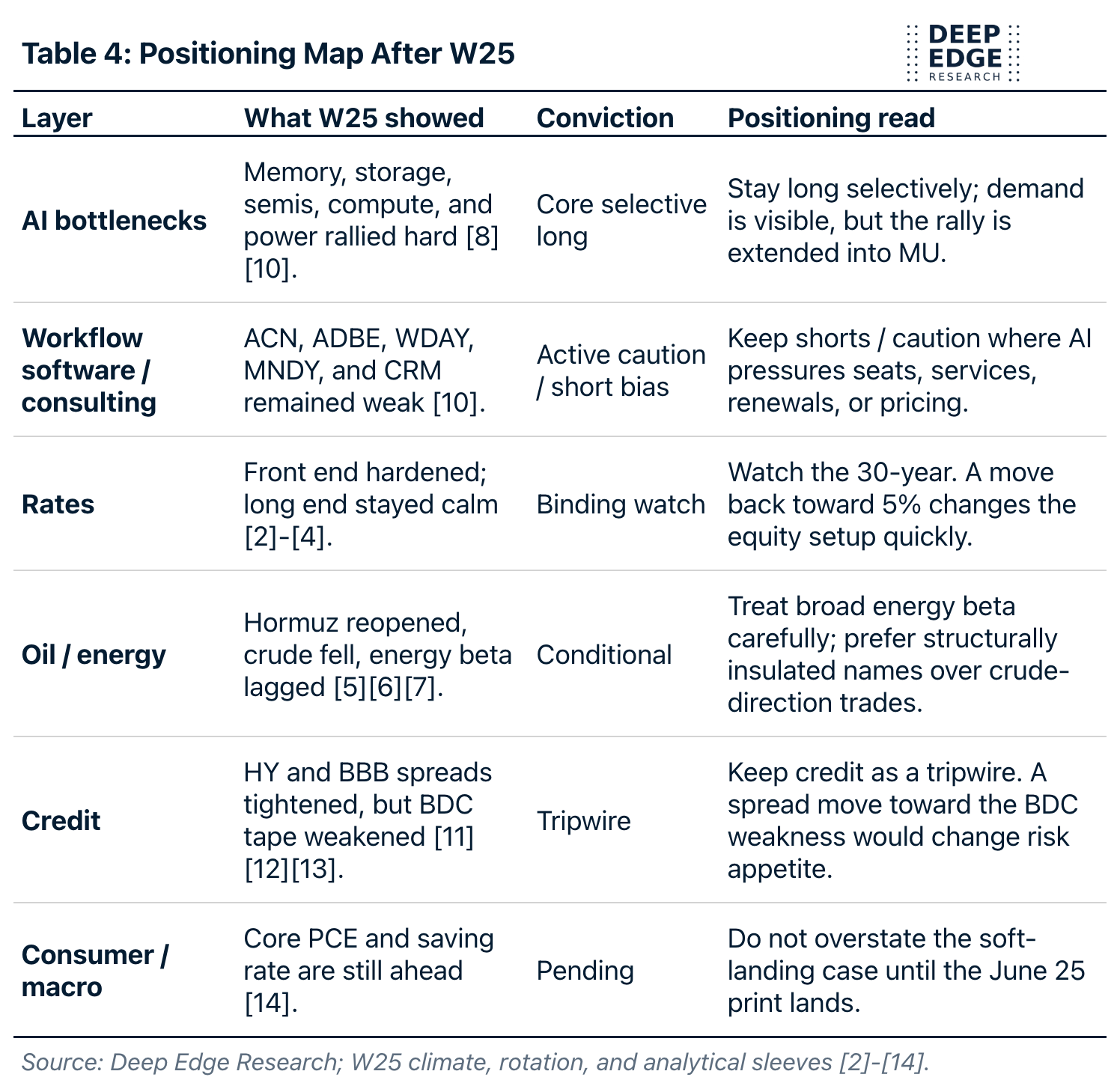
Table 4: Positioning Map After W25: Conviction legend: “Core selective long” means we want exposure but not indiscriminate beta; “Active caution / short bias” means the sleeve remains a source of shorts or avoided longs; “Binding watch” means the signal can change the whole book; “Tripwire” means it is not the centre of the thesis until it moves; “Pending” means wait for the next print before upgrading the claim.
Why: the surface is bullish, but not broad. Volatility fell, credit spreads tightened, and AI infrastructure ripped. Yet the rally concentrated in a small number of bottleneck names, while workflow software, consulting, energy beta, and parts of private credit weakened.
So what: the right response is participation with a tighter filter. Own the bottlenecks where the mechanism is real. Avoid the temptation to extrapolate the rally into every AI-adjacent stock. Keep liquidity for MU, PCE, EIA, and the next credit checks.
5. What we are watching this week
This week’s watchboard has two immediate tests and one broader risk check.
The immediate tests are Micron and PCE. Micron tells us whether the AI-infrastructure rally has near-term earnings cover. PCE and the saving rate tell us whether lower oil is becoming disinflation without another consumer-buffer squeeze.
The broader risk check is whether the long end and credit keep cooperating. If the 30-year stays contained and spreads stay tight, the rally can keep leaning on AI infrastructure. If the 30-year moves back toward 5% or credit spreads start following the BDC tape, the book has to get more defensive.
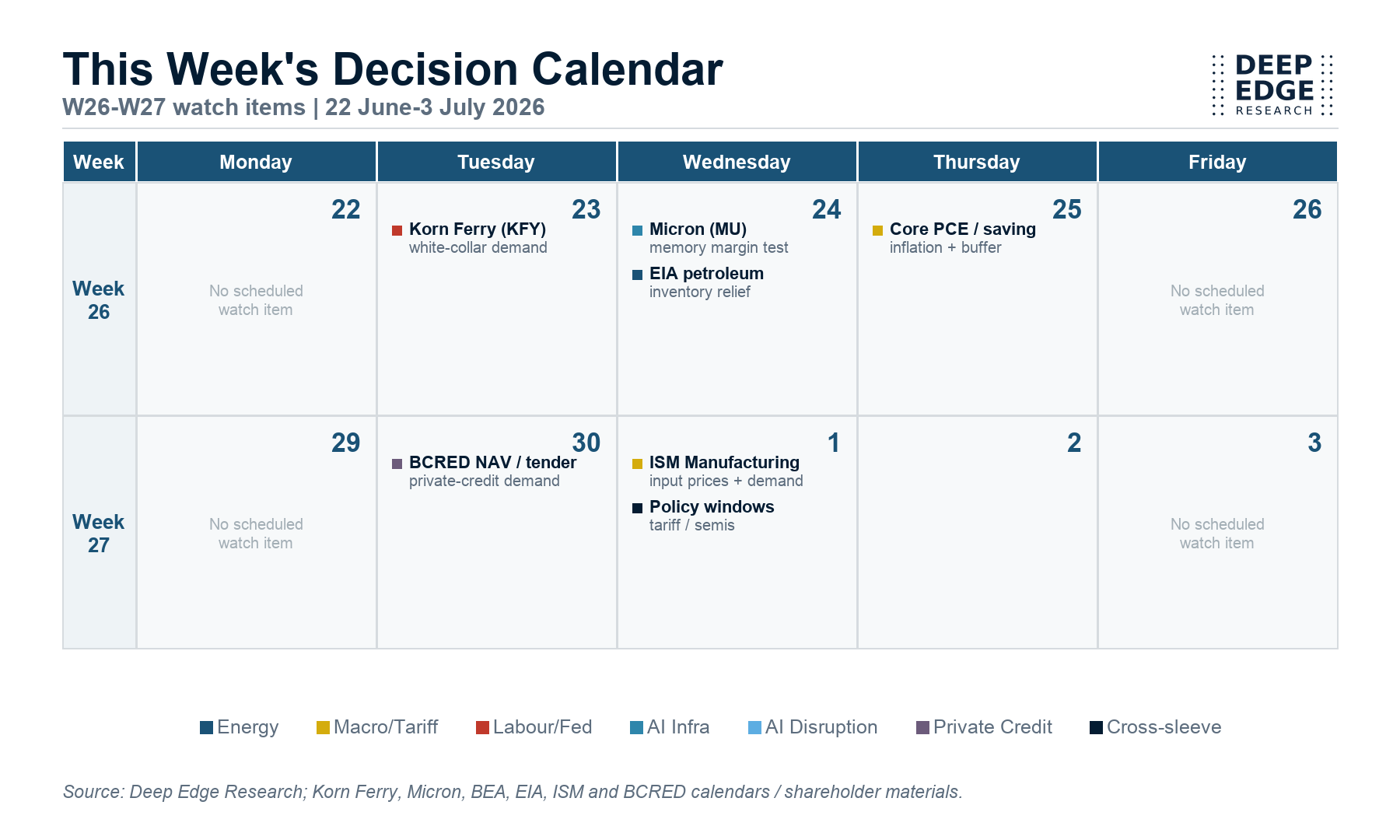
Figure 1: This Week’s Decision Calendar
So what: the next week is not about whether the Fed was hawkish. It was. The next week is about whether lower oil and AI earnings are strong enough to let the long end keep ignoring that hawkishness.
What would change the positioning
Kill switch: the AI-infrastructure rally stops being selective participation if the 30-year moves back toward 5%, Micron fails the margin test, oil relief stalls, and credit spreads start widening toward the weakness already visible in listed BDCs.
The rally stays investable if three things hold together:
The long end stays contained. The 30-year does not move back toward 5%, and the 10-year does not reclaim the 4.50% stress zone.
AI bottlenecks get earnings cover. MU confirms memory pricing power, and the July hyperscaler / capex cluster does not cut against the infrastructure thesis.
Oil relief becomes physical relief. Hormuz transit, inventories, and product pricing keep moving in the right direction.
The book tightens if any two of these fail:
MU misses gross-margin expectations after a 60% one-month rally.
Core PCE stays sticky while the saving rate weakens again.
The 30-year moves back toward 5%.
HY OAS or BBB OAS starts widening toward the weakness already visible in listed BDCs.
Hormuz reopening stalls or crude re-tightens.
W25 showed real buying pressure in the right parts of AI infrastructure. That deserves respect. It also puts the burden of proof in a very specific place: a narrow rally through a hawkish Fed needs the long end, oil, and earnings to keep cooperating.
Final thought
The cheapest mistake after W25 is to treat the AI rally as broad confirmation.
The trade can work, but the hurdle has moved higher. The companies that rallied now have to prove the earnings, margins, and financing access their prices already imply.
References
[1] Federal Reserve, FOMC statement and Summary of Economic Projections, 17 June 2026: https://www.federalreserve.gov/newsevents/pressreleases/monetary20260617a.htm and https://www.federalreserve.gov/monetarypolicy/files/fomcprojtabl20260617.pdf
[2] Federal Reserve / FRED, 2-Year Treasury Constant Maturity Rate (DGS2): https://fred.stlouisfed.org/series/DGS2
[3] Federal Reserve / FRED, 10-Year Treasury Constant Maturity Rate (DGS10): https://fred.stlouisfed.org/series/DGS10
[4] Federal Reserve / FRED, 30-Year Treasury Constant Maturity Rate (DGS30): https://fred.stlouisfed.org/series/DGS30
[5] Associated Press, US-Iran initial deal / Strait of Hormuz reopening reporting, June 2026: https://apnews.com/article/iran-us-israel-war-oil-deal-june-17-2026-19652f4611b704c0a991bf1f5bc9a4b9
[6] The Guardian, US-Iran deal takeaways and Hormuz restoration timeline, June 2026: https://www.theguardian.com/world/live/2026/jun/17/middle-east-war-iran-israel-us-donald-trump-hezbollah-lebanon-peace-deal-netanyahu-latest-news-updated
[7] Barchart crude-oil market commentary and WTI futures quote, June 2026: https://www.barchart.com/futures/quotes/CL*0/futures-prices
[8] Public historical-price pages for Western Digital (WDC), Seagate Technology (STX), SanDisk (SNDK), and Micron Technology (MU); Deep Edge calculated five-session returns from 11 June to 18 June 2026: https://stockanalysis.com/stocks/wdc/history/ ; https://stockanalysis.com/stocks/stx/history/ ; https://stockanalysis.com/stocks/sndk/history/ ; https://stockanalysis.com/stocks/mu/history/
[9] MarketWatch, Western Digital / Seagate rally and hard-drive shortage commentary, June 2026: https://www.marketwatch.com/story/your-next-videogame-console-could-cost-1-000-and-it-has-nothing-to-do-with-better-hardware-8cb180dd
[10] Deep Edge Research market-close dataset; W25 AI infrastructure, semiconductor, software, consulting, power, and hyperscaler cohort returns.
[11] ICE BofA US High Yield Option-Adjusted Spread via FRED (BAMLH0A0HYM2): https://fred.stlouisfed.org/series/BAMLH0A0HYM2
[12] ICE BofA BBB US Corporate Option-Adjusted Spread via FRED (BAMLC0A4CBBB): https://fred.stlouisfed.org/series/BAMLC0A4CBBB
[13] Deep Edge Research Private Credit work; ARCC, MAIN, OBDC and listed-BDC tape, W25 2026.
[14] Company investor-relations calendars for Micron Technology (MU), Korn Ferry (KFY), and relevant W26 catalysts; BEA release schedule for PCE.
[15] CBOE Volatility Index (VIX) via FRED (VIXCLS): https://fred.stlouisfed.org/series/VIXCLS
[16] Yahoo Finance, Invesco DB US Dollar Index Bullish Fund (UUP): https://finance.yahoo.com/quote/UUP/
[17] Energy Information Administration, Weekly Petroleum Status Report: https://www.eia.gov/petroleum/supply/weekly/