
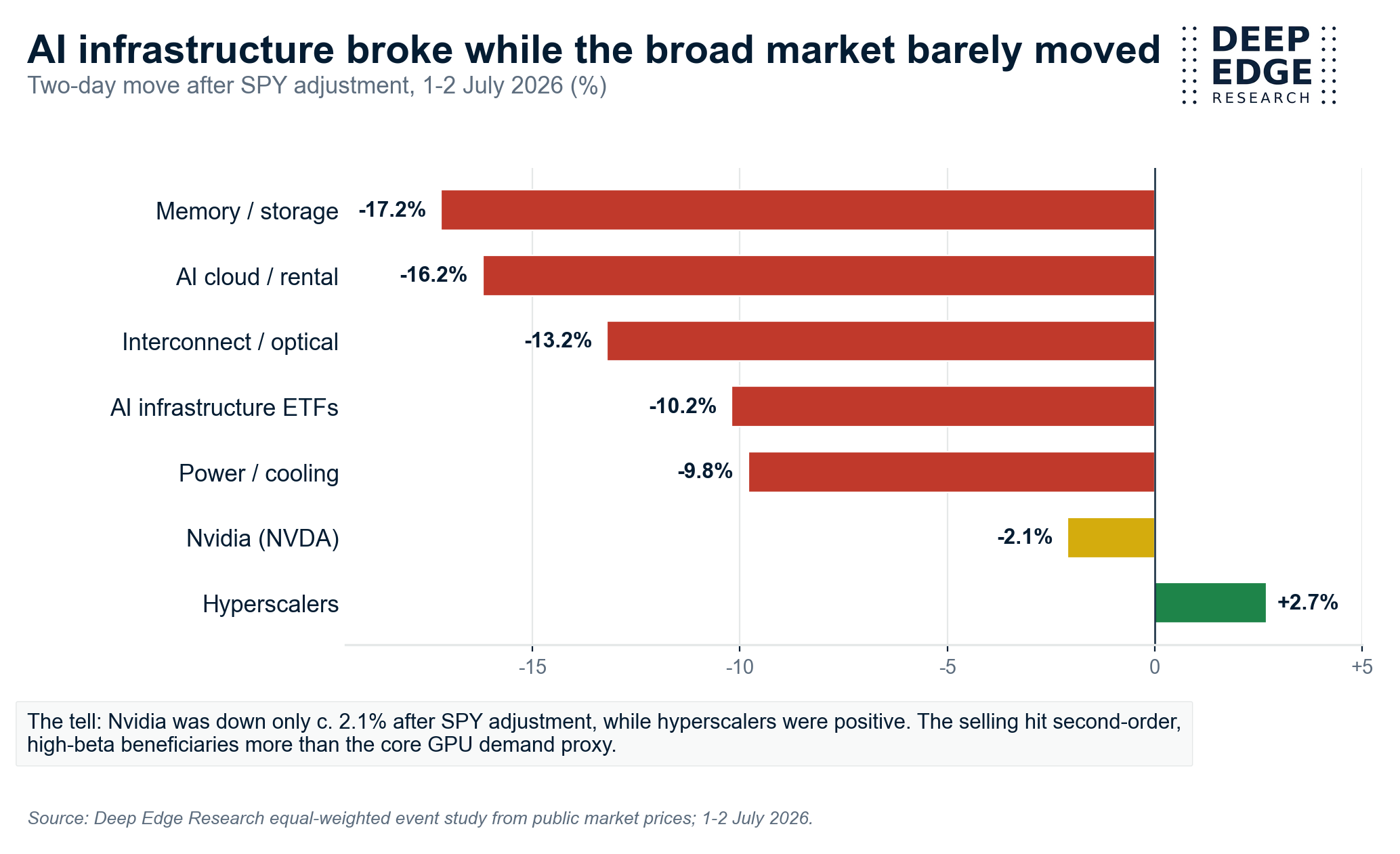
Last week, W27 (29 June-4 July 2026), the broad market barely moved while AI infrastructure broke. Across 1-2 July, SPDR S&P 500 ETF Trust (SPY) fell c. 0.3%. Our AI infrastructure exposure fell c. 11%. The damage was concentrated in memory, storage and AI cloud / rental. That gap is large enough to force a formal audit of the thesis.
The audit has two concerns:
Capacity monetisation: reports that Meta Platforms (META) and SpaceX / xAI may sell or lease spare compute suggest useful compute may be less scarce than we assumed [2][3].
Inference efficiency: reported OpenAI optimisations have cut inference costs for some models. If software efficiency reduces infrastructure intensity faster than usage grows, the long-term hardware demand curve flattens [4].
That does not mean the physical bottleneck thesis has failed. Tier-1 capital expenditure (capex) has not been cut, Micron Technology (MU) still has sold-out evidence into 2027-28, and the Nvidia (NVDA) move was small relative to the second-order AI infrastructure names. Our stance is audit over surrender: keep the bottleneck thesis alive, but make capacity utilisation, financing cost and late-July hyperscaler earnings the binding tests.
TLDR
What happened: the broad market barely moved, but our AI-infrastructure exposure fell c. 11% over two days.
Our read: this was a targeted re-rating of AI infrastructure, not a confirmed broad equity break.
What worries us: capacity resale and inference efficiency both challenge the return profile of the capacity being built.
What still holds: the supply-side bottleneck evidence has not failed. Capex has not been cut, MU still has sold-out evidence into 2027-28, and NVDA was down only c. 2.1% after SPY adjustment.
What we do now: audit over surrender. Keep bottleneck exposure under review, put AI cloud / rental under the hardest audit, and use late-July hyperscaler earnings as the binding test.
1. How We Are Running The Audit
This is not a normal weekly brief. It is an audit of a problem that hit our core exposure.
The job is simple: work out whether the selloff was mostly positioning, a real re-rating, or the first sign that one of our assumptions has changed.
We are doing that in three steps:
Measure the move. The PCA / event study checks whether this was really an AI-infrastructure selloff or just the broad market pulling everything down.
Diagnose the cause. RCA gives us the discipline. Cynefin stops us from pretending a messy market move has one neat cause. Kepner-Tregoe forces us to test the possible explanations instead of choosing the most comfortable story.
Re-test the thesis. The rest of the note asks which parts of the AI-infrastructure thesis still hold, which parts now need proof, and what evidence would change the book.
2. PCA / Event Study: What Re-Rated?
The event study says the move was targeted at AI infrastructure.
Across 1-2 July, the broad market barely moved while equal-weighted AI-infrastructure buckets sold off sharply [1].
Figure 1: AI infrastructure broke while the broad market barely moved
Source: Deep Edge Research equal-weighted event study from public market prices; 1-2 July 2026.
The worst moves after adjusting for the broad market clustered in SNDK, Nebius (NBIS), CRWV, WDC, Lumentum (LITE), MU, STX and Ciena (CIEN). Nvidia was relatively spared. The hyperscalers were flat to positive.
That pattern matters. If this were broad equity stress, we would expect the damage to be much wider. If this were a clean demand-collapse signal for AI compute, Nvidia should have worn much more of the damage. It did not. After adjusting for SPY, NVDA was down only c. 2.1%, while hyperscalers were up c. 2.7%.
That is one of the biggest tells in the tape. The selling was not aimed first at the company most directly tied to GPU demand. It was aimed at the profit-rich, higher-beta, second-order beneficiaries: memory, storage, AI cloud / rental, interconnect and optical. That looks more like a narrative shock, profit harvesting and stop-loss cascade than a clean verdict that AI infrastructure demand has cracked.
PCA points the same way, with caution. Before the event, the basket did not usually trade as one tight block: average pairwise correlation after adjusting for SPY was only c. 0.11, and the first principal component explained c. 32% of the basket’s move. During the two-day event window, that first component explained essentially all of the move.
Two sessions cannot carry a full statistical verdict. They can still show the shape of the move: investors suddenly traded different AI-infrastructure businesses as one common factor.
Interim conclusion: the broad market did not break. AI infrastructure did. The next step is to test whether that break was mostly narrative / positioning, or an early read-through to fundamentals.
3. Method Note: Why We Use RCA, Cynefin And Kepner-Tregoe
The method matters because the easy stories are already available.
Meta has spare compute, therefore the AI infrastructure trade is over.
The selloff is only de-grossing, therefore nothing matters.
Both skip the work.
RCA gives us the discipline to ask what changed. Cynefin keeps the problem honest: the price move is measurable, but the cause is messy. Kepner-Tregoe then forces each possible explanation to meet evidence, not the story we prefer.
The audit questions are:
Is compute still scarce?
Are memory and storage still bottlenecks?
Is rented GPU capacity still structurally attractive?
Is inference efficiency reducing infrastructure intensity?
Are hyperscalers still building because demand is visible, or because they are trapped in an arms race?
Are AI cloud platforms financed for the returns they can actually earn?
This is not a simple mechanical failure. Several things can be true at once:
quarter-end de-grossing;
momentum unwind;
ETF and factor pressure;
peer contagion;
excess-capacity fears;
inference-efficiency fears;
capex anxiety around hyperscalers;
reflexivity, where price action makes the bearish story feel more true.
That is why the audit has two layers:
Measurement: what sold off, how much was broad-market beta, and whether the basket traded as one factor.
Causality: why it happened, whether it will hold, and which operating evidence would confirm or contradict the move.
So what: the audit has a portfolio job. If the answers move against us, the book changes. If the answers still support bottleneck economics, price action alone does not get to rewrite the thesis.
4. Kepner-Tregoe: What Could Have Caused It?
Our current read is that this was a narrative / positioning shock with two real fundamental concerns underneath.
The two real concerns are capacity resale and inference efficiency. Meta and xAI raise the possibility that some capacity owners built or acquired more compute than they can absorb internally. OpenAI raises the possibility that software improvements reduce compute per unit of output faster than usage expands.
Kepner-Tregoe is useful because it keeps those causes separate. For each candidate, we ask what must be true.
Table 1: Kepner-Tregoe diagnostic matrix
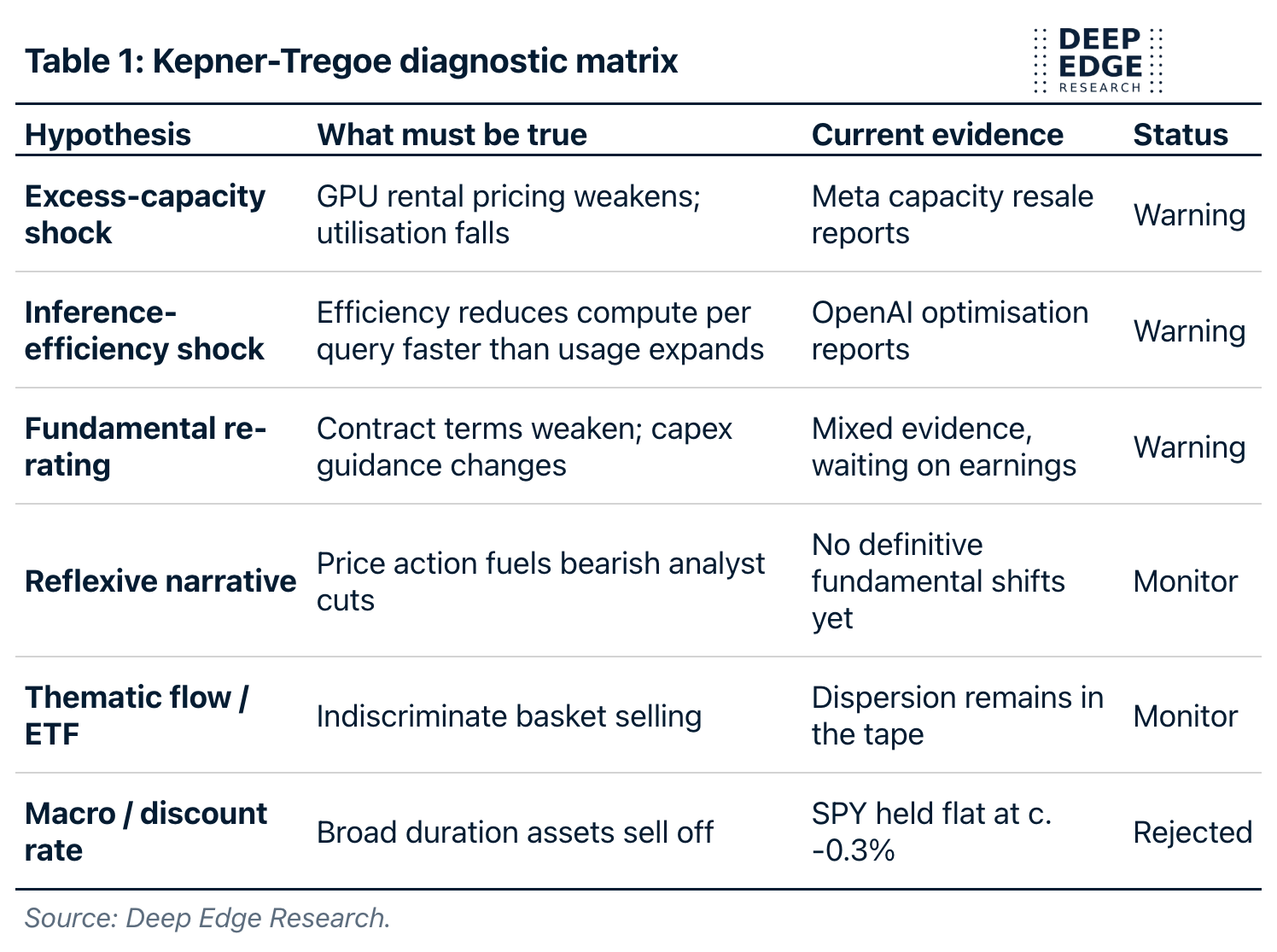
The evidence today is mixed. The selloff was targeted enough to respect. It has not yet delivered the operating evidence needed to call a thesis break.
So what: respect the tape, but do not let the tape become the whole argument. The selloff has earned a formal watchlist.
5. AI Infrastructure Sleeve: Supply Held, Absorption Cracked
The AI Infrastructure sleeve changes the tone of the audit.
The supply story still has evidence. The absorption story now needs proof.
Table 2: Supply held, absorption cracked
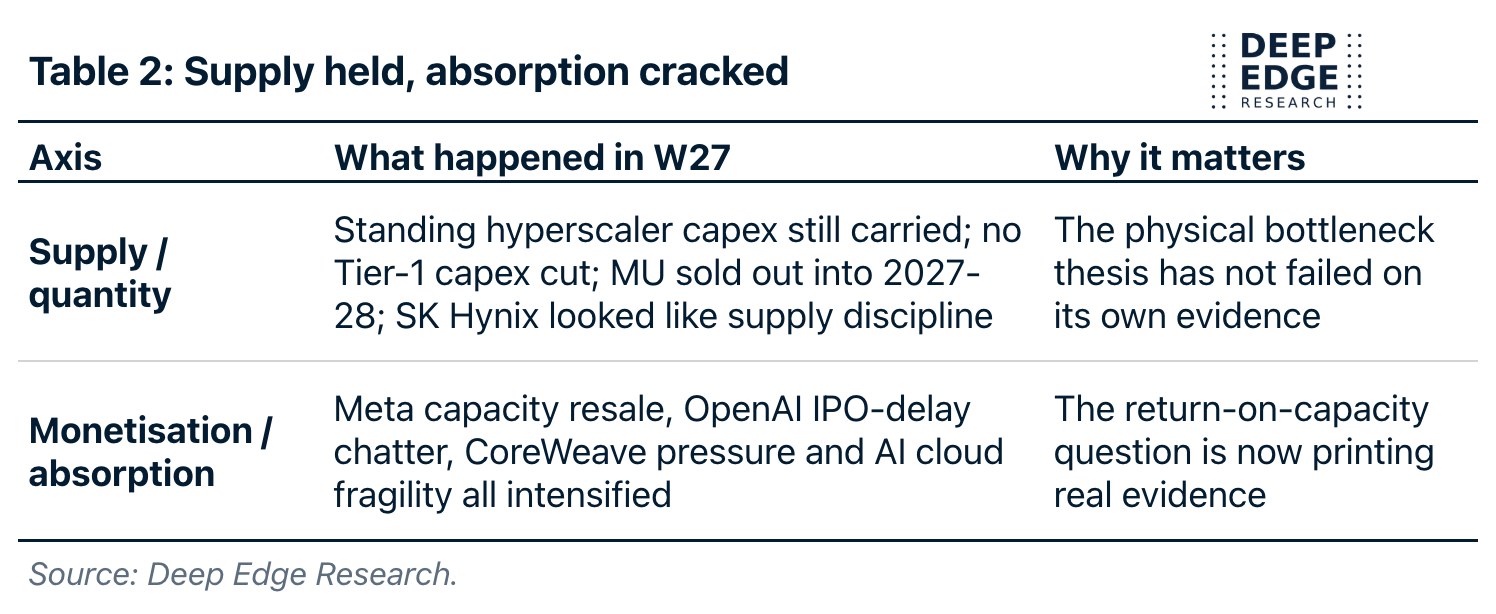
What still holds: supply / quantity
The supply side has not broken.
No major hyperscaler cut capex last week.
MU still has sold-out memory evidence into 2027-28.
The SK Hynix read looks more like supply discipline than demand collapse.
The tape sold the SK Hynix HBM4-ramp slowdown as a demand warning. The better read is narrower: HBM3E kept running longer on strong Blackwell demand, HBM4 timing moved with Nvidia Rubin, and capacity shifted toward severe DDR5 shortage. SK Hynix’s own market outlook carried expectations for dominant HBM4 share on Nvidia Rubin, while current memory-market coverage points to a broader DRAM shortage and reports that SK Hynix is prioritising DDR5 supply because the shortage is severe, not because AI memory demand has disappeared [8][9].
What now needs proof: absorption / monetisation
The absorption side did crack.
Meta capacity resale, OpenAI IPO-delay chatter, CRWV weakness and AI cloud fragility all point to the same issue: can the capacity being financed earn the returns investors assumed?
CoreWeave is the live case study.
Demand proof: Q1 revenue was $2.1 billion, backlog was $99.4 billion, active power exceeded 1 GW, and contracted power was over 3.5 GW [10].
Funding burden: net interest expense was $536 million in Q1, current and non-current debt totalled c. $24.9 billion, and the company priced another $1.25 billion plus EUR2 billion of senior notes in June [10][11].
Audit read: CRWV is not evidence that AI demand disappeared. It is evidence that the market is testing whether demand can outrun financing cost, depreciation, utilisation risk and customer concentration.
Inference efficiency is the demand-side test.
Bullish path: Jevons. Cheaper inference unlocks more usage, more agents, more enterprise adoption and more reasoning workloads. The market expands faster than compute intensity falls.
Bearish path: efficiency without enough elasticity. Each unit of output needs materially less infrastructure, and usage does not expand fast enough to offset it.
Audit read: the OpenAI report may be narrow. It may apply mainly to lower-value logged-out traffic. It may simply make AI usage cheaper and broader. The risk is that the same efficiency logic migrates into paid, API, enterprise or reasoning workloads.
So what: we should not flatten the selloff into “AI infrastructure broke.” The cleaner read is that physical bottlenecks still have support, while capacity monetisation and utilisation have become the live audit points.
6. Mechanism-Specific Diagnosis: Where The Pain Actually Sits
The same selloff hit different businesses for different reasons. That is why we should not treat “AI infrastructure” as one bucket.
AI Cloud / Rental
Key entities: CoreWeave (CRWV), Nebius (NBIS), Applied Digital (APLD), TeraWulf (WULF).
The problem: these names are most exposed to the capacity-resale narrative. If hyperscalers can become sellers of spare compute, the market has to re-price utilisation, rental pricing, financing cost and customer concentration for the independent platforms.
Current evidence: the selloff was severe, and the CRWV funding burden is real. The demand proof has not disappeared, but the return-on-capacity burden is now under direct review.
Audit test: GPU-rental pricing, utilisation language, customer concentration, contract durability and EBITDA / interest coverage.
Memory / Storage
Key entities: Micron (MU), SanDisk (SNDK), Western Digital (WDC), Seagate (STX), SK Hynix.
The problem: the price action looked like a demand-peak scare. These were among the largest losers because they had also been among the largest winners.
Current evidence: the operating evidence still points to scarcity rather than demand collapse. MU still has sold-out evidence into 2027-28. SK Hynix looks like supply discipline, not demand failure.
Audit test: contract terms, pricing power, backlog visibility, customer pull-forward risk and whether Nvidia weakness starts to confirm the same message. So far, it has not.
Power / Interconnect / Cooling
Key entities: Vertiv (VRT), Arista Networks (ANET), Ciena (CIEN), Lumentum (LITE), Credo Technology (CRDO).
The problem: these are capex-derivative suppliers. They do not need GPU-rental pricing to work directly, but they do need the physical buildout to keep converting into orders, backlog and margins.
Current evidence: the selloff hit the group, but the mechanism is different from AI cloud. The concern only broadens if order books, margins or guidance begin to crack.
Audit test: ANET Q2, optical / interconnect margin commentary, power and cooling backlog, and whether management teams still talk like the buildout is capacity-constrained.
So what: the book has to split AI infrastructure into mechanisms. The harshest audit belongs where utilisation, financing and resale risk matter most.
7. Provisional Decision: What We Do Now
Selling everything would overreact before the operating evidence has arrived. Averaging down blindly would ignore that the market may have found a real weakness in the thesis.
Our interim posture:
Keep the core bottleneck exposures under audit. Memory and storage still have the strongest evidence base, but we need contract, pricing and backlog support to keep holding that view.
Put AI cloud / rental under the hardest review. CRWV, NBIS and similar names are where capacity utilisation, financing, customer concentration and GPU-rental pricing matter most.
Separate the capex suppliers. Interconnect, optical, power and cooling need order / margin / backlog confirmation.
Treat inference efficiency as a live demand-side test. Narrow optimisation is manageable. Broad optimisation across paid, API, enterprise and reasoning workloads is more serious.
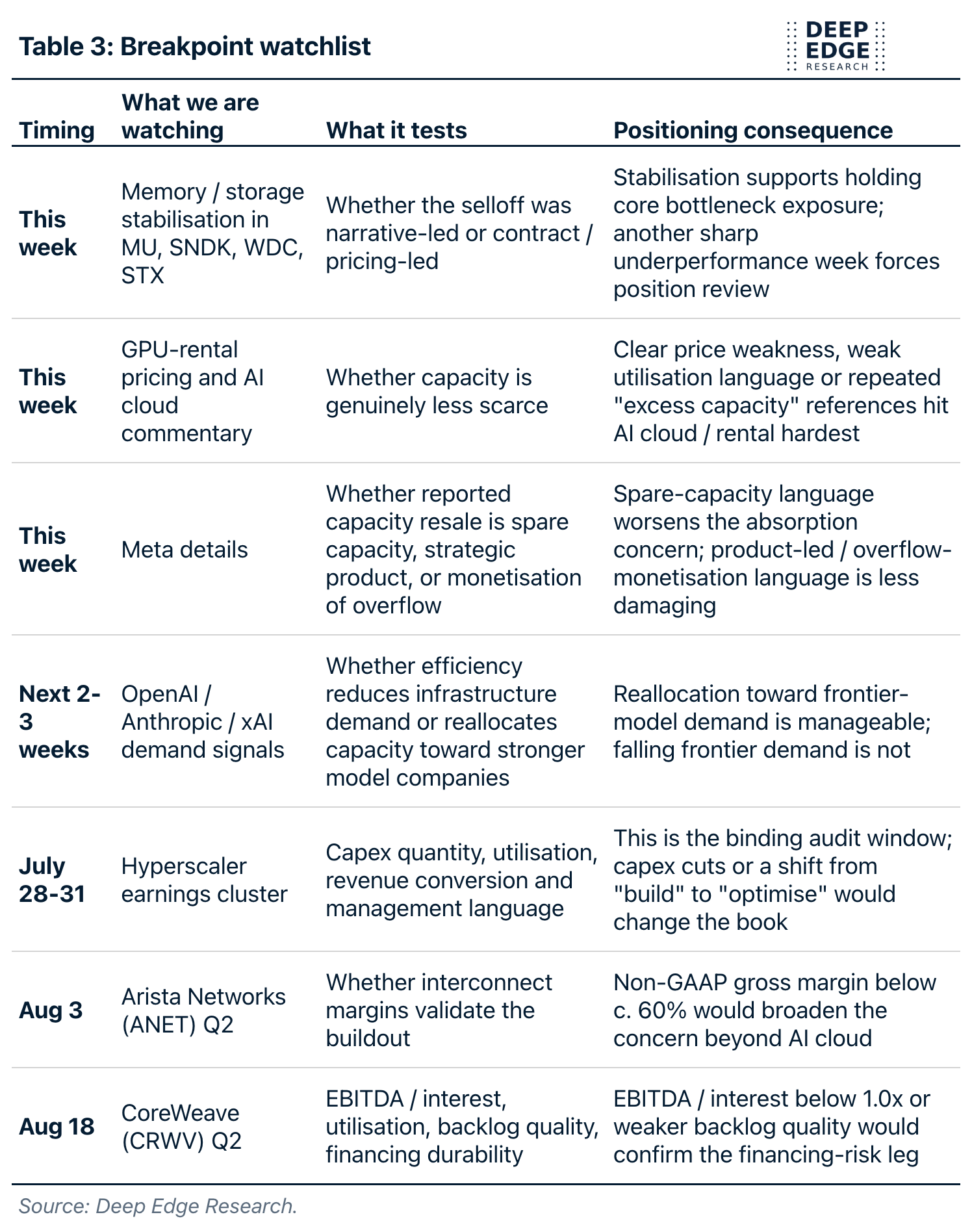
Wait for the hyperscaler cluster. Late-July earnings now matter more than usual because they will tell us whether capex quantity, utilisation language and revenue conversion still support the buildout.
This is the Peter Lynch rule under pressure: know what we own, and know why we own it [7]. If the facts change, the book changes. If they do not, price action still has to earn the right to change the thesis.
8. Breakpoint Watchlist
Table 3: Breakpoint watchlist
What Would Change The Book
We become materially more cautious if four things happen together:
Multiple hyperscalers or AI cloud platforms start talking about unused AI compute.
GPU-rental pricing or contract terms weaken.
OpenAI-style inference gains generalise beyond low-value guest traffic into paid, API, enterprise or reasoning workloads.
Memory / storage companies start losing pricing power, backlog visibility or take-or-pay support.
That combination would turn the scarcity thesis into something much weaker.
The evidence has not reached that point yet.
Right now, the evidence points to a targeted re-rating around AI capacity and returns. The tape has raised a real concern. The operating evidence has not settled it yet.
That is why the right response is a thesis audit before portfolio surrender.
References
[1] Deep Edge Research equal-weighted event study from public market prices; event window 1-2 July 2026; baskets grouped by mechanism, then adjusted against SPDR S&P 500 ETF Trust (SPY).
[2] Reuters / Bloomberg News, “Meta building cloud business to sell excess AI computing capacity,” 1 July 2026. https://srnnews.com/meta-to-sell-excess-ai-computing-capacity-via-cloud-business-bloomberg-news-reports/
[3] TechCrunch, “Meta, like SpaceX, looks to turn excess AI compute into cash,” 1 July 2026. https://techcrunch.com/2026/07/01/meta-like-spacex-looks-to-turn-excess-ai-compute-into-cash/
[4] The Information, “OpenAI Discovers New Way to Cut Inference Costs in Half,” 30 June 2026; corroborated by AI Weekly and The Decoder summaries. https://www.theinformation.com/newsletters/ai-agenda/openai-discovers-new-way-cut-inference-costs-half ; https://aiweekly.co/alerts/openai-engineers-say-theyve-more-than-halved-inference-costs ; https://the-decoder.com/openai-reportedly-cut-response-costs-for-guest-chatgpt-users-by-more-than-half/
[5] Wall Street Journal, “What’s Weighing on Chip Stocks?”, 2 July 2026. https://www.wsj.com/livecoverage/june-jobs-report-stock-market-07-02-2026/card/what-s-weighing-on-chip-stocks–Ls4UYgp0P8BNmnKafcsl
[6] Axios, “Why AI and semiconductor stocks stumbled,” 2 July 2026. https://www.axios.com/2026/07/02/ai-meta-stocks-chips
[7] Peter Lynch, One Up On Wall Street: “Know what you own, and know why you own it.” https://www.goodreads.com/quotes/7317641-know-what-you-own-and-know-why-you-own-it
[8] SK Hynix Newsroom, “2026 Market Outlook: Focus on the HBM-Led Memory Supercycle,” 2026. https://news.skhynix.com/2026-market-outlook-focus-on-the-hbm-led-memory-supercycle/
[9] OC3D, “SK Hynix to reportedly pivot planned HBM4 production to DDR5 as the company chases higher margins,” July 2026. https://overclock3d.net/news/memory/sk-hynix-to-prioritise-ddr5-expansion-over-hbm4-in-new-production-push/
[10] CoreWeave, “CoreWeave Reports Strong First Quarter 2026 Results,” 7 May 2026. https://investors.coreweave.com/news/news-details/2026/CoreWeave-Reports-Strong-First-Quarter-2026-Results/
[11] CoreWeave, “CoreWeave Announces Pricing of $1.25 Billion of Senior Notes and EUR2 Billion of Senior Notes,” 11 June 2026. https://investors.coreweave.com/news/news-details/2026/CoreWeave-Announces-Pricing-of-1-25-Billion-of-Senior-Notes-and-2-Billion-of-Senior-Notes/default.aspx