
For informational purposes only. Not investment advice.
As of 30 June 2026, the public Deep Edge portfolio was up +79.18% year to date, versus +9.47% for S&P500 on the same H1 comparison basis [1].
That spread did not come from buying “AI” as a theme.
It came from owning the parts of the infrastructure buildout where constraint, pricing power, and free cash flow were starting to line up.
This piece explains the Deep Edge Matrix behind that call.
The goal is simple: when AI infrastructure spend moves through the stack, which companies actually keep the economics?
TLDR
The public book was up +79.18% YTD as of 30 June 2026, versus +9.47% for SPY on the same H1 comparison basis. The spread came from owning constraint-solvers rather than buying the AI theme indiscriminately [1].
The H1 update split the AI trade into spenders and beneficiaries. This article focuses on the beneficiary side: once AI spend reaches Ship, which companies actually keep the economics?
This is the Balanced System Landscape for Ship. It groups five layers that have to work together before AI compute becomes useful: hot memory, persistent media, storage platforms, bridge silicon, and system integrators.
The Deep Edge Matrix sorts the eleven balanced-system names into four conviction states: ACT, STRATEGIC, WAIT, MONITOR. It ranks the business and the setup. It does not replace ticker-level underwriting.
The hottest bottleneck is not always the cleanest equity. Micron has powerful hot-memory exposure, but the build bill matters. SanDisk has the cleaner current ownership state because persistent-media scarcity is showing up with less dilution.
The important point here is dispersion. Names that look similar in a normal sector screen can sit in completely different quadrants once we ask who actually captures the profits.
The cycle is still live, not solved. Memory and storage are cyclical industries, but the current evidence points to a tight AI-driven supply environment rather than a normal peak-cycle unwind.
The next articles will zoom into the most useful teaching sequence: the system-integrator problem first, then SanDisk vs Seagate vs Western Digital, then Micron vs SK hynix.
The big picture
In Part 3 of our 2026 Outlook, we made the core call: AI infrastructure is a genuine buildout, not a bubble. The engine was real demand. The constraint was supply. The opportunity came from the way bottlenecks migrate across the system.
The H1’2026 performance update published last week is the proof point. It split the AI trade into two jobs. On the spender side, hyperscalers now have to prove that capex converts into revenue, margin, and free cash flow. On the beneficiary side, memory, storage, selected power, cooling, and interconnect names showed where scarcity was already becoming economics.
The Deep Edge Matrix is built for the second job: once the spend reaches a layer, who keeps it?
We organised that buildout into three arenas:
Ship: can we build balanced systems?
Energise: can we power and cool what we built?
Utilise: can thousands of GPUs behave as one machine?
This piece zooms into the first arena: Ship.
Shipping a Balance System means used to be shorthand for the memory stack: HBM, packaging, storage. That is still the core. But the investable universe has widened and now includes controllers and system integrators.
That balanced-system board can be mapped through the Deep Edge Matrix (see below).
The Deep Edge Matrix
The whole comparative surface belongs on one board. Eleven names. Four conviction states.
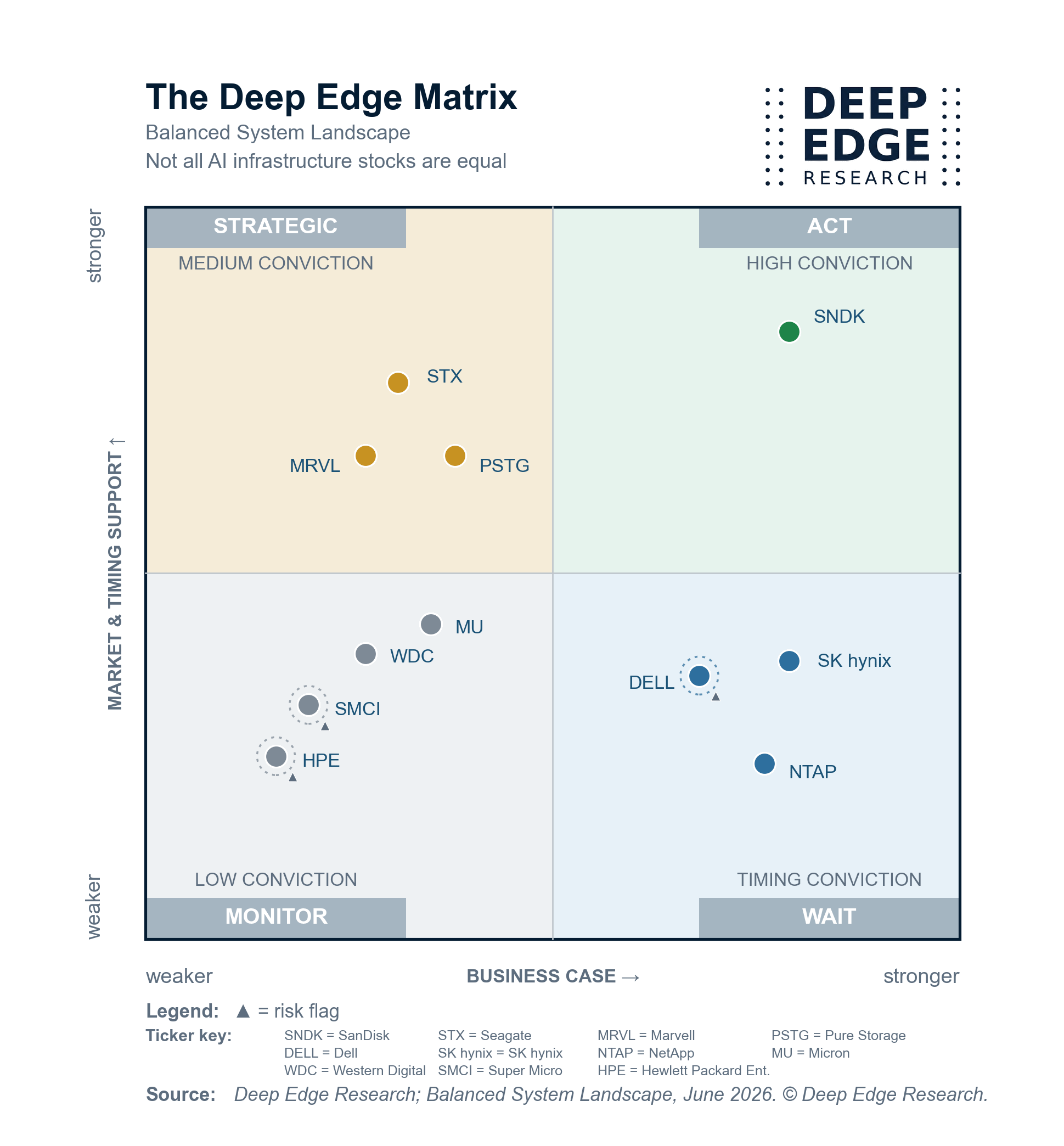
The Deep Edge Matrix scores each name across two public-facing dimensions:
Business strength: how good the underlying economics are, and how defensible the profit capture looks.
Market and timing support: whether the current tape, setup, and near-term evidence support action now.
Those two readings sort the board into four conviction states:
ACT means business quality and market support are aligned. This is the highest-conviction action candidate, subject to underwriting.
STRATEGIC means the setup is live and strategically relevant, but the economics or proof burden are more conditional.
WAIT means the business may be good, but the timing, entry, or catalyst is not yet supportive.
MONITOR means the company is strategically relevant, but there is not enough investable edge today.
The Deep Edge Matrix is our underwriting queue. It tells us where the evidence is strong enough to deserve company-level work. Price, downside, sizing, and risk come next. The company-level pieces can harden the posture as new evidence lands; the board is a live map, not a static verdict.
One warning matters: ACT is not a permanent state, and it is not an instruction to buy today. It means the business evidence and market setup are aligned enough to deserve immediate underwriting. A company can sit in ACT for two quarters and still be a poor entry if valuation has already pulled too much of the upside forward. ACT starts the work. It does not replace entry discipline, dwell-time analysis, or position sizing.
The conviction states matter. ACT names deserve immediate underwriting. STRATEGIC names deserve live work, but with a clearly stated condition. WAIT names stay on the watchlist until timing or entry improves. MONITOR names require a new trigger before they deserve fresh capital.
The board already shows the dispersion. One name is clean enough to sit in ACT. Three names are live but conditional. Three names require patience. Four matter to the system but do not clear today.
That hierarchy is the product. It is much more useful than saying “storage is good” or “AI servers are growing.”
Backtest evidence
The Deep Edge Matrix is part of the research process, not a decorative quadrant added after the view is formed. In our historical validation work, ACT and STRATEGIC beat S&P500 by materially more than MONITOR and WAIT [2].
Table 1: Deep Edge Matrix Backtest Evidence
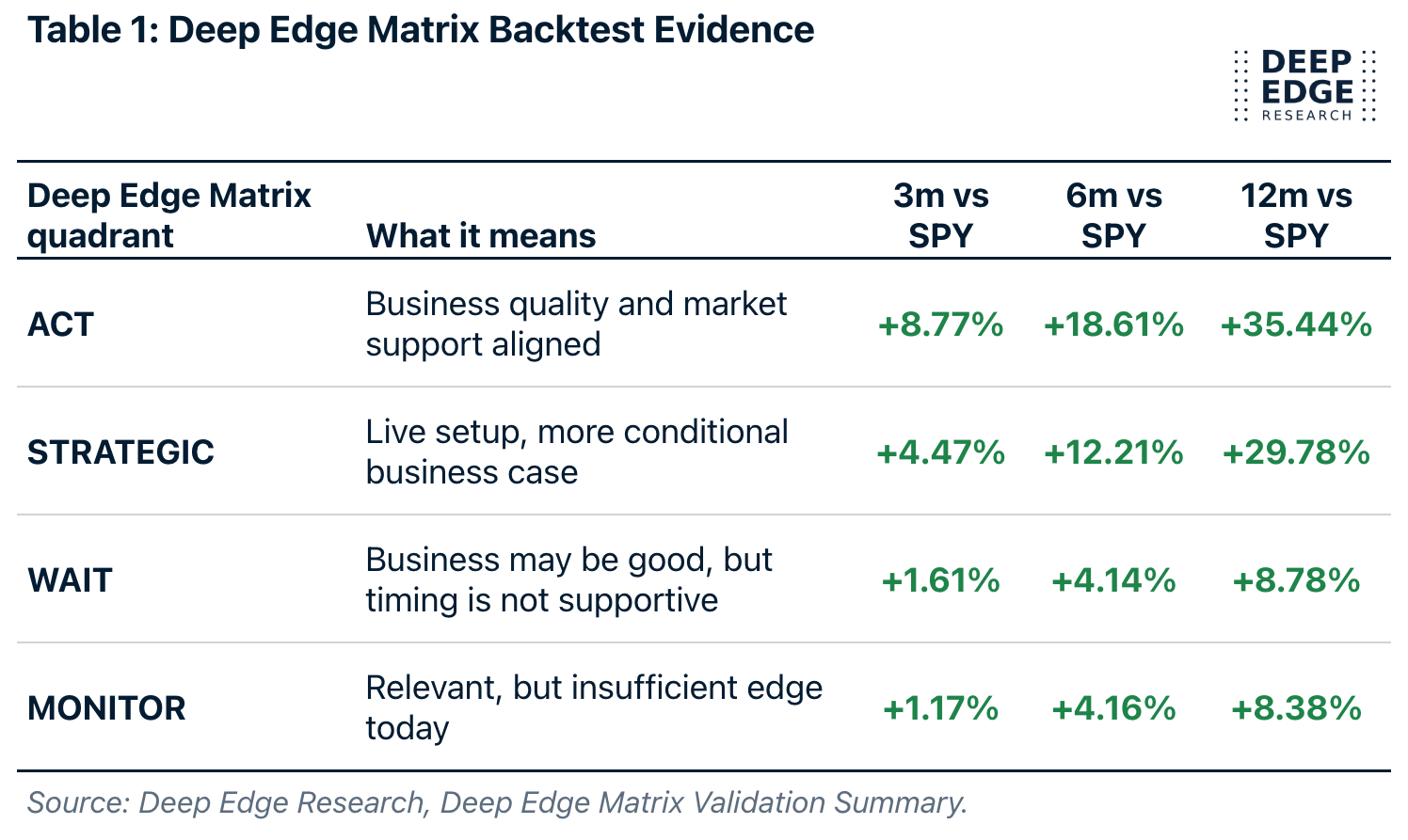
Read the table narrowly. These are median forward returns versus S&P500 (SPY) price returns, using the same start and end windows as the historical validation work. They are not audited portfolio returns. The longer-horizon figures should be read directionally rather than as a perfect calendar-year promise. Methodology details are in [2].
The historical work is the calibration set.
The 2026 public book is the live out-of-sample check: the same framework that separated historical action states also pointed us toward the bottleneck exposures that drove the +79.18% YTD result [1][2].
WAIT’s positive SPY-relative result is not a contradiction. It says the landscape itself was a strong place to look. The separation is still clear: ACT and STRATEGIC captured far more of that strength. WAIT remains the “good business, wrong timing” bucket: the business may deserve work, but the entry, catalyst, or tape is not yet doing its part. MONITOR is different. It is relevance without enough edge.
The peer-relative test still matters, but it belongs in the methodology note. It checks a different thing: within the same area of the market, the Matrix also separated the stronger companies from the weaker ones.
The live book gave us the practical version.
The YTD numbers matter because the January bottleneck map showed up in actual returns. The strongest performance came from the layers where the system constraint tightened first: memory and storage in Ship, then selected power, cooling, and interconnect. Exposure was the starting point. Economics decided the return.
The Balanced System Landscape
These five layers belong together because they answer one system question: can the accelerator be turned into useful deployed compute?
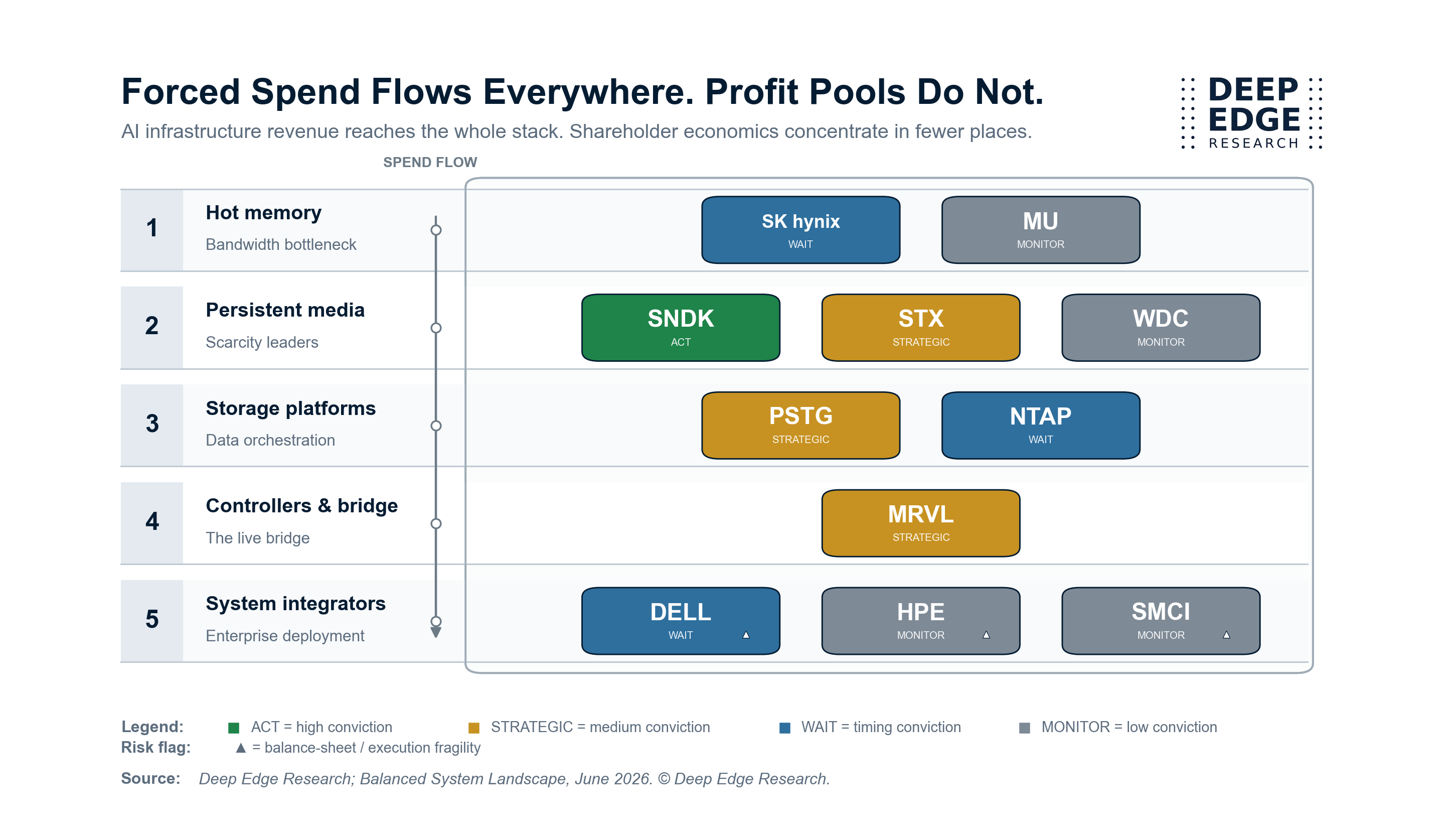
A hyperscaler cannot deploy accelerators without memory. It cannot use the memory without persistent capacity. It cannot manage the data without platforms. It cannot move the data without controllers and bridge silicon. It cannot ship the whole thing to enterprise buyers without integrators.
That makes this a landscape.
An investor still has to choose. If we are putting one incremental dollar into the AI infrastructure stack, we need to know where that dollar has the best chance of becoming profit and free cash flow. Product relevance and revenue growth only matter if the economics survive the trip from customer budget to shareholders.
The closer a company sits to scarce, qualified capacity, the more chance it has of keeping the economics. The closer it sits to aggregation, packaging, procurement, and price competition, the more those economics can leak away.
That is why the board cannot be a simple product map. A company can be strategically essential and still be a weak equity. It can touch the whole system and keep thin economics. It can own the hottest bottleneck and still have the cash flow consumed by the build bill.
Most AI infrastructure commentary misses that step. It notices participation in the buildout, then stops before asking who keeps the economics.
That is why “capex beneficiary” is only the first filter. System integrators receive AI spend too, but that does not mean they keep it. Scarce suppliers, powerful customers, working capital, and bundling pressure can all take their share before the economics show up in profit and free cash flow.
Where profits leak: In the Balanced System Landscape, the leak usually comes from five places: capex arrives before cash flow; customer qualification gives buyers leverage; scarce inputs get bundled into lower-margin systems; competition pushes a layer toward utility economics; and working capital absorbs the volume. The Deep Edge Matrix forces each company through that filter before it earns a place in the underwriting queue.
Layer 1: hot memory
Key names: SK hynix (WAIT), Micron (MONITOR).
Role: feeds accelerators with high-speed bandwidth.
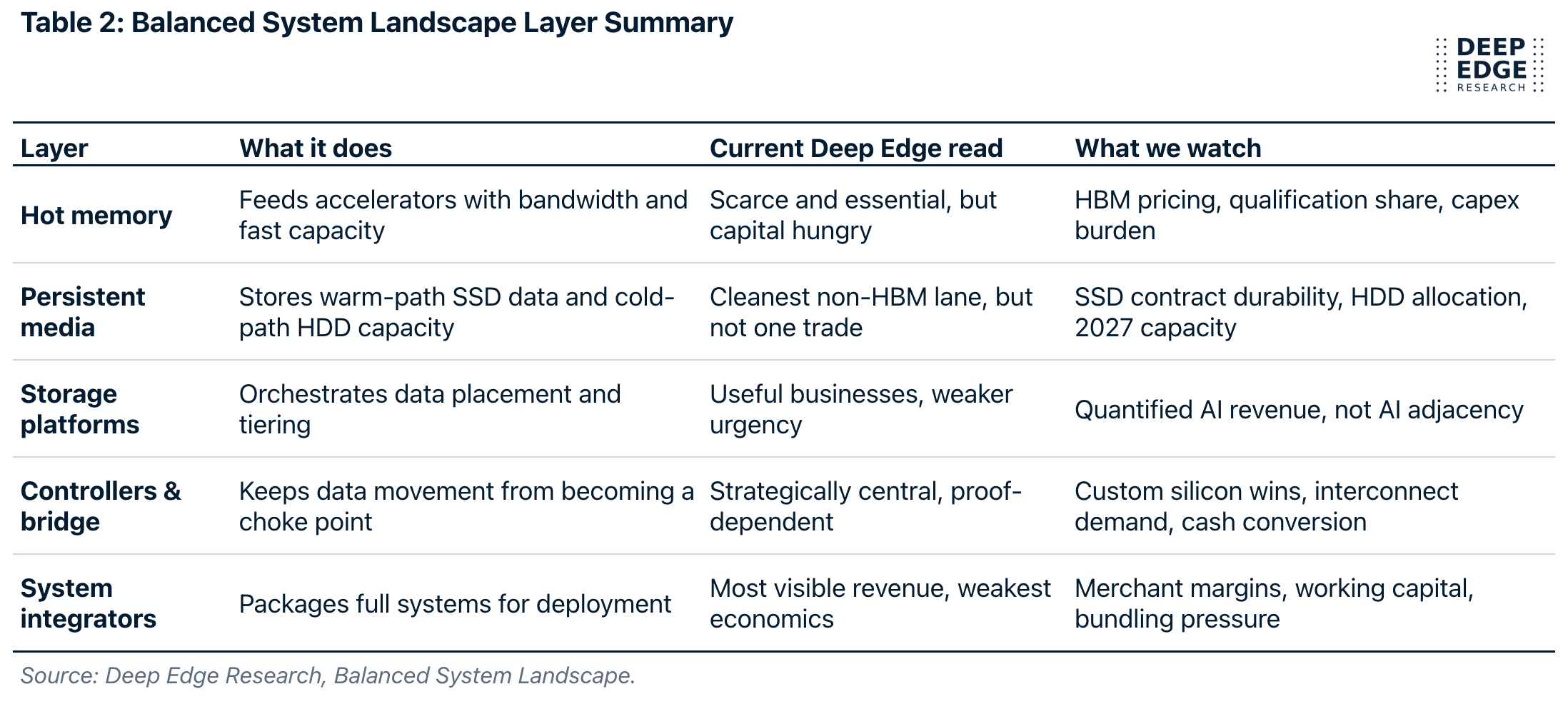
Current state: essential and scarce, but extremely capital hungry.
Deep Edge Matrix view: hot memory sits closest to the accelerator. If bandwidth and fast capacity are not available, the system starves quickly. That is why this layer creates the easiest analytical mistake: assuming the hottest technical constraint must be the cleanest equity.
The Deep Edge Matrix separates the two. SK hynix sits in WAIT because the operator quality is cleaner, but the setup still requires patience. Micron sits in MONITOR because the exposure is powerful, but the proof burden is heavier: new fabs, packaging, qualification cycles, and customer-specific HBM ramps can all consume cash before shareholders get paid.
Next dollar: not the cleanest place for fresh capital today. If HBM pricing, mix, and qualified share improve faster than the build bill, Micron moves closer to an investable action state. If the spending arrives first and the payoff remains forward-dated, hot memory stays the best bottleneck with the messier ownership claim.
Layer 2: persistent media
Key names: SanDisk (ACT), Seagate (STRATEGIC), Western Digital (MONITOR).
Role: stores models, checkpoints, retrieval data, context, corpora, logs, and enterprise AI workloads.
Current state: the cleanest non-HBM lane today.
Deep Edge Matrix view: persistent media is where the board gets more interesting because the same demand tailwind produces three different ownership states. A normal sector screen might group SanDisk, Seagate, and Western Digital together. The Deep Edge Matrix splits them apart because the path from demand to cash flow is different in each case.
SanDisk sits in ACT because the business case is more than spot NAND exposure. The cleaner argument is warm-path enterprise SSD demand: active data, retrieval, checkpoints, context, and high-performance storage close to AI workflows. Seagate sits in STRATEGIC because mature scarcity and capacity discipline can still work in cold-path nearline HDD: corpora, logs, archives, and low-cost capacity pools. Western Digital sits in MONITOR because the role is there, but the evidence is not yet strong enough to treat it like the clean owner.
Next dollar: this is the cleanest non-HBM lane today, but it is not one trade. SanDisk, Seagate, and Western Digital all benefit from AI storage demand. They do not all keep the same economics. Persistent media stays at the top of the queue if enterprise SSD pricing, prepayments, nearline allocation, and 2027 capacity commitments hold. If that evidence fades back into normal storage cyclicality, the ACT / STRATEGIC / MONITOR separation has to be revisited.
Table 2: Balanced System Landscape Layer Summary
Layer 3: storage platforms
Key names: Pure Storage (STRATEGIC), NetApp (WAIT).
Role: orchestrates data movement, data placement, and tiering.
Current state: useful, but less urgent than the physical bottlenecks.
Deep Edge Matrix view: storage platforms have a different problem: they are useful before they are urgent. Someone has to decide where data sits, how it tiers, and how it moves through the system. That can produce good businesses and good cash generation.
The gap is proof. Pure Storage sits in STRATEGIC because the setup is more active and the platform story has more growth urgency. NetApp sits in WAIT because the business may be good, but the current setup is not forcing action. Platforms often sound strategically obvious in AI infrastructure because data orchestration matters. The equity problem is that “data matters” is not the same as “this platform captures the next dollar of AI spend.”
Next dollar: not the first place we would allocate today. This layer moves higher when hyperscaler AI demand becomes a quantified revenue line, backlog, or expansion motion rather than a forward-dated narrative. Until then, platforms monetise usefulness more than scarcity.
Layer 4: controllers and bridge silicon
Key names: Marvell Technology (STRATEGIC).
Role: prevents data movement from becoming the next system choke point.
Current state: strategically central, but proof-dependent.
Deep Edge Matrix view: Marvell is the bridge case, and the word “bridge” is doing real work. Custom silicon, interconnect, optics, and data movement all matter more as the AI system grows beyond a single accelerator. Marvell’s architectural role is widening. The market has also paid for a lot of that future already.
That is why it sits in STRATEGIC. The role is real, but the cash proof has to catch up with the architecture. Strategic centrality has to become merchant economics.
Next dollar: live, but conditional. The risk is that the bridge layer becomes strategically important while the best economics are captured somewhere else: inside hyperscaler control planes, inside larger platform vendors, or in pricing terms that leave the merchant supplier with less upside than the architecture suggests. This layer improves when custom silicon and interconnect wins show up in cash conversion, not only design-win language.
Layer 5: system integrators
Key names: Dell Technologies (WAIT), Hewlett Packard Enterprise (MONITOR), Super Micro Computer (MONITOR).
Role: packages full systems for enterprise deployment.
Current state: highest relevance to the product map, weakest economics.
Deep Edge Matrix view: the integrators are the warning label and the negative-control layer for this whole exercise. Dell, HPE, and Super Micro touch more of the deployed system than almost anyone else. They package servers, storage, networking, and services into something enterprise buyers can actually deploy. In a product map, they look central.
In the Deep Edge Matrix, that centrality is the problem. Customer proximity is not profit capture. These companies sit between scarce upstream suppliers and powerful downstream customers: NVIDIA prices the GPU, memory suppliers price the HBM and DRAM, storage, networking, power, and cooling suppliers take their share, and the final buyer still has purchasing leverage. The integrator is left funding inventory, delivery, receivables, and execution risk in the middle.
That is why visible AI revenue can be a trap. Integrators absorb complexity. They compete on price. They carry working-capital burden. They sit close to bundled procurement. They can show enormous AI server volume while still failing to convert that volume into margin and free cash flow. Dell sits in WAIT because it is the best integrator to monitor, not because it earns fresh capital today. HPE and Super Micro sit in MONITOR because strategic relevance is not the same as investable edge.
Next dollar: weakest layer for fresh capital today. The integrator margin tell is the key test. If AI server volumes are still rising but integrator margins fail to improve, the system is telling us that bundling pressure is eating the economics before shareholders get paid. If merchant margins and cash conversion inflect, the weakest layer of the current board becomes much more interesting. That is why the system-integrator article comes first in the company-specific sequence: it teaches the difference between visible AI revenue and investable AI economics.
This is the practical use of the Deep Edge Matrix. It turns a wide product map into a capital-allocation map.
Cycle analysis and supply squeeze
While memory and storage are historically cyclical, current evidence suggests a unique AI-driven supply environment rather than a traditional peak-cycle unwind.
The current cycle stance rests on three pieces of evidence.
Supply scarcity: NAND suppliers have indicated 2026 production is sold out, and major suppliers are already negotiating 2027 allocations [3][4].
Pricing power: Enterprise SSD pricing has surged. External reporting points to the AI boom ending the era of cheap 1TB SSDs [4].
Manufacturing constraints: HBM and advanced packaging remain hard bottlenecks. Our memory and advanced-packaging archive points to harder HBM manufacturing, qualification friction, allocation language, and tight advanced packaging [5]. Public anchors point the same way: Micron’s FY26 materials show a capex step-up tied to HBM and DRAM investment, with Singapore HBM advanced-packaging capacity contributing meaningfully only from calendar 2027. TSMC’s Q1 2026 transcript describes engineering constraints around mechanical stress, warpage, and thermal limits [6].
What the capacity scare does and does not change
The evidence above now has a live counter-argument, and it deserves to be taken seriously rather than talked past. Around the turn of the half, three headlines argued the other side: Meta was reported to be building a cloud business to sell excess AI compute, SpaceX/xAI capacity was reported to be heading to outside customers, and The Information reported that OpenAI had cut inference costs for some workloads by roughly half. Across 1-2 July, AI infrastructure re-rated sharply while the broad market barely moved. Our book took that move directly, and we published a formal thesis audit before this piece [7].
The audit’s short version: the event study shows a targeted re-rating of the second-order beneficiaries — memory, storage, AI cloud — while Nvidia fell only c. 2.1% after market adjustment and the hyperscalers were flat to positive. If demand for AI compute had genuinely cracked, the company most directly tied to GPU demand should have worn far more of the damage. It did not. That pattern reads as a narrative shock and positioning cascade, not an operating verdict. Meanwhile the supply-side evidence in this section has not moved: capex has not been cut, 2026 production remains sold out, and 2027 allocations are still being negotiated.
What the scare changes for this board: the proof burden rises where the build bill is heaviest, and hot memory was already the board’s most cautious lane — Micron in MONITOR, SK hynix in WAIT. What it does not change: persistent-media scarcity rests on contracts, prepayments, and allocation visibility — exactly the kind of operating evidence that decides quadrants — and that evidence is still standing. If it cracks, the board changes; the specific tells are set out in the audit and re-tested in each company piece. One reading actually strengthens: a world with resale capacity and cheaper inference is a world with even less pricing power in the middle of the stack, which makes the integrator warning sharper, not weaker.
Risk is still there
The cycle trap is familiar. At the top of a cycle, earnings can look enormous and forward multiples can look cheap. On a cyclical, a low forward P/E can be a warning sign if the earnings base is about to roll over.
The evidence changes how we read that risk. The useful work is to identify which companies have contracted visibility, pricing power, qualification inertia, cleaner cash conversion, and less capex leakage. That is why the Deep Edge Matrix separates SanDisk, Seagate, Western Digital, SK hynix, and Micron rather than treating them as one storage or memory basket.
The cycle can still turn. If enterprise SSD scarcity eases, if HBM pricing rolls before the capex bill is earned, if hyperscalers internalise more of the bridge layer, or if integrator bundling hollows out margins further, the map changes. That work belongs in the ticker-level pieces.
Valuation comes next
This framework piece does not decide entry price, downside, or sizing. The individual deep dives will do that work.
For the landscape, the point is narrower: avoid the easy mistake of buying a cyclical because it looks optically cheap. We are mapping where the current AI-driven scarcity has the best chance of becoming durable profit and free cash flow before we underwrite the individual names.
Critical takeaways
Participation is not capture. AI revenue growth does not automatically become profit and free cash flow. The work is to identify where profits survive capex, customer qualification, pricing pressure, working capital, and competition.
Persistent media has the cleaner lane today. Hot memory is the more obvious bottleneck, but HBM carries a heavier build bill. Persistent media currently offers a cleaner path because scarcity, customer commitments, and 2027 allocation visibility are showing up with less capex leakage. The lane still splits: warm-path enterprise SSD is not the same trade as cold-path nearline HDD.
Economic leakage matters. Strategic importance is not the same as ownership quality. System integrators are essential to deployment, but they absorb complexity, compete on price, carry working capital, and sit close to bundled procurement. They are the clearest warning that the loudest AI revenue line can still be the weakest place to own the economics. Customer proximity is useful for headlines; it is not enough for portfolio capital.
The cycle risk is real, but not yet decisive. This still looks more like an AI-driven supply squeeze than a normal commodity peak: sold-out 2026 supply, 2027 allocation discussions, tighter enterprise SSD pricing, and harder HBM / advanced-packaging constraints.
The Deep Edge Matrix exists to sort those differences before we underwrite the individual names.
What comes next
This landscape sets the board. The next articles test the names.
The sequence from here should start with the clearest teaching order:
The system-integrator problem: why touching the full deployed system can still mean owning the weakest economics.
SanDisk vs Seagate vs Western Digital: the persistent-media lane. Same broad storage tailwind, different warm-path and cold-path economics, three different Deep Edge Matrix states.
Micron vs SK hynix: the hot-memory pair. Same bottleneck, different capital burden, different ownership state.
Those pieces will do the ticker work: valuation, entry, downside, sizing, and what would change the call. Each now carries one extra job: testing its name directly against the capacity-scare evidence the W27 audit opened [7].
The aim is to build a decision stack. First, map the landscape. Then identify where spend can become profit and free cash flow. Then underwrite the specific names one at a time.
© Deep Edge Research (2026)
References
[1] Deep Edge Research, “2026 Outlook, H1 Update: The AI Trade Is No Longer One Trade”; public eToro stats page showed +79.18% YTD for 2026 as of 30 June 2026. The SPY comparison uses the H1 update’s public-book performance chart basis and SPDR S&P 500 ETF Trust price data, showing +9.47% YTD on the same comparison basis. Included as observable live-book context, not audited fund performance. https://www.etoro.com/people/nashmaximus
[2] Deep Edge Research, Deep Edge Matrix Validation Summary; canonical live market-validation bundle matched to the current Deep Edge methodology and built from the extended 2022-2025 AI-infrastructure peer-set backtest source.
[3] Deep Edge Research Database, storage-media evidence archive, 2026-02-18 bundle; cycle evidence on enterprise SSD pricing, sold-out 2026 NAND production, 2027 allocation negotiations, and storage-media scarcity.
[4] Tom’s Hardware, “Phison CEO confirms NAND prices have more than doubled and will continue to rise, all 2026 production already sold out,” and “Kioxia exec says the AI boom means the era of the cheap 1TB SSD is over”; external reporting on NAND price pressure, sold-out 2026 production, and supply tightness potentially extending into 2027. https://www.tomshardware.com/pc-components/ssds/phison-ceo-confirms-nand-prices-have-more-than-doubled-and-will-continue-to-rise-all-2026-production-already-sold-out-ssds-facing-pricing-apocalypse-throughout-2027 ; https://www.tomshardware.com/pc-components/ssds/kioxia-exec-says-the-ai-boom-means-the-era-of-the-cheap-1tb-ssd-is-over-companys-nand-supply-is-sold-out-for-this-year-and-likely-through-2027
[5] Deep Edge Research Database, memory and advanced-packaging evidence archive, 2026-02-18 bundle; HBM and advanced-packaging cycle evidence on yield, allocation, qualification, and booked packaging capacity.
[6] Micron FY26 financial-results materials on HBM/DRAM-related capex and Singapore HBM advanced-packaging timing; TSMC Q1 2026 earnings transcript on tight advanced-packaging capacity and packaging engineering constraints. https://investors.micron.com/static-files/9c0becf5-df56-4eec-bd67-453dda68b273 ; https://investor.tsmc.com/english/encrypt/files/encrypt_file/reports/2026-04/3cef85204275f94fd111485cfdf4adb3c0263c45/TSMC%201Q26%20Transcript.pdf
[7] Deep Edge Research, “Thesis Audit: W27 2026 The AI Compute Scare”, published 6 July 2026. The audit contains the full event study (1-2 July window, SPY-adjusted basket moves), the diagnostic work on capacity resale (Meta, SpaceX/xAI) and reported OpenAI inference-cost reductions, and the four-condition test that would change the book. Primary sources for the capacity and inference reports are cited there.