
DEEP EDGE RESEARCH | POLICY WATCH
Evidence to 4 November 2026. For informational purposes only. Not investment advice.
Cipher Digital (CIFR) has raised about $4.5bn through project bonds to build three AI campuses. All three are in Texas, and management says they are funded through completion.
But its next big opportunity still needs permission to proceed. Colchis has 1GW of potential gross power, more than the 700MW required by those three funded campuses combined. Management expects its final grid classification in December. The Democratic election gains make what happens around that decision more important: Texas’s incoming governor has campaigned for a data-centre moratorium.
That matters because Cipher’s business depends on doing more than securing land and signing a tenant. It builds data centres, gets them powered and collects rent. Lenders finance much of the construction against that future income. If permission to switch on the power arrives later, the rent can arrive later too, while interest and other bills continue.
Texas governor-elect Gina Hinojosa campaigned for a data-centre moratorium pending legislative protections. That adds uncertainty to a state where the outgoing Republican administration had already ordered a grid review and a permit pause. The election has increased the risk that restrictions last longer or change shape; it has not established that Cipher’s three contracted projects must stop.
There is an important reason to distinguish them. Cipher has already delivered some halls, and its latest filing says management does not expect the existing permitting pause to materially affect its near-term development timeline. The more exposed part of the story is the expansion still needing approvals, tenants and financing.
Our judgement: Cipher’s funded construction plan remains credible, but we would put less confidence in the timing of the next growth phase until its remaining approvals are clear. Colchis is the clearest test. A delayed approval can push back the next lease and the income that follows, even if demand remains strong. For shareholders, that means a longer wait to earn back money already invested, with less flexibility if existing buildings also take longer to produce cash.
TLDR
The election changes the approval risk, not the money already raised. Cipher’s three contracted AI properties total 493 IT MW, all in Texas. Management says completion is funded.
Existing progress matters. Black Pearl has delivered 18 IT MW; Barber’s first 51 IT MW received a ready-for-service notice. Collected Barber rent is a separate milestone still to verify. Stingray has a favourable grid assessment, with remaining power-on requirements to confirm.
Colchis is the bigger growth question. Its 1GW power classification remains conditional. Management expects final classification in December and says a lease signed beforehand would retain an interconnection condition.
Delay still has a financing cost. Stingray’s existing bonds carry $24.3m of interest over six months. Rent starting later leaves the project carrying that interest for longer before its full income arrives.
What the election actually changes
The restrictions did not begin with the Democratic wins on 3 November.
In August, Governor Greg Abbott ordered a review of data centres progressing through the Texas grid-connection process. In September, he directed the Texas Commission on Environmental Quality, or TCEQ, to halt permits sought by data centres pending the audit. Cipher’s own filing describes certain power-on approvals being paused as well.
Those are separate permissions. An agreement to connect a campus to the grid does not necessarily mean its full load can start drawing electricity. Environmental permits can also remain necessary after a grid agreement is signed.
Hinojosa’s campaign called for a moratorium until a legislative session puts protections in place. She is governor-elect, so that proposal is not a new order already governing Cipher’s sites. What it changes is our confidence that the existing review will lead quickly to an uncomplicated restart.
Abbott’s directive ties the permit halt to completion of the grid review. The Texas grid operator, the Electric Reliability Council of Texas (ERCOT), expects related reports by 10 December. How that review is closed, and what the incoming administration then retains or changes, matter as much as the reporting date. Individual sites still need their approvals; the reporting date does not guarantee that every permitting restriction ends that day.
For Cipher, the immediate question is which permissions its unfinished buildings still need.
The current buildings have a stronger starting point
Cipher’s contracted programme is substantial: 493 IT MW across Barber Lake, Black Pearl and Stingray. An IT megawatt measures power for the computing equipment. Including cooling and other overheads, the same properties require 700MW of gross power. Those are two descriptions of the same estate, not additional capacity.
Adding management’s disclosures on the 2 November call and in its presentation gives 69 IT MW delivered or ready for service: 18MW at Black Pearl and 51MW at Barber Lake. Another 424 IT MW remains across the contracts. That unfinished capacity is not all at the same approval or construction stage.
Table 1 shows why a Texas address alone cannot tell us whether a building’s opening is at risk.
Table 1: Cipher’s contracted campuses are not equally exposed
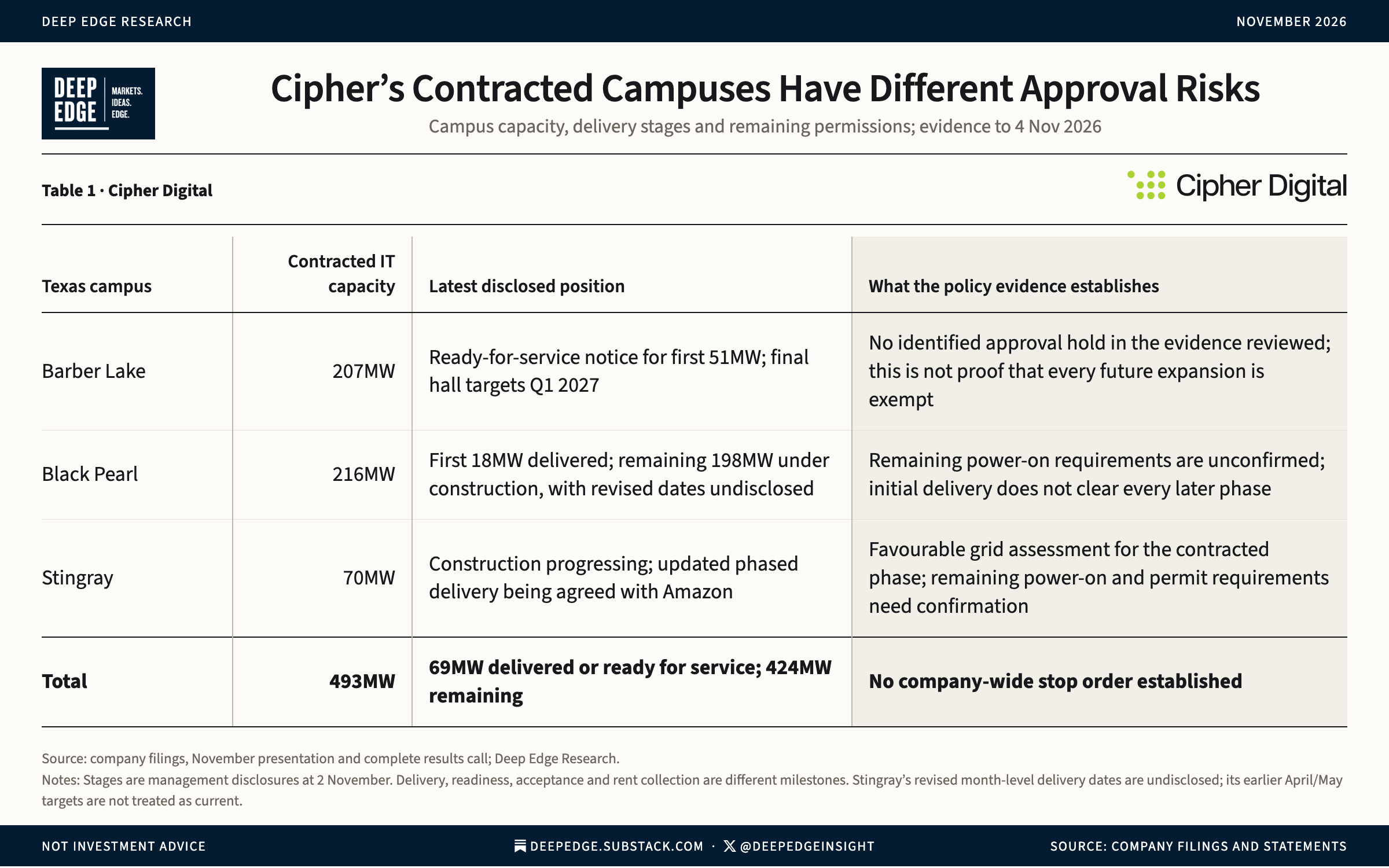
The map will separate the advanced Texas campuses from Colchis and the other development sites, with Ulysses shown in Ohio. Read the site’s remaining permissions alongside its location: a state-level pause does not establish that an individual building has been stopped.
Stingray deserves particular attention. The November presentation says the contracted phase was included in ERCOT’s May stability assessment, giving it base-load capacity without further study or reallocation. That is favourable evidence. It should not be confused with the separate 200 gross MW Stingray expansion, which has a conditional classification of its own.
It also does not establish that every remaining permission has been issued. We have not identified a named approval currently held for the contracted 70 IT MW, so treating that entire project as stopped would go beyond the evidence.
Management’s view that the permit pause should not materially affect near-term delivery therefore deserves weight. The same filing warns that future projects, expansions or modifications needing additional permits could be delayed.
That distinction is where the election matters most to Cipher’s growth story.
Colchis is where approval becomes the next lease
The 1GW Colchis opportunity is larger in gross power terms than the 700MW required by all three contracted AI campuses combined. But it has no signed tenant lease in the evidence reviewed, and its final grid classification remains outstanding.
On the November call, management said it expected final classification in December. It also explained the commercial consequence: any lease signed before the final interconnection agreement would need to be conditional on receiving it.
Cipher is already putting engineering and design money into Colchis ahead of a lease. So a longer review can delay more than electricity. It can postpone an unconditional lease, the project financing that lease supports and the rent the completed campus would earn. Tenant interest alone cannot close that chain.
Other pipeline sites have different starting points. Reveille, in Cotulla, Texas, has interconnection approval for 70 gross MW and a Q3 2027 power target. It still needs a tenant, and its remaining permit requirements are not established here. Ulysses is a separate 200 gross MW development in Ohio, with AEP Ohio capacity and access to the PJM electricity market. Its power target is Q4 2027.
Ulysses therefore provides geographic diversification from Texas, but it does not remove politics from the investment case. Ohio governor-elect Amy Acton has proposed a conditional moratorium tied to standards including utility costs, labour and environmental protections. She has called for legislation; no resulting order stopping Ulysses is established here. Existing AEP Ohio tariff protections are a separate requirement.
Nor is generating electricity on site an automatic escape. Cipher is developing gas connections that could support up to 2.5GW of generation. Its proposed structure has power producers supplying tenants, rather than Cipher necessarily buying every generator. But a turbine can need an air permit even where it avoids a grid bottleneck.
These alternatives can help Cipher develop its next sites. None yet justifies treating the whole pipeline as rent certain to start on a fixed date.
What a delay costs shareholders
A later rent start matters because Cipher has already borrowed against the properties.
Stingray’s $810m project bonds pay 6% annual interest, or $48.6m a year. Table 2 shows the interest attributable to different illustrative waiting periods, assuming that principal remains outstanding.
Table 2: Stingray’s interest continues while it waits for rent
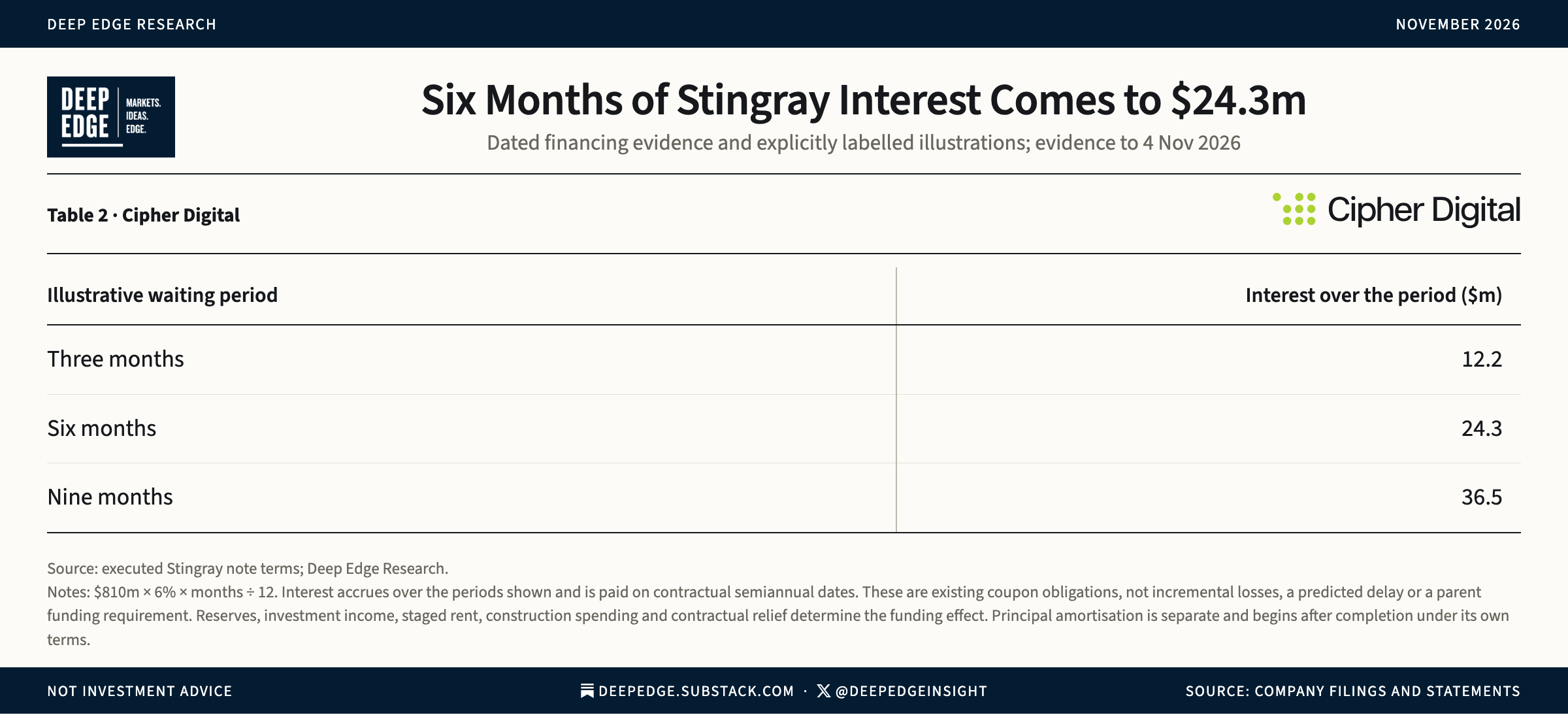
The indenture requires money to be set aside for debt payments. Its initial reserve requirement was $83m, with a formula reducing it as interest is paid, subject to a minimum. That initial amount exceeds the nine-month illustration above; it is not a verified current balance or spare parent cash. The first $24.3m coupon is due on 15 December 2026.
The problem is the timing of the money. If a hall starts earning later, cash that would have helped meet those payments is absent for longer. Whether that requires another parent contribution depends on the project’s reserves, remaining construction bill and contractual protections. Those balances and terms would have to cover the wait.
Amazon’s covered tenant obligations and Google’s support for specified Fluidstack obligations make Cipher’s rent easier to finance. But the September filing warns that lease guarantees and backstop arrangements become effective only after rent commencement, subject to their limits. They cannot simply be assumed to pay for the waiting period. The project companies still carry completion obligations; the leases determine when rent starts and what remedies apply.
This also affects the next campus. Management’s model is to recover capital from earning properties and reinvest it in new development. If existing cash releases arrive later while new sites take longer to secure approvals, both sources of progress slow together.
Management put pro forma unrestricted cash at c. $724m, allowing for October’s financing and the Barber investment. That gives Cipher room to work, although the 2 November statement does not establish the balance today. Money reserved for a specific property cannot automatically be used to bridge another one.
There is a possible benefit on the other side. If approvals become harder to obtain, powered and permitted sites can become scarcer. Cipher’s advanced campuses could be more valuable to tenants than competing projects much further from delivery. But shareholders benefit from that scarcity only when it becomes collected rent or better terms, rather than more money spent waiting.
What would change our view?
We would become more confident if Cipher demonstrates that the current halls can keep opening and its next projects can clear the remaining permissions. The tests are specific:
Through Q1 2027: remaining Barber delivery and collected rent, alongside further Black Pearl openings and a revised Stingray schedule that identifies the power-on requirements.
December’s decisions and bills: ERCOT’s report is expected by 10 December, Stingray’s first $24.3m coupon falls due on 15 December, and management expects final Colchis classification during the month. The conditions attached to that decision, followed by an unconditional tenant lease, would provide stronger evidence than another statement of interest.
The incoming administrations: the text, effective dates and treatment of existing projects under any new Texas or Ohio measures. A campaign pledge alone cannot establish those terms.
At the next financial update: cash released from completed properties, remaining costs and any additional parent contributions. Those show whether the funding plan is working through a longer approval process.
Our concern would increase if approval uncertainty pushes back leases or rent while Cipher continues committing development money. A requirement to put substantially more cash into the same contracted buildings would also weaken the completion case management has presented.
Our conclusion: the Democratic gains make the timing of Cipher’s expansion less dependable. They do not, on the evidence today, undo the funded three-campus programme. The distinction matters: shareholders own both the buildings now being completed and the opportunity to build more. We remain confident in the completion case for the first, but would require clearer approvals before giving the second the same confidence. Finishing the current halls and collecting their rent is now even more important, because that cash helps Cipher carry whatever wait comes next.
References
Cipher’s September financial statements, particularly the regulatory discussion on printed pages 58–59, the lease-guarantee risk factor and Note 14: existing reviews, management’s near-term expectation, future-permit risk, project notes and repayment conditions.
November business presentation, especially slides 11–12 and 15–18; complete 2 November results call: delivery, favourable Stingray assessment, revised phasing, conditional Colchis lease pathway, pipeline, financing and management’s later cash statement.
Cipher’s annual report, Business, Site Pipeline: Reveille in Cotulla, Texas; Ulysses in Ohio with AEP Ohio capacity and PJM access. Old dates and classifications are superseded where November supplies an update.
Abbott’s 21 September directive to TCEQ and ERCOT’s 14 September notice: separate permit and grid reviews; the December reporting expectation is not a universal approval date.
Hinojosa’s published moratorium proposal and AP’s Texas race call, 4 November: campaign intent and election outcome, distinct from enacted policy.
Acton’s conditional proposal, AP’s Ohio race call, 4 November and Ohio utility commission’s AEP tariff decision: proposal, election and utility requirements are separate facts.
Executed Stingray financing: coupon, the definition of Debt Service Reserve Required Amount and the first payment date; project-specific obligations. Delay periods in Table 2 are our illustrations, not management guidance. Policy and company evidence checked to 4 November; refresh before publication if new decisions arrive.