
DEEP EDGE RESEARCH | POLICY WATCH
Evidence to 4 November 2026. For informational purposes only. Not investment advice.
Hut 8 Corp. (HUT) has bought back $250m of shares using Bitcoin sales, before its new AI campuses start collecting rent. Now Texas’s governor-elect has campaigned for a data-centre moratorium, and the state accounts for 704 of Hut 8’s 949 contracted IT megawatts. That is about 74% of the programme.
So the question is what happens if those buildings take longer to start paying.
There is a good reason management felt able to return money. Hut 8’s first two projects have already raised $7.5bn of loans against future rent. Construction is advancing, and the company says key grid and site approvals are secured at its Texas campus. This is a more advanced business than a developer with a field, a power application and no tenant.
But the next phase still needs its own financing, while Hut 8 has spent part of the reserve it could otherwise keep for a setback. The election makes that choice more consequential. If approvals or delivery take longer, lenders still earn interest and the parent waits longer for cash it can reuse.
This does not mean the buybacks caused a funding crisis, or that a new governor has stopped Hut 8’s buildings. It means we should judge further capital returns against the permissions and financing still needed to get the rent started.
Our judgement: Hut 8 has a credible route to completing its first two AI projects. We would want clearer evidence on Beacon Point’s remaining approvals and Phase 2 financing before treating more parent cash as surplus. The $250m already returned bought a larger claim for each remaining share, but it also spent a buffer. Longer waits would make the next dollar kept inside the business more useful.
TLDR
Texas holds 74% of the contracted AI capacity. Beacon Point’s two phases total 704 IT MW. River Bend’s 245 IT MW is in Louisiana, under a different policy regime.
The first loans are real. River Bend raised $3.25bn; Beacon Point Phase 1 raised $4.25bn. Phase 2 has a lease, but its separate financing is still being arranged.
A large cash total is not a free reserve. About 98% of September’s $6.6bn cash and investment balance was restricted, largely for projects. Parent Bitcoin and American Bitcoin’s holdings are separate.
Delay makes capital allocation matter more. Beacon Phase 1’s existing coupon is c. $260m a year. Project reserves can bridge a wait, but collected rent and permitted cash releases are what eventually support the parent.
What the election changes
Texas governor-elect Gina Hinojosa called during the campaign for a data-centre moratorium pending legislative protections. Her win gives that position an incoming administration behind it. It does not establish the wording, exemptions or duration of a new restriction.
There are already restrictions to resolve. Outgoing governor Greg Abbott ordered a grid review in August and directed the Texas Commission on Environmental Quality, or TCEQ, to halt data-centre permits in September pending that review. The letter also directs other state agencies not to advance regulatory approvals related to data centres until the audit information is acquired.
The Electric Reliability Council of Texas (ERCOT), the grid operator, expects reports by 10 December. That is a reporting milestone. It is not a promise that every unfinished campus can switch on immediately afterwards.
For investors, the change is therefore the risk of a longer or differently scoped approval process. A restriction can matter through a new permit, an amendment or permission to start taking power. An operating hall and a future phase on the same campus can face different decisions.
That distinction matters particularly at Beacon Point. Hut 8 says key interconnection and site approvals are secured for the campus’s full 1,000MW of utility capacity. We have not established a named Beacon approval currently stopped. It would be wrong to turn Texas’s state-level restrictions into a claim that Hut 8’s entire site has been halted.
Equally, “key approvals secured” is not a list certifying every permission through final energisation. The question management must answer is which decisions remain, and whether the existing orders or a future moratorium reach them.
Two states, three different funding positions
Hut 8 is mainly the landlord at these campuses. It supplies the buildings and power infrastructure in which tenants operate their computing equipment. Its wider businesses include mining exposure and a smaller AI computing operation; their assets should not be mistaken for rent already earned by the new buildings.
The signed AI programme totals 949 IT MW, measuring power for the computers. Including cooling and other overheads, the same programme requires 1,330 utility MW. Table 1 keeps those measures separate and shows which projects already have their original loans.
Table 1: Texas exposure is concentrated at Beacon Point
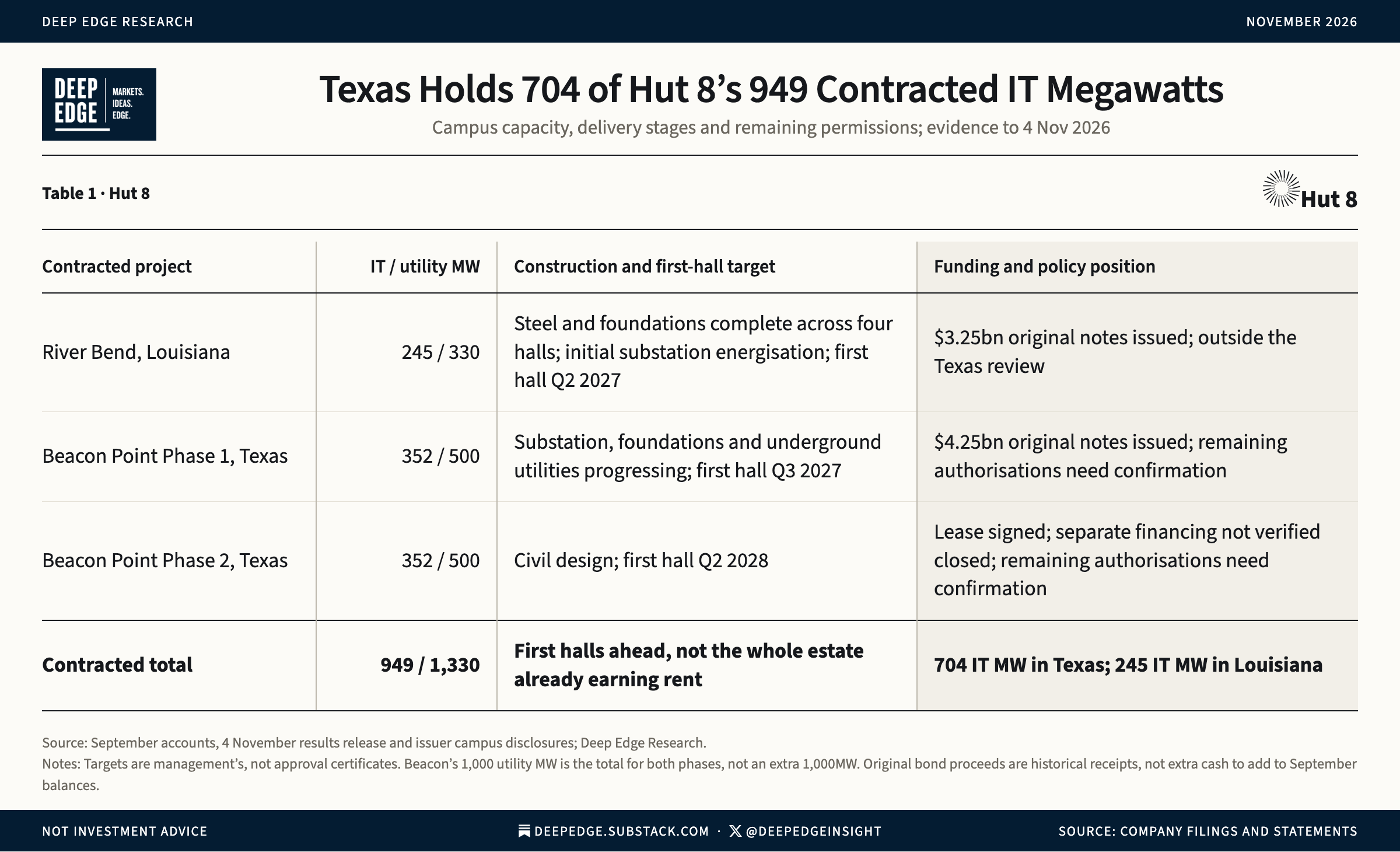
The first two projects account for 597 IT MW. Their financing is a substantial advantage. Hut 8 does not need to fund their entire construction bill from the cash left at its parent.
Phase 2 is a different task. Management expects project-level funding without new parent shares or parent-backed borrowing, and says financing plans are advancing. Until a package closes, the owner contribution, conditions and timing remain open. We should not turn an expectation into money already received.
Read the Texas concentration alongside the stage of each site. River Bend is outside ERCOT. Beacon Point’s existing approvals give it a stronger starting point than early-stage power opportunities, while the newly agreed West Texas sites still need final power approvals and development.
Louisiana has its own rules. A framework announced on 29 October requires commitments and attestations from prospective applicants for a data-centre tax exemption, including protection against costs being shifted to existing ratepayers. That is an incentive condition, not a statewide construction ban. We have found no evidence pausing River Bend’s construction.
Neither “Democrat state” nor “Republican state” is an adequate risk assessment. The decision that still needs to be made is what determines whether a particular building can proceed.
The buffer Hut 8 chose to spend
The buybacks were completed, rather than simply authorised. Hut 8 spent $74.7m during the September quarter and another $175.3m afterwards. Bitcoin sales financed both amounts.
In October it sold 2,148 parent Bitcoin. That was about 61% of the 3,510 parent coins that were unpledged at September’s end. American Bitcoin’s coins belong to a separately capitalised subsidiary and are not another unrestricted parent reserve to add to this calculation.
There is a shareholder benefit: fewer shares divide the eventual return. If the properties open on time, their loans cover construction and the next package needs little parent money, retiring shares can prove a sensible use of capital.
But it spends resources today, before those outcomes are delivered. The later $750m increase in repurchase authority is permission, not another completed outflow. Further repurchases remain a choice management can slow or stop if the evidence changes.
September’s headline cash total can obscure that choice. The balance sheet held c. $6.55bn of cash and investments, of which c. $6.39bn was restricted. Group-wide ordinary cash was c. $157m; its current allocation among the parent and subsidiaries is not established here. Money reserved to finish a building or service its lenders cannot automatically fund a parent buyback or another campus.
The $1.07bn parent credit facility provides another source of flexibility, but it was undrawn at September’s end. A later $3.9m letter of credit, drawing conditions and the liquidity covenant affect its use. From March 2027, the agreement requires minimum liquidity of 40% of commitments before stabilisation, falling to 25% afterwards. That test includes eligible unused credit; it is not necessarily a separate cash deposit. The full facility ceiling should not be described as spendable cash alongside the money used to satisfy that test.
The step-down is tied to the earlier defined commencement event at either River Bend or Beacon Point. Both project indentures define that event across all critical power phases, so the first hall’s rent alone does not establish it. A Texas-only delay therefore need not keep the requirement higher if River Bend meets that test. At unchanged commitments, the difference is c. $161m of required liquidity, rather than cash newly received. If both projects take longer to reach commencement, that flexibility arrives later too.
Another cash commitment arrives before AI rent. Hut 8’s two-site West Texas acquisition has a $100m payment at its planned December closing, subject to closing conditions and seller extension rights. Up to $80m more depends on a qualifying AI or high-performance-computing lease or transfer. The full $180m is not immediately payable, but the closing payment competes with other uses of the parent’s money.
This is why a longer approval process changes our assessment of further buybacks. It raises the value of keeping flexibility until the next project’s contribution and delivery dates are clearer.
What waiting costs, and who pays
Beacon Point Phase 1’s $4.25bn notes carry a fixed 6.129% coupon. That is c. $260.5m of annual interest at the original principal. Table 2 shows the coupon attributable to illustrative waiting periods; it does not predict a policy delay.
Table 2: Beacon Phase 1’s lenders earn interest before full rent arrives
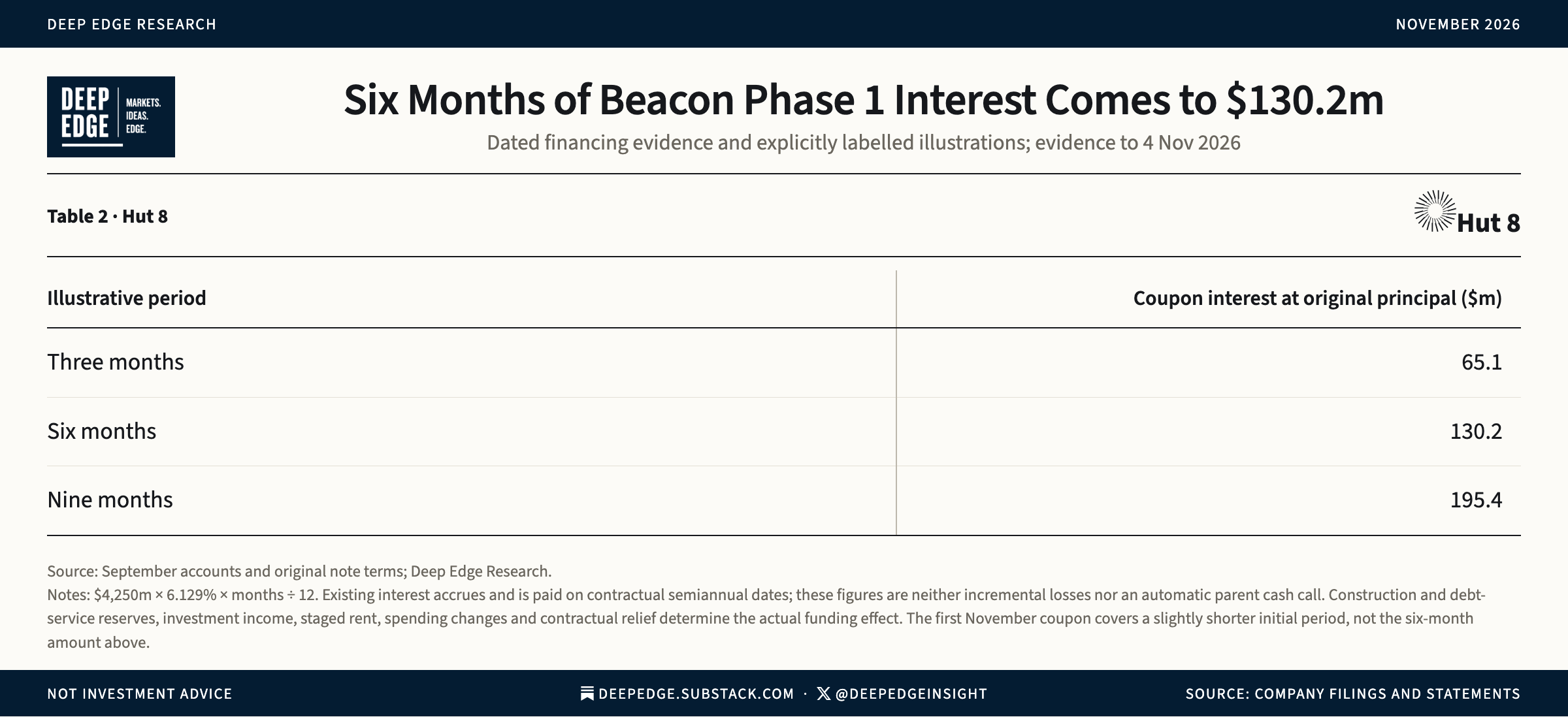
Project reserves exist precisely because construction takes time. A short wait can be absorbed without the parent writing another cheque. But a funded reserve is finite, and a later opening means a longer interval before the property supplies its expected income. The relevant disclosure is how remaining reserves compare with remaining costs and the revised timetable.
The legal protections also need to stay attached to the correct building. Google supports specified Fluidstack lease obligations at River Bend in Louisiana. That is not a guarantee of Beacon Point in Texas, every Hut 8 debt or the parent’s shareholder distributions. The two existing note issues are project obligations, not parent-guaranteed debt.
Even where the parent is not legally liable for a project loan, shareholders still own the value left after that project’s claims. A delay can reduce that value, postpone distributions or make an additional voluntary contribution commercially attractive. Non-recourse borrowing limits the lender’s claim on the parent; it does not make lost project value harmless to the parent’s owners.
There is also a constructive policy case. Hut 8 says Beacon’s required grid infrastructure has been pre-funded and its cooling design avoids municipal water for cooling. Abbott’s directive specifically addresses electrical-infrastructure costs and community water, so those features speak directly to the stated policy concerns. Advanced sites could become scarcer if competing developments struggle to get approved. But neither a company’s design claims nor scarcity supplies a legal exemption. The benefit must show up in approvals, tenant terms and ultimately paid rent.
What would change our view?
The next tests should let us separate a longer political debate from an actual change to Hut 8’s cash plan.
Before December’s site closing: confirm the $100m payment, remaining power conditions and what the parent keeps available afterwards.
Around the 10 December ERCOT reports: identify any Beacon permission still required, its status and any change to the delivery schedule. A report alone does not establish energisation.
Before further large repurchases: show the Phase 2 financing actually closed, its owner contribution and conditions. An expanded authority cannot answer those questions.
Through the 2027 hall openings: demonstrate accepted capacity, collected rent and cash available after project costs, lender payments and required reserves.
When the incoming administration specifies its policy: read the effective date and treatment of existing sites. Do not assume either a blanket shutdown or blanket grandfathering.
Our conclusion: the election makes Hut 8’s capital-allocation decision more important, rather than proving its Texas buildings cannot open. The first loans and construction progress support confidence. What we would not do is treat all remaining resources as surplus before the next financing and approval steps are resolved. The buybacks have already spent $250m of flexibility. Management now needs to show that the rent can start without needing it back.
References
September financial statements, filed 4 November: cash restrictions, parent and subsidiary Bitcoin, notes, credit facility, repurchases and subsequent acquisition terms. Retained issuer-linked copy checked where SEC access was unavailable.
4 November results filing and release: construction, 949 IT MW, phased targets, completed buybacks and management’s project-financing expectation. This note uses the release, not unread results-call guidance.
Beacon Point campus disclosure and River Bend disclosure: geography, key approvals and attributed design claims. Neither is a complete permit certificate.
September parent credit agreement: Liquidity, Commencement Date and Stabilization Date definitions; the earlier qualifying project event, not first-hall rent alone, controls the step-down.
Executed Beacon Point notes and River Bend notes: project entities, account restrictions and payment terms.
Abbott’s September TCEQ directive, ERCOT September notice, Hinojosa’s campaign proposal and AP’s 4 November Texas race call: existing measures, reporting expectation and proposed policy are distinct.
Louisiana’s 29 October incentive framework: prospective incentive applications, not a construction moratorium. Policy evidence to 4 November; refresh before publication if new orders appear.