
For informational purposes only. Not investment advice.
SanDisk Corporation (SNDK) just reported an 84.6% gross margin. For a NAND manufacturer, that is an extraordinary number. It also raises an obvious question: is this peak cycle?
At first glance, the explanation looks fairly straightforward. Revenue rose 51% sequentially to $8.965 billion. Data-centre revenue more than doubled. SanDisk’s adjusted free cash flow reached $5.035 billion after removing customer funding and Flash Ventures joint-venture activity [1][2].
The answer depends on what we mean by the peak.
Management said approximately two-thirds of SanDisk’s sequential revenue growth came from pricing. Only one-third came from volume [3]. That makes Q4 a plausible peak for the rate of revenue growth, particularly as Q1 FY2027 guidance already implies a slower c. 18% sequential increase at the midpoint.
It does not however prove that the NAND cycle itself has peaked.
Management says customer demand is still running ahead of supply, with allocation extending beyond calendar 2027 and supply growth kept to the mid-to-high teens through technology transitions rather than new wafer capacity [3]. Q1 FY2027 gross-margin guidance of 83-85% also points to a plateau near the current level, not an immediate collapse.
But SanDisk is no longer selling all of its output into that cycle in the same way.
The company now has ten New Business Model agreements across eight customers. More than half of FY2027 bits and approximately two-thirds of FY2028 bits are covered. Those customers have committed minimum revenue, guarantees and capital to secure access to NAND supply [3].
We think that the harder question is what those different clocks mean for the stock.
Cyclical shares usually move before reported margins fall. Slower revenue growth can compress the multiple while absolute pricing and margins remain high, because investors are already looking towards the eventual normalisation.
SanDisk’s shares have already fallen roughly 34% from the reference price used in our previous comparison. So the question for us is not simply whether margins will eventually compress.
They will.
It is whether the sell-off already compensates us for that compression, particularly if the new contracts make the next trough shallower.
SanDisk was already our preferred persistent-media business going into earnings. It ranked first against Seagate and Western Digital and sat in ACT on our 31 May Deep Edge Matrix. But ACT is a relative state, not permission to buy at any price. At our previous $1,915.92 reference price, the c. $1,870 weighted scenario value left almost no margin of safety.
Q4 strengthened the business case, while the sell-off changed the price. We now need to decide whether enough of the economics changed with it.
What Exactly Is Peaking?
Let’s start with the rate of change. Most of SanDisk’s sequential growth came from price.
Management attributed approximately one-third of the increase to volume and two-thirds to pricing [3]. That is exactly what we would expect a scarce supplier to do in a tight market: capture the scarcity through higher selling prices. But it also means that revenue growth can slow sharply once the pricing contribution decelerates, even if absolute prices, revenue and margins remain high.
We can already see the first signs of that deceleration. TrendForce expects NAND contract prices to rise approximately 10-15% sequentially in Q3 2026, after an estimated 70-75% increase in Q2 2026 [7]. Prices are still rising. They are simply rising much more slowly.
The spot market adds another layer. On a like-for-like per-gigabyte basis:
512Gb TLC pricing eased from approximately $0.321 in Q1 2026 to $0.310 in Q2 2026 and $0.301 at the latest captured reading on 27 July 2026.
By contrast, 256Gb and 128Gb were still firm at approximately $0.337 and $0.428 per gigabyte respectively [8].
The important point is not that one density maps neatly onto data centres and another onto consumer devices; these products overlap across end markets. It is that pricing support is no longer moving uniformly across the NAND curve.
For SanDisk, that matters because contract pricing still supports near-term earnings, but the high-density spot curve suggests that the support is becoming less broad. Since pricing supplied approximately two-thirds of the sequential revenue gain, volume and enterprise mix increasingly need to carry the next leg of growth.
That does not mean pricing was the only thing that improved. The table below shows where the quarter strengthened beyond the headline margin, before we separate those gains from the part of the result that remains tied to the cycle.
Table 1: SanDisk Q4 Evidence
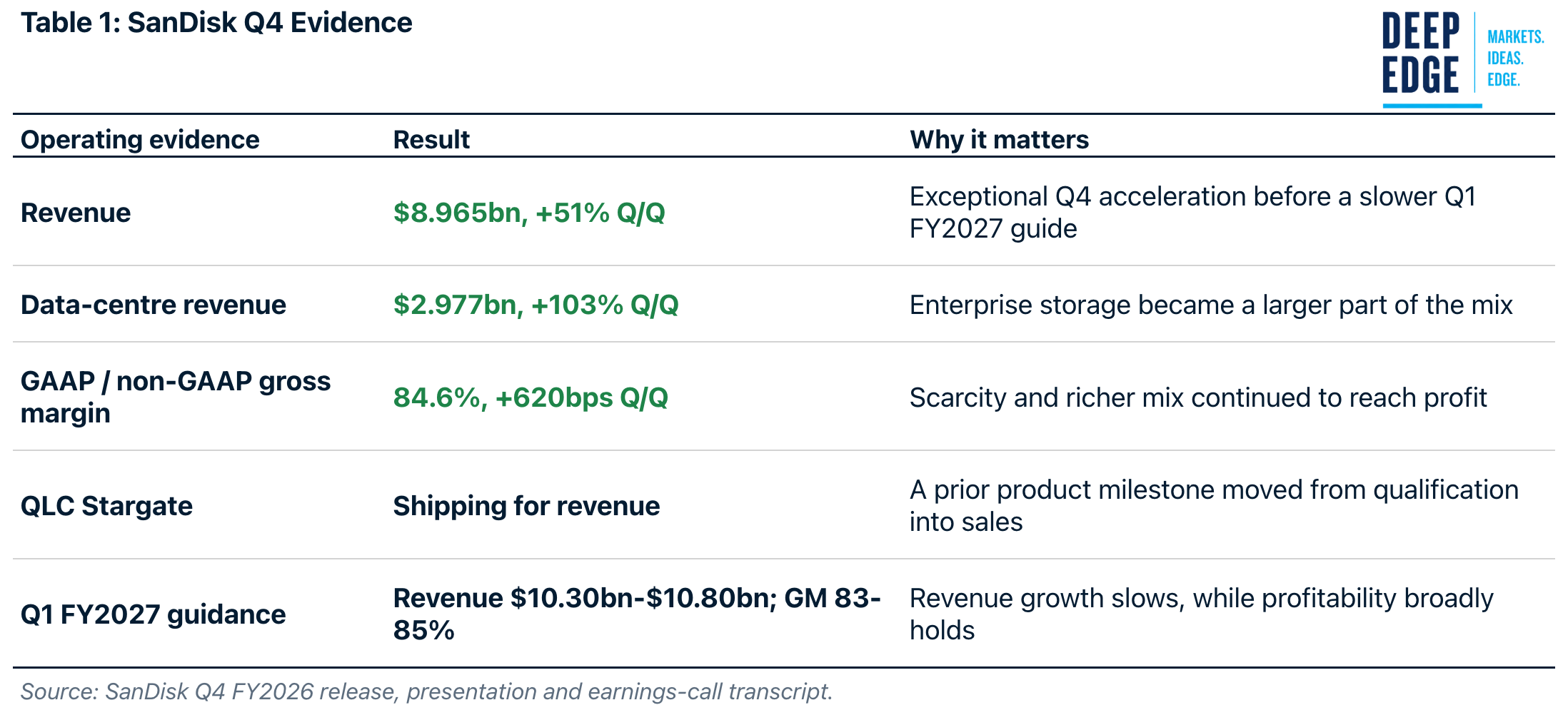
Not all of that improvement was pricing. Data-centre revenue doubled sequentially and reached 38% of bits, up from approximately 12% a year earlier, while consumer revenue fell 32%. Stargate moved from qualification into revenue shipments. Enterprise mix therefore became materially richer at the same time that the NAND market tightened.
This is why we do not reduce Q4 to nothing but a pricing move. The enterprise mix improved and Stargate moved into revenue. Even so, pricing still supplied most of the acceleration, and the Q1 FY2027 guide already points to a slower rate of sequential growth.
That gives us a more precise answer. Revenue growth may have peaked. Profitability may be approaching a plateau. The NAND cycle probably has not turned. A genuine downturn requires supply to catch or overtake demand. Management is currently describing the opposite: customer demand ahead of supply and allocation beyond calendar 2027 [3].
We are still not underwriting 84.6% gross margins as a permanent earnings base. Pricing will eventually weaken. The question is how much of today’s economics will remain when it does.
That is where the contracts become important.
What Has Actually Changed?
At the previous results, SanDisk had five of what it calls New Business Model agreements. It now has ten agreements across eight customers, which is why this part of the quarter deserves more attention than another record margin.
The numbers are substantial:
more than 50% of FY2027 bits are covered;
approximately two-thirds of FY2028 bits are covered;
the weighted-average agreement runs for more than four years;
minimum revenue at floor pricing totals $93.9 billion;
financial guarantees total $16.5 billion; and
management expects NBM margins of around 80% [3].
These are not simply purchase forecasts. Customers are committing volume, minimum revenue, guarantees and capital because access to NAND supply matters. That gives SanDisk a degree of contractual protection that did not exist across the same proportion of the business in previous cycles.
For us, this is the strongest evidence that the next downturn may not look like the last one. The agreements are a structurally new feature of SanDisk’s business model, with customers committing capital and minimum revenue to secure supply. But we also need to be precise about what has changed, because the contracts are easier to overstate than they first appear.
The agreements do not remove pricing risk. They contain variable pricing with floors and ceilings. Supply outside the agreements still floats with the market. The contracts have also never been tested through a weaker NAND pricing environment.
More importantly, the disclosures do not allow us to translate contractual coverage into a consolidated margin floor. SanDisk tells us how much of future bit volume is covered. It does not tell us the equivalent share of future revenue or gross profit.
An enterprise bit and a consumer bit do not necessarily carry the same selling price or margin. We do not have the annual contract schedule, product mix or floor selling prices required to bridge from covered bits to protected economics. Management’s expectation of approximately 80% NBM margins is also not the same thing as a contractual guarantee of an 80% margin at floor pricing.
We could manufacture a blended estimate. We won’t. Doing so would turn bit share into revenue share, fill undisclosed contract terms with assumptions and give the appearance of precision where the evidence does not support it.
Our read: The contracts have probably raised SanDisk’s through-cycle floor. The disclosures do not tell us exactly where that floor sits.
That may sound like a cautious conclusion, but it is not a small one. More than half of FY2027 bits are no longer fully exposed to quarter-by-quarter market pricing, and approximately two-thirds of FY2028 bits have coverage. We therefore think SanDisk’s future economics should be less dependent on the spot cycle than they otherwise would have been. The remaining book still floats.
There is also a concentration question we cannot yet close. SanDisk’s top ten customers represented 46% of quarterly revenue in Q3, before the latest five agreements were signed [4]. Eight NBM customers provide breadth, but we need the equivalent disclosure in Note 3 of the FY2026 10-K to determine whether customer concentration has actually improved or merely shifted.
Right now, the mechanism that normally creates the trough is not visible. Demand is still ahead of supply, which also means the contracts have not been properly tested. Q4 has not proved that SanDisk has escaped the memory cycle. What it has given us is credible evidence of something more modest, and potentially more useful: when the cycle eventually turns, the next trough may be higher than the old ones.
The Cash Test
The contracts tell us how the next downturn might change. They do not tell us whether today’s cycle-amplified economics are producing real cash. Before we get to valuation, we need to answer that as well.
SanDisk reported $7.083 billion of free cash flow, equivalent to a c. 79% margin. But that headline included $1.938 billion of NBM prepayments and deposits, alongside other working-capital benefits [2].
Customer funding is economically valuable, but it is not the same thing as cash generated by the underlying operations. We therefore would not use the reported number without adjusting for it.
SanDisk’s own adjusted free-cash-flow measure excludes NBM funding and Flash Ventures joint-venture activity. On that basis, free cash flow was still $5.035 billion, more than double the previous quarter. We view that as the cleaner measure of core conversion, although it still includes ordinary working-capital movements and should not be mistaken for a pure through-cycle cash run-rate.
Inventory is where we would look first for any deterioration in that conversion. Inventory days rose from approximately 159 to 178 sequentially. We would not call that excess supply today: inventory increased approximately 30% year over year, far more slowly than revenue at roughly 372%, and SanDisk ended the quarter with approximately $4.37 billion of net cash [1][2]. But the next step matters. If guided growth slows, that inventory should convert into shipments. If inventory days continue rising while revenue decelerates, working capital will begin absorbing more of the cycle’s cash.
That nuance does not weaken our reading of the result. The customer-funding model made a spectacular cash quarter look even better, but it did not manufacture the cash generation underneath it. SanDisk converted scarcity, enterprise mix and pricing into substantial owner cash before the customer prepayments were included.
That gives us two separate pieces of evidence. The contracts suggest that some of the economics may be better protected through the next cycle, while the cash tells us today’s economics are real. Neither, on its own, tells us what the stock is worth. That is where the sell-off begins to matter.
The Price Changed More Than Our Valuation Did
At its $1,258.58 closing price on 6 August 2026, SanDisk was roughly 34% below the $1,915.92 reference price used in our previous comparison [5][6].
We could value SanDisk by annualising its Q1 FY2027 non-GAAP EPS guidance of $44-$46. That gives us $176-$184 of earnings and puts the shares at approximately 7.0-7.3x that quarterly run-rate.
It looks cheap. The problem is that this can be exactly the wrong way to think about a cyclical when current earnings are being amplified by pricing. A low forward P/E does not tell us whether the stock is inexpensive if the “E” is likely to normalise. Memory companies can look optically cheapest before reported profits have begun to fall.
The stock market does not normally wait for that compression to appear in the financial statements. If investors expect the pricing contribution to slow, the multiple can contract while revenue and margins are still rising. That is why the 34% sell-off matters: some normalisation is already being priced, even though we cannot observe exactly how much.
So we have not used Q4 to move the valuation goalposts. We returned to the scenario bridge we published before SanDisk reported these results and left the underlying earnings assumptions, valuation multiples and scenario weights unchanged.
Table 2: SanDisk Scenario Bridge
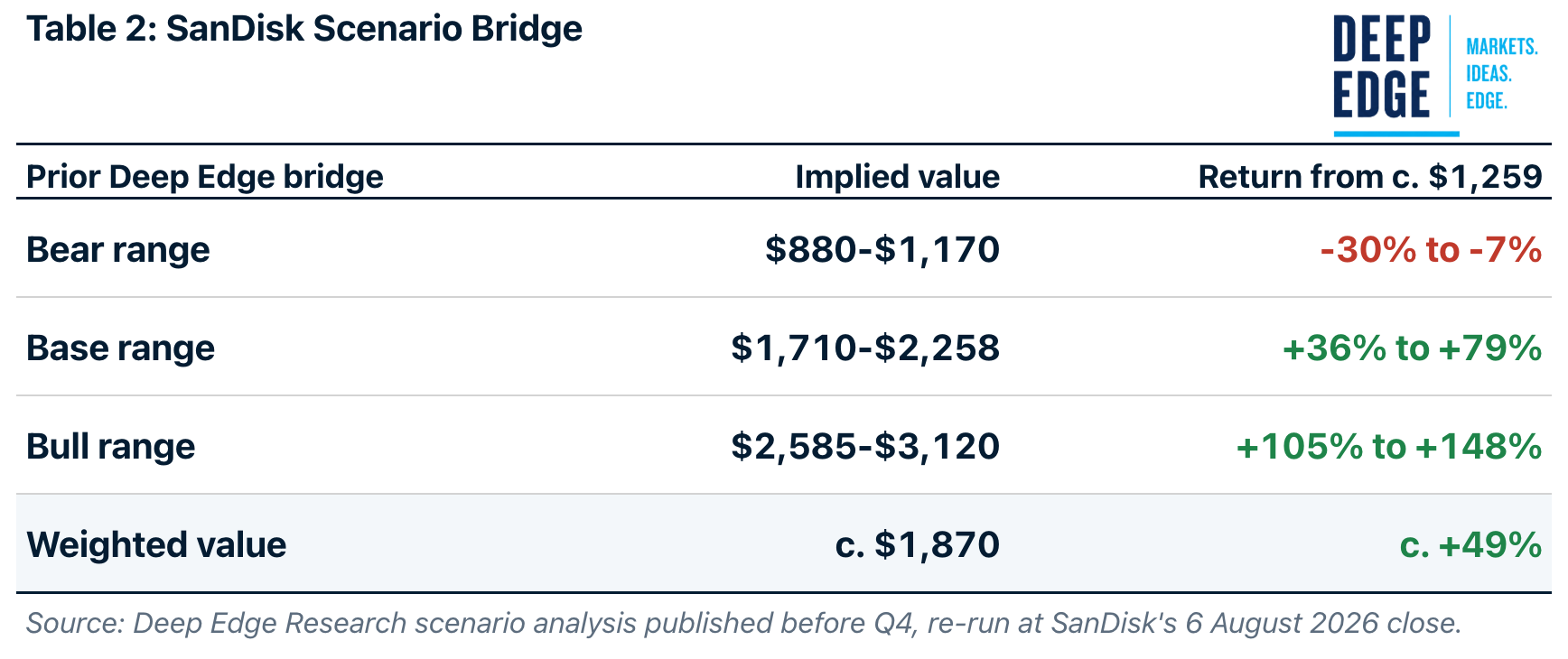
That control matters to us. The bridge was constructed before SanDisk disclosed that more than half of FY2027 bits are covered by NBM agreements and before Stargate began shipping for revenue. It also already incorporated a bear case in which margins fall materially from today’s level.
Since we built it, the operating evidence has improved and the share price has fallen. That is the whole reason the investment decision has changed.
At $1,916, our weighted value of approximately $1,870 gave us little reason to add capital despite SanDisk being our preferred persistent-media business. At c. $1,259, the same bridge offers around 49% upside to weighted value. The prior bear range remains 7-30% below the current quote, which is why cycle discipline still matters.
This is the stock-price answer to the cycle question. We do not need to declare that the NAND cycle has peaked. We need the current price to compensate us for slower revenue growth and eventual margin compression. The unchanged bridge says that it now does, without requiring us to answer the hardest analytical question with false precision.
We do not need to know whether SanDisk’s new through-cycle gross margin is 55%, 60%, 65% or something else. We do not need to assume 84.6% lasts. And we do not need to raise our previous valuation assumptions because Q4 was strong.
We need enough evidence that the downside economics may have improved, combined with enough prospective return to compensate us for the fact that we cannot yet quantify that improvement precisely.
At c. $1,259, we think we have both.
That moves our fresh-capital posture from prefer a better entry to attractive, with cycle discipline.
What We Are Watching Next
We are prepared to allocate without pretending that we know exactly when the cycle turns or where the next trough sits. That only makes sense if we are equally clear about the mechanisms we expect to hold and the evidence that would tell us they are breaking.
Price versus volume: Contract prices are still rising, but their rate of growth has slowed sharply and 512Gb spot pricing has softened. Q1 FY2027 should show volume and enterprise mix taking more of the load. The warning would be further price deceleration before those two can replace it.
Inventory conversion: Inventory days have risen to approximately 178. That is manageable while demand exceeds supply and inventory growth trails revenue, but those days should begin converting into shipments as guided growth slows. A further rise would tell us working capital is starting to absorb more of the cycle’s cash.
Contract protection: SanDisk’s Investor Day on 13 August 2026 and the FY2026 10-K, when filed, should reconcile the $93.9 billion minimum revenue commitment to annual coverage, explain how much supply remains exposed to market pricing and clarify whether the approximately 80% NBM margin expectation represents genuine through-cycle economics. Investor Day begins at 9:00am EDT [9].
Stargate and cash quality: Stargate needs to scale beyond its first revenue shipment, while adjusted free cash flow needs to remain strong without another large customer-funding inflow.
Q1 FY2027, Investor Day and the FY2026 10-K can improve our understanding. They cannot perform the real test.
The first weaker NAND pricing environment will.
That is when we will find out whether the contractual protection visible today actually changes the earnings profile when the cycle moves against SanDisk.
Our formal decision rules remain unchanged. Positive evidence on contract coverage, Stargate scale and margin durability would strengthen the ACT case at the next formal review. We would reassess ACT if non-GAAP gross margin fell below 50%, the bear-case margin threshold in our prior bridge, or if the run-rate pointed below 45% within the next two reported quarters without greater contract coverage.
This is not an investment premised on knowing the answer today. We are allocating because the evidence and expected return are now good enough, while retaining a clear way to recognise if the evidence subsequently proves us wrong.
Bottom Line
So, is this peak cycle? Not in the simple sense. Revenue growth may have peaked because pricing supplied most of the Q4 acceleration and Q1 FY2027 guidance already points to a slower sequential increase. Contract prices are still rising, although much more slowly, while 512Gb spot pricing has begun to soften. Profitability may therefore be approaching a plateau. But the mechanism that would confirm a NAND-cycle peak, supply catching or overtaking demand, is not evident yet.
That does not remove the risk to the share price. Cyclical stocks often reprice before margins compress, and slower revenue growth can be enough to pressure the multiple. What has changed is that SanDisk’s shares have already fallen by roughly a third while the operating and contractual evidence improved.
The contracts matter to the other side of the cycle. SanDisk now has multiyear agreements covering more than half of FY2027 bits and approximately two-thirds of FY2028 bits. Those agreements come with minimum revenue, guarantees and customer capital. Our read is that they probably raise the company’s through-cycle floor.
We cannot responsibly tell you exactly where that floor sits. At c. $1,259, we no longer think we need to.
Our previous valuation assumptions remain unchanged, yet the same bridge now offers approximately 49% upside to weighted value. The core cash generation remains exceptional after excluding customer funding and Flash Ventures activity, while the bear case still leaves enough downside to demand cycle discipline. We are not allocating because we think the cycle cannot turn. We are allocating because the price now compensates us for the fact that it eventually will.
That is enough for us to allocate fresh capital to SanDisk ahead of the other persistent-media names.
ACT does not mean the cycle has disappeared. It means the combination of business evidence, timing and prospective return is now strong enough for us to own the uncertainty.
The first softer-pricing quarter will tell us how much of the new floor is real.
References
[1] SanDisk, Q4 FY2026 earnings release, 5 August 2026.
[2] SanDisk, Q4 FY2026 earnings presentation, 5 August 2026.
[3] SanDisk, Q4 FY2026 earnings-call transcript, supplied by Quartr and published by Stock Analysis, 5 August 2026; checked against the issuer webcast replay.
[5] Deep Edge Research, SanDisk vs Seagate vs Western Digital: Who Turns AI Storage Demand Into Cash Flow?, 13 July 2026. The frozen scenario analysis used a $1,915.92 reference price and produced a c. $1,870 weighted value.
[6] Stock Analysis, SanDisk historical market data, closing-price record of $1,258.58 on 6 August 2026.
[7] TrendForce, AI Server Demand to Drive Memory Contract Price Increases in 2Q26 as CSPs Secure Supply via Long-Term Agreements, 31 March 2026; TrendForce Q3 2026 NAND Flash contract-price forecast, 3 July 2026. The ranges used here are 70-75% for Q2 and 10-15% for Q3.
[8] TrendForce, NAND Flash price data, with historical density observations retained in the frozen Deep Edge Research NAND-density workpaper and normalised from dollars per die to dollars per gigabyte. The workpaper records each observation date, density, dollars-per-die input and conversion factor. The latest captured reading is dated 27 July 2026.
[9] SanDisk, 2026 Investor Day event page, scheduled for 13 August 2026 at 9:00am EDT.
© Deep Edge Research (2026)