
On Sunday, Elon Musk caused a scare across the neocloud stocks. Debt markets, he warned, had all but shut for the specialist operators renting out AI computing capacity, and he put the number of neoclouds at “200+”.[1]
The implication most people drew was simple: the business model runs on borrowed money, and the money is running out.
Some of that long tail may well be in trouble. But more than 200 companies is not one industry with one balance sheet. So we started with operators whose accounts we can actually read: nine of the biggest US-listed cloud and data-centre builders.
The question we asked of each is narrower than Musk’s, and more useful: if no new money arrives, how long does the funding they already have last at their latest pace of building?
The short answer is that their construction is running far ahead of their own cash. In our test, cash from operations, excluding customer prepayments, covers less than a fifth of the spending rate for every one of the nine. Seven reach a funding gap by June 2027.
Our view: Musk is right that this money has to come from somewhere. He is wrong if he means these companies are about to fail. What the filings show is a set of operators that will need new financing within months, and the real question is on what terms they get it.
TLDR
Seven of nine reach a funding gap by June 2027 at the modelled pace. These are spending scenarios, not predictions of a fundraising month or a default.
Four are the most exposed: WhiteFiber, Applied Digital, CoreWeave and TeraWulf. Their runways stay at or before June 2027 across every cash-flow variant we tested.
A funding gap is not a default. Most of their debt is not due until 2029 or later; CoreWeave is the exception, with $10.6bn due by the end of 2027.
If lenders pull back, the cost moves to shareholders. Convertible notes, debt that can turn into shares, already supplied c. $10.2bn of the c. $11.8bn of usable funding raised since June.
A longer runway is not a fully funded build. Hut 8 is still seeking financing for Beacon Point Phase 2 despite its January 2029 model endpoint.
These nine are not the whole market. Builders, capacity renters and marketplaces need different funding tests, and the long tail may look very different.
1. What the funding dates show
We are asking how long the funding counted in this exhibit would support continued building. That includes cash, later receipts and credit facilities, some of which have conditions attached. The dates show where those resources would run out at the modelled pace:
WhiteFiber (WYFI): November 2026
Applied Digital (APLD): January 2027
CoreWeave (CRWV): January 2027
Core Scientific (CORZ): February 2027
TeraWulf (WULF): March 2027
IREN: April 2027
Nebius (NBIS): June 2027
Cipher (CIFR): March 2028
Hut 8 (HUT): January 2029
Companies generally arrange financing well before they reach that point, so the dates tell us where the pressure is, not when to expect an announcement. They fall into three groups:
The four most exposed: WhiteFiber, Applied Digital, CoreWeave and TeraWulf. Their modelled runways end at or before June 2027 even when we retain customer prepayments or use a two-quarter average.[2][3][4][5]
The names where the assumptions decide it: Core Scientific, IREN and Nebius. Keep customer prepayments in operating cash flow and Nebius moves to October 2027 and IREN to March 2028.[6][7][8]
The two with the longest runways: Cipher, March 2028, and Hut 8, January 2029. Their project funding gives them more time in this calculation, but we still need to know what that money can pay for.[9][10]
CoreWeave makes the point particularly clearly. Its c. $19.3bn of modelled funding lasts to January 2027 because it needs c. $8.7bn a quarter. Hut 8’s smaller c. $7.9bn stretches much further against c. $761m a quarter. A bigger balance provides less comfort when the business is spending it so much faster.
Exhibit: When each neocloud’s funding runs out at its latest building pace
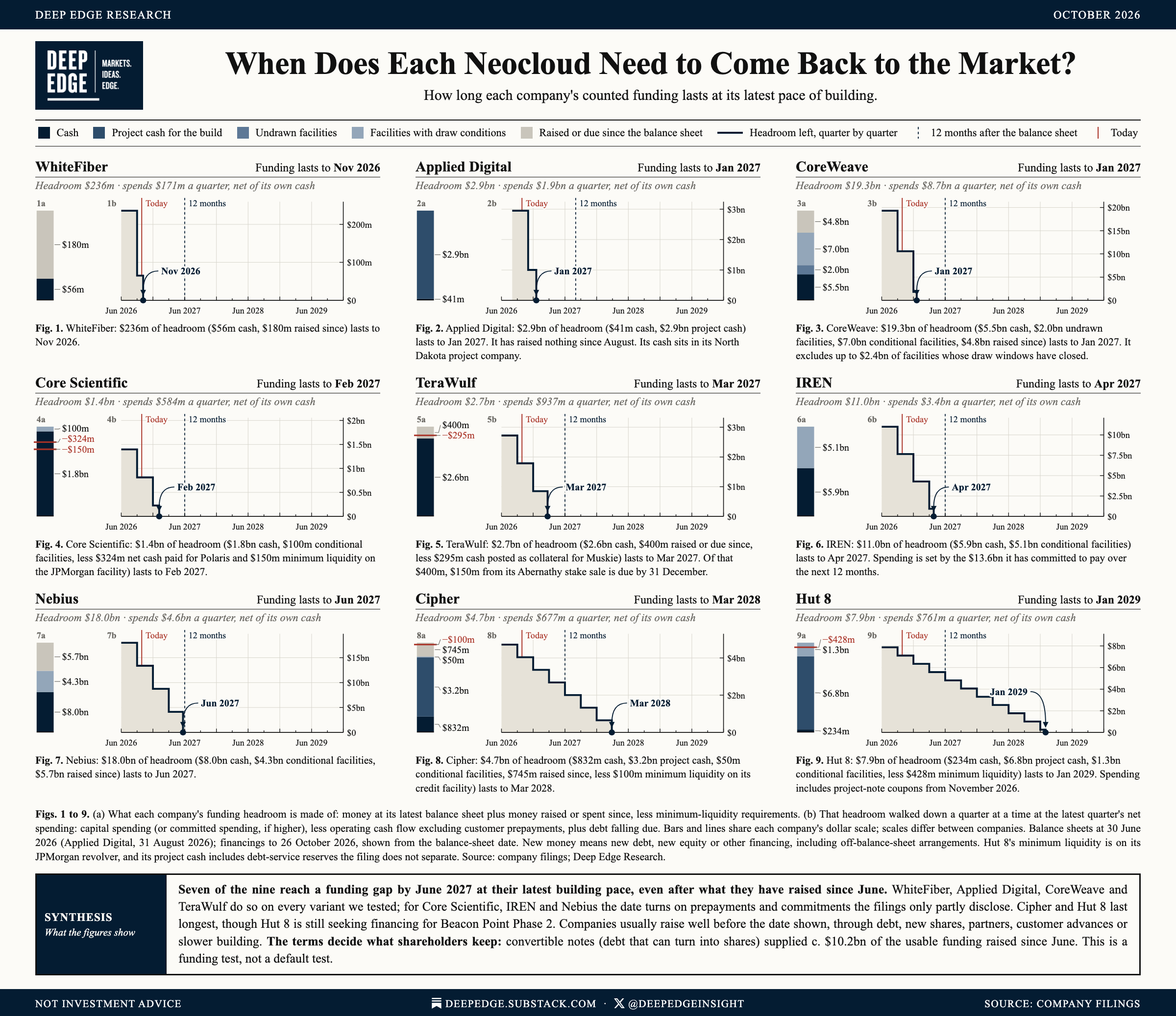
Source: Deep Edge Research calculations from company filings, with financing information to 26 October 2026.
Hut 8 still has a funding decision ahead of it. It says it is pursuing financing for Beacon Point Phase 2, whose initial delivery is expected in Q2 2028. Its existing project accounts also include money reserved for debt payments that the filing does not separately quantify. We would therefore read January 2029 as a result at the modelled spending pace, not as proof that the whole development programme is funded.[10]
WhiteFiber’s date depends on how we classify one receipt. We treat c. $66m collected on receivables as a one-off customer prepayment, although the statements do not prove that link. Leave it in operating cash flow and the modelled date moves from November 2026 to January 2027. That gives it more time, but still leaves it among the four most exposed.[2][11]
2. Is this a solvency problem?
Not on these numbers. A funding gap means a company has to raise money to keep building at its current pace; it does not mean it cannot pay what it already owes. Cash from revenue is already in the calculation, and most of the debt is not due until 2029 or later. CoreWeave is the one with a large amount due sooner: $10.6bn by the end of 2027.
Needing more money also does not dictate where it comes from. An operator can borrow, bring in a project partner, obtain customer advances, sell assets or slow construction. Musk’s warning is about the first of those. If debt does get scarcer or dearer, the others still exist, but each has a price: slower building means slower growth, and new shares spread the same business across more holders.
That shift is already visible. In our calculations, convertible notes issued by CoreWeave, Nebius, Cipher and WhiteFiber account for c. $10.2bn of the c. $11.8bn of usable new funding raised since June, after the relevant fees, hedging costs and refinancing cash uses.[12][13][14][15] The price at which the notes convert, their settlement terms and the hedges intended to limit dilution all affect what existing holders eventually give up. The amount raised alone tells us neither the eventual dilution nor that lenders forced management’s hand.
Nine listed operators are not the whole market
This also puts a limit on what we can say about the rest of the industry. Musk’s warning concerned what he described as more than 200 neoclouds. We have examined nine US-listed cloud providers and data-centre developers with disclosed accounts. We have not established that they represent the whole industry or are its nine biggest companies.
The business model matters as much as the size. Vast.ai, for example, describes a marketplace connecting customers with hosts that list their own hardware.[16] A provider renting capacity can avoid some upfront construction spending, but it still needs enough paying customers to cover the rent. Leasing a building while buying the GPUs can require substantial capital too; CoreWeave itself relies on third-party data centres.[4]
So we would not jump from these results to the conclusion that the smaller operators must be worse off. They may have fewer financing options, but they may also need much less money to keep operating. For a renter or reseller, the test would begin with rental commitments, customer margins and dependence on upstream providers, rather than the builders’ spending test applied unchanged.
3. How to read the calculation
To make the comparison, we start with each company’s June balance sheet, except Applied Digital’s August balance sheet. We add the later financing and credit facilities included in the test, then deduct the cash uses, collateral and minimum balances identified in the filings. The left-hand bars show what that funding consists of; the red marks show deductions. Each company has its own dollar scale.
We keep the categories separate because cash received, scheduled receipts and conditional facilities are not equally available. TeraWulf’s c. $400m of later inflows includes a $150m sale instalment due by 31 December. We include that contracted receipt, but have not verified it was received by 26 October.[5] Similarly, Applied Digital’s c. $2.9bn of project cash sits in its North Dakota project company. We would not treat it as interchangeable with cash at the parent.[3]
We then compare that funding with the cost of continuing to build. We use the higher of the latest quarter’s cash building spend and one quarter of disclosed next-twelve-month commitments. From that we subtract operating cash flow excluding customer prepayments, then allow for near-term debt repayments and identified additional interest costs. The right-hand line spends the resulting amount each quarter.
Holding that pace constant lets us compare the companies, but it does not forecast how construction and revenue will develop. We also use a regular quarterly allowance for debt payments instead of placing every repayment on its contractual date. The further out a date lies, the more we need a dated project and debt schedule before treating it as a financing timetable. These lines show the modelled use of funding, not historical cash balances.
4. What would change our view
The September-quarter disclosures, due from late October to mid-November, will replace the spending baselines, and we will rerun the same exhibit as each company reports. We will look for evidence that changes the funding requirement or the terms on which it can be met:
Available funding: confirmation of later receipts, collateral requirements and what project accounts can pay for. Conditional facilities are material: c. $7.0bn for CoreWeave, $5.1bn for IREN and $4.3bn for Nebius in this exhibit.
Cash from operating capacity: whether it is catching up with the spending still needed to complete contracted projects. Customer prepayments help finance delivery, but should not simply be assumed to repeat every quarter.
The next financing terms: what the money costs, what existing holders give up and when it must be repaid. Nebius’s $3.5bn Citi bridge matures in October 2027. A scenario extending beyond that date must account for repayment of drawn amounts or refinancing, rather than merely count the facility as funding.[17]
When a date moves, we would want to know why. Slower construction can make the money last longer while reducing growth; earlier customer receipts can improve funding without new shares.
Conclusion: the biggest listed neoclouds are not running out of money to pay their debts. They are running out of money to keep building at today’s pace, most of them within months. If Musk is right about the debt markets, that does not end the build-out; it changes who pays for it, and the four most exposed (WhiteFiber, Applied Digital, CoreWeave and TeraWulf) will show first what those terms look like.
References
[1] Reuters, Musk’s grim outlook hits neoclouds as debt concerns mount, 26 October 2026.
[2] WhiteFiber, quarterly report for the period ended 30 June 2026, 12 August 2026.
[3] Applied Digital, quarterly report for the period ended 31 August 2026, 7 October 2026.
[4] CoreWeave, quarterly report for the period ended 30 June 2026, 12 August 2026.
[5] TeraWulf, quarterly report for the period ended 30 June 2026, 5 August 2026.
[6] Core Scientific, quarterly report for the period ended 30 June 2026, 28 July 2026.
[7] IREN, annual report for the year ended 30 June 2026, 27 August 2026.
[9] Cipher, quarterly report for the period ended 30 June 2026, 4 August 2026.
[10] Hut 8, quarterly report for the period ended 30 June 2026, 4 August 2026.
[11] WhiteFiber, quarterly report for the period ended 31 March 2026, 14 May 2026.
[13] Nebius, closing of $5.75bn convertible senior notes offering, 24 August 2026.
[14] Cipher, convertible notes issuance, capped calls and debt exchange, 16 October 2026.
[15] WhiteFiber, convertible notes issuance and exchange transactions, 21 August 2026.
[16] Vast.ai, What is Vast.ai? FAQ, accessed 27 October 2026.
[17] Nebius, Citi bridge facility agreement disclosure, 22 October 2026.
Not investment advice.