
Last week was tough.
Our portfolio lost 12.7%, against c. 2.0% for the S&P 500.[1]
Yet the business news reinforced demand for AI infrastructure. ASML raised its sales outlook, and Taiwan Semiconductor Manufacturing Company (TSMC) reported revenue above its own forecast.[2][3]
The selling reached well beyond our portfolio. In Korea, both the KOSPI and KOSDAQ triggered 20-minute trading halts on Thursday; the KOSPI finished down c. 7.6%.[4]
Our read is that investors shifted from questioning demand to questioning who would pay for delivery. Alongside that financing scare, memory and hard drives faced their own competitive threats. We need to separate all three:
Financing: who pays for the next site?
Broadcom chief executive Hock Tan warned that capital could become AI’s biggest constraint. CoreWeave’s expensive debt gave that warning a price. If customers postpone construction, suppliers can lose orders even while demand remains strong.[5]
CXMT: how long can memory suppliers defend exceptional pricing?
China’s ChangXin Memory Technologies announced a server-memory product targeted for year end. That challenges Micron’s future pricing, but its impact depends on reliable production, customer acceptance and cost.[6]
Toshiba: an existing hard-drive risk, still unresolved.
First shipments from Toshiba’s expanded Philippine hard-disk-drive (HDD) line began on 2 October. This matters to Seagate and Western Digital, but was not fresh W42 news or an established cause of their weekly declines.[7]
We think the blanket funding scare goes too far. Financing reaches across our supply chain, but lenders have backed different contracts on very different terms, even within one company. That distinction matters before we put more of our money to work.
TLDR
The book fell c. 12.7%; the S&P 500 fell c. 2.0%. The iShares Semiconductor ETF (SOXX) and VanEck Semiconductor ETF (SMH) lost c. 10.7% and c. 9.8%. All use Monday’s US open to Friday’s close.[1]
Credit stress was real, not universal. Oracle’s default-insurance cost reached near 300 basis points; CoreWeave’s notes reportedly yielded over 15.5%.[8][9] Earlier protected AI projects financed near 6-7%.[10][11] Even CoreWeave’s loan margins ranged from 2.25 to 5.50 percentage points above the overnight dollar reference rate, depending on the deal.[12][13]
Oracle depends on when customers pay. Our stress test leaves c. $7.9bn after twelve months if equivalent customer advances recur, versus a c. $37.7bn funding gap without them. This is a stress, not a cash forecast.[14]
Our AI exposure hurt most. Nebius lost c. 23.8%, interconnect fell c. 23.3% and storage fell c. 15.9%. Different products left us exposed to shared customer-spending risk.[1]
We hold every position, buy nothing and retain c. 23.8% cash. Purchases require operating evidence, updated value and a combined-exposure review. Cash rose as a percentage because the investments fell; we did not sell.[1]
What Changed Since W41
Our view: Seagate and Western Digital are now below our entry-price limits. We still need the operating evidence before we buy.
Last week, we questioned how long suppliers could defend exceptional margins. ASML and TSMC have since strengthened demand evidence; TSMC also reaffirmed its capital-spending range.[2][3] Before buying cheaper shares, we need to revisit the tests we set:[15]
HDD entry prices: passed; operating protection: pending. Section 6 puts the prices and remaining conditions together.
Inflation: no reassurance. September consumer and producer prices rose 0.6% and 1.3% month on month.[16]
Memory and buyer spending: pending. Samsung’s full results, SanDisk and cloud-buyer investment plans remain ahead. The Micron/SanDisk calendar-2027 valuation refresh is still owed.
Research: pending. Meta’s Muse consumer-agent usage check falls on 19 October; Lam’s results on 21 October. Power-generator research and the original Toshiba scoring commitments remain in our investment record.[15]
Conclusion: We have prices we wanted. They only offer value if customer funding and supplier profits still support our assumptions.
1. The Credit Market Was Giving a Warning
Our view: We take the financing risk seriously. We do not think CoreWeave’s distressed bond yield is the borrowing rate to apply to every AI project.
A customer can keep paying existing debts and still postpone a data centre if new financing leaves too little profit. That is how a cloud operator’s borrowing cost becomes a cooling supplier’s earnings problem, well before any default.
Oracle’s five-year credit-default swap (CDS), insurance against default, reached near 300 basis points on 15 October, c. 31 wider during the week. One basis point is 0.01 percentage points. CoreWeave’s unsecured 2032 notes reportedly fell from c. 85 at the start of October to c. 78 per $100 of face value midday on 14 October, pushing their yield above 15.5%.[8][9]
But CoreWeave’s fixed interest rate, its coupon, remains 9.625%. The higher yield reflects the discounted price a new investor pays for that bond. Nor is an unsecured promise the same as a loan secured against specific graphics processors (GPUs) and customer receipts.
Figure 1 separates company borrowing in panel A from project borrowing in panel B. Investment grade is the higher credit-rating category; speculative-grade debt carries greater credit risk. Floating loans add a margin to SOFR, an overnight dollar reference rate. A delayed-draw term loan (DDTL) lets a borrower take money in stages.
Figure 1: Corporate and project borrowing costs, panels A and B
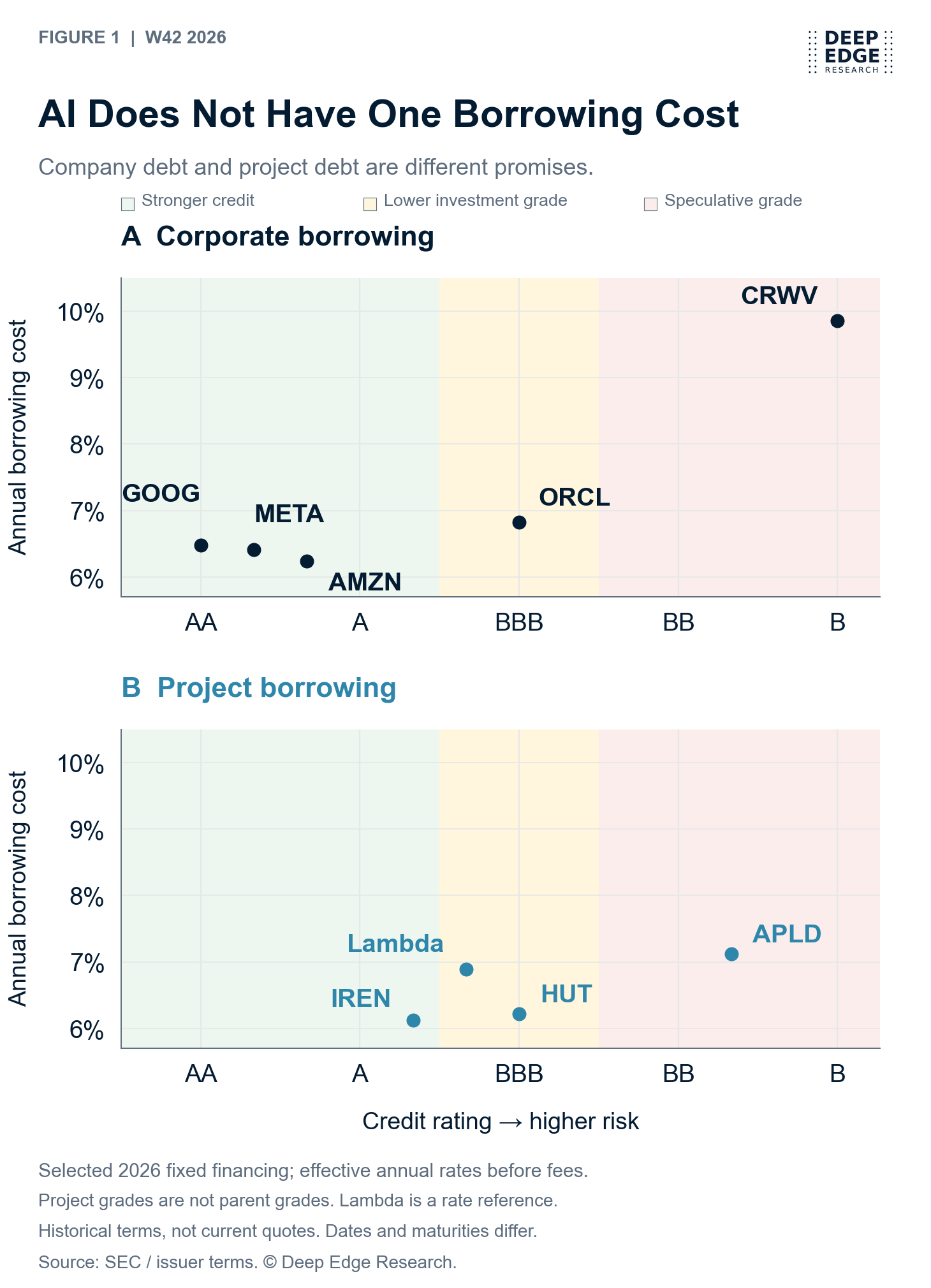
Source: Issuer terms and public rating evidence; Deep Edge Research calculations. Identical axes; one fixed financing per company in each panel, using the lowest disclosed agency grade. Corporate notes are 30-year issues except CoreWeave’s 2032 notes. Project observations are Hut 8 Beacon Point, Applied Digital ComputeCo 3, IREN’s June hardware notes and Lambda’s October facility. Alphabet, Oracle and ComputeCo 3 use expected-at-pricing grades; Oracle’s point is not moved to its later company downgrade. IREN uses a programme-rating proxy; Lambda’s rate is a contractual reference. Microsoft lacks a matched issue cost; Nebius lacks a verified debt grade. Dates, maturities and protections differ: this is not a controlled measure of project-finance savings or a current refinancing curve. [10][11][17][18][19][20]
The difference is what lenders can rely on. A corporate creditor looks to the wider company’s cash flows and debt burden. A project lender can have claims on a defined site’s assets and contracted customer payments. Those protections can support cheaper financing even when the operator’s wider business is riskier. They do not fund every future project or protect every shareholder.[10][11][12][13][18][19]
These deals predate last week’s stress, so we would not assume the next project gets the same terms. They do establish that lenders have been willing to finance protected projects far more cheaply than CoreWeave’s distressed bond yield.
Even CoreWeave pays different prices for different contracts
In CoreWeave’s DDTL 5.5 facility, customer contracts average a shorter life than the debt, leaving renewal risk. The 3.25-point margin gap shows how differently lenders price promises from one sponsor. Dates and structures differ too, so we cannot assign the whole gap to contract length.[12][13]
That still leaves pressure on the next project. Morgan Stanley identified issuance difficulty as asset-backed borrowing costs approach 8%, even for completed, rent-producing facilities.[21] We take that warning seriously.
The wider credit market was calmer
From 9 to 15 October, investment-grade spreads widened c. 1 basis point and high-yield spreads c. 12. Ten-year Treasury yields fell 14 basis points to 5.10%; thirty-year yields fell 17 to 5.43%. These readings end one day before our 12-16 October equity window closes; Friday readings are not yet available.[22]
Haven buying during the AI sell-off helps reconcile falling Treasury yields with hot inflation. Macquarie’s Thierry Wizman also argued that weaker AI investment could depress growth and yields.[23]
Conclusion: The risk to our suppliers is delayed customer spending. Before cutting their earnings, we need to identify which buyers depend on fresh money or contract renewals.
2. Which Buyers Actually Need New Money?
Our view: We see no blanket inability to fund the buildout. Microsoft’s cash generation gives us much more comfort than Oracle’s latest cash flow.
The large cloud buyers can use reserves and operating cash as well as borrowing. Public S&P evidence puts Microsoft at AAA, Alphabet at AA+, Amazon at AA and Meta at AA−; Oracle was reportedly downgraded to BBB− in July, the lowest investment-grade notch. Those ratings assess the companies, not every project they buy.[24][25]
To judge their ability to keep buying, Table 1 puts reserves alongside cash left after investment.
Table 1: Cash Behind the Buildout
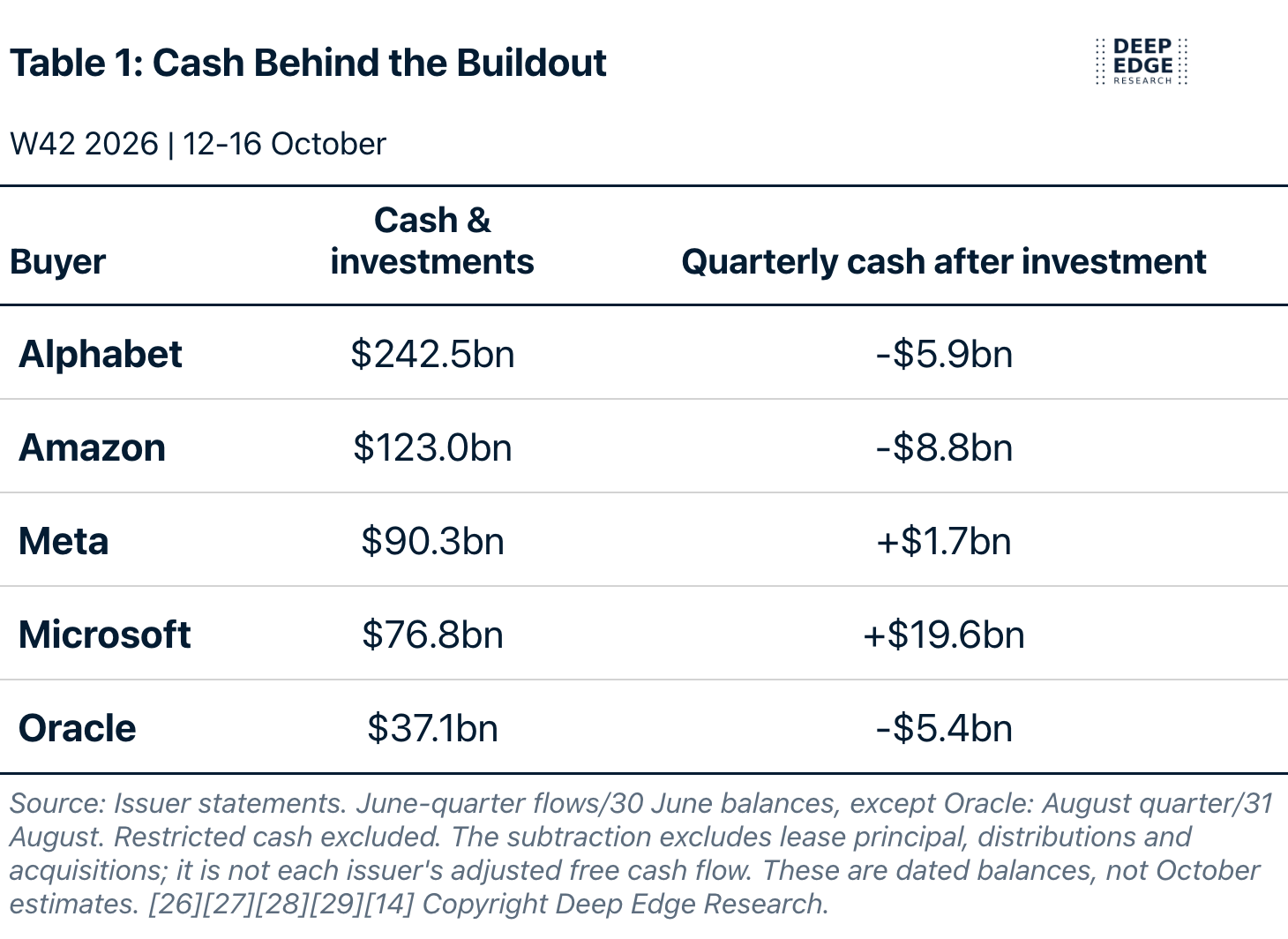
Source: Issuer statements. June-quarter flows/30 June balances, except Oracle: August quarter/31 August. Restricted cash excluded. The subtraction excludes lease principal, distributions and acquisitions; it is not each issuer’s adjusted free cash flow. These are dated balances, not October estimates. [26][27][28][29][14]
Microsoft generated c. $67.0bn after cash property spending over its full year, against c. $9.2bn of long-term debt due within a year. Meta had no scheduled second-half 2026 principal maturity and $2.75bn due in 2027.[26][28] Alphabet and Amazon consumed cash after investment in the quarter, but had much larger reserves than Oracle. Those reserves also reflect prior fundraising, not just retained profits.
Oracle shows why customer advances matter
Oracle needs a closer look. Its $37.1bn cash sat against $7.6bn of current borrowings, and its $5.4bn quarterly investment cash deficit already benefited from $11.4bn of customer prepayments with a significant financing component.[14]
Table 2 tests that dependence by holding the quarter’s other operating flows and investment spending constant for twelve months, subtracting current borrowings and assuming no new financing.
Table 2: Oracle’s Customer Advances
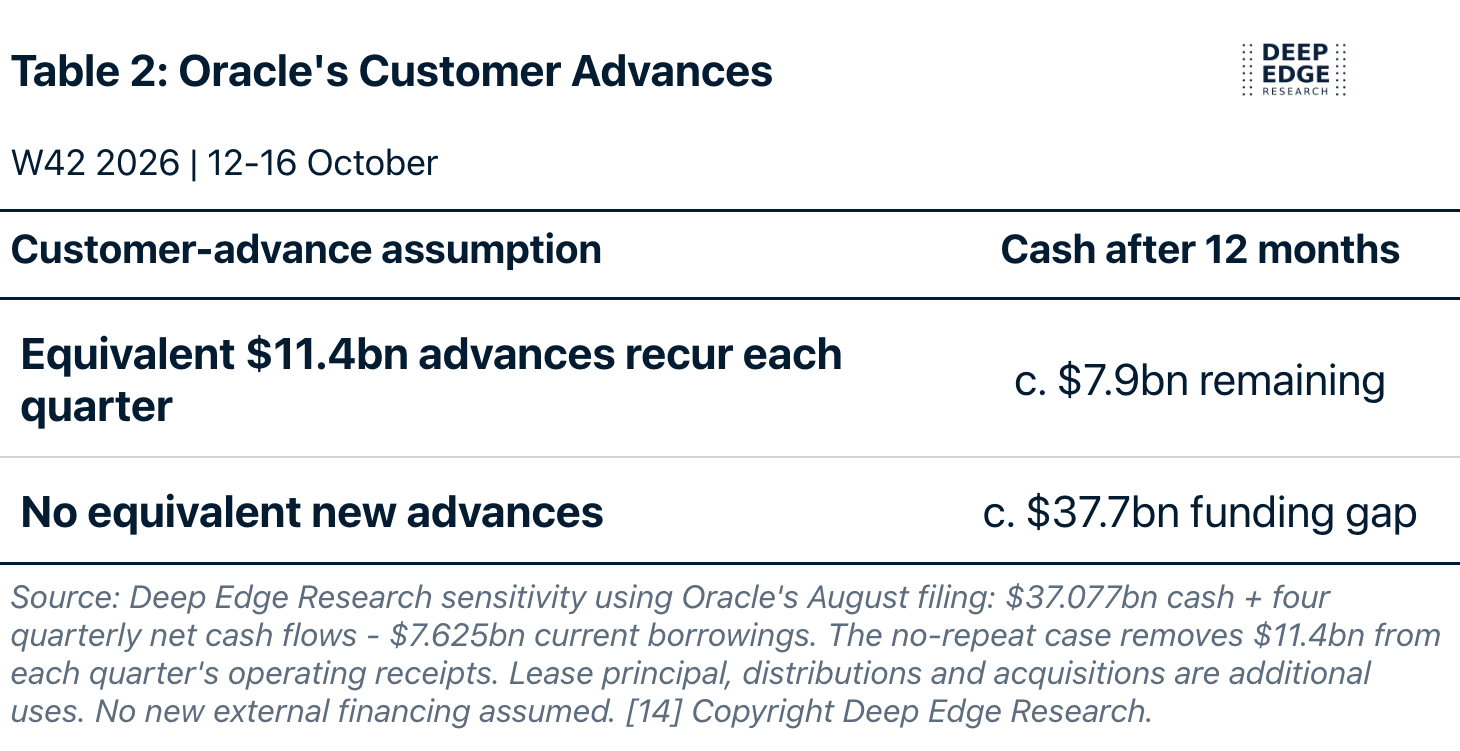
Source: Deep Edge Research sensitivity using Oracle’s August filing: $37.077bn cash + four quarterly net cash flows - $7.625bn current borrowings. The no-repeat case removes $11.4bn from each quarter’s operating receipts. Lease principal, distributions and acquisitions are additional uses. No new external financing assumed. [14]
That $45.6bn swing is a sensitivity, not a forecast. It shows why we need payment schedules as well as backlog to judge whether construction is funded.
Conclusion: These buyers are not equally dependent on borrowing. Where expansion needs repeated advances, we need payment dates. Our specialist cloud holding deserves the same scrutiny.
3. CoreWeave and Nebius Need Different Underwriting
Our view: Nebius’s lighter near-term debt burden and completed financing support our hold. It still has to show how it pays for the next stage of construction.
Neoclouds buy equipment and rent out computing capacity, paying for construction before collecting all the revenue. Funding is a genuine risk. Both shares lost almost a quarter of their value, but Table 3 shows why we would assess their obligations differently.
Table 3: CoreWeave and Nebius: Different Obligations
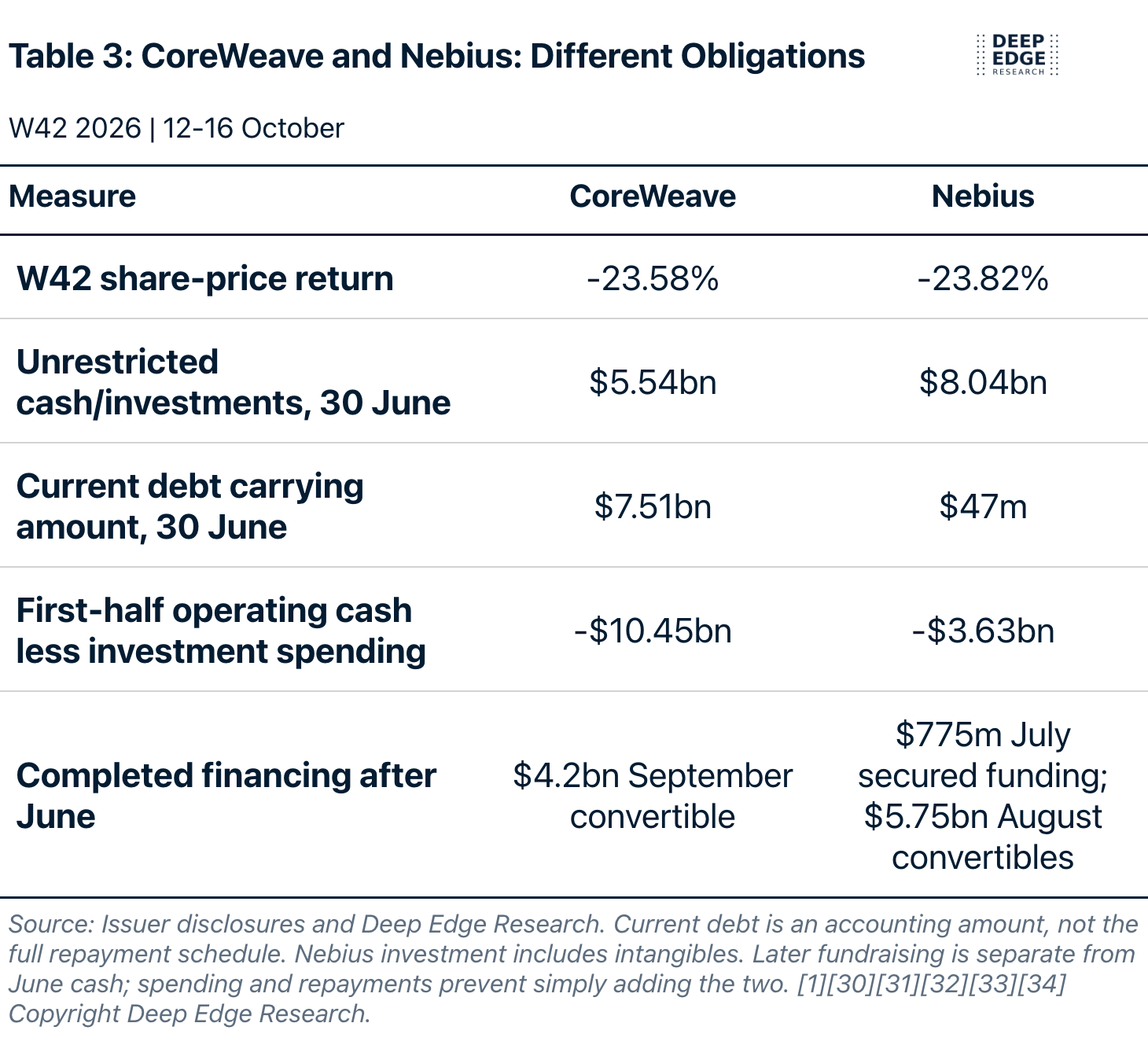
Source: Issuer disclosures and Deep Edge Research. Current debt is an accounting amount, not the full repayment schedule. Nebius investment includes intangibles. Later fundraising is separate from June cash; spending and repayments prevent simply adding the two. [1][30][31][32][33][34]
CoreWeave’s current debt exceeded June cash. Total principal debt was c. $35.6bn, with $4.4bn scheduled in second-half 2026 and $6.2bn in 2027. Its September convertible paid a 2.875% coupon, partly because investors can convert the debt into shares.[30][31]
Nebius’s near-term debt was small against reserves. Its August convertibles carry 0.5% and 4.5% coupons, due in 2030/2034. Management said customer funding covered 50-60% of investment associated with new Q2 deals, not the entire expansion.[32][33][34]
By 25 October, we will reconcile unrestricted cash, committed undrawn finance and contract-backed receipts against the next twelve months’ delivery spending and repayments. Coverage must be at least 1.0 times, with no cash deficit along the way.
A shortfall means reviewing how much we own. Unknown spending or conditional funding cannot pass: we will publish a hold, reduce or exit judgement that day even with incomplete disclosure. We will not add before completing this work.
A good project loan does not protect every obligation
Nebius’s July release describes an investment-grade customer, not Nebius or its facility, so we cannot use that rating to justify our holding.[33] Applied Digital’s Polaris Forge 1 is leased to CoreWeave, while its investment-grade hyperscaler tenants sit at other campuses, so we cannot count the two companies as independent credits.[35]
The supplier can carry the customer’s risk
The same customer risk reaches Vertiv and Bloom, whose shares fell c. 13.9% and c. 19.6%, yet their own debt maturities do not suggest an immediate refinancing crisis. Vertiv had c. $3.1bn of June liquidity and no current funded debt. Bloom held c. $2.67bn of unrestricted cash; its dominant $2.5bn convertible matures in November 2030.[1][36][37]
Their customers’ ability to pay is another matter. Oracle reaffirmed Bloom’s microgrid as Project Jupiter’s primary power source on 13 October.[38] Bloom’s June filing put 73% of first-half revenue with one unnamed contractual customer, possibly a finance vehicle rather than the ultimate user. That is not a disclosed Oracle percentage.[37]
At Bloom’s 22 October results and the following filing, we need to see deliveries, payments collected, deposits and cancellation terms, alongside updated concentration. If Oracle exposure remains undisclosed, we will leave it unknown.
Conclusion: Our Nebius hold comes with a dated funding test. For suppliers, we also need to follow customer payments: manageable debt does not protect them from unpaid deliveries.
4. Competition Still Has to Reach Pricing
Our view: New supply could shorten exceptional profits even if funding improves. We take CXMT seriously and think Seagate has more protection against Toshiba than WDC does.
Micron: strong prices, a credible competitor
DRAM is working memory; NAND is flash storage. CXMT’s server-DRAM plans challenge Micron, Samsung and SK Hynix. They do not establish new NAND competition for SanDisk.
CXMT already claims volume production on its fifth-generation mobile-memory platform. Its separate server design has a year-end target. We would not dismiss an established producer, but it still needs to demonstrate server qualification, usable output and economics.[6][39]
Micron reported fiscal-Q4 sequential price increases of a high-teens percentage in DRAM and c. 30% in NAND. Fiscal-Q1 guidance was revenue of $61.5bn plus or minus $1.5bn, adjusted earnings per share (EPS) of $38.15 plus or minus $1, and adjusted gross margin of 86.25%.[40]
TrendForce forecasts Q4 conventional-DRAM contract prices up 10-15%, and NAND up 15-20%, sequentially. These are forecasts, not realised weekly prices.[41]
A comparable DRAM forecast revised below 10% growth opens our Micron earnings review. So does guidance cut below $60bn revenue or $37.15 adjusted EPS, or withdrawal of the 86.25% margin outlook. Samsung’s 29 October results provide another warning if sequential DRAM prices are flat/falling while inventory rises. None alone proves CXMT caused the deterioration.
Hard drives: Toshiba is already expanding
Toshiba is further along: shipments from the expanded line have begun. It targets nearly double the Philippine operation’s annual storage-capacity output by fiscal 2027 against fiscal 2025. That is not a doubling of all Toshiba production.[7]
WDC’s own annual filing says long-term agreements commit volumes at predetermined or formula-based prices. That offers contractual protection, but can also cap pricing upside.[42] Nearline drives are the high-capacity hard drives used in data centres. Seagate said most nearline volume was allocated through calendar 2028, with pricing discussions covering 2027. Allocated volume is not a fixed 2028 price.[43]
Toshiba’s 30-34-terabyte M12 entered sampling in March. Seagate’s up-to-44-terabyte platform was qualified and shipping in volume to two hyperscalers. Its density reduces drives, slots and power per unit of storage. WDC’s current 40-terabyte product has less protection from density, leaving its agreements to carry more of the defence.[44][45][46]
We still think the original Toshiba sell-off ran ahead of demonstrated lasting earnings damage. WDC on 22 October and Seagate on 27 October will test that protection. The separate overreaction verdict closes at fiscal-Q2 FY2027 results, expected early 2027, as supported, challenged or unproven; fixed earnings references remain unchanged.[15][47]
Conclusion: Current pricing still supports our holdings. But we can be right about funding and lose money to new supply. Qualified competition and weaker realised prices would make us cut our earnings assumptions.
5. The Book Had More Shared Risk Than the Ticker Count Suggests
Our view: We owned different products, but they needed customers to keep spending on the same buildout. That concentration amplified our loss and matters before we add.
Figure 2 compares weekly price changes across our portfolio sleeves and the portfolio against the S&P 500. Interconnect means connections between machines.
Figure 2: W42 Weekly Changes Across the Portfolio
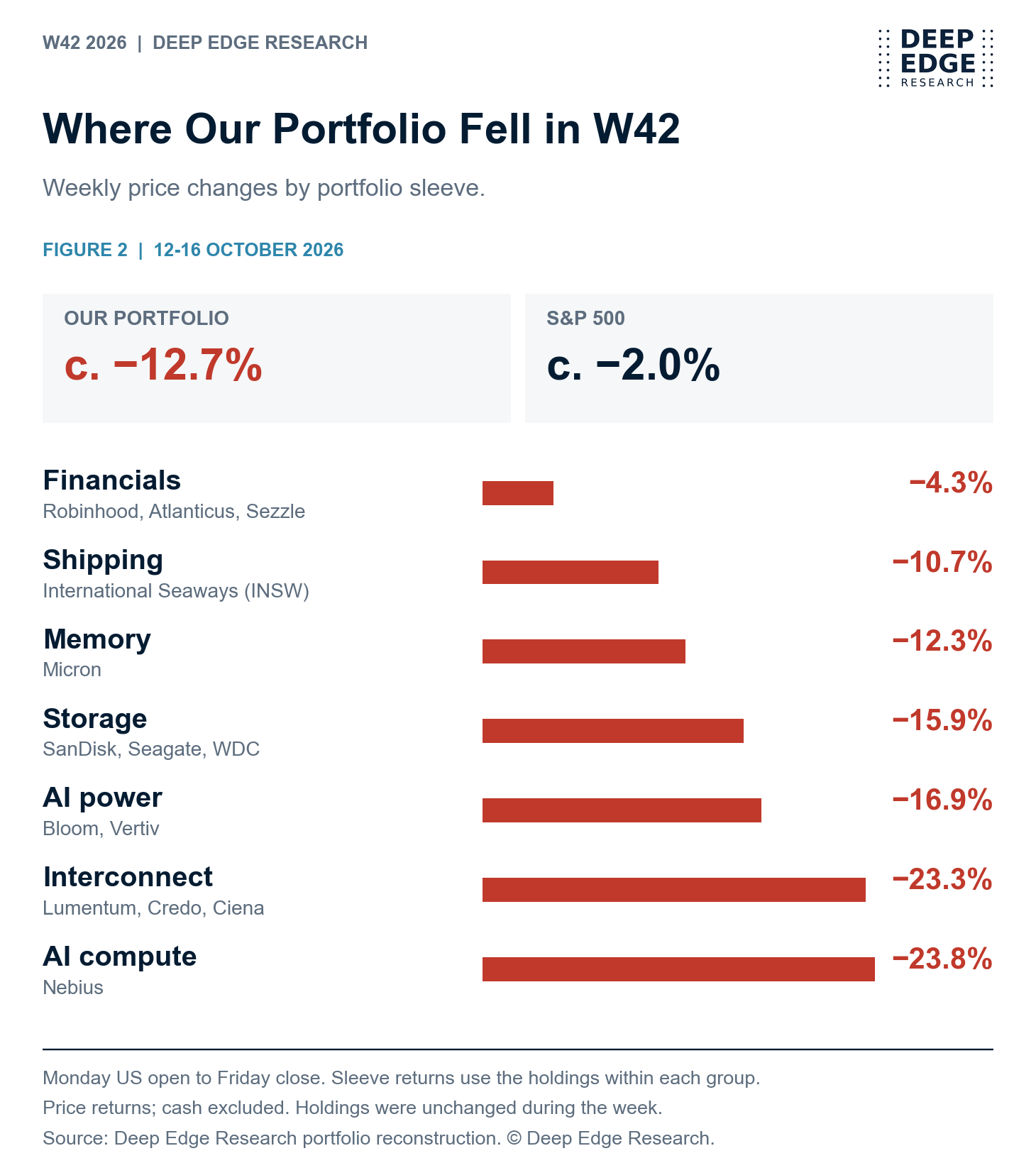
Source: Deep Edge Research, Monday 12 October US open to Friday 16 October close. Sleeve price returns use the holdings within each group; cash is excluded. [1]
Our AI positions fell much more than the financials sleeve. That does not tell us why every share fell. Our read is that different suppliers left us exposed to the same decision: whether their customers fund delivery now.
We then checked revenue from their largest customers. Table 4 shows the disclosed shares, although unnamed buyers prevent us identifying every overlap across holdings.
Table 4: Customer Concentration, panel 1 of 2
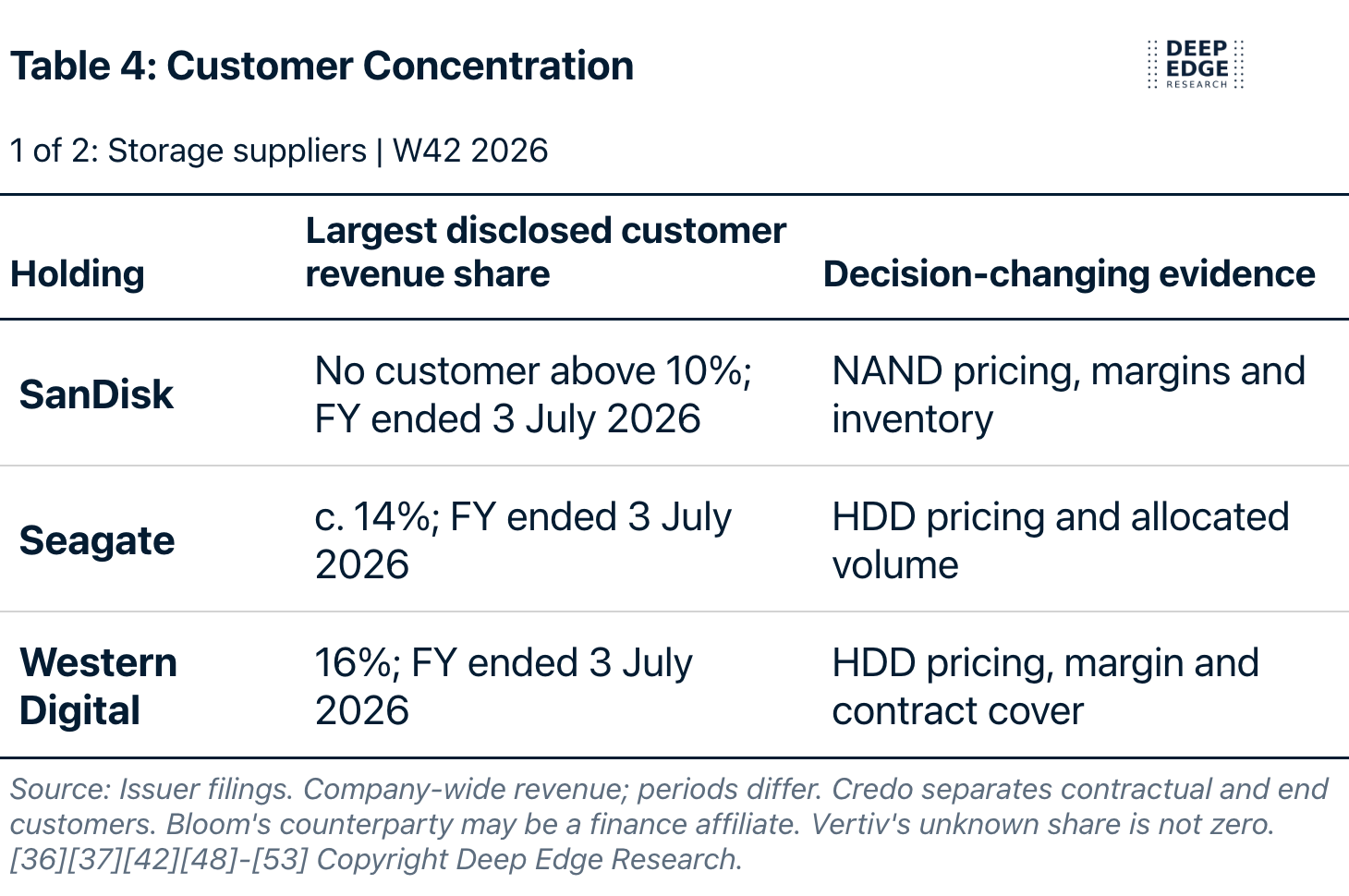
For networking and power, the definition of the customer matters as much as the percentage.
Table 4: Customer Concentration, panel 2 of 2
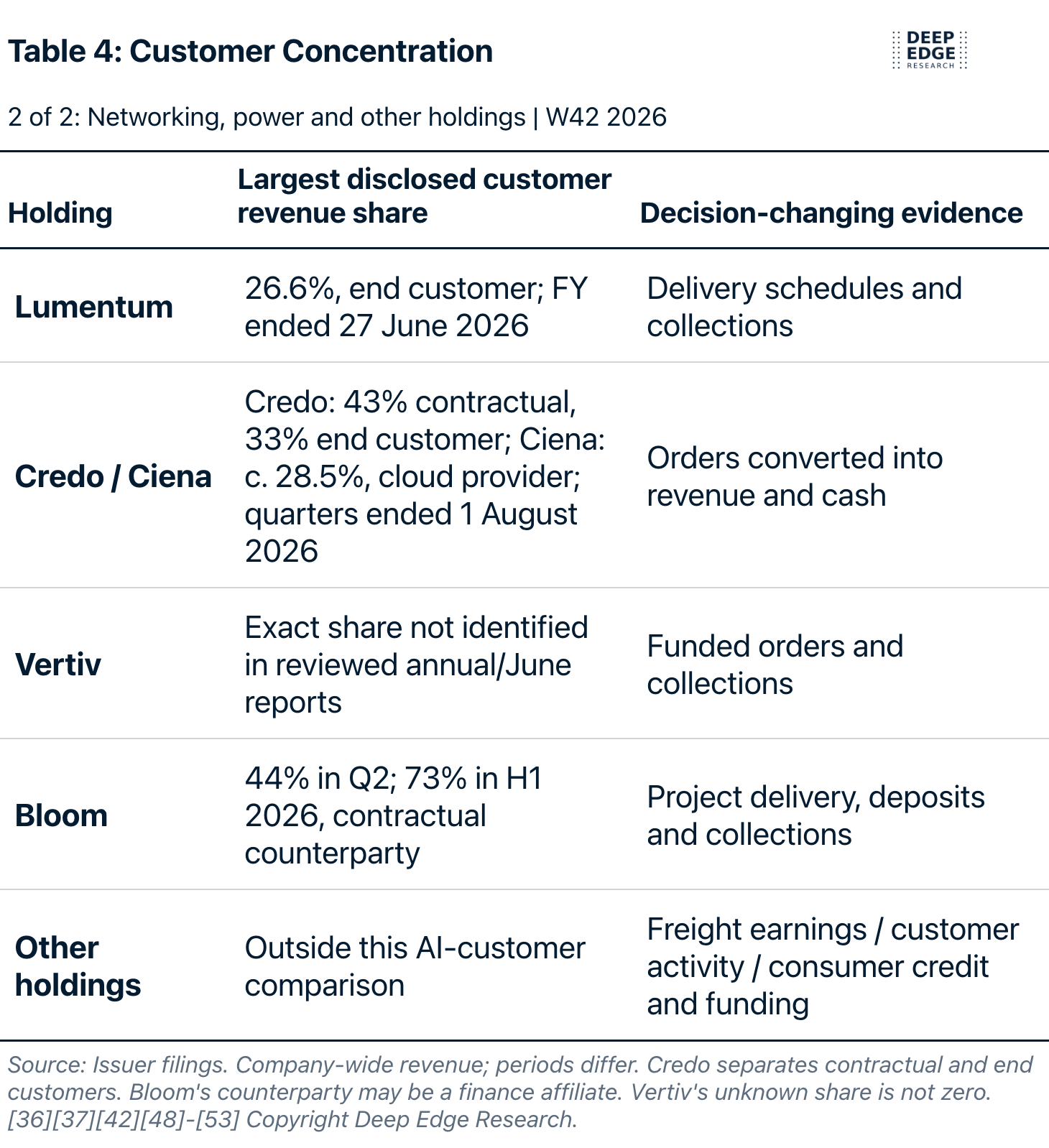
Source: Issuer filings; periods differ. Company-wide shares, not AI-only sales. Ciena = $476.570m / $1,671.129m. Credo separately identifies contractual and end customers; Bloom’s counterparty may be a finance affiliate. Vertiv’s unquantified share is not zero. [36][37][42][48][49][50][51][52][53]
Several suppliers depend heavily on individual buyers. Definitions matter, though: Lumentum reports end customers; Credo also sells through manufacturers. We cannot assume their unnamed buyers are identical, or label Bloom’s 73% as Oracle. SanDisk has a broader disclosed customer base, but its customers can still face the same industry-spending pressure.
The rest of the book needs different tests: Nebius funds its own construction; Micron faces DRAM competition. Even our non-AI holdings fell: International Seaways c. 10.7%, Robinhood c. 9.0%, Atlanticus c. 1.8%, Sezzle c. 0.1%. Our read is that investors cutting positions added to the damage, although we cannot measure forced selling.[1]
Conclusion: Fourteen names did not protect us from shared customer-spending risk. Before adding, we must judge how the portfolio would fare if buyers postpone delivery.
6. What Would Reopen Purchases?
Our view: We hold every position, buy nothing and retain c. 23.8% cash. We want to use lower prices, but only if the earnings and customer funding still justify them.
Storage, interconnect, memory and power suppliers now total c. 55.4% of the book, excluding Nebius’s own construction exposure.[1] We have not set a numerical cap, and that current weight should not be mistaken for one.[15] Before adding, we must publish the proposed combined weight and explain why customer funding, delivery schedules and downside value justify it. One stock passing its tests does not settle that portfolio decision.
Table 5 shows the company conditions still standing between lower prices and a purchase.
Table 5: What Must Clear Before We Add
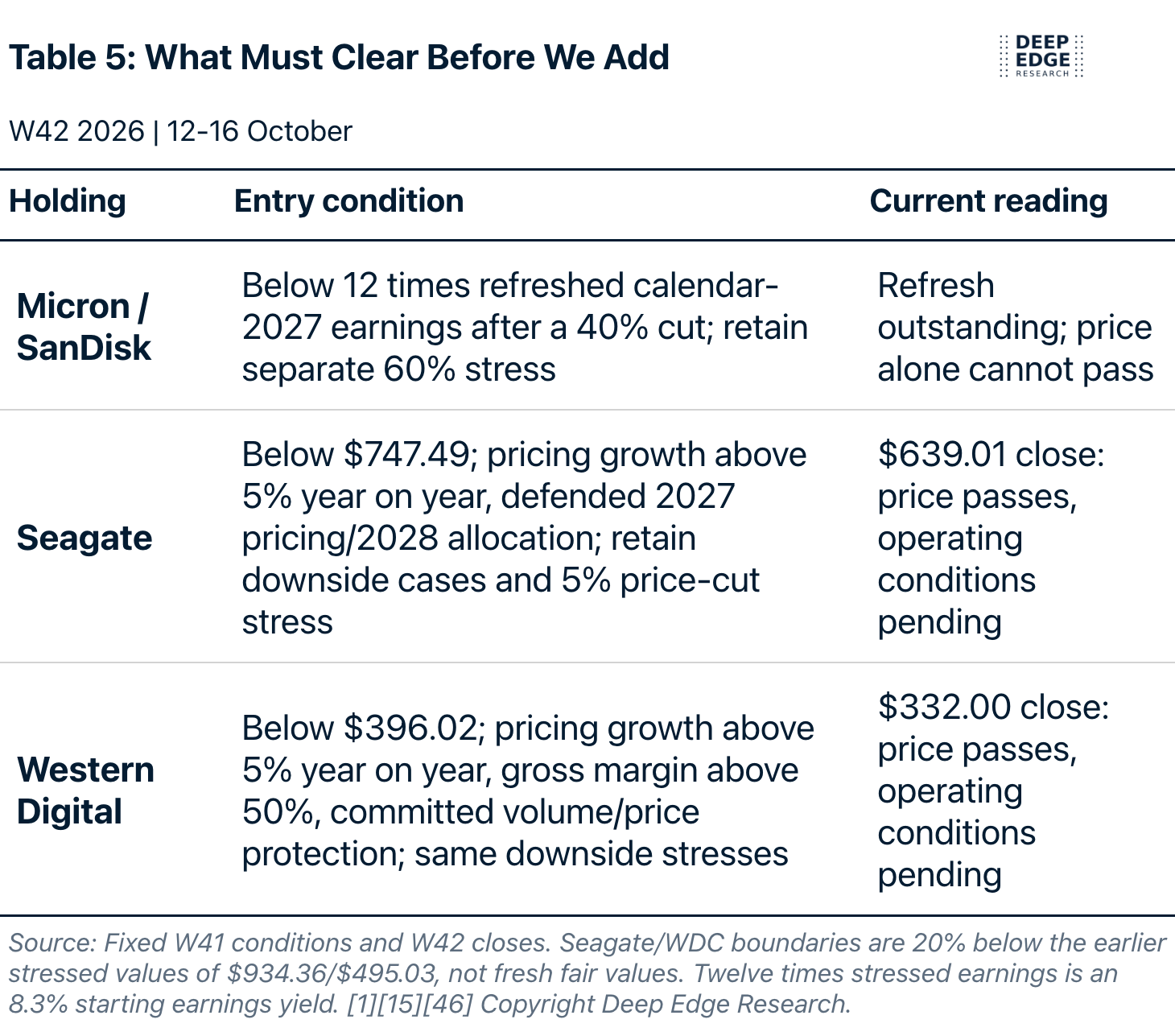
Source: Fixed W41 conditions and W42 closes. Seagate/WDC boundaries are 20% below the earlier stressed values of $934.36/$495.03, not fresh fair values. Twelve times stressed earnings is an 8.3% starting earnings yield. [1][15][46]
Lower prices must not distract us from the warnings. SanDisk’s quarterly revenue below $10.3bn, adjusted gross margin below 83%, or negative realised flash pricing with rising inventory opens a hold, reduce or exit review. Deeper margin warnings and the two-of-three deterioration rule across flash and HDD remain in our existing investment rules.[15]
Conclusion: We are keeping our cash until earnings, valuation and combined exposure justify an addition. Averaging down would hurt us if the lower price came with worse earnings or more shared funding risk.
7. What We Will Check Next
Our view: We now need evidence that customers can fund delivery and suppliers can defend pricing. Another statement that AI demand is strong will not answer either question.
Table 6 separates company results from our own deadlines. We will examine Meta’s spending carefully: higher capital spending (capex) alone proves neither healthy funding nor demand from agents.
Table 6: The Next Decisions, panel 1 of 2
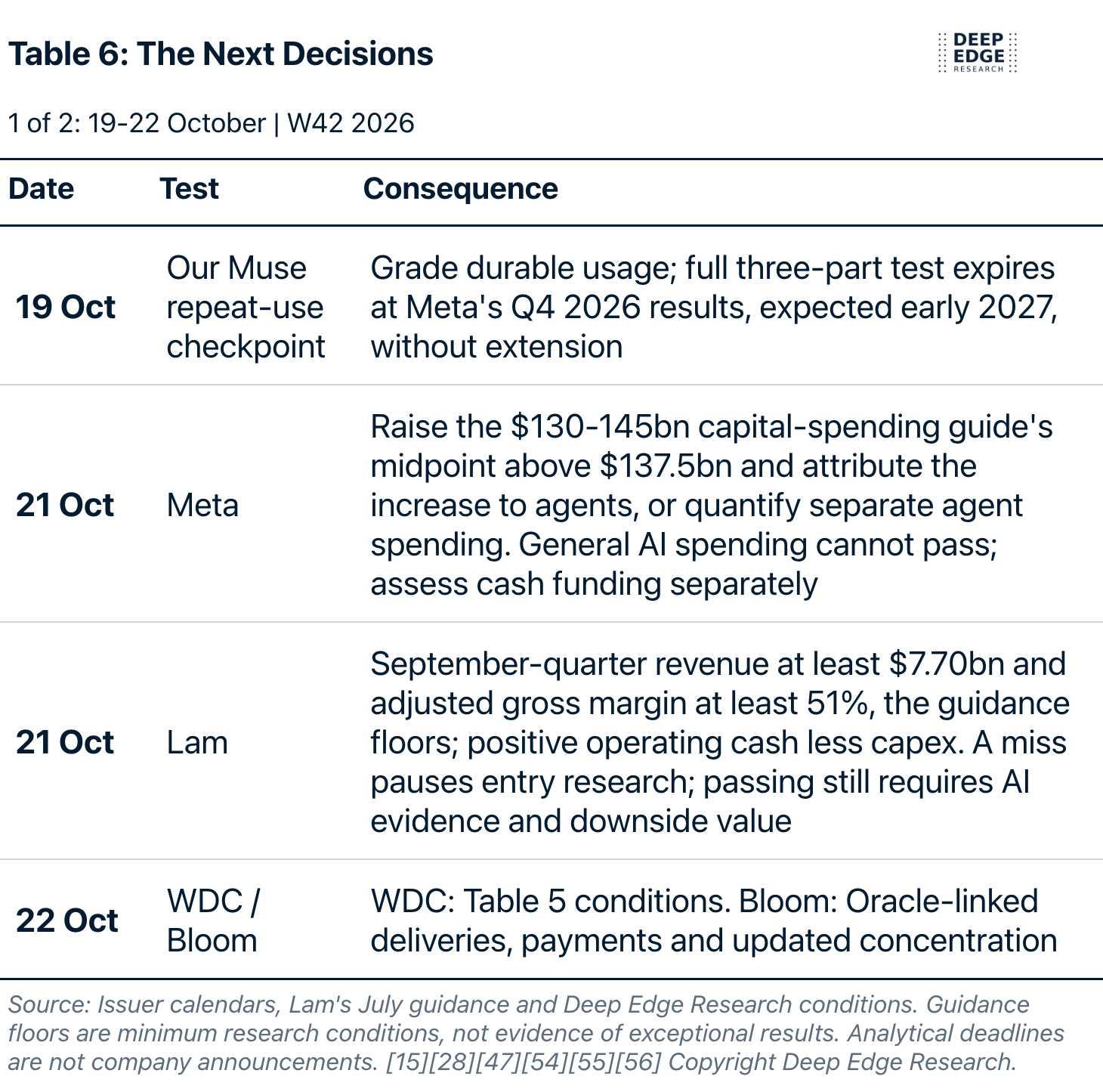
The following week tests whether operators can fund delivery and suppliers can defend pricing.
Table 6: The Next Decisions, panel 2 of 2
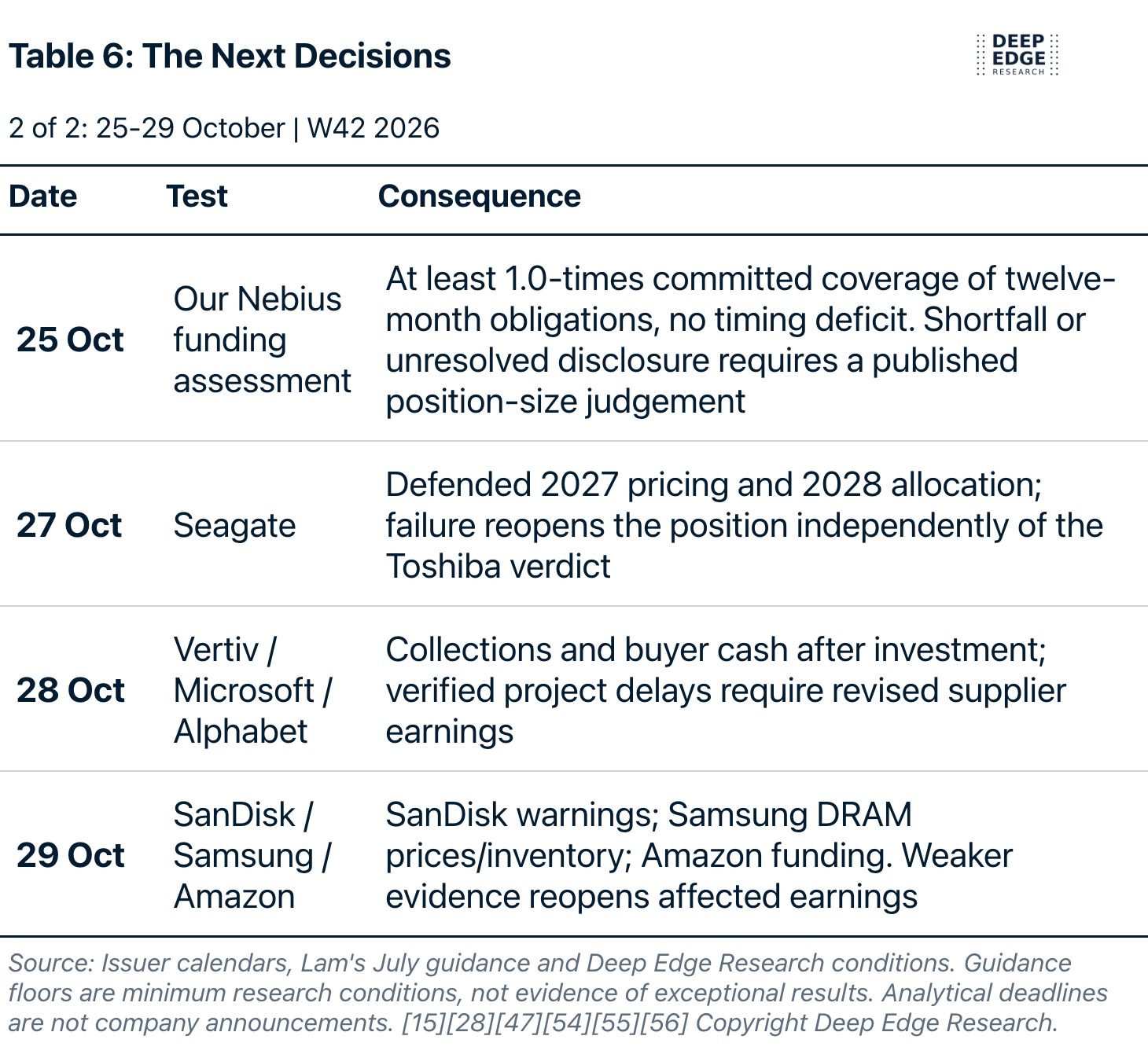
Source: Issuer calendars, Lam’s July guidance and Deep Edge Research conditions. Guidance floors are minimum research conditions, not evidence of exceptional results. Analytical deadlines are not company announcements. [15][28][47][54][55][56]
Missing disclosure cannot pass. The Nebius judgement and Toshiba verdict keep their deadlines; the existing agent and holding tests remain unchanged.
Conclusion: These dates commit us to decisions. Where the evidence remains incomplete, we will explain what is unknown and what that means for our money rather than keep rolling the test forward.
Final Thought
We still believe in the buildout these businesses supply. After a c. 12.7% loss, though, we need more than another strong demand report to decide what to do with our money.
We think the indiscriminate selling went too far because the financing evidence separates borrowers the sell-off treated alike. But customers still have to pay, and suppliers have to defend profits against new competition.
For now, we are holding our positions and keeping our cash. Before putting more money in, we need funded delivery, defensible earnings and value at the price we pay.
References
Deep Edge Research: verified positions, price observations and reconciled contributions for 12-16 October 2026, retained internally. Returns use Monday US open to Friday close; event-day moves do not establish buyer motive.
TSMC: Q3 results, 15 October; earnings-call transcript and capital-spending outlook.
Aju Press: Korean market closes and halts, 15 October; Korea Exchange: circuit-breaker rules.
Reuters: Hock Tan’s 12 October remarks, reported 13 October.
Toshiba: first shipments from expanded Philippine line, 2 October.
Reuters: AI credit-default-swap spreads, updated 15 October. Oracle observation is near 300 basis points, c. 31 wider during the week; not the earlier intraday version.
MT Newswires: CoreWeave’s 2032 note pricing, 15 October report. Cites TRACE: above 15.5% and price 78 midday 14 October versus 13.36% and c. 85 at the start of the month. Reported observation, not an independently retrieved trade series.
IREN: 1 June financing announcement; FY2026 10-K, Note 23; SEC note-purchase agreement reproduced by Yahoo, Sections 1-2. The 5.96% par notes pay monthly; programme ratings do not establish a parent rating.
Hut 8: issuer financing release, 9 June; River Bend 8-K; Beacon Point 8-K. Par project notes, semi-annual payments; the River Bend narrative and closing documents differ by three days within April.
CoreWeave: investment-grade DDTL 4.0 financing, 31 March. Customer/asset-backed financing, not a parent-company rating.
CoreWeave: DDTL 5.5, 10 August. Ba2/BB+ facility ratings, SOFR + 5.50%, and shorter customer contracts than debt maturity.
Oracle: August 10-Q. Constant-quarter cash sensitivity is our calculation, not guidance.
Deep Edge Research: W41 Weekly Brief and retained W39-W41 investment conditions, retained internally.
Bureau of Labor Statistics: September CPI, 14 October; September PPI, 15 October.
SEC issue-pricing terms: Meta, 30 April; Amazon, 7 July; Alphabet, 6 August; Oracle, 2 February. Historical deal pricing and offering ratings on different dates, not current refinancing quotes.
Applied Digital: August 10-Q; ComputeCo 2 pricing and rating headlines; 9 July public reprint of ComputeCo 3 final Fitch BB− assignment. ComputeCo 2’s reported 7.232% issue yield, not its 6.75% coupon, enters the calculation; final agency reports were not independently retrieved.
CoreWeave: June 2032 USD note indenture; transaction counsel confirms par issuance; 15 June public reprint of S&P’s B issue rating. This matches the June offering rather than substituting the B+ company rating.
Morgan Stanley: Carolyn Campbell’s data-centre financing assessment, 16 October. Category-level yields and financing assessment, not a named ABS tranche’s weekly price.
Federal Reserve/ICE via FRED: ten-year Treasury, thirty-year Treasury, investment-grade spread, high-yield spread. Latest observations: 15 October; next scheduled release 19 October.
Yahoo Finance: Treasury haven buying and Macquarie’s growth interpretation, 15 October. Attributed explanation, distinct from the FRED closing series.
S&P: hyperscaler credit comparison, 14 May, publicly accessible primary excerpt; Microsoft investor ratings FAQ. Dated public rating evidence, not a live agency feed.
Reuters via Euronext: Oracle’s July BBB− downgrade, reported 4 August. Original agency action not retrieved.
Alphabet: June 10-Q; Q2 release.
Meta: June 10-Q; Q2 release.
Nebius: June statements; shareholder letter.
Nebius: August convertible financing and earlier-note exchange.
Applied Digital: fiscal-Q1 results, 7 October, HPC Hosting Update identifies campus tenants.
Bloom: June 10-Q. See concentration definition in Note 1 and Oracle warrant consideration in Note 3; unnamed contractual customers cannot be identified as ultimate users.
CXMT: fifth-generation mobile-memory platform production announcement, 20 September, Chinese.
TrendForce: Q4 contract-price forecasts, 30 September. Forecast growth, not realised weekly contract prices.
WDC: FY2026 10-K, customer concentration and long-term agreements.
Deep Edge Research: SanDisk versus Seagate versus Western Digital.
Seagate: 13 October announcement confirming 27 October results.
Credo: August-quarter 10-Q, contractual and end-customer shares.
Issuer calendars: WDC, 22 October; Bloom, 22 October; Meta, 21 October; Lam, 21 October.
Issuer calendars: Vertiv, 28 October; Microsoft, 28 October; Alphabet, 28 October; SanDisk, 29 October; Samsung, 29 October; Amazon, 29 October.
Lam: June-quarter results and September-quarter guidance, 29 July.
Not investment advice. Holdings and author assumptions are disclosed for accountability, not as recommendations to copy the portfolio.