
Below is a copy of the investment letter we sent to our clients.
Due to the depth and length of our original analysis, this note has been adapted for Substack; it has been divided into three parts for readability. This is Part 1 of 3.
For informational purposes only. Not investment advice.
TLDR
2026 is the year AI shifts from a narrow “GPU trade” into a broader infrastructure buildout as bottlenecks migrate across the stack: memory bandwidth (HBM), advanced packaging (CoWoS), power delivery, thermal, and interconnect
The driver is not sentiment; it’s mechanics: both training and inference are accelerating, and inference is compounding as reasoning models and agentic workflows increase tokens-per-task
Hyperscaler capex is revealed preference: spend is stepping up because demand is outstripping supply and monetisation is increasingly capacity-constrained
Breakpoints we will be watching: token growth plateaus, pricing/attach rates roll over, or capability gains decouple from compute (a real break in scaling)
Introduction
As we close Q3’25, you will be aware that AI-related stocks have experienced massive draw-downs recently. The general outlook on Wall Street is turning sceptical on AI infrastructure investments.
Our 2026 Outlook remains the same as 2025: AI infrastructure remains our highest-conviction asymmetric setup, but in 2026, it will be in a broader and more practical way.
The reason is simple: 2023–2025 were largely years of building the foundation and figuring out business models. We saw impressive product demos (chatbots; video and music generators; coding tools), but for many observers the ROI still felt questionable.
In 2026, that changes. Chatbots are no longer glorified Google searches: they are increasingly agentic and doing real-value work. That fundamental shift both opens up new revenue streams and puts increasing pressure on every part of the system. And when the system is pressured, spend broadens.
We can already see offshoots of this: HBM from all vendors is sold out for 2026; capex guidance is stepping up again, hyperscaler cloud demand is growing rapidly with capacity frequently cited as the limiter, and management teams talking less about “AI strategy” and more about build plans and monetisation. Our view is that this sustains.
Contrary to the rest of the Street, we also do not believe that we are in a bubble. Not because the narrative is provocative, but because (a) the underlying drivers are not only accelerating but they are compounding and (b) our Bubble Stress Tests do not suggest being in bubble territory but rather to be in a genuine buildout.
These elements for us point to asymmetric upside opportunities across a broad range of equities.
In this Investment Memo we will cover three things:
Lay out the causal chain driving why we believe 2026 is the year of AI infrastructure (Part 1)
Address the elephant in the room: is AI infrastructure investing a bubble? (Part 2)
Map the opportunity set into the three infrastructure arenas where we see the most opportunity (Part 3)
Although nothing in life is guaranteed except for death and taxes, our deep expertise in software and technology industry, and the weighted probability of our analysis points to continued asymmetric upside opportunities — if you know where to look.
1) Why 2026 is the year of AI infrastructure
This is not a faith statement.
It is based on our understanding of the AI industry and AI infrastructure landscape and the causal relationships that exist within.
Since many analysts seem to misunderstand the AI industry, let us first use an example everyone will understand: in traditional manufacturing, nobody questions whether increasing number of “units shipped” is a signal of aggregate demand.
So, if Ford were to announce tomorrow that demand for the F150 model had increased by 130x in the last 18 months, this would be seen as a great indicator of strong aggregate demand and therefore as a net positive for Ford.
Similarly, if Ford then added during earnings calls that even with such high demand, they have customers lining up around the block but unfortunately Ford doesn’t have the inventory to meet demand, no Ford investor would bat an eye-lid if management then start investing in factory expansions.
This example applies directly to what we are seeing in AI and AI infrastructure, the only difference is that the “factory” in this case is an AI model (and GPUs used to train them), and the output of that factory is tokens.
Tokens are therefore the unit of production used to measure “factory” output, the equivalent of cars rolling off the production line, and signal aggregate demand.
So, when Google, in a recent earnings call, tell us that Gemini usage shows 130× token growth over the last 18 months — that is not a vanity metric, that is Ford saying “we shipped 130× more cars”.
And when Google then add in earnings calls that they could have grown more but were limited by capacity, that is Ford saying “if we had more factory capacity we could have shipped more F150s…we are leaving money on the table”.
If you understand this simple concept then the rest is just economics and our 2026 Outlook will make sense.
A) The AI infrastructure causal chain
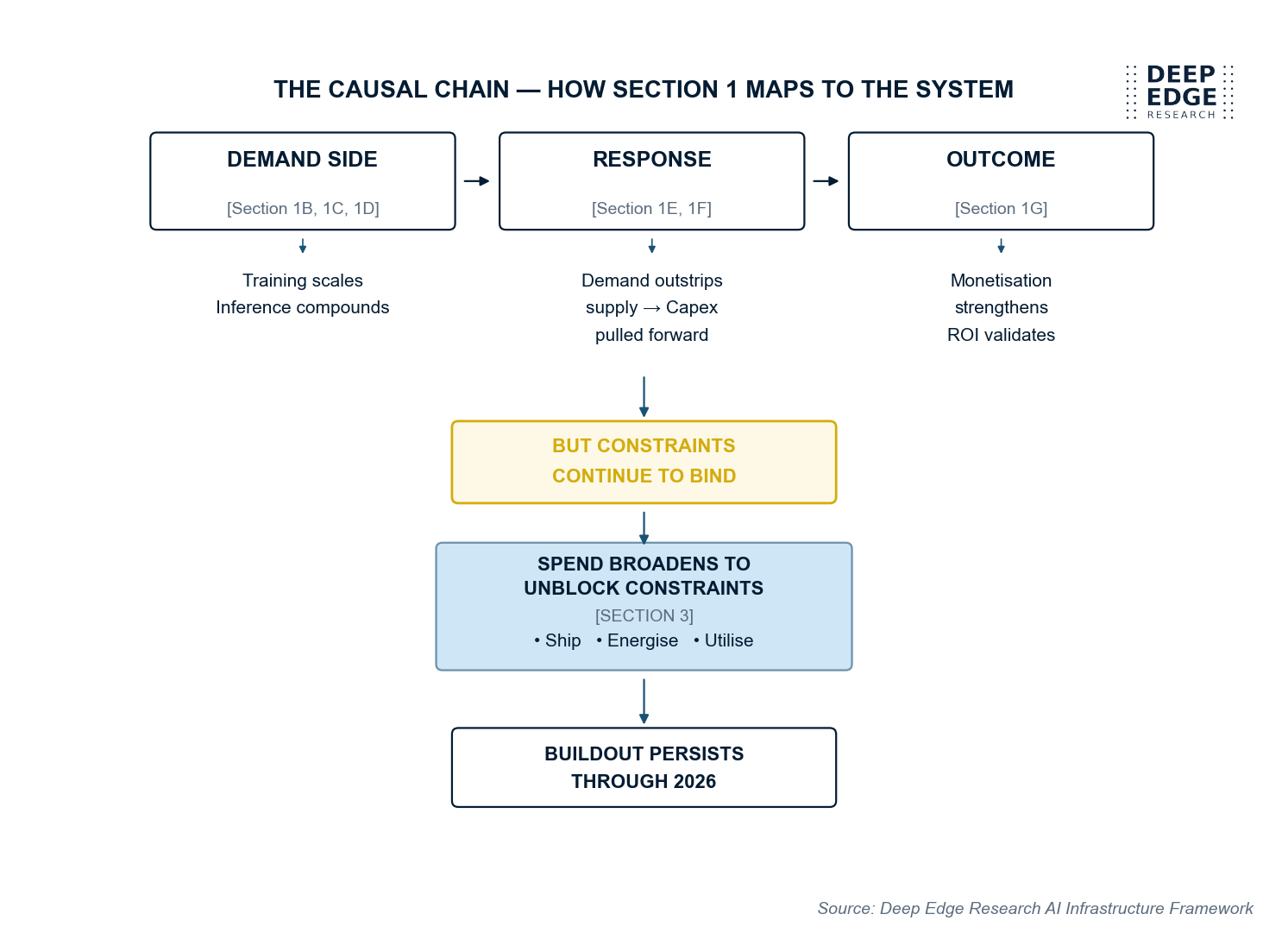
In a nutshell, our 2026 Outlook is driven by the dominant causal chain we have seen playing out over the last few years and continue to see play out across the AI infrastructure landscape:
Increases in Training & Inference [Sections 1B, 1C, 1D] → Increases in usage & demand outstrips supply [1E] → hyperscalers pull forward capex to meet demand [1F] → Supply constraints bind → Spend broadens to unblock constraints [Section 3] → Throughput increases → Monetisation strengthens [1G] → ROI validates → Buildout persists
For us, this causal chain is not conjecture but rather what we see because we do not look at the AI infrastructure landscape on a ticker-by-ticker basis or even at a sector level, but we are looking at it at a systems level.
As you know from our previous reports, for us, systems-level thinking about investments has generated significant alpha in prior years because it is a holistic approach to understanding complex problems (of-which AI development and AI infrastructure are two examples).
And by focusing on causal relationships, patterns, and dynamics within the system, rather than just isolated parts, we understand where the market is mispricing certain opportunities.
Figure 1: AI Infrastructure causal chain
Source: Deep Edge Research AI Infrastructure Framework
B) The two engines of AI development (Training and Inference) are accelerating
Let’s start with the first part of our causal chain for 2026: Training and Inference. These components are the key driver of our 2026 Outlook.
As we discuss in detail in section 1C and 1D, both elements are accelerating exponentially and that is a vital leading indicator for downstream infrastructure demand.
Training. To stick with our analogy from before: Training (and GPUs) is the factory. It’s the upfront investment, the months-long compute runs that turn raw data into a capable model. Training is a capex-style expenditure: you pay once, and then you have an asset. The only “problem” however (as we explain in section 1C) is that due to competitive dynamics, this factory needs to be upgraded every 6-7 months.
Inference on the other hand is the output of the factory. Every prompt is a production run. Inference is an opex-style expenditure: the more customers you acquire, the harder the factory runs. And as we’ve already mentioned, the production output are tokens. If we see this unit of production increasing, it suggests increasing aggregate demand.
We labour on this point because for most of AI model development history, a lot of focus has been spent building the factory (Training).
However 2025 was a crucial turning point: it saw the rise of reasoning models and agentic workflows and as a result the factory output (Inference) changed dramatically and has been growing aggressively.
For us, this highlights incredible aggregate demand that we do not think has been accurately priced by the market.
The increased Inference will increase hyperscaler and AI lab revenues however, it will also add significant pressure across the rest of the system as we are already seeing with HBM. Power, Thermal and Interconnect are next.
Conclusion: It is our house view that with both engines accelerating and compounding this creates asymmetric upside opportunities across the AI infrastructure landscape (see section 3). For now, we begin by explaining the impact on Training and Inference on our 2026 Outlook.
C) Training: building better models requires more compute
In AI model development, for the last 15 years, it has generally been understood that to build a more capable model requires more data and more compute.
This was the case with the seminal AlexNet in 2012, AlphaGo Master in 2016 as well as the more popularly recognised ChatGPT and Gemini models (to name a few).
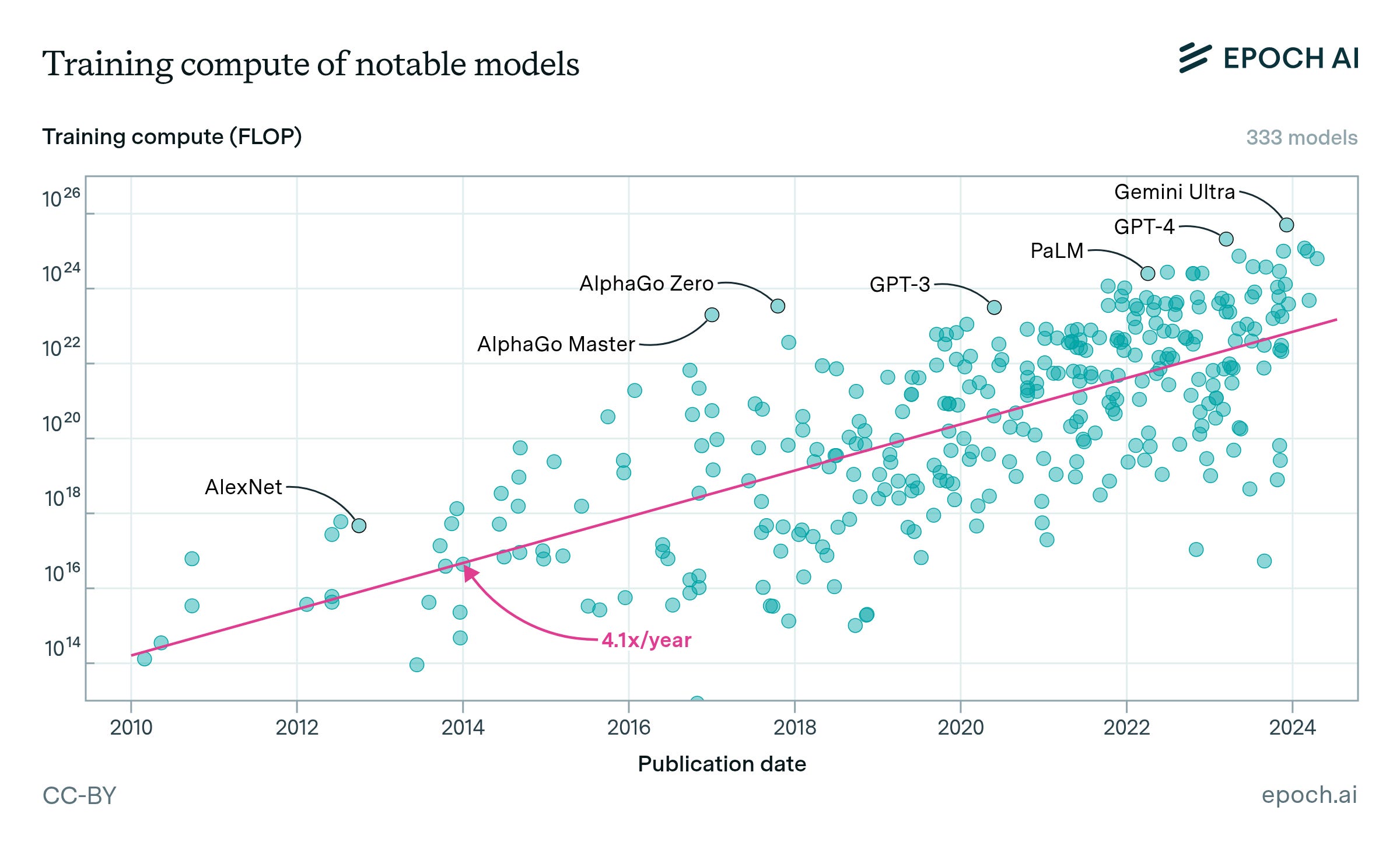
This exponential compute demand is known as the Scaling Law and research from EPOCH AI sheds an interesting light on just how much compute has been required (and will likely continue to be required) to train the next models.
The research shows that since 2010, frontier models have required a 4-5× increase in compute per year to improve model capabilities.
This is forecast to continue to be the case until at least 2030 (or the earlier of running out of training data or other parts of the system not being able to keep pace with GPU accelerator performance).
Figure 2: Scaling Law: for the last 15 years, compute has been increasing 4-5x per year
Source: EPOCH AI Training compute of frontier AI models grows by 4-5x per year
So, returning to our analogy, this is the equivalent of Ford having to increase factory capacity by 400% every year just to continue making cars fit for the modern age.
To put it in a more practical way, especially in AI model development terms: the amount of compute required to train a frontier model (and therefore keep up with your competitors) doubles every 6-7 months.
Taken from this view, we hope it becomes obvious very quickly why hyperscalers and AI labs keep increasing capex, because if they do not invest in more compute their “latest” model will be obsolete in 6-7months when their competitor releases their latest model.
This is not discretionary spend; this is the price to stay in the game. We call this the obsolescence trap and it explains why now you increasingly see AI Labs publishing incremental version updates rather than one big annual model update .
This is an angle that is often missed and not discussed by many Wall Street analysts or the media and to us this highlights a fundamental misunderstanding of the AI infrastructure industry.
However, that misunderstanding is the very definition of a market inefficiency and this creates significant mispricing opportunities across the AI infrastructure landscape that we can capitalise on.
Conclusion: To us, this is why Training remains a priming factor in our 2026 Outlook. Until capability gains decouple from compute; until the Scaling Law breaks; the pressure on infrastructure spend continues. And there’s still no evidence the law is breaking. When it breaks, we will reassess our thesis. Training, however is only half the equation: Inference (the factory output) also shows compounding characteristics and that’s where the 2026 story gets interesting.
D) Inference: strong aggregate demand will drive even more investment
The second part of our 2026 Outlook causal chain is increasing aggregate demand. However, as we have already mentioned earlier, this piece is often missing from most other AI investing coverage, and crucially, there is little to no discussions about the linkage between unit of production (tokens) and aggregate demand.
We find this surprising as this is the equivalent of trying to talk about Ford on revenue terms alone without talking about the number of Ford models produced or delivered per quarter.
Our checks on AI model unit of production metrics (tokens), show that Inference workloads have shifted structurally and token usage is growing aggressively across a wide range of use cases.
This shift has happened because usage is no longer users simply asking single question and answer pairs; it is increasingly driven by reasoning models answering more complex questions and agentic workflows where “agents” plan, use tools, and execute multi-step tasks — increasingly autonomously for hours.
This is a fundamental step-change in what the factory is producing and arguably, because agentic workflows are no longer a glorified Google search but rather actual work, this fundamental change in factory output is far more valuable to users and is a sign of further advancements to come in 2026.
We believe this creates increased aggregate demand through-out 2026 and beyond especially in knowledge work.
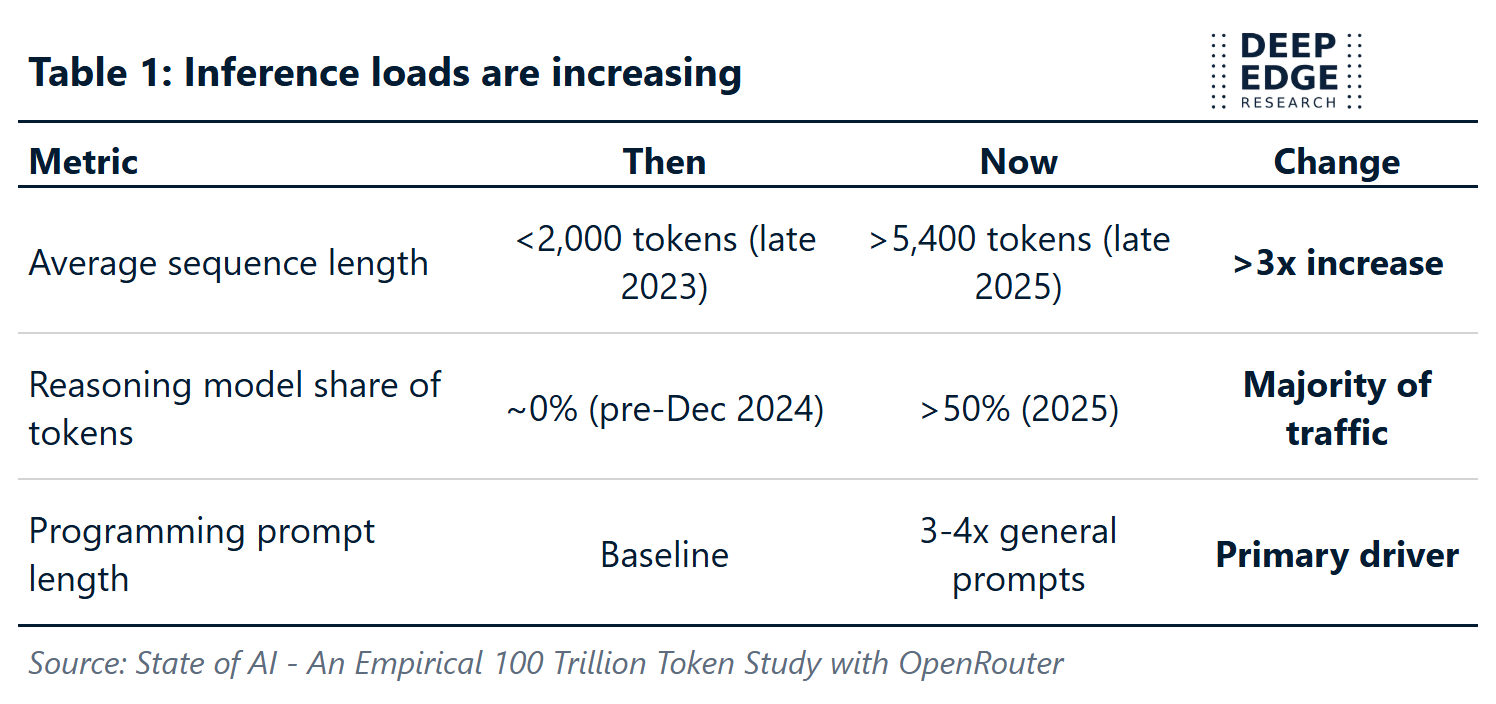
A recent study from OpenRouter supports this view: their analysis of 100 trillion real-world token usage shows three clear signals: over the last 12-24 months the average sequence length of conversations have tripled (signaling more usage). Reasoning models now account for the majority of token traffic (signaling more complex usage). And programming prompts, the heaviest workloads, are the primary driver (signaling integration of AI into real work).
Table 1: Inference loads are increasing
Source: State of AI An Empirical 100 Trillion Token Study with OpenRouter
These points taken alone or in combination highlight AI adoption taking hold in real ways and this will only compound through-out 2026 and will increase aggregate demand and therefore provide attractive investment opportunities across the system.
In our view, when tokens compound at the rates above, everything downstream is forced to scale: models are going to need more memory bandwidth, packaging throughput, power delivery, thermal management, and interconnect efficiency.
As such, the right question for 2026 is therefore not “do we still believe in AI?”. No; it is whether the infrastructure can scale fast enough to meet the workload and which downstream companies will capture the economic rent.
Conclusion: Inference is no longer a secondary concern. It’s now a structural, continuous load on the system and it is compounding fast. This changes the investment picture: demand is no longer just spiky training runs anymore; it is persistent factory output. That means all downstream components of the system have to scale to support increased factory output and, the downstream companies that can do this successfully will capture tremendous economic rent (see Section 3).
E) Demand is massively outstripping supply
Whenever we do demand-side checks, we always try to triangulate what third-party sources are saying as well as what management are saying in earnings calls.
And what we are hearing from management across the board echoes the third-party sources.
“We’ve been growing a lot and are out of GPUs… OpenAI has always been in a compute deficit… Doubling GPU capacity would nearly double revenue.”
Sam Altman (CEO, OpenAI)
When C-suite executives explain missed upside as “we couldn’t build fast enough” and “we’re out of GPUs,” that’s not hype. That’s a throughput problem.
The factory can’t run fast enough to meet orders…and essentially it’s an admission that they are leaving money on the table.
“Compute requirements exceeded internal expectations… We expect to invest aggressively to meet these needs, both by building our own infrastructure and contracting with third-party cloud providers… CapEx dollar growth will be notably larger in 2026 than 2025”
Susan Li (CFO, Meta)
That language matters. It validates our third-party checks and supports our thesis. It ties capex to a physical bottleneck, not to a narrative. The spend isn’t speculative, it’s a necessity to simply keep up with demand.
Although we will cover this in more detail in section 2, it is at this point we feel compelled to quickly address the prevailing bear-case narrative on whether all of this spend is simply “AI Bubble” spending.
As we have already alluded to in the introduction, AI infrastructure spend is not a bubble.
The reason we can say that so confidently is by using what we call the Bubble Litmus Test.
How to distinguish a bubble from a buildout:
In a bubble, supply chases demand that isn’t there
In a buildout, demand outruns supply that can’t keep up
We are clearly in the second scenario.
For us, the fact that companies are spending heavily to simply try to meet demand is the clearest proof-point that AI infrastructure is not a bubble; however in section 2, we also apply 6 stress-tests add further support to this view (see section 2A-F).
Conclusion: If we look at the most commonly cited parallels, the dotcom crash and the financial crisis, both were genuine bubbles because companies built capacity for demand that was not there. AI infrastructure on the other hand is not a bubble because the demand is here and plentiful, it is the supply that is limited. Both our demand-side checks and management’s own comments support this and we expect this to continue providing structural tailwinds through-out 2026.
F) Capex guidance is rising: revealed preference confirms the thesis
Given that both training and inference are increasing, and demand in constrained, the next part of the causal chain is increased capex spending.
Whilst we can listen to CEOs and CFOs on CNBC and on various podcast talking about AI spending and use this as proxies, it is often said that actions speak louder than words, the colloquial equivalent of the economic principle revealed preference.
As such, when we look at the evidence, CEOs and CFOs are not just talking, they are putting their money where their mouth is and writing cheques at an accelerating rate, and this is understandable to try and meet the increased demand but also given the obsolescence trap we discussed earlier.
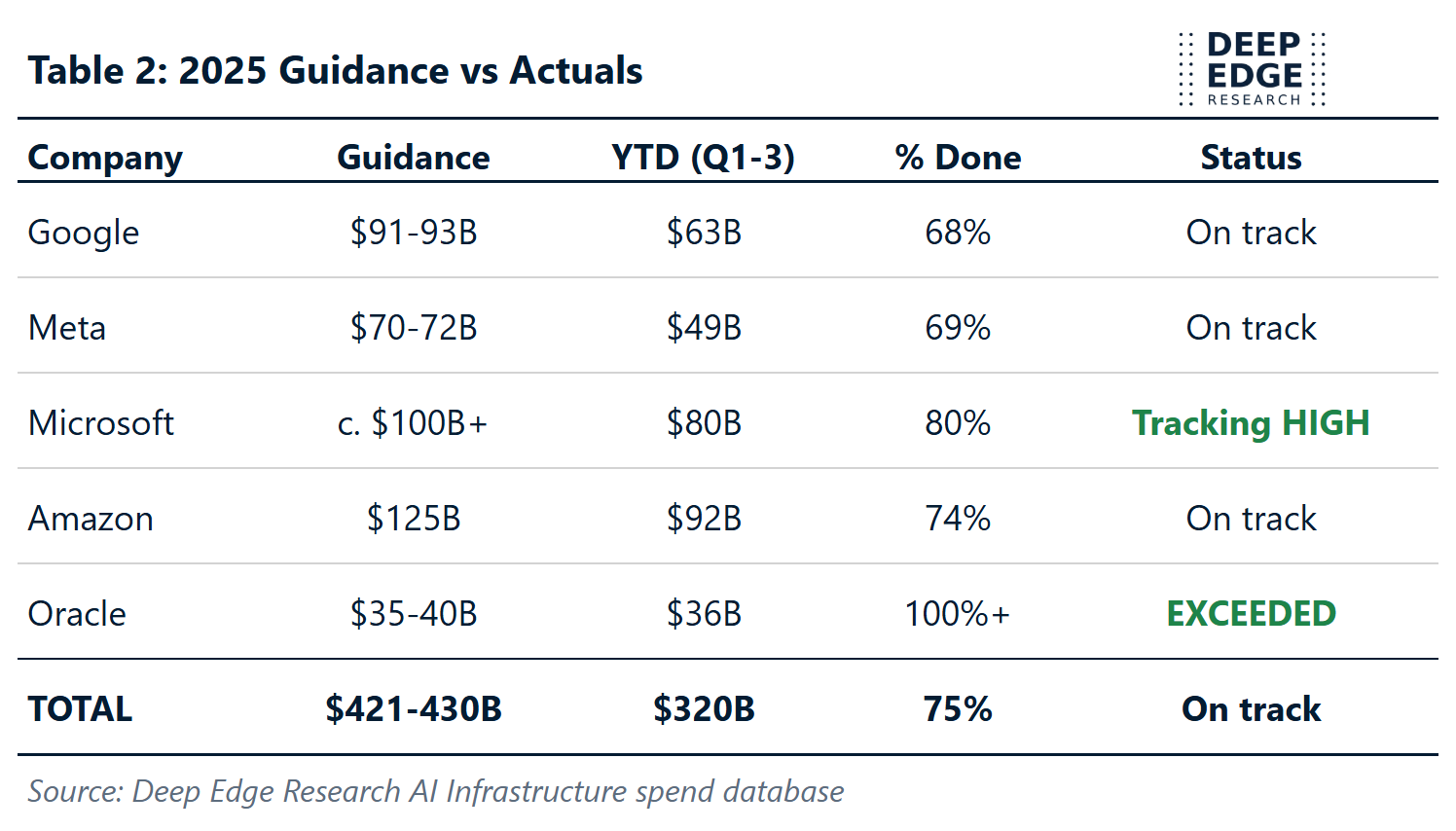
Our analysis shows that every major hyperscaler is tracking at or above their 2025 capex guidance. Oracle has already exceeded its full-year target. Microsoft is 80% through guidance with a quarter still to go. The aggregate picture shows c. $320B deployed so far to Q3’25 and that is on pace to hit or exceed $430B for the full year.
Table 2: 2025 Guidance vs Actuals
Source: Deep Edge Research AI Infrastructure spend database (compiled from public filings, earnings calls, and investor presentations; includes finance leases)
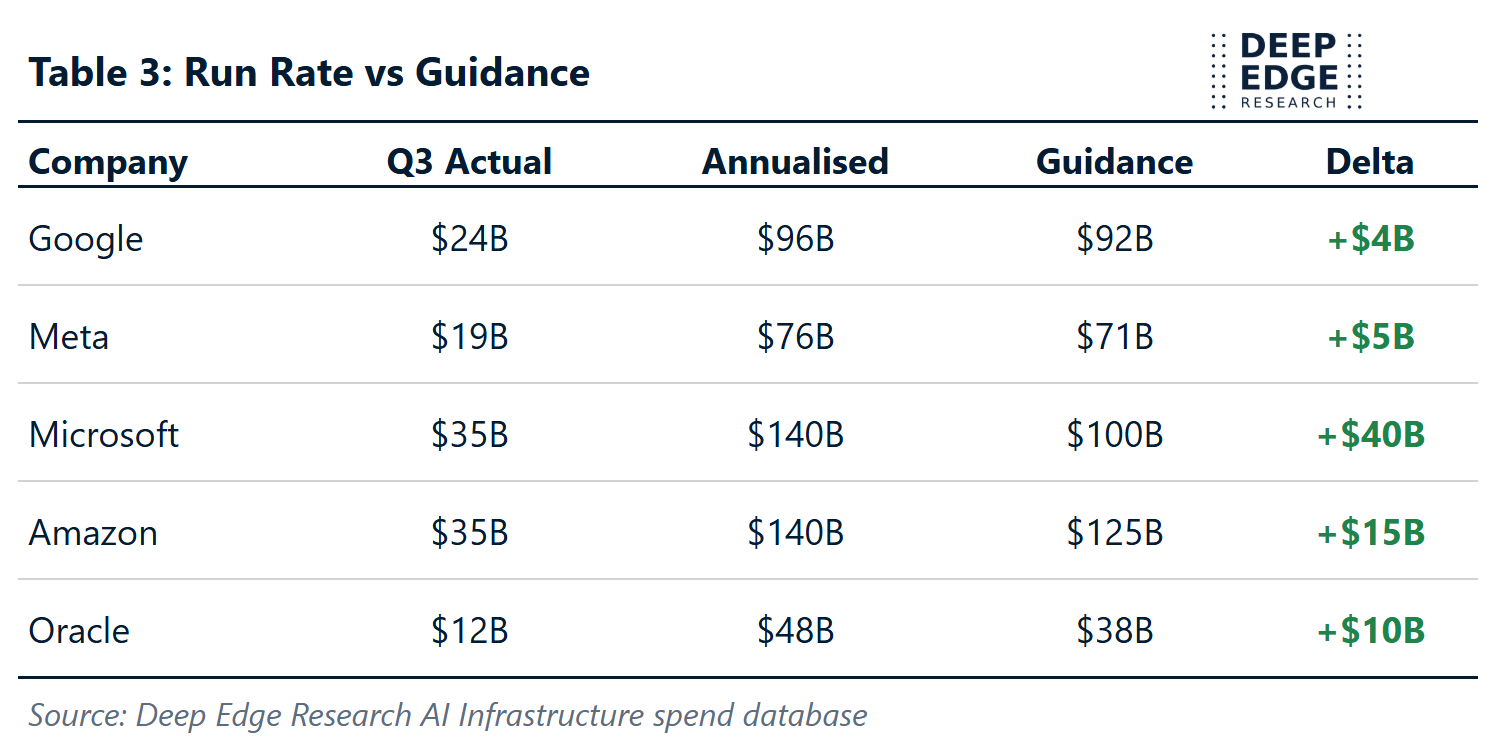
But tracking guidance only tells us one side of the story: are they on track to meet commitments? The more telling signal is whether they are accelerating beyond guidance.
Our annualised Q3’25 run-rate calculations suggest that every hyperscaler is trending above stated targets. By our calculations, if Microsoft continue at the same run-rate it implies 140B vs 100B guidance — a $40B overshoot. We will update figures when Q4’25 results come out in February 2026.
Table 3: Run Rate vs Guidance
Source: Deep Edge Research AI Infrastructure spend database (compiled from public filings, earnings calls, and investor presentations; includes finance leases)
Conclusion: At current run-rates, total 2025 capex could hit $440-450B vs. c. $425B guided. This is not cautious spending that might slow down, it’s committed capital that’s accelerating even as it deploys. When the largest cheque-writers in the world are all overshooting their own guidance, that’s not narrative. That’s revealed preference. And it tells you what they see coming in 2026. This supports our thesis.
G) Monetisation is accelerating: the ROI case is becoming concrete
The last piece of our 2026 Outlook causal chain is monetisation and ROI. This is a crucial part of any flywheel. To address this section we will look at two of the most prevailing bear cases.
Bear case 1:
Where is the ROI on all these investments?
This is a fair question.
A year ago, the answers were ambiguous. Today however, companies can point to numbers and crucially, those numbers keep coming with the same qualifier: “we could have grown more if we had more capacity”.
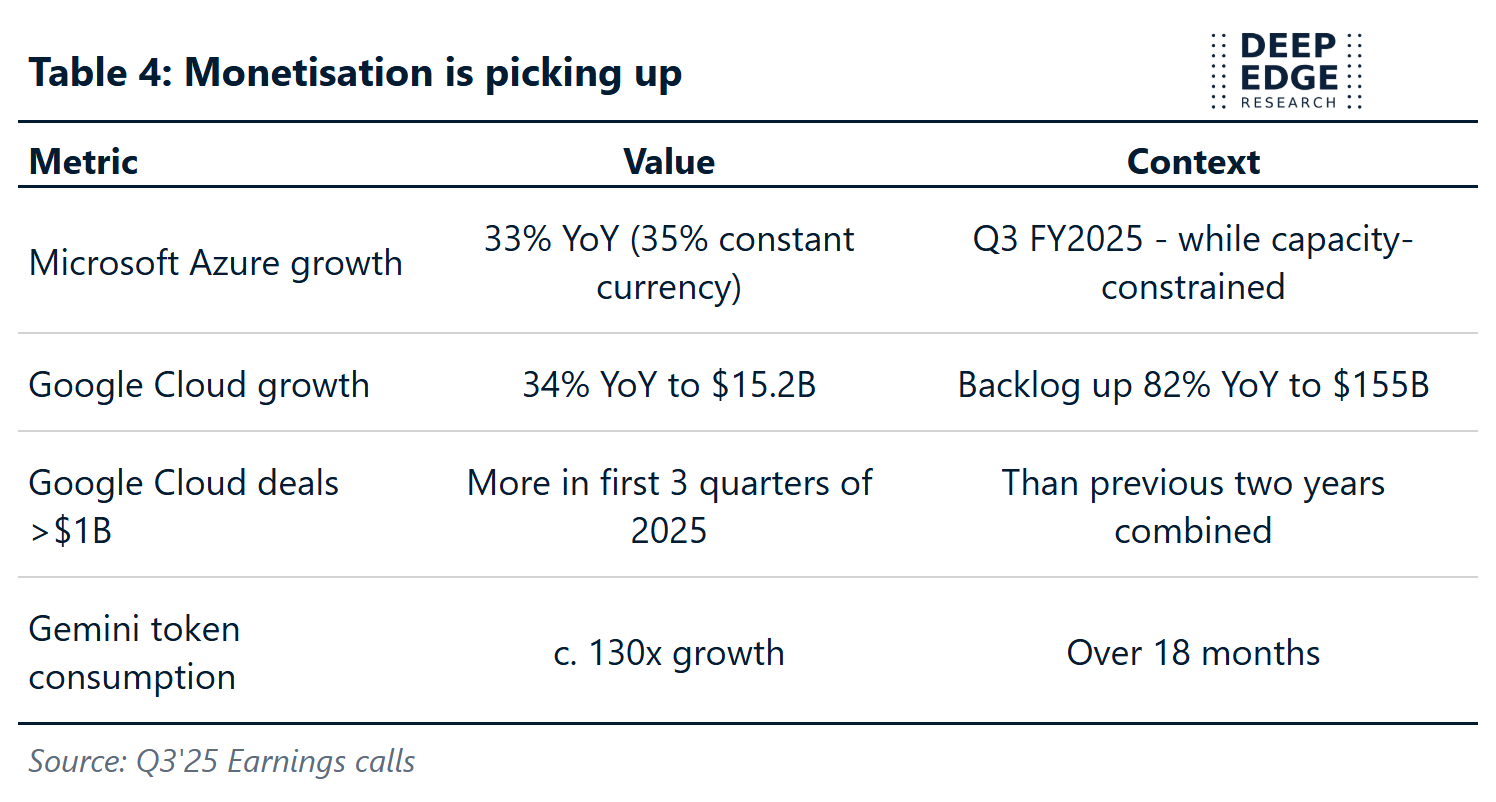
Let’s take Google Cloud (GCP) for example, they closed more $1B+ AI deals in the first three quarters of 2025 than in the previous two years combined. As a result the cloud business grew 34% YoY. Crucially however, because they are capacity constrained, backlog is up 82% YoY to 155B.
Table 4: Monetisation is picking up
Source: Q3’25 Earnings calls
The picture is similar with Azure. In the last earning call, management highlighted that the business grew 33% YoY while capacity-constrained.
For us, these data-points suggest that monetisation is accelerating and ROI is becoming concrete; the only thing holding these companies back is more capacity. This will change in 2026 as more capacity comes online and we expect to see even higher monetisation and ROI metrics.
Bear case 2:
So ROI may be showing at the infrastructure layer but it is not evident at the application layer (arguably the most important layer because this is the diffusion layer)
This bear case observation is true, the application layer hasn’t fully diffused.
But again, to us, we don’t follow this argument because this is the normal sequencing of events: Infrastructure comes first, applications, products and services come after. Think of the often used example of railroads, they were built before the towns they served, not the other way round.
Or to use a more recent living memory example — traditional Cloud capacity roll-out: for years, AWS built massive infrastructure, before people knew what SaaS was and before there was online streaming services like Netflix or Spotify or companies like AirBnB and Uber. And yet, it is that massive infrastructure spend that originally “didn’t make sense” that is now essentially the backbone to a lot of the internet.
The pattern is not new. Infrastructure comes first, applications, products and services come after.
Conclusion: As people that were around when AWS was investing heavily in (traditional) Cloud infrastructure will tell you, you don’t need full maturity to justify a buildout; you need credible evidence that usage is scaling, pricing is holding, and attach rates are not collapsing. As we look at the industry, AI infrastructure has crossed that line. The question is no longer “will AI make money?” that is increasingly being answered. The question is now “who captures the margin as it scales?” To us, that’s a different, and far more investable question. And it’s the question that defines our 2026 Outlook.
What’s next in Part 2
We’ve highlighted the causal chain driving AI infrastructure demand in 2026: Training and Inference are both accelerating, demand is outstripping supply, and hyperscalers are responding with record capex commitments. The monetisation flywheel is beginning to turn.
But the sceptics have a question that deserves a direct answer: Is this a bubble?
In Part 2, we’ll address the elephant in the room. Using our Bubble Litmus Test and a rigorous comparison to the dotcom and housing bubbles, we’ll stress-test the thesis across three dimensions: demand trajectory, financial health, and valuation context.
Continue to Part 2 →
2026 Outlook: AI Infrastructure Is Not a Bubble

Below is a copy of the investment letter we sent to our clients.
© Deep Edge Research (2026). Equity research. No bull. No fluff. Just actionable insights.